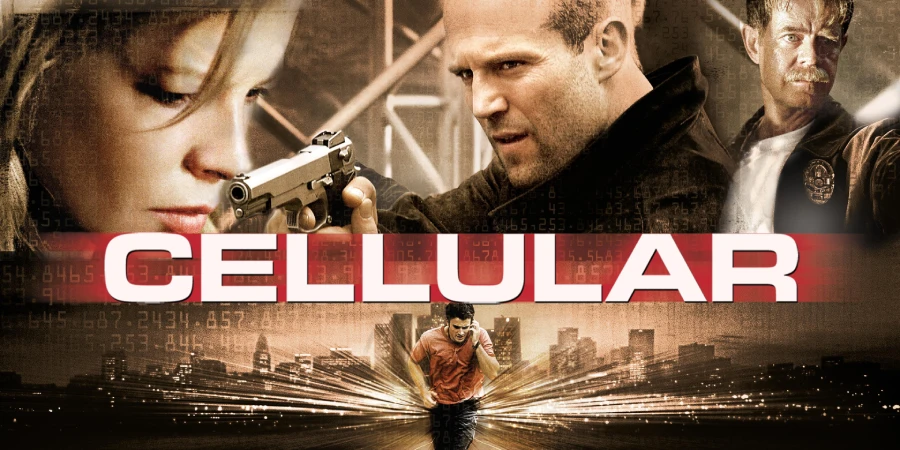

Cellular runs on a premise so deliriously simple it almost feels like a dare: one wrong number, one kidnapped woman, one dying cell phone battery standing between life and death. Released in 2004 and directed by David R. Ellis, this lean, propulsive thriller squeezes every drop of tension from its high-concept setup. It never pretends to be anything other than what it is, and that confidence is exactly what makes it work.
Detailed Summary
Jessica Martin Is Taken
Jessica Martin (played by Kim Basinger) opens the film as a seemingly ordinary suburban science teacher. Her morning turns violent when a group of armed men, led by the cold and calculating Ethan Williamson (played by Jason Statham), breaks into her home and abducts her.
Ethan and his men are not random criminals. They are corrupt cops on a mission to silence Jessica before she can expose them. Her husband is already in their custody, and her son Ricky is next on their list.
The Smashed Phone and a Desperate Gamble
Ethan smashes the phone in Jessica’s attic prison to cut off her only communication with the outside world. However, Jessica is a science teacher, and that detail matters. She uses her knowledge of basic electronics to hot-wire the shattered phone, manually connecting its components to generate a random outgoing call.
That call lands on Ryan (played by Chris Evans), a young, directionless beach guy who is in the middle of his own petty romantic drama. Ryan initially doubts the panicked woman on the other end of the line. Consequently, precious minutes slip away before he accepts that she is telling the truth.
Ryan Becomes the Only Lifeline
Ryan commits fully once he believes Jessica. His mission becomes brutally simple: keep the call alive, find out where she is, and get help. Meanwhile, he cannot hang up, because the smashed phone on Jessica’s end cannot redial.
He races to a police station and tries to report the kidnapping to Sergeant Bob Mooney (played by William H. Macy), a quietly competent cop days away from retirement. Mooney listens but cannot immediately act on such a vague tip.
Ryan Takes Matters Into His Own Hands
Frustrated by the slow official response, Ryan escalates his one-man operation dramatically. He steals a car, barges into a lawyer’s office to borrow a charger, intimidates civilians, and generally leaves a trail of chaos across Los Angeles. For instance, one of the film’s best sequences involves Ryan storming into a cell phone store and commandeering a charger from a bewildered salesman named Chad.
Chris Evans plays Ryan as genuinely likable despite his recklessness. His performance carries the film’s momentum because audiences root for him even as he does increasingly unhinged things.
The Corruption Comes Into Focus
Jessica pieces together the full picture from her attic prison. Ethan and his team of dirty cops are after a flash drive belonging to her husband Craig. Craig witnessed something he should not have, and the corrupt officers need to eliminate the entire family to protect their operation.
In addition, the film slowly reveals that Ethan operates with frightening efficiency. He is not a scenery-chewing villain. His calm makes him genuinely menacing.
Ryan Intercepts the Son
Ryan races to Ricky’s school after Jessica warns him that Ethan’s men are heading there. He arrives just in time and snatches Ricky before the corrupt cops can grab him. This sequence is kinetic and genuinely tense, staged around a crowded school pickup zone.
Ricky’s safety gives Ryan brief leverage, but it also draws more heat. Ethan’s crew escalates their pursuit of Ryan directly.
The Highway Confrontation
A high-speed chase sequence on a Los Angeles freeway marks the film’s most purely action-driven stretch. Ryan maneuvers desperately while corrupt cops attempt to force him off the road. The sequence leans into B-movie exuberance without apology.
Mooney, meanwhile, has been doing his own quiet detective work. His investigation independently converges toward the same corrupt network, and the two storylines begin threading together.



Movie Ending
Ryan ultimately tracks Jessica to a house where Ethan holds her and Craig. He infiltrates the location in a move more fueled by adrenaline than strategy, which suits the character perfectly. A violent confrontation follows, and Ryan manages to free Jessica and Craig.
Ethan faces Ryan in a direct showdown. Ryan shoots Ethan, ending his threat decisively. It is a cathartic payoff that the film earns honestly through its sustained tension.
Mooney’s parallel investigation climaxes simultaneously. He confronts the senior corrupt officer, Lieutenant Ethan’s superior, and handles the situation on his own terms. Mooney gets his moment of quiet heroism just before his planned retirement, which gives his arc a satisfying close.
The family reunites, and Ryan survives his impulsive crusade. Notably, the film resists piling on an elaborate epilogue. It ends cleanly, without overstaying its welcome.
What the ending ultimately argues is that ordinary people, given enough motivation and a working phone signal, can cut through institutional inertia and actually save lives. Ryan is not a hero by training. He is a hero by circumstance, and the film finds genuine warmth in that idea.
Are There Post-Credits Scenes?
Cellular contains no post-credits scene. Once the story resolves, the film ends without any additional footage after the credits roll. Audiences can safely leave when the credits begin.
Type of Movie
Cellular is a action thriller with a strong high-concept backbone. Its tone sits comfortably between genuinely suspenseful and entertainingly over-the-top. It never ventures into horror territory, but it maintains real stakes throughout.
In contrast to many thrillers of its era, it keeps its runtime tight and its plotting efficient. There is humor, mostly drawn from Ryan’s increasingly chaotic improvisation, but the film never lets comedy undercut its tension.
Cast
- Kim Basinger – Jessica Martin
- Chris Evans – Ryan
- Jason Statham – Ethan Williamson
- William H. Macy – Sergeant Bob Mooney
- Noah Emmerich – Detective Greer
- Jessica Biel – Chloe
- Eric Christian Olsen – Chad
- Richard Burgi – Craig Martin
Film Music and Composer
John Ottman composed the score for Cellular. Ottman is a versatile composer and editor with strong roots in genre filmmaking. His work on thrillers and action films gave him a natural fit for this project.
His score for Cellular keeps pace with the film’s propulsive energy. It amplifies tension without overwhelming the procedural logic of the story. Ottman layers urgency into quieter scenes as effectively as he does in the action set pieces.



Filming Locations
Cellular filmed extensively across Los Angeles, California. The city is not just a backdrop here; it is a functional part of the story. Ryan’s cross-city race only works because Los Angeles is simultaneously sprawling and gridlocked.
Specific locations include recognizable LA streets, freeways, and suburban neighborhoods. The urban geography creates a constant sense of distance between Ryan and Jessica, which the film uses to sustain dread. Los Angeles rarely looks glamorous in this film; it looks like an obstacle course.
Awards and Nominations
Cellular did not receive significant recognition from major awards bodies. It performed respectably at the box office but remained largely outside awards conversation, which is unsurprising for a lean genre thriller of this type.
Behind the Scenes Insights
- Chris Evans took the role before his superhero career defined his public image. Cellular offered him an early showcase for the charm and physicality he would later bring to bigger productions.
- Director David R. Ellis came from a stunt coordination background, which directly informed the film’s kinetic, practically grounded action sequences.
- The film’s screenplay came from Larry Cohen, a prolific writer and director known for inventive low-budget genre work. Cohen conceived the high-concept premise and sold it as an original script.
- Joel Silver produced the film, bringing his experience with high-energy action thrillers to the project.
- The production leaned heavily on practical driving and stunt work, consistent with Ellis’s background and the film’s grounded aesthetic.
- Kim Basinger spent much of her shooting time in a confined attic set, a physically and emotionally demanding constraint that she used to build genuine anxiety into her performance.
Inspirations and References
Larry Cohen developed Cellular as an original concept, not as an adaptation. However, the film clearly draws inspiration from a long tradition of real-time thriller storytelling, where a ticking clock and a communication device define the entire dramatic structure.
Cohen had previously explored resourceful protagonists in confined situations throughout his career. Cellular applied that instinct to the then-contemporary anxiety around mobile phone culture and the new vulnerabilities it created.
Thematically, the film also echoes earlier single-location or limited-communication thrillers. Films like Phone Booth (released a year earlier in 2003) explored similar territory around the dramatic potential of a single telephone call as a lifeline.
Alternate Endings and Deleted Scenes
No widely documented alternate endings or significant deleted scenes from Cellular have entered public record. The film does not appear to have a well-known extended cut or director’s cut release. Production materials suggesting major structural changes have not surfaced in available interviews or releases.
Book Adaptations and Differences
Cellular is not based on a book. Larry Cohen wrote it as an original screenplay. There is no source novel to compare it against, and no significant literary adaptation preceded the film.



Memorable Scenes and Quotes
Key Scenes
- Jessica hot-wiring the smashed phone in the attic, using her science knowledge to generate a random outgoing call.
- Ryan storming the cell phone store and enlisting the hapless Chad to help keep the call alive.
- Ryan arriving at Ricky’s school just ahead of Ethan’s men, turning a school pickup zone into a tense extraction sequence.
- The Los Angeles freeway chase, where corrupt cops attempt to force Ryan off the road at high speed.
- Mooney’s quiet, competent confrontation with the corrupt superior, played with understated intensity by William H. Macy.
- Ryan’s final confrontation with Ethan at the house, resolving the film’s central threat with direct, unglamorous violence.
Iconic Quotes
- “I don’t know who you are, but please, please don’t hang up.” – Jessica Martin
- “I know this sounds crazy, but I need you to trust me.” – Ryan
- “Do you know who I am? I’m the guy who’s gonna save your life.” – Ryan
Easter Eggs and Hidden Details
- The film was shot during a period when flip phones represented mainstream mobile technology. Observant viewers will notice the specific models used are period-accurate to 2004, grounding the story in its era.
- Jessica’s profession as a science teacher is not accidental. Her ability to repair the phone is the entire engine of the plot, and the film plants this detail early so the repair feels earned rather than convenient.
- Mooney’s impending retirement is introduced very early. This is a classic thriller device, and the film uses it self-awarely, allowing Macy to play Mooney as someone who knows exactly what genre he is in.
- Ryan’s beach lifestyle and lack of direction at the film’s opening deliberately contrast with the competence and decisiveness he displays once the stakes become real. His arc is compressed but legible.
- Chad the cell phone store employee reappears at the film’s end in a brief callback that rewards attentive viewers with a small moment of comedic closure.
Trivia
- Cellular was remade in India as Thoongaa Vanam in 2015, demonstrating the premise’s cross-cultural adaptability.
- Larry Cohen also wrote the screenplay for Phone Booth (2002), making him responsible for two of the most memorable phone-based thrillers of the early 2000s.
- Chris Evans plays Ryan with a notably lighter touch than many of his later action roles. Fans revisiting the film often note how different this early performance feels compared to his later work.
- Director David R. Ellis later directed Snakes on a Plane (2006), cementing his reputation for high-concept, entertainingly absurd action thrillers.
- The film’s entire dramatic premise depends on a plot detail that has since aged considerably: the inability to redial from a damaged phone. Modern smartphones would resolve the crisis almost immediately.
- William H. Macy reportedly enjoyed the role of Mooney precisely because the character operates independently, solving the case through patience and instinct rather than action heroics.
- Jessica Biel appears as Ryan’s girlfriend Chloe in a supporting role that is largely a comedic subplot running parallel to the main thriller narrative.
Why Watch?
Cellular delivers exactly what it promises: a tight, fast, genuinely tense thriller built on a brilliant simple concept. Chris Evans and Kim Basinger bring more to their roles than the premise strictly requires. Moreover, at under 100 minutes, it respects your time completely.
Director’s Other Movies
- Final Destination 2 (2003)
- Snakes on a Plane (2006)
- The Final Destination (2009)
- Shark Night 3D (2011)
Recommended Films for Fans
- Phone Booth (2002)
- Buried (2010)
- Speed (1994)
- Nick of Time (1995)
- Unstoppable (2010)
- Brake (2012)
- The Call (2013)