
A rookie prison guard accidentally becomes a hostage negotiator from the wrong side of the bars, and Cell 211 never lets you forget just how thin the line between order and chaos really is. Daniel Monzón’s 2009 Spanish thriller is a masterclass in moral compression, squeezing its protagonist into increasingly impossible choices until something has to break. It swept Spain’s Goya Awards and earned every single one of them.
Detailed Summary
Juan’s First Day Goes Catastrophically Wrong
Juan Oliver arrives at Zamora Prison a day early for his first shift as a guard. He wants to make a good impression on his superiors. However, a chunk of ceiling collapses and knocks him unconscious in an abandoned cell block, cell 211.
His colleagues panic and leave him there, alone and unattended. Moments later, a full-scale riot erupts across the prison. Guards retreat, locking Juan inside with the inmates.
Juan Becomes a Prisoner to Survive
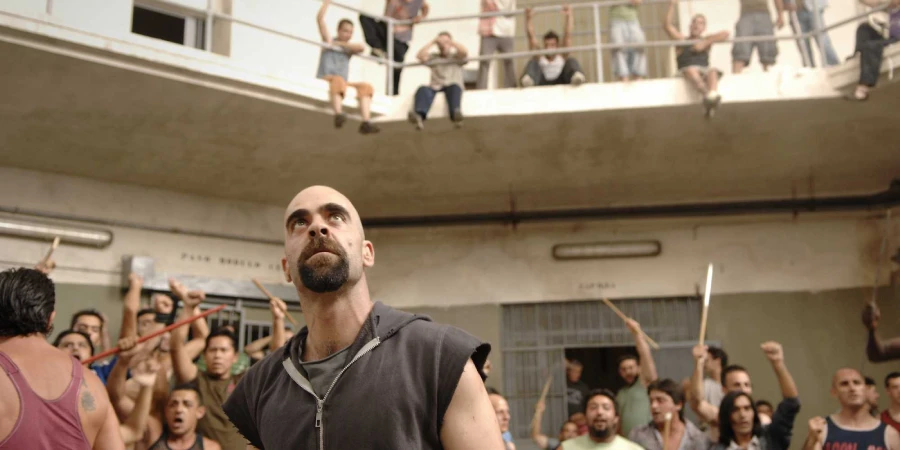
Juan wakes up surrounded by rioting inmates and makes a split-second decision: he strips off his guard uniform and pretends to be a prisoner. His survival instinct is razor-sharp and completely believable. In contrast, his actual colleagues outside have no idea he is trapped inside.
Malamadre, the prison’s brutal and charismatic leader, quickly takes Juan under his wing after Juan demonstrates surprising toughness. Juan beats a threatening inmate without hesitation, earning Malamadre’s respect immediately. This violent act of self-preservation locks Juan into his false identity.
The Hostage Situation Escalates
Malamadre and his crew take three ETA inmates hostage after discovering the government has moved other ETA prisoners to isolation as a political maneuver. He demands their return as a condition of peace. The situation transforms from a riot into a politically charged standoff.
Juan feeds Malamadre insider information, framing it as knowledge he picked up from other inmates. He becomes genuinely useful to Malamadre’s operation. Meanwhile, the authorities outside scramble to manage a crisis they barely understand.
Juan’s Pregnant Wife Becomes a Fatal Variable
Outside the prison, Juan’s pregnant wife Elena grows frantic. She rushes to the prison gates to find her husband. Authorities keep her in the dark about Juan’s exact situation inside.
Elena’s presence at the prison gates eventually reaches Malamadre through leaked information. This detail will ultimately destroy everything Juan has carefully constructed. Her proximity to the riot becomes the story’s most devastating pressure point.
The Government Plays Dirty
Authorities deploy a manipulative strategy, using the ETA prisoners as bargaining chips without genuinely intending to honor their agreements. They stall, delay, and deceive. Juan watches all of this from the inside and starts to lose faith in the institution he signed up to serve.
Moreover, a secretive government official takes charge of negotiations and prioritizes political optics over human lives. Juan sees the cynicism firsthand. His loyalty to the system he represents begins to crack visibly.
Juan’s True Identity Begins to Slip
Several inmates and guards outside start to suspect Juan is not who he claims to be. Tension builds both inside and outside the walls. Juan keeps improvising, patching each crack in his cover story with sharp thinking and nerves of steel.
Malamadre develops a genuine bond with Juan, viewing him as a kindred spirit rather than just a useful ally. This bond makes everything that follows more emotionally brutal. Furthermore, Juan starts to genuinely admire and even identify with Malamadre’s raw, unfiltered sense of justice.



Movie Ending
Everything collapses when authorities outside identify Juan as a prison guard, not an inmate. They leak this information deliberately, using it as a tactical weapon against Malamadre to destabilize the revolt. Malamadre feels profoundly betrayed, not just politically, but personally.
Before Malamadre can act on his rage toward Juan, he discovers that riot police outside have killed Elena during a chaotic confrontation at the prison gates. She dies along with her unborn child. This news destroys Juan completely.
Juan, hollow with grief and fury, does something nobody expects: he helps Malamadre escape through a section of the prison in a final act that feels less like loyalty and more like two broken men acknowledging each other’s pain. Consequently, Malamadre makes it to a rooftop, where riot police shoot him dead. His death is almost inevitable, almost willed.
Juan surrenders to authorities. He has lost his wife, his child, his first day on the job, and whatever innocence he carried into that prison. Authorities charge him as a collaborator. His survival is not a victory; it is a sentence of its own.
The ending lands so hard because the film refuses to assign clean guilt. The government’s cynicism killed Elena. Malamadre’s riot created the chaos. Juan’s own choices trapped him at every turn. Nobody walks away clean, and that moral ambiguity is precisely what makes Cell 211 so suffocating and so brilliant.
Are There Post-Credits Scenes?
Cell 211 contains no post-credits scenes whatsoever. Once the final frames end, the film is done. Given the tone, adding anything after those closing moments would have been a serious artistic mistake.
Type of Movie
Cell 211 is a prison thriller with strong elements of political drama and psychological tension. Its tone is relentlessly grim, morally complex, and occasionally brutal. This is not an action film in the conventional sense; it is a pressure cooker of identity, loyalty, and institutional failure.
Cast
- Luis Tosar – Malamadre
- Alberto Ammann – Juan Oliver
- Antonio Resines – Almansa
- Marta Etura – Elena
- Carlos Bardem – Tachuela
- Manuel Morón – Rancel
Film Music and Composer
Roque Baños composed the score for Cell 211. He is one of Spain’s most accomplished film composers, known for his ability to generate dread through restraint. His work here avoids melodrama and instead builds tension through sparse, grinding textures.
The score mirrors the film’s mood perfectly: it never manipulates the audience into feeling something; it simply creates an atmosphere and lets the story do its work. Notably, Baños has collaborated with director Daniel Monzón on multiple projects, making their working relationship a genuine creative partnership.



Filming Locations
Production teams shot Cell 211 primarily in Zamora, Spain, using a real decommissioned prison facility. This choice gives the film an authentic, claustrophobic texture that a studio set could never replicate. Every cracked wall and dim corridor carries genuine institutional weight.
Shooting in an actual prison facility forced the cast and crew to work in genuinely tight, uncomfortable spaces. As a result, the performances feel physically grounded rather than theatrical. The location is not just a backdrop; it actively shapes the film’s suffocating atmosphere.
Awards and Nominations
Cell 211 dominated Spain’s Goya Awards in 2010, winning eight awards including Best Film, Best Director for Daniel Monzón, Best Actor for Luis Tosar, and Best Supporting Actor for Alberto Ammann. It also received Spain’s submission consideration for international awards recognition. Few Spanish films of its era swept the Goyas so decisively.
Behind the Scenes Insights
- Director Daniel Monzón spent considerable time researching real prison riots in Spain to ensure the film’s depiction of inmate hierarchy and guard procedures felt authentic.
- Luis Tosar reportedly prepared extensively for the role of Malamadre, working to physically transform himself and studying the psychology of charismatic criminal leaders.
- Alberto Ammann, an Argentine actor, was relatively unknown to Spanish audiences before this film; his casting was a deliberate risk that paid off significantly.
- Shooting inside a real former prison created logistical challenges for the crew, particularly with lighting and camera movement in confined corridors.
- Monzón has described the film as a story about institutional corruption as much as it is about individual survival, with both sides of the prison wall equally implicated.
Inspirations and References
Cell 211 is based on the 2004 novel of the same name by Spanish author Francisco Pérez Gandul. Gandul drew inspiration from real Spanish prison conditions and political tensions surrounding ETA, the Basque separatist organization that was a major source of domestic conflict in Spain for decades.
The film also resonates thematically with broader traditions of European social realism, particularly films that examine how institutions betray the individuals who serve them. In addition, the hostage-negotiation framework echoes classic siege thrillers, though Monzón subverts those conventions by placing his protagonist on the wrong side of every equation.
Alternate Endings and Deleted Scenes
No officially documented alternate endings or deleted scenes from Cell 211 have been released publicly. Monzón and his team have not disclosed significant cuts from the final edit in major interviews. On the other hand, the film’s tight pacing suggests a disciplined editing process rather than a heavily cut production.
Book Adaptations and Differences
Cell 211 adapts Francisco Pérez Gandul’s novel, and the screenplay by Monzón and Jorge Guerricaechevarría makes meaningful changes. In the novel, certain political details receive more extended treatment than the film allows. The screenplay condenses and sharpens the source material, prioritizing visceral momentum over political exposition.
Elena’s role in the film carries more immediate emotional impact than in the novel, largely because Monzón positions her death as the story’s central moral catastrophe. This emphasis amplifies Juan’s final breakdown considerably. Overall, the film distills the novel’s themes rather than faithfully transcribing them.
Memorable Scenes and Quotes
Key Scenes
- Juan strips off his guard uniform and decides to impersonate an inmate, a single choice that sets the entire film’s tragedy in motion.
- Juan beats a threatening inmate to earn Malamadre’s trust, committing genuine violence for the first time in his life.
- Malamadre delivers his demands to the authorities, standing on a prison balcony with total physical and psychological command of the space around him.
- Juan learns that Elena has been killed, and his composure shatters completely in one of the film’s most devastating single moments.
- Juan’s quiet, grief-stricken decision to help Malamadre reach the rooftop, knowing it will almost certainly end in Malamadre’s death.
Iconic Quotes
- “You’re not a guard. You’re one of us.” – Malamadre to Juan, a line that carries entirely different weight by the film’s end.
- “They use us, and when they’re done, they throw us away.” – Malamadre, articulating a cynicism that Juan comes to share by the final act.
Easter Eggs and Hidden Details
- Cell 211 itself, the physical location where Juan is knocked unconscious, is visually presented as the most neglected, forgotten space in the prison, which mirrors Juan’s invisibility to both sides once the riot starts.
- Malamadre’s tattoos are detailed and specific, suggesting a long institutional history that the film never fully explains but rewards attentive viewers who notice the visual storytelling.
- In early scenes, the camera lingers briefly on structural cracks in the ceiling before the collapse, a visual warning the film plants without underlining it.
- Juan’s wedding ring appears in several tight close-up shots throughout the film, serving as a quiet visual reminder of what he is risking and ultimately losing.
Trivia
- Cell 211 was Spain’s biggest domestic box-office hit in its release year among Spanish-language productions.
- Luis Tosar won the Goya for Best Actor for his role as Malamadre, and the performance is widely considered one of the finest in Spanish cinema of the 2000s.
- Alberto Ammann’s casting broke from the expectation of using an established Spanish star for the lead, and his Argentine background gave Juan a subtle outsider quality that enriched the character.
- Director Daniel Monzón had previously worked primarily in lighter genre material before Cell 211 marked a dramatic shift toward serious, politically engaged filmmaking.
- Francisco Pérez Gandul’s source novel was a debut work, making the film’s enormous success an unusual case of a first novel generating a major award-winning adaptation.
Why Watch?
Cell 211 is the rare thriller that hits harder the more you think about it after the credits roll. Luis Tosar and Alberto Ammann deliver performances of extraordinary power, and Monzón orchestrates every scene with precise, suffocating control. For anyone who values morally complex cinema that respects its audience’s intelligence, this film is essential.
Director’s Other Movies
- El corazón del guerrero (1999)
- El robo más grande jamás contado (2002)
- Fuga de cerebros (2009)
- El niño (2014)
- El cuaderno de Sara (2018)
Recommended Films for Fans
- A Prophet (2009)
- Bronson (2008)
- The Raid (2011)
- Carandiru (2003)
- Dog Day Afternoon (1975)
- Elite Squad (2007)
- Hunger (2008)