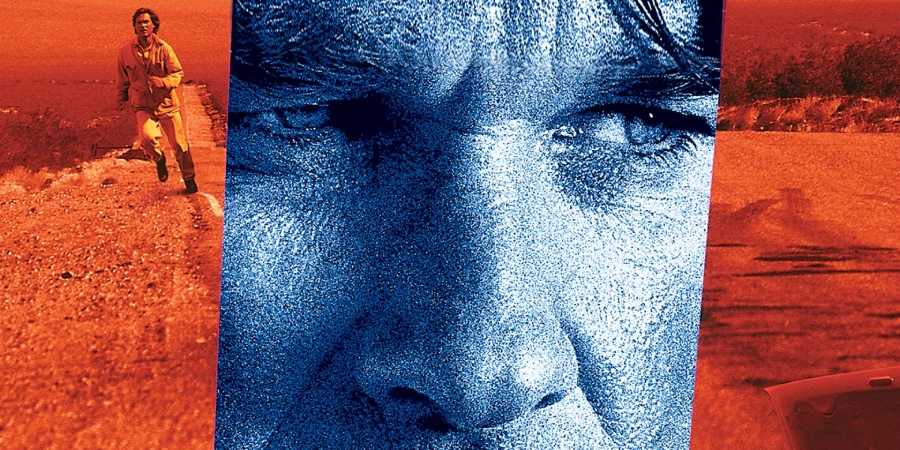

A wife vanishes into thin air on a desolate stretch of American highway, and her husband spends the rest of the film convinced he is losing his mind. Breakdown (1997) is a lean, vicious thriller that wastes zero time on pleasantries. Director Jonathan Mostow strips the premise down to its bones and squeezes every last drop of dread from a scenario that feels uncomfortably plausible.
Detailed Summary
Jeff and Amy Taylor Hit the Road
Jeff Taylor (Kurt Russell) and his wife Amy (Kathleen Quinlan) are relocating from the East Coast to California. They are driving through the remote Southwest in their brand-new red Jeep Cherokee, already a little tense with each other before anything goes wrong.
A near-collision with a beat-up pickup truck early on establishes the film’s first antagonist, a rough local named Billy Red (Jack Noseworthy). That confrontation plants a seed of hostility that pays off later. Meanwhile, the vast emptiness of the landscape quietly signals that help, if needed, will be very far away.
The Jeep Dies and a Stranger Offers Help
The Jeep stalls on a lonely desert road. Jeff suspects a loose battery connection, but he cannot get the vehicle running again. A large, friendly semi-truck pulls up, driven by a man named Red Breaker (J.T. Walsh), who radiates calm competence and neighborly warmth.
Amy accepts a ride with Red to the nearest diner to call for a tow. Jeff stays with the Jeep. He fixes the connection relatively quickly, drives to the diner, and finds no trace of Amy or Red anywhere. Nobody at the diner claims to have seen either of them.
Jeff Searches for Amy and Hits a Wall
Jeff flags down a deputy, but the investigation stalls almost immediately. When Jeff later spots Red’s truck on the road and forces the driver to stop, Red denies ever meeting Amy. He also denies giving anyone a ride. Red produces a convincing alibi and acts genuinely baffled by Jeff’s accusations.
Local law enforcement seems skeptical of Jeff’s story. Consequently, Jeff begins to doubt himself, wondering if he missed something or misremembered the encounter. However, he refuses to abandon the search, and that stubbornness is what keeps the film’s engine running.
Jeff Discovers the Truth
Jeff secretly hides under Red’s truck and trails him to a remote farmhouse. Inside, he finds Amy alive but captive, held by Red and his associates: his wife, his brother Earl (M.C. Gainey), and Billy Red, the same man from the earlier road confrontation. The whole operation turns out to be a kidnapping-for-ransom scheme targeting travelers who look financially comfortable.
In addition, Jeff discovers the gang has done this before. They select victims with out-of-state plates, isolate the husband, grab the wife, and demand a quick cash ransom before anyone organizes a proper search. It is cold, efficient, and utterly terrifying.
The Ransom Demand and Jeff’s Desperation
Red contacts Jeff and demands $90,000, the approximate amount in Jeff and Amy’s joint bank account. Jeff realizes the gang knew their financial details, suggesting they had scoped the couple out earlier. He withdraws the cash and attempts the exchange.
However, Red’s crew never intended to release Amy cleanly. Jeff makes the drop but does not get Amy back. From this point forward, Jeff stops playing by the rules and starts fighting back with everything he has.
Jeff Goes on Offense
Jeff manages to locate the farmhouse again and infiltrates it. He frees Amy, and the couple attempts to escape. Red and his gang pursue them relentlessly across the rural landscape, turning the film’s final stretch into a punishing, high-octane chase.
Billy Red pursues them in a vehicle and Jeff kills him during the chase. Earl also dies during the confrontations. Red himself becomes the final obstacle, and the film builds to a brutal showdown on a bridge.
Movie Ending
Jeff and Amy make it to a bridge in Red’s massive semi-truck, with Red himself clinging to the exterior of the cab and fighting to regain control. Jeff manages to open the cab door and kicks Red off the truck. Red falls and becomes pinned beneath the front axle of the truck.
In a moment of visceral, crowd-pleasing justice, Jeff releases the air brakes and lets the truck roll forward, crushing Red completely. It is not a subtle ending. Mostow leans fully into the satisfaction of watching a predator destroyed by his own machinery.
Amy and Jeff survive. They stand together on the bridge, physically and emotionally wrecked but alive. Notably, the film does not offer a tidy emotional coda; it ends quickly after Red’s death, almost as if the couple is too exhausted for anything more than survival.
Audiences frequently ask whether Red truly dies and whether any of the gang escapes. The answer is unambiguous: Red dies under the truck, Billy Red and Earl die during earlier confrontations, and no member of the kidnapping ring survives. Justice arrives, but it feels brutal rather than triumphant, which is precisely what makes it stick.
Are There Post-Credits Scenes?
Breakdown contains no post-credits scenes whatsoever. Once the credits roll, the film is finished. There are no stingers, no bonus footage, and no setup for a sequel.
Type of Movie
Breakdown sits firmly in the thriller and action-thriller genres, with strong elements of survival horror. Its tone is tense and relentless, favoring suspense over spectacle for most of its runtime before unleashing its action-heavy finale.
In contrast to many 1990s action films, this one keeps its body count low and its stakes personal. The film feels grounded and realistic, which amplifies every moment of danger considerably.
Cast
- Kurt Russell – Jeff Taylor
- J.T. Walsh – Red Breaker
- Kathleen Quinlan – Amy Taylor
- M.C. Gainey – Earl
- Jack Noseworthy – Billy Red
- Rex Linn – Sheriff Boyd
- Ritch Brinkley – Al the mechanic
Film Music and Composer
Basil Poledouris composed the score for Breakdown. Poledouris was already well-established in Hollywood, known for his muscular, orchestral work on films like Conan the Barbarian and RoboCop. His score here takes a different approach, favoring tension and unease over bombast.
For most of the film, the music stays spare and unsettling, mirroring Jeff’s isolation and confusion. As the film shifts into its action finale, Poledouris opens up the orchestra, giving the climax a propulsive, urgent energy that matches the truck chase perfectly.
Filming Locations
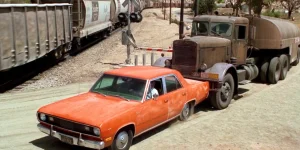
Principal photography took place in the American Southwest, primarily in Utah and Arizona. These locations were not chosen randomly; the vast, empty highways and brutal desert landscapes are essential to the story’s premise.
Isolation is the film’s most important dramatic tool. The barren scenery communicates immediately that Jeff and Amy are completely on their own, far from any help. Furthermore, the rugged terrain makes the vehicle chases feel genuinely dangerous and physically plausible rather than Hollywood-slick.
Awards and Nominations
Breakdown did not receive significant awards attention during its release. It performed respectably at the box office but remained largely off the awards circuit, positioned as a commercial thriller rather than a prestige production.
Behind the Scenes Insights
- Jonathan Mostow co-wrote the screenplay alongside Sam Montgomery, giving him unusually tight creative control over the finished product.
- J.T. Walsh reportedly brought significant depth to Red Breaker by playing the character as genuinely warm and helpful in his early scenes, making the reveal of his true nature land harder.
- Kurt Russell performed a number of his own physical stunts throughout production, particularly during the truck sequences.
- Mostow studied real-world cases of highway crime and predatory criminal networks targeting travelers while developing the script.
- The production used practical effects and real trucks extensively, prioritizing physical authenticity over digital shortcuts, which was standard for the era but notable for how convincingly it paid off on screen.
- J.T. Walsh passed away in 1998, making Breakdown one of his final major theatrical releases. His performance here stands as a reminder of how exceptional a character actor he was.
Inspirations and References
Breakdown draws on a long tradition of highway terror narratives in American cinema and literature. Films like Duel (1971) and The Hitcher (1986) explored similar anxieties about vulnerability on remote roads. Mostow taps into a specifically American fear: the open highway as a place where civilization’s protections simply evaporate.
On a thematic level, the film also engages with class anxiety. Red and his crew target people who look prosperous, and Jeff’s initial helplessness reflects how little wealth and comfort prepare a person for raw, physical danger. That subtext gives the story an extra layer beyond its surface-level thrills.
Alternate Endings and Deleted Scenes
No officially documented alternate endings or significant deleted scenes have been widely publicized for Breakdown. The film’s theatrical cut appears to represent Mostow’s intended vision relatively closely. No major extended or director’s cut release followed the film’s theatrical run.
Book Adaptations and Differences
Breakdown is not based on a book. Mostow and Montgomery wrote the original screenplay directly for the screen. No source novel or short story served as its foundation.

Memorable Scenes and Quotes
Key Scenes
- Red driving past Jeff’s broken-down Jeep, stopping, and offering Amy a ride in a scene oozing false warmth and neighborly charm.
- Jeff arriving at the diner and finding no trace of Amy, with the staff denying any knowledge of her or Red, creating an almost surreal atmosphere of gaslighting.
- Jeff hidden underneath Red’s truck as it rolls down the highway, clinging on while the desert rushes past beneath him.
- Red denying everything to the deputy while Jeff stands there looking desperate and unhinged, a masterclass in controlled villainy from J.T. Walsh.
- Jeff infiltrating the farmhouse and finding Amy bound and terrified but alive, the film’s emotional pivot point.
- The bridge climax, with Red pinned under the semi as Jeff releases the brakes and the truck rolls forward.
Iconic Quotes
- “I never saw this woman before in my life.” – Red Breaker, delivered with devastating calm to the deputy.
- “You want your wife back? Ninety thousand dollars.” – Red, making the ransom demand with chilling matter-of-factness.
- “Do you have any idea who you’re messing with?” – Jeff, finally fighting back after reaching his breaking point.
Easter Eggs and Hidden Details
- The early road-rage confrontation with Billy Red serves as a deliberate red herring, directing audience suspicion away from Red Breaker and toward a more obvious threat.
- Red’s truck number and the diner’s name are visible in early scenes, small details that reward attentive viewers on repeat viewings because they connect locations Jeff later struggles to find.
- Amy’s decision to ride with Red rather than wait with Jeff subtly reflects a small but meaningful tension in their marriage, a couple not quite in sync, which Mostow establishes quickly and efficiently in the opening scenes.
- Red’s overly helpful, almost performative friendliness in his first scene reads very differently on a second viewing, every gesture of warmth recontextualized as calculated predation.
Trivia
- Breakdown was Jonathan Mostow’s second feature film, and its commercial success directly led to him being hired to direct Terminator 3: Rise of the Machines (2003).
- J.T. Walsh was one of Hollywood’s most in-demand character actors during the 1990s, appearing in numerous acclaimed films in supporting roles throughout the decade.
- Kurt Russell accepted the role partly because the script offered him a character defined by vulnerability and fear rather than conventional action-hero toughness, a deliberate departure for him at that point in his career.
- For most of the film, Jeff Taylor does not behave like a traditional action hero; he improvises, panics, and makes mistakes, which was a conscious creative choice by Mostow to keep the tension credible.
- The film was produced by Dino De Laurentiis and Martha De Laurentiis, veteran producers with a long history of genre filmmaking.
- Breakdown opened in May 1997 and performed solidly against significant competition, earning a reputation as one of the tighter, more effective thrillers of that decade.
Why Watch?
Breakdown is a masterclass in sustained tension, proof that a thriller does not need a high concept or a bloated budget to get under your skin. J.T. Walsh delivers one of the great underrated villain performances of the 1990s, and Kurt Russell grounds every escalating moment in genuine, relatable fear. Moreover, at a tight 93 minutes, it respects your time completely.
Director’s Other Movies
- Terminator 3: Rise of the Machines (2003)
- Surrogates (2009)
- Breakdown (1997)