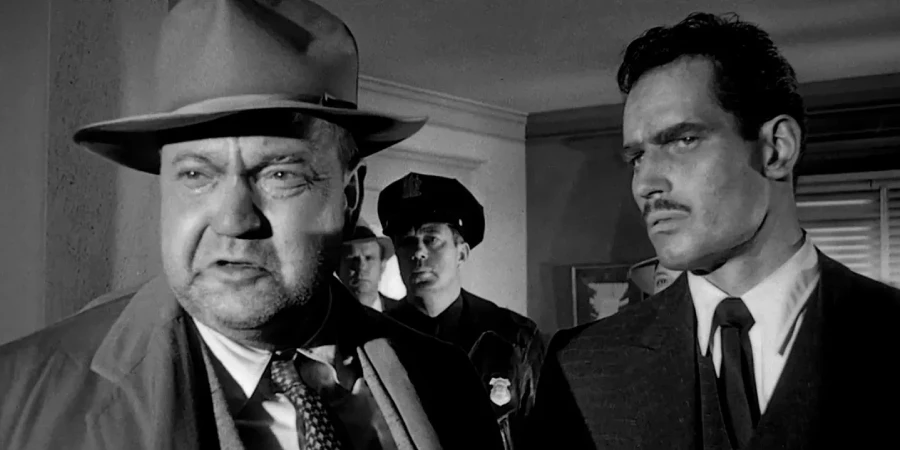

Orson Welles’s Touch of Evil opens with what might be the most audacious single shot in cinema history. This three-and-a-half-minute unbroken take is not just a technical marvel. Instead, it serves as a masterclass in building suspense, establishing character, and defining the grimy, morally ambiguous world of the film. It’s a promise of the darkness to come.
Detailed Summary
The Bomb in the Trunk
The film ignites in the Mexican border town of Los Robles. An unseen figure plants a time bomb in the trunk of a convertible. A wealthy businessman, Rudy Linnekar, and his girlfriend enter the car and drive toward the American border.
Meanwhile, Mexican narcotics official Mike Vargas (Charlton Heston) and his new American wife, Susan (Janet Leigh), are strolling nearby. Their honeymoon walk intersects with the doomed car’s path. Ultimately, the vehicle crosses the border and explodes, killing its occupants just inside the United States.
Vargas vs. Quinlan
The explosion brings in the local American police captain, Hank Quinlan (Orson Welles). Quinlan is a hulking, corrupt detective with a reputation for getting his man, often through intuition rather than evidence. Vargas, on the other hand, insists on following proper procedure.
This ideological clash begins almost immediately. Quinlan quickly fixates on a young Mexican man, Manolo Sanchez, as his prime suspect. Vargas, however, finds Quinlan’s certainty suspicious and decides to observe the investigation.
The “Discovery” of Evidence
At Sanchez’s apartment, Quinlan and his devoted partner, Sergeant Pete Menzies (Joseph Calleia), conduct a search. Vargas watches closely. Sanchez and his girlfriend vehemently deny any involvement.
Suddenly, Menzies shouts that he found something in the bathroom. He emerges with two sticks of dynamite, supposedly hidden in a shoebox. Vargas, who was just in the bathroom, saw nothing. He openly accuses Quinlan of planting the evidence, a charge Quinlan furiously denies.
Susie’s Nightmare
As Vargas becomes more embroiled in the murder case, Susan is targeted. The Grandi family, a local crime syndicate Vargas is investigating, begins to harass her. “Uncle Joe” Grandi (Akim Tamiroff) wants to pressure Vargas into dropping his case against the family.
Their intimidation campaign escalates dramatically. The gang terrorizes Susan at her isolated motel before abducting her. They take her to a different motel, one owned by Grandi himself, setting a trap.
The Frame-Up
Quinlan, enraged by Vargas’s interference, conspires with Joe Grandi. At the motel, the Grandi gang drugs Susan until she is unconscious. Quinlan then murders Grandi in the room, strangling him with one of Susan’s stockings.
He leaves Susan in the bed next to Grandi’s corpse. The scene is meticulously staged to frame her for murder, fueled by a supposed drug-crazed rage. Consequently, Quinlan has a way to discredit Vargas and remove him from the picture entirely.
The Alliance
Menzies, investigating the new murder scene, finds something devastating. He discovers Quinlan’s cane, which the captain had accidentally left behind. This discovery confirms Menzies’ long-suppressed fears that his mentor has been planting evidence for years.
Heartbroken and disillusioned, Menzies approaches Vargas. He agrees to help expose Quinlan. Menzies will wear a wire and attempt to lure Quinlan into a confession, providing the undeniable proof Vargas needs.
Movie Ending
The film’s climax is a tense, shadowy pursuit. Menzies, wearing a hidden microphone connected to a recorder operated by Vargas, confronts Quinlan near a network of oil derricks and a filthy river. He prods Quinlan about past cases, hoping for a confession.
Quinlan, drunk and rambling, admits to planting evidence on suspects for years. He justifies his actions, claiming all his victims were guilty anyway. However, an echo from Vargas’s radio device alerts Quinlan to the betrayal. Realizing he’s being recorded, Quinlan furiously turns on his partner.
He takes Vargas’s gun, which Menzies had brought, and shoots his loyal sergeant. Quinlan then prepares to kill Vargas, planning to claim self-defense. But Menzies, with his last ounce of strength, shoots Quinlan. The corrupt captain stumbles backward and falls into the polluted water, dead.
Just then, Assistant District Attorney Schwartz arrives with Susan, now cleared of all charges. Schwartz listens to the tape recording, which captured Quinlan’s confession and exonerated Sanchez. Quinlan’s longtime friend, brothel madam Tana (Marlene Dietrich), gives him a final, complicated eulogy, stating, “He was some kind of a man. What does it matter what you say about people?”
Are There Post-Credits Scenes?
No, there are no post-credits scenes in Touch of Evil. The film concludes after the final shot and the credits roll, which was standard for films of this era.
Type of Movie
Touch of Evil is a classic example of film noir. It features all the genre’s key ingredients: a cynical and corrupt world, morally ambiguous characters, and a pervading sense of doom. Visually, its use of deep shadows, canted angles, and wide-angle lenses creates a distorted, nightmarish atmosphere.
It is also a gripping crime thriller. The plot revolves around a murder investigation entangled with kidnapping and police corruption, creating a narrative filled with suspense and betrayal.
Cast
- Charlton Heston – Ramon Miguel “Mike” Vargas
- Janet Leigh – Susan Vargas
- Orson Welles – Police Captain Hank Quinlan
- Joseph Calleia – Sgt. Pete Menzies
- Akim Tamiroff – “Uncle Joe” Grandi
- Marlene Dietrich – Tana
- Dennis Weaver – The Night Man
Film Music and Composer
The score was composed by the legendary Henry Mancini. It was a groundbreaking soundtrack for its time. Mancini masterfully blended jazz, rock and roll, and Latin-tinged lounge music to create the film’s sleazy, vibrant border-town feel.
Notably, much of the music is diegetic, meaning it originates from sources within the film’s world, like car radios and bar jukeboxes. This technique blurs the line between score and sound design, immersing the audience in the chaotic environment of Los Robles.
Filming Locations
Despite being set on the US-Mexico border, Touch of Evil was filmed almost entirely in Venice, California. The seaside community’s decaying architecture, oil derricks, and dark canals provided the perfect stand-in for the fictional, corrupt town of Los Robles.
The location was not just a backdrop. Its grimy, rundown state serves as a powerful visual metaphor for the moral decay of the characters, especially Hank Quinlan.
Awards and Nominations
Upon its initial release, Touch of Evil received little critical recognition and no major awards. However, its reputation has grown immensely over the decades. In 1993, the United States Library of Congress selected it for preservation in the National Film Registry for being “culturally, historically, or aesthetically significant.”
Behind the Scenes Insights
- Orson Welles was originally only hired to act as Hank Quinlan. Star Charlton Heston misunderstood and believed Welles was also directing. Heston told the studio he would only do the film if Welles directed, forcing their hand.
- Universal Pictures was unhappy with Welles’s initial cut. The studio significantly re-edited the film and hired director Harry Keller to shoot additional scenes to make the plot more straightforward.
- In response, Welles wrote an impassioned 58-page memo detailing his intended vision for the film’s editing, music, and narrative structure.
- In 1998, editor Walter Murch and producer Rick Schmidlin used this memo to create a “restored” version that attempted to reconstruct the film as Welles had originally intended.
Inspirations and References
The film is based on the 1956 pulp novel Badge of Evil by Whit Masterson, a pseudonym for writing duo Robert Wade and Bill Miller. Welles reportedly dismissed the novel, claiming he never read it and was only attracted by the title. Nonetheless, the core plot of a corrupt cop framing a suspect remains intact.
Alternate Endings and Deleted Scenes
There is no known alternate ending for Touch of Evil. The major differences between versions lie in the editing. The original theatrical cut, overseen by the studio, chopped up Welles’s long takes and inserted new scenes for clarity, disrupting the director’s intended pacing and tone.
The most significant change involved the opening. The studio cut back and forth between the ticking bomb and the Vargas couple, adding opening credits and Henry Mancini’s score over the shot. In contrast, Welles’s intended version was an uninterrupted take, with only diegetic source music, which the 1998 restoration reinstated.
Book Adaptations and Differences
While the film follows the basic premise of the novel Badge of Evil, Orson Welles made substantial changes. The book’s protagonist is a white assistant district attorney named Mitch Holt. Welles changed the character to a Mexican narcotics agent, Mike Vargas, which introduced themes of racism and cross-border tension.
Furthermore, Welles expanded the role of Quinlan, transforming him from a simple villain into a complex, tragic figure. Susan’s harrowing ordeal at the motel was also largely a cinematic invention, intensifying the film’s suspense and darkness.
Memorable Scenes and Quotes
Key Scenes
- The Opening Shot: The legendary three-and-a-half-minute tracking shot that follows a car with a bomb in its trunk, seamlessly introducing the main characters and setting the stage for the entire film.
- The Apartment Interrogation: A claustrophobic scene where Quinlan’s imposing presence dominates a tiny apartment as he closes in on his suspect, Sanchez, showcasing his manipulative tactics.
- The Motel Terror: A surreal, terrifying sequence where Susan is trapped in her motel room and tormented by a bizarre gang, shot with disorienting angles and lighting.
- Confession by the River: The final confrontation where Menzies records Quinlan’s confession, ending in a tragic double shooting against the backdrop of industrial waste.
Iconic Quotes
- Tana: “He was some kind of a man. What does it matter what you say about people?”
- Vargas: “A policeman’s hunch is a fancy name for prejudice.”
- Tana: “Your future is all used up.”
- Night Man: “That’s a crazy story. I’m the night man. I’ve got a crazy story of my own. I’ve been the night man here for… 12 years.”
Easter Eggs and Hidden Details
- Mercedes McCambridge, who voiced the demon in The Exorcist, has an uncredited cameo. She plays the leather-clad gang leader who terrorizes Susan Vargas at the motel.
- Joseph Cotten, a frequent collaborator of Welles from his Mercury Theatre days, also appears in an uncredited cameo as the coroner at the site of Joe Grandi’s murder.
- When Vargas calls the district attorney, the phone number is “ED-gewater 4-7123”. This is a subtle nod to the Edgewater Beach Hotel in Chicago, where Welles once lived.
Trivia
- Orson Welles underwent a significant physical transformation to play Quinlan, gaining over 50 pounds and using a prosthetic nose, wigs, and padding to create the character’s monstrous appearance.
- Marlene Dietrich agreed to appear in the film for a minimal salary as a personal favor to her friend, Orson Welles.
- Charlton Heston later stated that his performance as a Mexican man was a poor choice, admitting it was one of the few roles he would not have taken in his later career due to modern sensibilities about casting.
- The film performed poorly at the American box office and was originally released as the lower half of a double bill. It was European critics, particularly at the 1958 Brussels World’s Fair Film Festival, who first championed it as a masterpiece.
Why Watch?
Touch of Evil is essential viewing. It represents the pinnacle of film noir, pushing the genre’s visual and thematic boundaries to their absolute limit. Welles’s direction is breathtaking, and his performance as the monstrous Quinlan is unforgettable. Watch this for its style, substance, and influence.
Director’s Other Movies
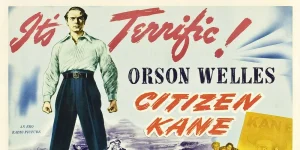
- Citizen Kane (1941)
- The Magnificent Ambersons (1942)
- The Lady from Shanghai (1947)
- The Trial (1962)
- Chimes at Midnight (1965)
- F for Fake (1973)