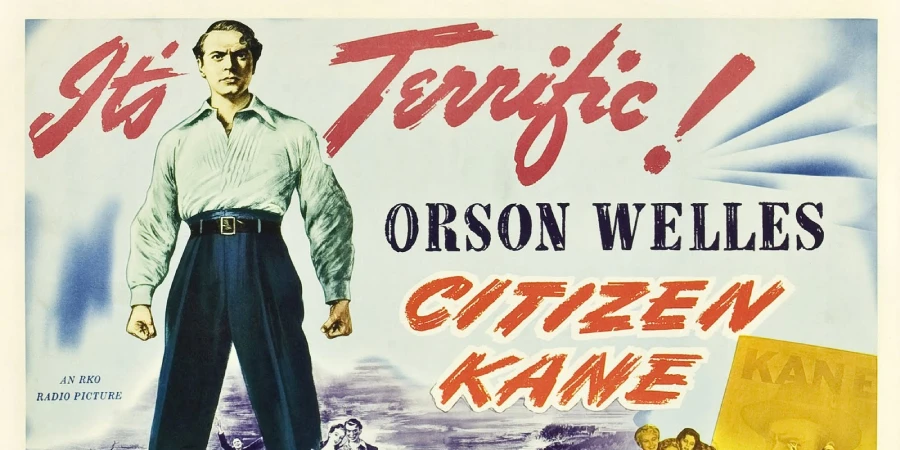

Charles Foster Kane owns newspapers, castles, statues, and most of the people around him, yet he dies alone whispering a single word. Citizen Kane turns that word into a mystery, then argues that no mystery can sum up a life. Orson Welles made it at 25 and never escaped its shadow. Spoilers follow, right down to the burning sled.
Detailed Summary
A Dying Word at Xanadu
A No Trespassing sign hangs on a chain-link fence. Beyond it sits Xanadu, a private mountain of a mansion in Florida, dark except for one lit window. Inside, an old man holds a snow globe, whispers “Rosebud,” and dies.
His hand releases the globe. It shatters on the floor, and a nurse enters to cover the body. Just like that, the richest man in America is gone.
News on the March
A booming newsreel takes over. News on the March races through Kane’s public life: the newspaper empire, two marriages, a run for governor, Depression losses, and the palace he never finished. Xanadu holds enough art to fill ten museums, plus a private zoo.
Then the lights come up in a screening room. Editor Rawlston finds the obituary hollow. He wants to know what “Rosebud” meant, so he hands the job to reporter Jerry Thompson.
Thompson Hits a Wall with Susan
Thompson starts with Susan Alexander Kane, the second wife, now singing in an Atlantic City nightclub. She sits drunk at a table and refuses to speak. Her manager tells Thompson she never heard the word.
Thatcher’s Memoirs and the Boy in the Snow
Next stop is the Thatcher Memorial Library, a mausoleum of a building. Thompson reads the unpublished memoirs of Walter Parks Thatcher, the banker who raised Kane. The pages flash back to Colorado in 1871.
Mary Kane runs a boarding house. A defaulting lodger paid her with a worthless deed, and that land turned out to hold the Colorado Lode gold mine. She signs her son over to Thatcher’s bank, partly to protect him from his father.
Outside, young Charles plays with a sled in the snow. He rams it into Thatcher’s stomach when he learns he must leave. That sled, and that abandoned childhood, will matter later.
On his twenty-fifth birthday, Kane takes control of his fortune. He ignores the mines and picks one asset: the failing New York Inquirer. “I think it would be fun to run a newspaper,” he writes.
Thatcher watches with horror as Kane attacks the trusts, including Thatcher’s own interests. Kane’s response is legendary. At a million dollars a year in losses, he says, he will have to close the paper in sixty years.
The memoir ends in 1929. Depression losses force Kane to sign his newspapers over to Thatcher’s bank. “If I hadn’t been very rich,” he admits, “I might have been a really great man.”
Bernstein Remembers the Inquirer Years
Thompson visits Mr. Bernstein, Kane’s loyal business manager, now chairman of the board. Bernstein delivers one of the film’s tenderest moments: a girl in a white dress he saw on a ferry in 1896, for one second. He has thought of her every month since.
His flashback shows Kane storming into the Inquirer with Jedediah Leland and Bernstein in tow. Kane fires the stuffy editor Carter, sleeps in the office, and prints a Declaration of Principles on the front page. Leland asks to keep the original.
Kane then buys the entire staff of the rival Chronicle. A staff photograph comes to life as the men celebrate at a party with dancing girls. Leland wonders aloud whether Kane bought the staff or the staff bought Kane.
Kane sails to Europe and mails back crates of statues. He returns engaged to Emily Monroe Norton, niece of the President of the United States.
Leland and the Breakfast Table
Thompson finds Leland in a hospital, old, sharp, and begging for cigars. Leland describes Kane’s first marriage through a single montage. Each breakfast jumps forward in time as the couple grows colder.
By the last cut, Emily reads the rival Chronicle across a long table. Silence has replaced conversation. Both Emily and their son will later die in a car accident, a fact the newsreel mentions in passing.
Years afterward, Kane meets Susan Alexander on a muddy street after a carriage splashes him. She has a toothache; he has mud on his coat. She invites him up, sings for him, and he begins paying for singing lessons.
The Gettys Scandal and the Lost Election
Kane runs for governor against political boss Jim W. Gettys. He gives a thunderous speech at Madison Square Garden beneath a giant portrait of himself. Victory looks certain.
Gettys strikes back. He summons Emily to Susan’s apartment, confronts Kane with the affair, and offers a quiet withdrawal in exchange for silence. Kane refuses and screams threats down the stairwell.
As a result, the Chronicle prints the love nest story. Kane loses the election, and the Inquirer blames fraud at the polls. Leland, drunk and disgusted, asks for a transfer to Chicago.
Susan’s Opera Career
Emily divorces Kane, and he marries Susan two weeks later. He builds the Chicago Municipal Opera House so she can star in an opera called Salammbo. She cannot sing it.
Opening night is a disaster. Leland passes out drunk over his half-written review. Kane finishes the notice himself, keeps it savage, and fires his oldest friend.
Leland later mails back the torn Declaration of Principles along with Kane’s severance check, ripped to pieces. Nothing more passes between them.
Susan’s own account fills in the rest. Kane drags her through a national tour of humiliating performances. She finally swallows sleeping pills, and only then does he let her quit.
Xanadu and the Empty Palace
Kane retreats to Xanadu with Susan. She assembles jigsaw puzzles in an enormous hall while he collects more statues. Their conversations echo across a room the size of a train station.
A forced picnic in the Everglades ends with Kane slapping her. Susan packs and leaves. He begs her to stay, but she recognizes a demand for love without any love offered in return.
Raymond, the butler, gives Thompson the final piece. After Susan left, Kane destroyed her bedroom in a silent rage. He stopped only when he found a snow globe, murmured “Rosebud,” and walked past a hall of mirrors.
Movie Ending
Thompson gathers with the other reporters in Xanadu’s great hall, surrounded by crates. Kane’s belongings stretch into the distance: statues, paintings, furniture, and junk from a Colorado boarding house. Nobody knows what Rosebud was.
Thompson gives up. He calls Rosebud a missing piece in a jigsaw puzzle and adds that no word can explain a man’s life. Kane got everything he wanted and then lost it, and the reporters head for the train.
Meanwhile, the camera pulls back over the crates. Workers feed worthless items into a furnace, and one of them tosses in a child’s sled. Flames curl over the painted name: Rosebud.
Only the audience sees it. Rosebud was the sled from the day Thatcher took Charles away from his mother. Kane spent his life buying things because someone once took the one thing he loved.
Welles himself dismissed the device as a gimmick, and he had a point. This film is not really about a sled. It is about the impossibility of knowing another person, which is why Thompson’s failure feels more honest than a solved mystery.
Smoke rises from the chimney. The No Trespassing sign returns, and the fence closes the film exactly as it opened it. Xanadu keeps its secret from everyone but us.
Are There Post-Credits Scenes?
No. Citizen Kane ends with the chimney smoke, the fence, and a closing roll call of the cast. Films of 1941 did not use post-credits scenes, and nothing follows the final title card.
Type of Movie
Citizen Kane is a drama built like a mystery. It borrows the structure of a detective story, but the crime under investigation is a wasted life. Critics also file it under biographical fiction, since Kane stands in for real press barons.
Its tone shifts constantly. Early scenes crackle with newsroom comedy; later scenes sink into gothic loneliness. Gregg Toland‘s deep focus photography gives even the jokes a hard, shadowed edge.
Cast
- Orson Welles – Charles Foster Kane
- Joseph Cotten – Jedediah Leland
- Dorothy Comingore – Susan Alexander Kane
- Everett Sloane – Mr. Bernstein
- Ruth Warrick – Emily Monroe Norton Kane
- George Coulouris – Walter Parks Thatcher
- Ray Collins – Jim W. Gettys
- Agnes Moorehead – Mary Kane
- Paul Stewart – Raymond
- Erskine Sanford – Herbert Carter
- William Alland – Jerry Thompson
- Harry Shannon – Jim Kane
- Buddy Swan – Young Charles Foster Kane
- Fortunio Bonanova – Signor Matiste
- Philip Van Zandt – Mr. Rawlston
Film Music and Composer
Bernard Herrmann wrote the score, his first for a feature film. He had already worked with Welles on the Mercury Theatre on the Air radio broadcasts, including The War of the Worlds. Welles gave him an unusually long schedule, which let the music grow alongside the cut.
Two motifs anchor the film. A brooding Rosebud theme appears in the opening and returns for the sled. A power motif tracks Kane’s ambition through the newsreel and beyond.
Herrmann also composed the fake opera Salammbo. He pitched the aria deliberately high so Susan’s voice would sound strained and overwhelmed. In contrast, the rowdy campaign number “Charlie Kane” gives the newsroom party its bounce.
Herrmann earned an Oscar nomination for the score. He lost, yet he won that same night for All That Money Can Buy. His later work includes Vertigo, Psycho, and Taxi Driver.

Filming Locations
Welles shot nearly everything on RKO soundstages in Hollywood. Studio control let Toland build sets with visible ceilings, which cinematographers rarely showed at the time. Those low ceilings press down on Kane during his later years.
Xanadu never existed as a building. Matte paintings, miniatures, and clever lighting created its towers and cavernous halls. That artificiality suits a palace built from an old man’s vanity.
Notably, the Everglades picnic relies on stock footage, including strange birds that reportedly came from Son of Kong. Even Kane’s escape from Xanadu looks fake, which feels appropriate.
Awards and Nominations
The Academy handed the film nine nominations in 1942: Best Picture, Director, Actor, Original Screenplay, Cinematography, Art Direction, Sound Recording, Score, and Film Editing. It won only one, Best Original Screenplay, shared by Herman J. Mankiewicz and Welles. Accounts of the ceremony describe boos whenever the title came up.
How Green Was My Valley took Best Picture that year. However, the New York Film Critics Circle named Citizen Kane the best film of 1941.
Its reputation only grew. The Sight & Sound critics’ poll ranked it number one from 1962 through 2002, until Vertigo displaced it in 2012. The American Film Institute placed it first on both editions of its 100 Greatest American Movies list.
Behind the Scenes Insights
- Welles signed an RKO contract that granted him final cut, a freedom almost unheard of for a first-time director.
- Gregg Toland asked to work on the film because he wanted a director with no Hollywood habits. Welles rewarded him by sharing the same title card.
- During the staircase confrontation with Gettys, Welles injured his ankle and directed for a stretch from a wheelchair.
- Makeup artist Maurice Seiderman aged Welles from 25 to his seventies, a process that took hours each morning.
- William Randolph Hearst saw himself in Kane and banned his newspapers from mentioning the film.
- Louis B. Mayer reportedly offered to reimburse RKO’s costs in exchange for destroying the negative. RKO refused.
- Most of the cast came from Welles’s Mercury Theatre and had never acted in a film before.
- Welles reportedly told the studio that the first days of shooting were only camera tests, which kept executives away from the set.
- Editor Robert Wise later directed West Side Story and The Sound of Music.
- Despite the acclaim, the film lost money on its first release, thanks in part to the Hearst boycott.
Inspirations and References
Hearst is the obvious model. His San Simeon castle became Xanadu, his newspaper empire became Kane’s, and his sensational journalism shaped the Inquirer‘s style. A famous Hearst anecdote about supplying a war lives on in Kane’s telegram to his Cuba correspondent.
Susan Alexander drew unfair comparisons to Hearst’s companion Marion Davies. Welles later insisted Davies was a gifted actress and nothing like Susan. Closer models came from Samuel Insull, who built a Chicago opera house, and Harold McCormick, who bankrolled his wife’s opera ambitions.
Other press barons fed the character too. Joseph Pulitzer’s crusading style left clear fingerprints. Furthermore, the name Xanadu comes from Coleridge’s poem Kubla Khan, which the newsreel quotes directly.
Alternate Endings and Deleted Scenes
No alternate ending exists. Welles held final cut, and the sled reveal already appears in Mankiewicz’s original draft, titled American.
Several scenes did disappear. A brothel sequence originally followed the Chronicle staff celebration, but the Production Code office objected. Welles reshot it as the newsroom party with dancing girls, and the original footage no longer survives.
Welles also trimmed longer versions of the Thatcher and Leland sections for pace. Consequently, the finished film runs a tight 119 minutes.
Book Adaptations and Differences
Citizen Kane is an original screenplay. No novel preceded it; the story grew from Mankiewicz’s draft American and Welles’s revisions. Later books such as Pauline Kael’s essay Raising Kane analyze the film, but they interpret it rather than adapt it.
Memorable Scenes and Quotes
Key Scenes
- The snow globe slips from Kane’s hand and shatters, moments after the whispered “Rosebud.”
- Kane and Emily age across a single breakfast table, with each cut chilling the marriage a little more.
- Kane rallies a crowd at Madison Square Garden while a colossal portrait of his own face looms behind him.
- Gettys, Emily, Kane, and Susan crowd into a stairwell as the affair comes into the open.
- Susan’s opening night ends with the camera rising to the rafters, where one stagehand holds his nose.
- Kane applauds alone after the performance, long after the rest of the audience has stopped.
- Kane tears apart Susan’s bedroom, finds the snow globe, and passes between mirrors that multiply him into infinity.
- Flames consume the sled in the furnace, revealing the word nobody else will ever read.
Iconic Quotes
- “Rosebud.”
- “I think it would be fun to run a newspaper.”
- “You know, Mr. Thatcher, at the rate of a million dollars a year, I’ll have to close this place in sixty years.”
- “If I hadn’t been very rich, I might have been a really great man.”
- “Old age. It’s the only disease, Mr. Thompson, that you don’t look forward to being cured of.”
- “A fellow will remember a lot of things you wouldn’t think he’d remember.”
- “I don’t think any word can explain a man’s life.”
- “You’re going to need more than one lesson, and you’re going to get more than one lesson.”
Easter Eggs and Hidden Details
- The snow globe sits on Susan’s dresser the night Kane meets her, years before he clutches it at death.
- Thompson’s face stays in shadow for the entire film. He functions as a device, not a character.
- The News on the March newsreel parodies the March of Time series, right down to the narrator’s cadence. William Alland, who plays Thompson, voices it.
- The Chronicle staff photograph turns into a live celebration six years later, a jump cut disguised as a still image.
- Kane’s walk between two mirrors produces an endless line of Kanes, a visual joke about a man with no single self.
- Bernstein’s name honors Dr. Maurice Bernstein, Welles’s own guardian.
- Alan Ladd appears briefly as one of the reporters in the final Xanadu scene.
- The fence and No Trespassing sign bookend the film, and the camera crosses that boundary in both directions.
Trivia
- Welles was 25 years old when he directed, co-wrote, produced, and starred in the film.
- Its working title was American.
- The film premiered on May 1, 1941, at the Palace Theatre in New York.
- Dorothy Comingore reportedly was pregnant during production, so Toland framed her carefully in later scenes.
- Welles never won another competitive Oscar. He received an honorary award in 1971.
- Kael’s Raising Kane argued that Mankiewicz deserved nearly all the credit for the script, a claim later scholars strongly disputed.
- David Fincher’s Mank (2020) dramatizes the writing of the screenplay from Mankiewicz’s point of view.
Why Watch?
Every modern film about ambition owes something to this one. Its structure, camera work, and bitter humor still feel fresh eighty-five years later. Watch it once for the mystery, then again for the mirrors, the ceilings, and the quiet cruelty in every breakfast.
Director’s Other Movies
- The Magnificent Ambersons (1942)
- The Stranger (1946)
- The Lady from Shanghai (1947)
- Macbeth (1948)
- Othello (1951)
- Mr. Arkadin (1955)
- Touch of Evil (1958)
- The Trial (1962)
- Chimes at Midnight (1966)
- F for Fake (1973)
- The Other Side of the Wind (2018)