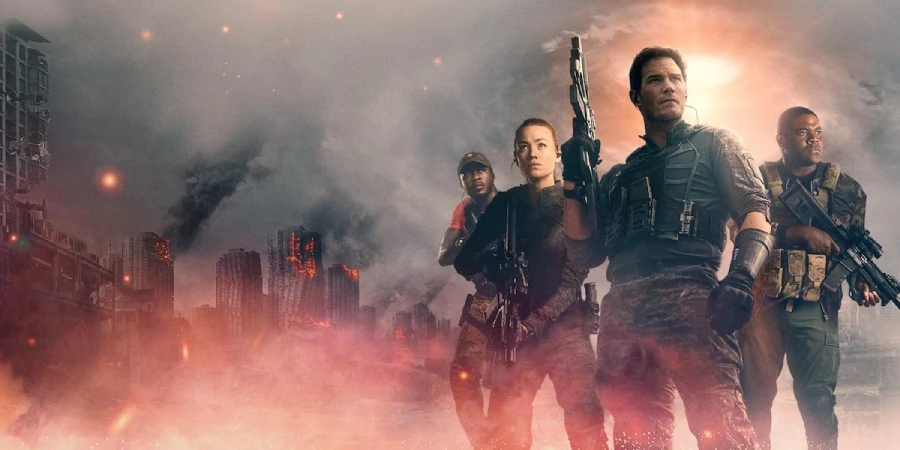

Soldiers teleporting from the future to beg the present for help sounds ridiculous on paper, and The Tomorrow War leans into that absurdity with genuine commitment. Dan Forester watches alien creatures tear through a Miami resort during a live World Cup broadcast, and somehow that one image does more narrative heavy lifting than most sci-fi films manage in their entire second act.
Chris Pratt anchors the film with a restrained, physically grounded performance that critics largely undersold. This is a film that wants to be three things at once, a war movie, a father-daughter story, and a monster survival thriller, and it almost pulls all three off.
Detailed Summary
The Draft Announcement
During a Christmas Day soccer broadcast, soldiers from the year 2051 rip open a wormhole above the stadium and deliver a warning. Humanity is losing a war against an alien species called Whitespikes, and the present-day population must send soldiers forward in time to help fight.
A global draft begins, conscripting civilians with no future descendants still alive in 2051. Dan Forester, a high school biology teacher and Army veteran, receives a draft notice. His daughter Muri is young, his marriage is strained, and he has no idea how much worse things are about to get.
Arriving in the Future
Dan’s unit teleports into a chaotic Miami already overrun by Whitespikes. Their arrival goes immediately wrong: they materialize hundreds of feet in the air and plummet into buildings. Several recruits die before they even fire a shot.
Survivors regroup under the command of Colonel Forester, a soldier who quickly reveals she is Muri, Dan’s adult daughter from this timeline. That reveal lands hard. Yvonne Strahovski plays grown Muri with a cold efficiency that makes every interaction with Pratt’s Dan feel like watching someone hold grief at arm’s length.
Fighting the Whitespikes
Whitespikes are fast, armored, and nearly impossible to kill with conventional weapons. They communicate with high-pitched shrieks and move in coordinated swarms. The film takes real care in staging their threat, particularly in a sequence inside a research facility where the creatures hunt Dan’s squad through flooded corridors.
Dan discovers that Muri has been developing a toxin capable of killing Whitespikes. She needs live female specimens to complete the formula. Her research consumes her, partly from duty and partly because she grew up knowing her father abandoned the family.
Muri’s Revelation and Dan’s Past Failure
Muri confronts Dan directly. In her timeline, Dan left the family after failing to land a research position he wanted, gave up on his dreams, and became emotionally absent. She carries that wound into combat.
Pratt handles the scene quietly, sitting still, letting Muri’s words hit without deflecting. It is the film’s best performance moment and the one scene where the screenplay earns its emotional weight rather than just announcing it.
The Toxin and the Escape
Muri completes the toxin and uploads the formula to Dan before the facility collapses under a Whitespike assault. She dies in the attack, sacrificing herself so Dan can carry the weapon back to the present.
Dan and a handful of survivors jump back through the time rift. He returns home changed, carrying the toxin formula and the knowledge that his daughter’s future death is not yet inevitable if he acts differently now.
Back in the Present and the Real Discovery
Dan tries to push the toxin into mass production, but governments drag their feet. He runs tests and realizes the Whitespikes did not arrive in 2048 as previously believed. Their ship actually crashed on Earth decades earlier, buried under Arctic ice.
This changes everything. The aliens have been dormant, waiting. Their invasion timeline can be disrupted if someone destroys the ship before it launches.
The Arctic Mission
Dan assembles a small team that includes his estranged father, James Forester, played by J.K. Simmons with his usual intimidating authority. James spent decades preparing for an alien invasion as a conspiracy-leaning survivalist, which suddenly looks less like paranoia and more like prescience.
They locate the crashed vessel beneath the ice, infiltrate it, and discover hundreds of dormant Whitespikes still in stasis. Dan plants charges and floods the ship with the toxin. Most of the creatures die, but several escape, including the Alpha, the dominant female.

Movie Ending
Dan faces the Alpha alone in the frozen wilderness, and the film commits to a brutal, close-quarters fight in the snow. No clean heroics, just a man burning a creature alive and then stabbing it to make sure. J.K. Simmons shows up with a flamethrower, which is exactly the kind of over-qualified cavalry arrival that would normally feel cheap but somehow feels earned here because Simmons sells the moment with complete physical conviction.
With the Alpha dead and the remaining escaped Whitespikes presumably hunted down, the immediate threat collapses. Dan calls Muri, his young daughter in the present timeline. He is different now, present, attentive, unwilling to become the man she described in 2051.
What the ending quietly argues is that the war was never purely against aliens. Dan had to travel thirty years forward in time to understand he was already losing a smaller, quieter war at home. Whether you find that moving or a little on-the-nose depends entirely on your patience for sci-fi films that want to be about fatherhood. Personally, it works because Pratt earns it scene by scene rather than telegraphing it from the opening frame.
The future is not erased and the film does not pretend to resolve the paradox cleanly. Dan can change his behavior but cannot confirm whether the 2051 war still happens. That open ambiguity is smarter than the rest of the screenplay, and it deserves more credit than it gets.
Are There Post-Credits Scenes?
The Tomorrow War does not include any post-credits scenes. Once the credits roll, the film is finished. No teases, no franchise setup, no extra footage.
Type of Movie
This is a sci-fi action thriller with a strong family drama undercurrent. The tone shifts noticeably across its runtime: the first act plays like a disaster epic, the middle section becomes a survival horror film inside that flooded research facility, and the finale pivots to a small-scale action thriller in the Arctic.
Expect large-scale spectacle cut with intimate character moments. It skews toward mainstream blockbuster entertainment but makes occasional, genuine attempts at emotional sincerity.
Cast
- Chris Pratt – Dan Forester
- Yvonne Strahovski – Colonel Muri Forester
- J.K. Simmons – James Forester
- Betty Gilpin – Emmy Forester
- Sam Richardson – Charlie
- Edwin Hodge – Dorian
- Jasmine Mathews – Lieutenant Hart
- Ryan Kiera Armstrong – Young Muri Forester
Film Music and Composer
Lorne Balfe composed the score. Balfe has built a reputation scoring large-scale genre films and television, including work on Mission: Impossible: Fallout and the Black Widow score. His style leans toward orchestral intensity layered with electronic textures.
For The Tomorrow War, Balfe uses a recurring motif built around strings and low brass to underline the alien threat. The father-daughter scenes get quieter, piano-led arrangements that pull the film away from pure blockbuster sound design.
The score does its job without demanding attention, which is probably the right call for a film already juggling several tonal registers. It is functional, occasionally stirring, but not the aspect of the film you will remember most.


Filming Locations
Production shot primarily in Iceland and Georgia, USA. Iceland provided the Arctic sequences, and the bleak volcanic landscape makes the final act feel genuinely remote and hostile without any obvious digital augmentation.
Georgia hosted most of the studio and interior work, including the future-set research facility sequences. Atlanta and surrounding areas have become a standard production base for large American genre films, largely due to tax incentives.
The Miami sequences relied heavily on visual effects to transform standing sets and location work into a convincing warzone. Some of those city-scale shots hold up well; others show their seams on a large screen.
Awards and Nominations
The Tomorrow War did not receive significant awards attention or major nominations. Its release as an Amazon Prime Video streaming title positioned it outside the theatrical awards conversation entirely.
Behind the Scenes Insights
- Paramount Pictures originally planned a theatrical release for The Tomorrow War. Amazon Studios acquired it during the COVID-19 pandemic and shifted it to a streaming premiere on Prime Video in July 2021.
- Director Chris McKay came to the project from an animation background, having directed The Lego Batman Movie. Transitioning to a live-action sci-fi blockbuster at this scale was a significant career shift for him.
- Chris Pratt performed a substantial portion of his own physical work during the production. The Arctic sequence reportedly involved demanding conditions for the cast and crew on location in Iceland.
- Yvonne Strahovski worked closely with the production team to develop Muri’s military bearing and command presence, researching how soldiers carry authority in high-stress environments.
- The Whitespike creature design went through numerous iterations. The final design emphasized speed and predatory instinct over sheer size, a deliberate choice to make them feel more like hunting animals than traditional movie monsters.
- Sam Richardson’s comedic presence as Charlie was reportedly encouraged to develop organically, with Richardson bringing a lot of his natural improvisational instinct to the role.
Inspirations and References
The Tomorrow War draws visibly from several pillars of sci-fi cinema. The time-drafted soldier concept echoes themes in Edge of Tomorrow, while the alien creature design and swarm behavior carry clear Aliens influence.
The Arctic finale, with its buried ship and dormant creatures, calls back to John Carpenter’s The Thing, almost certainly intentionally. Screenwriter Zach Dean has also cited the broader tradition of invasion literature as a touchstone.
At the family drama level, the film borrows emotional scaffolding from films like Interstellar, particularly the idea of a father-child bond stretched and complicated by time displacement.
Alternate Endings and Deleted Scenes
No officially confirmed alternate endings or major deleted scenes have been released or detailed by the production. Given the film’s streaming release context, additional material may exist but has not been made publicly available in a verified form.
Book Adaptations and Differences
The Tomorrow War is an original screenplay written by Zach Dean, not an adaptation of any book or pre-existing source material. No source novel exists to compare it against.


Memorable Scenes and Quotes
Key Scenes
- The drop zone catastrophe: Dan’s unit materializes in midair above Miami and falls through glass and concrete. Recruits die before firing a single shot. It immediately establishes this war as something the present is catastrophically unprepared for.
- The flooded facility sequence: Whitespikes hunt Dan’s squad through rising water in near-darkness. Creatures lunge from below the surface and the film briefly becomes a different, nastier kind of horror movie.
- Muri’s confrontation with Dan: Strahovski delivers her grievances without raising her voice, which makes every word land harder. Dan does not argue back. He absorbs it.
- The Alpha fight in the snow: No elaborate staging, just Dan using fire and a blade in the dark, with J.K. Simmons arriving at the exact right moment with a flamethrower.
- Dan calling young Muri: A quiet, two-minute phone call at the end that does more emotional work than any explosion in the film.
Iconic Quotes
- “We are losing. We have been losing for thirty years.” (the future soldiers’ opening broadcast warning)
- “I never needed a hero. I just needed my dad.” (Muri to Dan)
- “You want to save the world? Start with your family.” (James Forester, characteristically blunt)
Easter Eggs and Hidden Details
- The Whitespike creature sounds were designed using recordings of real animal vocalizations layered together. Sharp ears can pick up canine and feline frequencies in the creatures’ attack shrieks.
- Dan wears a specific watch throughout the film that mirrors one his father James wears, a visual detail suggesting inherited stubbornness even during their estrangement.
- During the Miami arrival sequence, background news chyrons reference countries in open conflict over the draft, hinting at a geopolitical collapse that the main plot never fully explores.
- The World Cup game interrupted by the future soldiers in the opening features a specific scoreline that some viewers have noted reappears on a screen in the future war room, suggesting the timeline always reached this exact convergence point.
- Charlie’s running jokes about his risk calculations get progressively darker as the film advances, a subtle background arc that tracks how quickly civilian optimism collapses in a real war.
Trivia
- The Tomorrow War reportedly had a production budget in the range that placed it among the more expensive acquisitions Amazon Studios made during the pandemic streaming wave.
- Chris McKay and Chris Pratt had not previously worked together; their collaboration here laid groundwork for a continued professional relationship.
- J.K. Simmons committed to a significant physical transformation for the role of James, bulking up considerably to convey a survivalist who has spent decades preparing for exactly this scenario.
- Yvonne Strahovski is Australian, and her American accent work as Muri required sustained preparation during production.
- Sam Richardson’s role as Charlie was widely cited by viewers as a highlight, with many arguing he deserved more screen time than the film ultimately gave him.
- Zach Dean wrote the original screenplay before selling it; it appeared on the Black List of notable unproduced scripts, which helped attract studio attention.
Why Watch?
Watch it for the flooded facility sequence alone: fifteen minutes of genuine creature-horror tension that proves McKay can direct fear, not just spectacle. Strahovski’s performance as grown Muri is the most underrated element in the film, playing a woman who learned leadership in a world her father helped create by failing her. Those two elements, one visceral and one quietly devastating, justify the runtime.
Director’s Other Movies
- The Lego Batman Movie (2017)