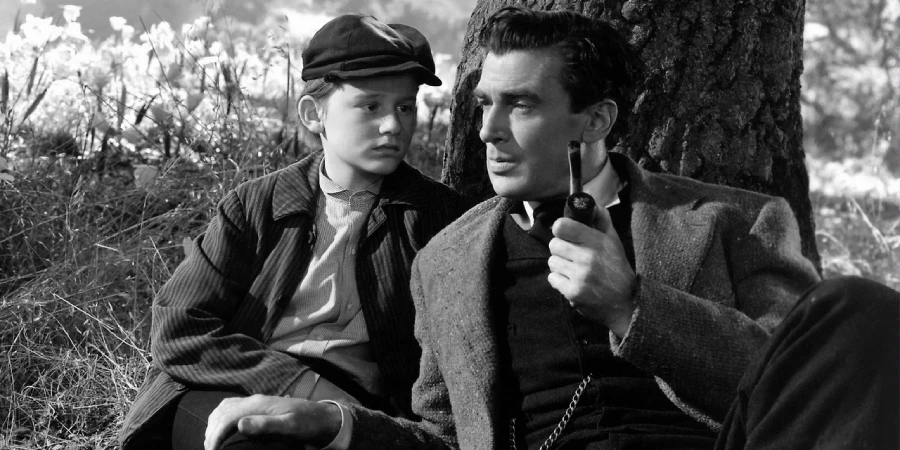

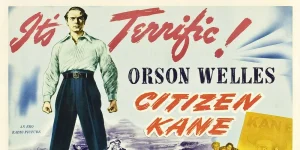
John Ford’s How Green Was My Valley beat Citizen Kane for Best Picture at the 1942 Oscars, and people have been arguing about that ever since. Set in a Welsh mining community during the late nineteenth century, it follows the Morgan family’s slow unraveling as industrialization, labor conflict, and grief chip away at everything they once held dear.
Ford tells this story through the adult memories of Huw Morgan, framing nostalgia itself as the film’s true subject. What you get is not simply a family drama; it is a meditation on loss so quietly devastating it sneaks up on you.
Detailed Summary
Huw Narrates From Memory
An unseen, adult Huw Morgan narrates the entire film in voiceover as he prepares to leave the Welsh valley of his childhood forever. His words carry the weight of someone who knows exactly how the story ends. From the opening moments, Ford signals that this is a film about remembering, not just witnessing.
The Morgan Family in Its Prime
Young Huw (Roddy McDowall) lives with his large, close-knit family in a tidy colliery town. His father, Gwilym Morgan (Donald Crisp), works the coal mine alongside Huw’s older brothers: Ianto, Ivor, Davy, Owen, and Gwilym Jr. Their mother, Beth Morgan (Sara Allgood), runs the household with fierce, loving authority.
In addition, the family enjoys a respected standing in the community. Gwilym Sr. is a foreman, and the Morgans gather every payday to hand wages directly to their mother at the dinner table. It is an image of working-class dignity that Ford lingers on deliberately.
Labor Trouble Fractures the Family
Wages at the mine begin to fall, and the older brothers push their father to support a union. Gwilym Sr. resists, believing in individual hard work over collective action. This ideological split drives a painful wedge between father and sons.
Ianto and several brothers eventually leave home over the dispute. Huw watches his family fragment in real time, and the warm payday ritual disappears. The household shrinks, and a kind of grief settles in even before any tragedy strikes.
Huw’s Near-Fatal Accident
Young Huw falls through ice while trying to defend his mother from taunting miners, and the exposure leaves him unable to walk. He spends months bedridden, his legs seemingly paralyzed. His sister-in-law Bronwen (Maureen O’Hara) and the local preacher, Mr. Gruffydd (Walter Pidgeon), tend to him during his long recovery.
Gruffydd becomes Huw’s intellectual and moral guide during this period. His patience and encouragement help Huw regain the will to fight. Eventually, a determined Huw forces himself to stand and walk again, in one of the film’s most quietly triumphant moments.
Ivor’s Wedding and the Choir
Brother Ivor marries Bronwen in a joyful ceremony that briefly restores the family’s happiness. Ford frames the wedding with warmth and communal singing, leaning into Welsh choral tradition as a symbol of cultural identity. For one fleeting stretch, the valley feels genuinely green again.
Angharad and Mr. Gruffydd
Huw’s sister Angharad (Maureen O’Hara) and Preacher Gruffydd develop a deep, obvious mutual love. However, Gruffydd refuses to pursue her because his modest income cannot support a wife in the manner she deserves. His self-denial is principled but quietly heartbreaking.
Angharad consequently agrees to marry Iestyn Evans (Mervyn Johns), the mine owner’s son, a man she does not love. Gruffydd watches her leave for a wealthier life. The valley’s rigid class structure claims another casualty.
Huw Goes to School
Huw earns a scholarship and attends a school outside the village, where he faces bullying and class snobbery. He fights back, literally, after taking boxing lessons from a former champion. Ford presents this subplot as Huw’s initiation into a harder, less sheltered world.
Ivor’s Death
A mine collapse kills Ivor, leaving Bronwen a widow. His death lands without fanfare, almost abruptly, which makes it more devastating. Ford refuses to let the audience fully brace for it.
Bronwen remains part of the family’s life, and Huw’s devotion to her deepens into something close to reverent love. She becomes, for him, a living symbol of everything good the valley once held. Her grief is quiet, dignified, and persistent.
Angharad’s Unhappy Return
Angharad returns from her wealthy marriage visibly unhappy, and rumors circulate that she and Gruffydd have been seen together. The town gossips savagely. Gruffydd eventually faces a deacons’ tribunal over the alleged impropriety.
He confronts the congregation directly, delivering a blistering sermon that condemns their gossip and small-mindedness. Gruffydd then resigns his post and prepares to leave the valley. His departure signals that the community’s moral center has collapsed.

Movie Ending
Gwilym Morgan goes down into the mine on what will be his last shift. A collapse traps him underground, and Huw insists on joining the rescue team despite everyone’s protests. He descends into the darkness to find his father.
Huw reaches Gwilym, but the old man is dying. Father and son share a final exchange underground, and Gwilym dies in Huw’s arms. Ford shoots these moments with immense restraint; there is no melodramatic score swell, just shadow and quiet.
As they bring Gwilym’s body to the surface, the entire village lines the hillside in silence. Beth Morgan stands waiting. It is a communal mourning that feels both specific to this Welsh town and completely universal.
Meanwhile, Huw’s voiceover returns. Adult Huw tells us he is now leaving the valley for the last time, because there is nothing left to stay for. His brothers have scattered, Gruffydd is gone, his father is dead, and the valley itself has been slowly consumed by industry. Yet, rather than ending in pure despair, Huw insists that the people he loved are not gone; he carries them with him.
The final images show Huw walking away as ghostly visions of his father, his brothers, and the valley’s better days flicker through his memory. Ford makes memory itself the only form of preservation that survives. It is not a happy ending, but it is a deeply human one, because it argues that love outlasts the physical world that housed it.
Audiences most often wonder whether there is any hope left after all this loss. Ford’s answer is careful and honest: the material world of the valley is gone, but Huw’s inner life remains rich with the people who shaped him. That distinction is what gives the ending its emotional power without tipping into false consolation.
Are There Post-Credits Scenes?
How Green Was My Valley contains no post-credits scenes of any kind. Films of this era did not include them as a practice. Once the final frame fades, the story is complete.
Type of Movie
This film sits firmly in the family drama and period drama genres. Its tone blends nostalgia with genuine tragedy, never quite settling into either pure sentimentality or outright bleakness. Ford balances warmth and grief throughout, which is precisely what makes the film so durable.
Some critics also classify it as a social realist work, given its unflinching attention to labor conditions and class inequality. On the other hand, its lyrical, memory-driven narration pushes it toward something more poetic than strictly realist. It occupies a genuinely rare tonal space.
Cast
- Walter Pidgeon – Mr. Gruffydd
- Maureen O’Hara – Angharad Morgan
- Donald Crisp – Gwilym Morgan Sr.
- Anna Lee – Bronwen Morgan
- Roddy McDowall – Young Huw Morgan
- John Loder – Ivor Morgan
- Sara Allgood – Beth Morgan
- Barry Fitzgerald – Cyfartha
- Patric Knowles – Ianto Morgan
- Irving Pichel – Adult Huw Morgan (voice)
- Mervyn Johns – Iestyn Evans
Film Music and Composer
Alfred Newman composed the score, drawing heavily on Welsh folk melodies and choral traditions to root the film in its cultural setting. Newman was one of Hollywood’s most prolific and decorated composers of the classical studio era. His work here feels less like underscoring and more like a living part of the valley itself.
Welsh choral singing features prominently throughout, both diegetically and within the score. For instance, the wedding sequence and the miners singing on their way home from work use choral performance as a direct expression of community identity. Newman’s score won the Academy Award for Best Original Score at the 1942 ceremony.



Filming Locations
Despite being set in Wales, the film was shot entirely in California, specifically on a large outdoor set constructed in the Brent Crags area of the Santa Monica Mountains near Malibu. The production team built an entire Welsh mining village from scratch, including cottages, a chapel, and a working mine shaft exterior. It was an enormous physical undertaking for the time.
Ford and cinematographer Arthur Miller used the California hills and artificial slag heaps to convincingly suggest South Wales. Consequently, the film’s visual landscape feels both real and slightly dreamlike, which suits the memory-based narration perfectly. Miller won the Academy Award for Best Cinematography, Black-and-White for his work on this film.
Awards and Nominations
How Green Was My Valley received ten Academy Award nominations at the 1942 ceremony and won five, including Best Picture, Best Director (John Ford), Best Supporting Actor (Donald Crisp), Best Cinematography, Black-and-White (Arthur Miller), and Best Original Score (Alfred Newman).
Its Best Picture victory over Citizen Kane and The Maltese Falcon remains one of the most debated outcomes in Oscar history. Sara Allgood and Donald Crisp both received acting nominations, reflecting the ensemble’s overall strength. Ford’s win added to his extraordinary run of directorial success at the Academy.
Behind the Scenes Insights
- John Ford originally planned a much longer, multi-part film adaptation but ultimately condensed the story into a single feature to satisfy studio requirements at 20th Century Fox.
- William Wyler was initially attached to direct the film before Ford took over the project.
- Roddy McDowall was a British child evacuee living in the United States during World War II, which gave his performance an authentic undercurrent of displacement and longing.
- Ford reportedly had a close rapport with McDowall on set and took genuine care to protect the young actor from the pressures of production.
- The artificial Welsh village set was one of the largest built in Hollywood up to that point, requiring months of construction before cameras rolled.
- Maureen O’Hara and Ford developed a long professional relationship through this film; she credited him as one of the most demanding but effective directors she ever worked with.
- Ford used deep-focus photography in collaboration with Arthur Miller to give scenes a visual richness that matched the story’s emotional density.
Inspirations and References
The film adapts Richard Llewellyn‘s 1939 novel of the same name, which became a massive bestseller on both sides of the Atlantic. Llewellyn presented the book as autobiographical, though later research suggested his personal connections to Wales were considerably thinner than he implied. Nonetheless, his novel captured something universally recognizable about the loss of a way of life.
Screenwriter Philip Dunne adapted the novel, making significant structural choices to compress its sprawling narrative into a workable screenplay. The film’s framing device, using adult Huw’s voiceover narration, comes directly from the novel’s structure. Dunne preserved the book’s elegiac tone while sharpening its dramatic focus.
Alternate Endings and Deleted Scenes
Ford’s original conception involved a much longer production, potentially told in two parts, covering more of the novel’s later material including Huw’s adult life and further family dispersal. Studio pressure forced a tighter, single-film structure. As a result, substantial portions of the source novel never reached the screen.
No officially documented alternate endings or restored deleted scenes have entered wide public circulation. The film as released represents Fox’s approved final cut. Some of the compressed or omitted storylines from the novel, including more detailed accounts of the brothers’ later lives, simply never existed as filmed material.
Book Adaptations and Differences
Richard Llewellyn’s novel is considerably longer and more sprawling than the film. It follows Huw into adulthood, covering his experiences working in the mine himself and his eventual departure from Wales as a grown man. The film concentrates almost entirely on his childhood and adolescence, giving Ford a tighter emotional arc.
Moreover, the novel develops several secondary characters more fully than the film allows. Some of the brothers receive richer individual storylines in print. Philip Dunne’s screenplay wisely prioritized Gwilym Sr., Angharad, Gruffydd, and Bronwen as the emotional pillars, sacrificing breadth for depth.
In contrast to the film’s relatively contained ending, the novel’s closing is bleaker and more expansive in its account of industrial devastation. Ford softened this somewhat by centering the finale on Huw’s interior life rather than on the valley’s physical ruin. Both approaches are valid; they simply serve different artistic purposes.


Memorable Scenes and Quotes
Key Scenes
- The payday ritual, where the brothers file into the kitchen and place their wages in Beth Morgan’s hands, establishing the family’s unity and working-class dignity in one compact, wordless sequence.
- Huw learning to walk again, forcing himself upright with Gruffydd watching, a scene of personal will overcoming physical despair without any false sentimentality.
- Gruffydd’s sermon condemning the congregation’s gossip, a rare moment of righteous anger in an otherwise restrained film, delivered by Pidgeon with quiet fury.
- The wedding of Ivor and Bronwen, shot with communal warmth and choral singing that makes it the film’s emotional high point before the losses begin accumulating.
- The mine rescue sequence, where Huw descends to find his dying father, shot in near-darkness and almost entirely without music.
- The final hillside mourning, as the entire village lines the slope in silence while Gwilym’s body returns to the surface.
Iconic Quotes
- “Men like my father cannot die. They are with me still, real in memory as they were in flesh, loving and beloved forever.” (Adult Huw, closing narration)
- “I had good intent, but I was too late, or I was not there. Or perhaps I had no goodness.” (Mr. Gruffydd, in self-reproach)
- “How green was my valley then.” (Adult Huw, the film’s final words)
Easter Eggs and Hidden Details
- Ford subtly mirrors the film’s opening and closing narration, using the phrase “How green was my valley” as both a structural bracket and an emotional payoff that recontextualizes everything seen in between.
- The progressive darkening of the valley’s landscape across the film is not accidental; Arthur Miller’s cinematography deliberately drains warmth and light from the exteriors as the family’s happiness erodes.
- Bronwen’s costuming grows progressively plainer and darker after Ivor’s death, a visual shorthand for widowhood and grief that unfolds across multiple scenes without a word of dialogue.
- The choral singing appears in both joyful and mournful contexts throughout the film, functioning almost as a musical barometer for the community’s emotional state at any given moment.
- Ford places Gruffydd physically above the congregation in several pulpit scenes, then shoots him at ground level or below it once his authority begins to crumble, using vertical framing as a status indicator.
Trivia
- How Green Was My Valley is one of four films John Ford directed that won the Academy Award for Best Picture.
- Roddy McDowall was approximately twelve years old during filming and delivered one of the most praised child performances in Hollywood’s classical era.
- The film’s Best Picture win over Citizen Kane is frequently cited in discussions about the Academy’s historical preference for emotionally accessible drama over formal innovation.
- Donald Crisp, who won Best Supporting Actor for his role as Gwilym Morgan, was actually Scottish rather than Welsh, a casting choice Ford defended on the grounds of performance quality.
- Sara Allgood, nominated for Best Supporting Actress, was Irish, continuing the film’s pattern of casting non-Welsh actors in Welsh roles.
- Philip Dunne’s screenplay is widely taught in film schools as an example of how to adapt a lengthy novel without losing its emotional core.
- Ford shot the film in black and white despite Technicolor being available, a deliberate aesthetic choice that reinforced the film’s elegiac, memory-tinged quality.
Why Watch?
Few films earn their emotional weight as honestly as this one does. Ford builds his world slowly and carefully, so that every loss registers with full force. Furthermore, the performances, especially from McDowall, Crisp, and O’Hara, are the kind that remind you what screen acting at its best actually looks like. Simply put, this is filmmaking that respects its audience.
Director’s Other Movies
- Stagecoach (1939)
- The Grapes of Wrath (1940)
- The Quiet Man (1952)
- The Searchers (1956)
- Fort Apache (1948)
- She Wore a Yellow Ribbon (1949)
- My Darling Clementine (1946)
Recommended Films for Fans
- The Grapes of Wrath (1940)
- Citizen Kane (1941)
- Mrs. Miniver (1942)
- Coal Miner’s Daughter (1980)
- The Quiet Man (1952)
- Cavalcade (1933)
- Akenfield (1974)