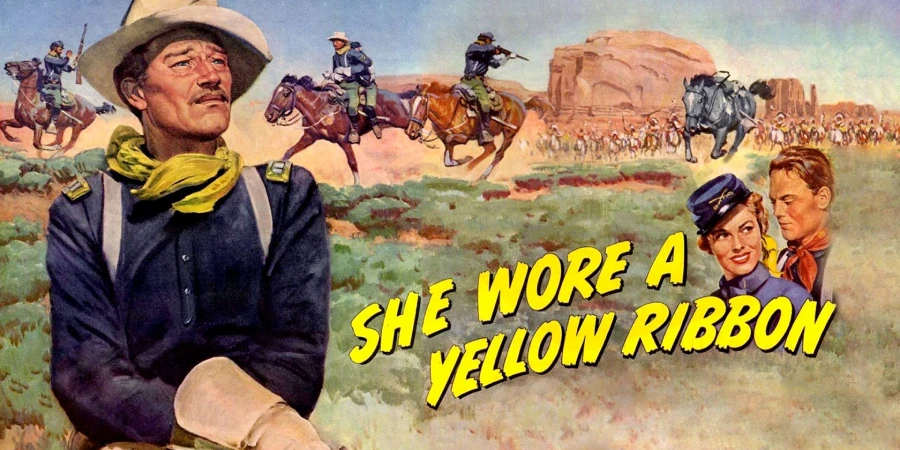

John Ford turned Monument Valley into a cathedral, and She Wore a Yellow Ribbon is his most breathtaking sermon. Captain Nathan Brittles is one of cinema’s great aging heroes, a man counting down his final days of service while a nation teeters on the edge of war. This 1949 Western earns every frame of its Technicolor glory. It also breaks your heart in the quietest, most unexpected ways.
Detailed Summary
The Setting and the Stakes
Ford drops viewers into the American Southwest shortly after Custer’s Last Stand at Little Bighorn in 1876. Native American tribes across the plains are uniting, and the U.S. Cavalry faces a powder keg situation with limited men and dwindling time. Captain Nathan Cutting Brittles, played by John Wayne, has exactly six days left before mandatory retirement.
Ford wastes no time establishing the emotional core. Brittles is beloved, experienced, and utterly irreplaceable, yet the Army’s bureaucracy will push him out regardless. That tension between institutional indifference and personal dignity runs through every scene.
Olivia and Constance Arrive
Two women complicate the mission immediately. Olivia Dandridge and her aunt Abby Allshard must leave the fort for safety, and Brittles receives orders to escort them out of the danger zone. Olivia, young and charming, attracts the competitive attention of two junior officers: Lieutenant Flint Cohill and Lieutenant Ross Pennell.
Their rivalry provides the film’s lighter, more romantic subplot. Ford uses it shrewdly, balancing the weight of impending conflict with genuine warmth and humor. Neither Cohill nor Pennell gets the girl without a fight, and Olivia seems to enjoy every moment of it.
Brittles Visits His Wife’s Grave
In one of the film’s most quietly devastating scenes, Brittles visits the grave of his late wife, Mary, and speaks to her as if she were still present. He updates her on the regiment, on the children he mentions by name, on the world she left behind. Wayne plays this with total sincerity, no performance, no grandstanding.
Ford returns to this grave more than once. Each visit deepens the audience’s understanding of who Brittles really is beneath the uniform. He is a widower holding himself together through duty and routine.
The Patrol Runs Into Trouble
Brittles leads his patrol out of Fort Starke, escorting the women toward safety. However, a massive gathering of Native warriors, including Arapaho, Comanche, and Kiowa fighters, blocks their path. Brittles scouts the situation and recognizes that a direct confrontation would be suicidal.
Meanwhile, Sergeant Quincannon, played with scene-stealing gusto by Victor McLaglen, manages to get himself into various scrapes that add comic relief without undercutting the tension. Ford trusted McLaglen’s Irish bravado completely, and it pays off.
Brittles Attempts Diplomacy
Rather than charge into battle, Brittles rides directly into the Native encampment to meet with Pony That Walks, an old chief he has known for years. Their exchange is one of Ford’s most humanizing portrayals of Native characters in this period of his career. Both men recognize they are old, both understand war is coming, and neither can stop it.
Brittles tries. He genuinely tries. But the younger warriors overrule the chief, and diplomacy collapses. Brittles retreats without violence, but without victory either.
Retirement Day Arrives
Brittles officially retires at sundown. His regiment presents him with a silver watch engraved with their names. He reads the inscription aloud in a voice that barely holds together. For a moment, John Wayne lets Nathan Brittles be genuinely undone by love, and it is extraordinary.
Ford frames this farewell with full ceremony. Flags, formation, the whole tradition of military honor. Then Brittles rides away alone into the dying light, and it feels like the end of an era.
One Last Ride
Brittles cannot let it go. He rides back, catches up with the young officers, and takes command one final time. His plan is audacious: rather than fight the assembled warriors, he and his men stampede the horse herd, scattering the Native mounts across the plains. No horses means no war. At least not yet.
Consequently, a massive battle never happens. Brittles defuses the crisis through ingenuity rather than bloodshed. Ford makes this feel like a triumph without making it feel easy.
Movie Ending
Brittles completes the mission and rides away again, this time fully resigned to civilian life. He heads west alone, a figure shrinking into Monument Valley’s impossible landscape. Ford holds that image long enough for it to ache.
Then a rider catches up with him. Brittles receives a dispatch informing him that the government has appointed him Chief of Scouts for the territory. His military career is not over. In fact, it is starting a new chapter. He turns his horse around.
That reversal matters enormously. Ford refuses to leave his hero abandoned by the institution he served. Brittles gets to stay in the world he knows and loves, on his own terms, serving in a role that suits his wisdom rather than his stamina. It is not a triumphant fanfare ending; it is something quieter and more earned. The film rewards patience with genuine emotional satisfaction rather than spectacle.
Olivia ultimately ends up with Cohill, a resolution the film telegraphs but handles with grace. Pennell accepts defeat without bitterness. Even the romantic subplot closes on a note of maturity rather than melodrama.
Are There Post-Credits Scenes?
She Wore a Yellow Ribbon contains no post-credits scenes. Films of this era did not include them as a convention. Once the final frame fades, the experience is complete.
Type of Movie
This is a Technicolor Western drama with strong elegiac undertones. Ford blends action, romance, and character study into something that feels closer to a poem than a plot. The tone is nostalgic, warm, and occasionally melancholic.
In contrast to more action-driven Westerns, this film prioritizes mood and character over gunfights. It belongs to Ford’s celebrated Cavalry Trilogy, alongside Fort Apache (1948) and Rio Grande (1950).
Cast
- John Wayne – Captain Nathan Cutting Brittles
- Joanne Dru – Olivia Dandridge
- John Agar – Lieutenant Flint Cohill
- Ben Johnson – Sergeant Tyree
- Harry Carey Jr. – Lieutenant Ross Pennell
- Victor McLaglen – Sergeant Quincannon
- Mildred Natwick – Abby Allshard
- George O’Brien – Major Mac Allshard
- Chief John Big Tree – Pony That Walks
Film Music and Composer
Richard Hageman composed the score. Hageman was a classically trained musician who worked extensively with Ford, and his work here leans heavily on traditional American folk songs and cavalry bugle calls. The result feels authentically rooted in the period.
The title song, She Wore a Yellow Ribbon, is a traditional American folk tune that Ford wove into the film’s identity. Its recurring presence reinforces themes of loyalty, longing, and military tradition. Hageman’s orchestrations give it genuine emotional weight rather than reducing it to background noise.

Filming Locations
Ford shot the film primarily in Monument Valley, on the Utah-Arizona border. He returned to this location repeatedly throughout his career because its red rock formations and vast skies created a mythic visual landscape unlike anywhere else on Earth.
Cinematographer Winton Hoch captured several sequences during actual storms, including a legendary thunderstorm scene that produced some of the most striking Technicolor photography ever committed to film. Ford reportedly insisted on shooting through the storm rather than waiting it out. That decision won Hoch the Academy Award for Best Cinematography.
Awards and Nominations
Winton Hoch won the Academy Award for Best Cinematography (Color) at the 1950 ceremony. That single Oscar represents the film’s most prestigious recognition, though the movie’s reputation has only grown in the decades since.
Behind the Scenes Insights
- Ford pushed cinematographer Winton Hoch to keep filming during a genuine electrical storm over Monument Valley. Hoch initially protested, believing the light was too unpredictable. Ford overruled him, and the resulting footage became some of the most celebrated Technicolor photography in Hollywood history.
- John Wayne wore aging makeup to portray the 60-something Brittles. Wayne was in his early forties at the time. The transformation required significant prosthetics and hair work.
- Ford used Navajo Nation members from the Monument Valley area as extras throughout the production. He maintained a long working relationship with the local Navajo community across his Monument Valley films.
- Victor McLaglen and Ford had a famously combative working relationship built on deep mutual respect. Ford often provoked his actors into genuine emotional responses rather than asking for them politely.
- Ben Johnson, who plays Sergeant Tyree, was initially a working rodeo cowboy and stuntman. Ford recognized his natural screen presence and gave him increasingly substantial roles.
Inspirations and References
Ford based the film loosely on two short stories by James Warner Bellah: War Party and Big Hunt, both published in The Saturday Evening Post. Bellah’s fiction drew heavily on his research into post-Civil War cavalry life on the American frontier.
Bellah’s writing was itself influenced by the real history of the U.S. Cavalry’s operations in the Southwest during the 1870s. Ford filtered that material through his own romantic, deeply patriotic vision of American military tradition. The result diverges considerably from Bellah’s darker, more cynical source material.
Alternate Endings and Deleted Scenes
No documented alternate endings or significant deleted scenes from She Wore a Yellow Ribbon have entered the public record. Ford was known for shooting lean and cutting decisively. He rarely generated large amounts of unused footage.
Ford’s editing instincts were sharp enough that his films typically arrived close to their final shape during principal photography. Consequently, major excised sequences from this production remain undocumented.
Book Adaptations and Differences
As noted above, the film adapts elements from James Warner Bellah’s short stories rather than a single novel. Bellah’s original stories are considerably grimmer in tone, with less romanticism and more moral ambiguity surrounding the cavalry’s treatment of Native peoples.
Ford softened Bellah’s edges significantly. He added the love triangle, deepened Brittles as a character, and introduced the grave visits entirely. Furthermore, the optimistic ending, with Brittles receiving his new appointment, reflects Ford’s sensibility rather than Bellah’s.

Memorable Scenes and Quotes
Key Scenes
- Brittles visiting Mary’s grave and speaking to her as though she can hear him, updating her on the regiment’s news.
- The thunderstorm sequence over Monument Valley, cinematographically unlike anything else in 1940s Hollywood.
- Brittles riding into the Native encampment alone to negotiate with Pony That Walks, a moment of extraordinary quiet courage.
- The retirement ceremony, where the regiment presents Brittles with the engraved silver watch and he reads it aloud.
- The horse stampede sequence, where Brittles’ cavalry scatters the warriors’ mounts to prevent full-scale war.
- Brittles riding away into Monument Valley at sunset, then turning back after receiving his new orders.
Iconic Quotes
- “Never apologize, son. It’s a sign of weakness.” (Brittles to a junior officer, a line that became one of Wayne’s most quoted.)
- “You’re not young anymore, Brittles.” (Said to Brittles, underlining the film’s central preoccupation with aging and purpose.)
- The narrated opening: “Gettysburg, Shiloh, Appomattox… wherever the flag was carried by brave men…” (Ford’s patriotic framing device, read over sweeping landscape shots.)
Easter Eggs and Hidden Details
- Ford composed several shots to deliberately mirror Frederic Remington’s famous paintings of the American West. The framing, color palette, and figure placement in key cavalry scenes echo Remington’s iconic artwork directly.
- Chief John Big Tree, who plays Pony That Walks, appeared in silent films decades earlier and was one of the most recognized Native American actors of the studio era. His presence connects the film to a much longer Hollywood history.
- Brittles’ habit of checking his pocket watch throughout the film is a visual metaphor that Ford uses consistently. Every glance at the watch reminds both character and audience that time is running out.
- Ford staged several background extras in ways that create visual echoes of Civil War photography, nodding to the historical context the opening narration establishes.
- The yellow ribbon worn by Olivia early in the film directly references the folk tradition in which women wore yellow ribbons to honor soldiers or signal their romantic attachment to a military man.
Trivia
- John Ford won four Academy Awards for Best Director during his career, more than any other director at that time. She Wore a Yellow Ribbon represents the middle chapter of his Monument Valley cavalry work.
- Winton Hoch initially filed an official complaint with the American Society of Cinematographers about Ford forcing him to shoot in unsafe storm conditions. He withdrew the complaint after the footage turned out to be extraordinary.
- John Wayne considered his performance as Nathan Brittles among his personal favorites. He felt the role allowed him to play genuine emotional vulnerability rather than conventional heroism.
- Ben Johnson went on to win an Academy Award for Best Supporting Actor for The Last Picture Show (1971), decades after his work with Ford helped establish his career.
- Ford used the same stretch of Monument Valley so consistently that specific rock formations became informally associated with his name among locals and film historians alike.
- Harry Carey Jr., who plays Pennell, was the son of silent film star Harry Carey, one of Ford’s earliest and most important collaborators. Ford’s use of the younger Carey was a deliberate tribute.
Why Watch?
Few films capture the ache of a life fully lived with such visual grace. Wayne delivers a career-best performance, Ford shoots Monument Valley like it is sacred ground, and the story earns its emotional payoff honestly. This is essential American cinema.
Director’s Other Movies
- Stagecoach (1939)
- The Grapes of Wrath (1940)
- How Green Was My Valley (1941)
- My Darling Clementine (1946)
- Fort Apache (1948)
- Rio Grande (1950)
- The Quiet Man (1952)
- The Searchers (1956)
- The Man Who Shot Liberty Valance (1962)
Recommended Films for Fans
- Fort Apache (1948)
- Rio Grande (1950)
- The Searchers (1956)
- Stagecoach (1939)
- Red River (1948)
- My Darling Clementine (1946)
- Winchester ’73 (1950)
- The Man Who Shot Liberty Valance (1962)