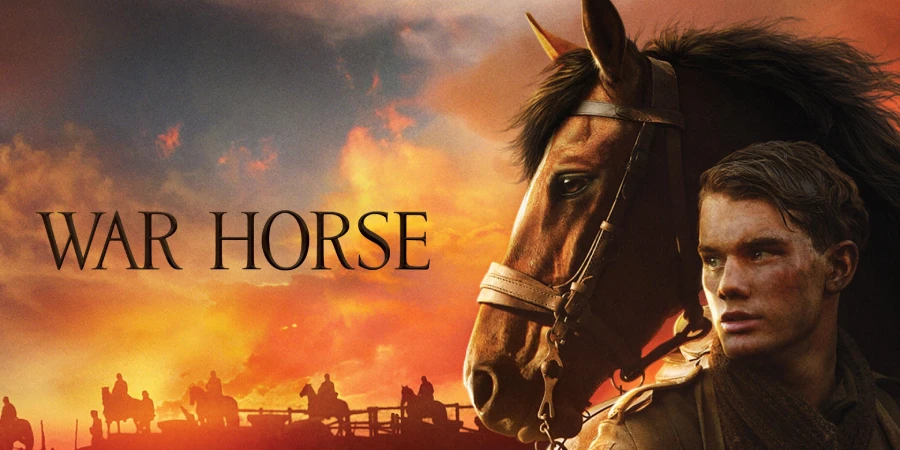

A horse named Joey survives World War One while every human around him struggles to do the same. Steven Spielberg’s War Horse (2011) is an unabashedly emotional epic that refuses to apologize for its sentimentality, and that bold refusal is precisely what makes it work. Based on Michael Morpurgo’s beloved novel and the acclaimed stage production, the film follows one animal across multiple owners, multiple fronts, and multiple heartbreaks.
Detailed Summary
A Boy and His Horse in Devon
Young Albert Narracott watches his father Ted bid on a thoroughbred foal at a Devon auction. Ted, impulsive and proud, outbids a neighbor and spends money the family cannot afford. Albert names the horse Joey and immediately bonds with him, training him despite Joey being wholly unsuited to farm work.
Albert teaches Joey to plow a rocky field, a desperate act to prove the horse’s worth to his skeptical mother Rose. Joey succeeds, and the Narracotts plant their turnip crop. However, a brutal storm destroys the harvest, and the family faces ruin.
Joey Goes to War
Forced by debt, Ted sells Joey to the British Army. Captain Nicholls, a kind officer who sketches Joey’s portrait and sends it to Albert, takes ownership. Albert, too young to enlist, watches Joey ride away and vows to find him.
Nicholls leads a cavalry charge against a German encampment in France. The charge initially succeeds, but German machine guns cut down the cavalry. Nicholls dies in the assault, and Joey falls into German hands.
Joey Under German Command
German soldiers Gunther and his younger brother Michael take charge of Joey and a second horse named Topthorn. Gunther, desperate to keep Michael from the front lines, assigns them both to transport duty. For a time, the horses live relatively well.
Consequently, when officers discover Gunther helped his underage brother avoid combat, both soldiers face punishment. Gunther and Michael attempt to flee on the horses. German soldiers shoot them both, and Joey and Topthorn pass to yet another set of owners.
A Peaceful Interlude in France
A French grandfather named Emilie and his granddaughter Henriette care for the horses secretly on their farm. Henriette, who has a degenerative illness, rides Joey joyfully. This brief chapter offers the film its warmest, most tender breath before the war reasserts itself.
German officers reclaim Joey and Topthorn for heavy labor, pulling artillery through the mud. The horses endure grueling conditions on the Western Front. Topthorn eventually collapses and dies from exhaustion, leaving Joey alone.
No Man’s Land
Panicked and alone, Joey bolts across no man’s land and becomes tangled in barbed wire. Both British and German soldiers watch him struggle. In one of the film’s most memorable moments, a British soldier and a German soldier call a spontaneous truce to free him together.
They flip a coin, and the British soldier wins custody of Joey. Meanwhile, Albert, now old enough to serve, has enlisted and arrived at the Western Front. A mustard gas attack temporarily blinds him.
Movie Ending
Joey reaches the British lines, but nobody knows who he is. Albert, still recovering from temporary blindness, hears a horse nearby. He whistles the distinctive call he taught Joey as a foal back in Devon.
Joey responds instantly. Albert recognizes him by touch, running his hands over Joey’s markings and confirming his identity. The reunion is quiet and earned, carrying the full weight of everything both of them have survived.
However, a veterinary officer declares Joey too injured to save and orders him put down. Albert pleads for the horse’s life. Emilie’s grandfather appears, having followed Joey to the front, and he offers to buy Joey back. Albert cannot afford to outbid him.
In a genuinely moving gesture, the old man gives Joey to Albert as a gift, recognizing the depth of their bond. He tells Albert that Joey belongs with him, acknowledging that Henriette, who loved the horse, would have wanted it that way.
Albert and Joey return home to Devon together. Rose meets them at the door of the farmhouse. Ted, scarred and humbled, watches his son and the horse walk toward a sunset-lit horizon, a shot Spielberg frames with his signature golden-hour romanticism. It is unashamedly sentimental, and it lands with full force precisely because the film has spent two hours earning every tear it asks for.
Are There Post-Credits Scenes?
War Horse contains no post-credits scenes of any kind. Once the credits roll, the film is done. You can safely leave your seat.
Type of Movie
War Horse is a war drama with strong elements of family adventure and coming-of-age storytelling. Its tone sits somewhere between epic historical drama and classical Hollywood melodrama, unafraid of open emotion.
Spielberg deliberately evokes the look and feel of old-fashioned epic cinema, referencing John Ford’s visual style throughout. In contrast to many modern war films, War Horse leans into beauty rather than grit, using the horror of war as a backdrop rather than a subject in itself.
Cast
- Jeremy Irvine – Albert Narracott
- Peter Mullan – Ted Narracott
- Emily Watson – Rose Narracott
- Tom Hiddleston – Captain Nicholls
- Benedict Cumberbatch – Major Jamie Stewart
- Niels Arestrup – Emilie’s Grandfather
- Celine Buckens – Emilie (Henriette in the stage version; the film uses the name Emilie for the grandfather and granddaughter pair)
- David Kross – Gunther
- Leonard Carow – Michael
- Toby Kebbell – Andrew
- Eddie Marsan – Sergeant Fry
Film Music and Composer
John Williams composed the score for War Horse, his longtime collaboration with Spielberg producing yet another deeply affecting result. Williams draws heavily on English folk idioms and pastoral orchestration, grounding the music in the Devon countryside before letting it expand into sweeping wartime themes.
Notable tracks include the main theme, which uses solo violin to evoke both Joey’s spirit and Albert’s longing. Williams builds tension during the cavalry charge with urgent, percussion-driven writing that contrasts sharply with the gentle pastoral opening. The score received an Academy Award nomination, a recognition that felt entirely deserved.
Filming Locations
Principal photography took place across several locations in England. Dartmoor National Park in Devon served as the Narracott family farm, its rugged, rain-soaked landscape perfectly capturing the hardscrabble life of a tenant farming family.
Additional scenes used locations in Salisbury Plain and other parts of rural England to recreate the French and Belgian countryside. Spielberg reportedly preferred real locations over studio back-lots wherever possible, and that commitment shows in the texture of every outdoor frame.
Furthermore, the no-man’s-land sequences required large-scale construction of trenches and wire fields, built specifically for production. Choosing real English countryside rather than sound stages gave the film a physical authenticity that supports its emotional ambition.
Awards and Nominations
War Horse received six Academy Award nominations, including Best Picture. It also earned nominations from BAFTA, the Golden Globes, and the American Society of Cinematographers, with Janusz Kaminski’s cinematography drawing particular praise.
Notably, the film did not win any of its Oscar nominations, a result that surprised some critics given the scope and craft on display. John Williams’ score nomination added to his remarkable career total of Academy Award nominations.
Behind the Scenes Insights
- Fourteen different horses shared the role of Joey across the production, each trained for specific types of action or temperament required by individual scenes.
- Spielberg cited John Ford’s How Green Was My Valley and classic westerns as direct visual references when planning the film’s look with cinematographer Janusz Kaminski.
- Jeremy Irvine, in his feature film debut, worked extensively with the horses before shooting began to build genuine on-screen chemistry with the animals.
- The production worked closely with the American Humane Association to monitor all animal activity on set throughout filming.
- Spielberg has described War Horse as one of the most technically demanding films of his career, specifically citing the large-scale cavalry charge sequence.
- Tom Hiddleston and Benedict Cumberbatch both had relatively brief screen time despite their prominent billing, a reflection of how the horse-centered structure works against traditional character arcs.
Inspirations and References
War Horse began as a 1982 children’s novel by Michael Morpurgo, who drew inspiration from elderly Devon veterans he met in the 1970s. Several of those men described their wartime relationships with horses in vivid detail, planting the seed for his story.
Before Spielberg’s film, playwright Nick Stafford adapted Morpurgo’s novel for the stage, and the National Theatre production opened in London in 2007. That stage version, famous for its life-size horse puppets, became a global phenomenon and directly accelerated Hollywood interest in the property.
Spielberg’s visual references extend beyond the source material. In addition to Ford’s westerns, the film echoes the sweeping humanism of David Lean’s epic productions, particularly in how it frames individual lives against enormous historical forces.
Alternate Endings and Deleted Scenes
No officially confirmed alternate ending or major deleted scene package has been released for War Horse. Spielberg has not publicly discussed significant footage cut from the final edit that would have changed the story’s outcome.
Some pacing adjustments were reportedly made during editing, tightening the episodic middle section of the film. However, specific details about cut sequences have not been officially confirmed, so no particular scene can be cited with confidence.
Book Adaptations and Differences
Morpurgo’s novel is narrated entirely from Joey’s point of view, a first-person animal perspective that gives the book a distinctive intimacy. Spielberg’s film shifts the perspective to a more conventional third-person cinematic approach, allowing the human characters more fully realized emotional arcs.
In the novel, Albert’s role is less prominent during the war’s middle section, with Joey’s various owners receiving roughly equal narrative weight. The film expands Albert’s presence and intercuts his story more deliberately with Joey’s journey, strengthening the central reunion payoff.
The granddaughter in the novel is named Emilie, a detail the film preserves for her character. Some of the German soldier characterization is also deepened in the film compared to the relatively swift treatment in the book.
Memorable Scenes and Quotes
Key Scenes
- Albert teaching Joey to plow the rocky field while the whole village watches, a scene of pure suspense built entirely around a horse and a boy.
- The British cavalry charge against the German encampment, filmed with breathtaking scale and ending in devastating machine-gun fire.
- Gunther and Michael’s desperate nighttime escape on horseback, and the quietly brutal aftermath in the forest.
- Emilie riding Joey freely across the French countryside, the film’s most joyful and fleeting moment of peace.
- Joey tangled in barbed wire in no man’s land, with both sides watching and one British and one German soldier walking out together to free him.
- Albert whistling for Joey among the chaos of the British lines, and Joey answering.
- Emilie’s grandfather surrendering Joey to Albert at the end, a moment of profound generosity between two strangers united by grief and love.
Iconic Quotes
- “No one who sees you, Joey, will think anything but good thoughts.” (Captain Nicholls, writing to Albert)
- “He’s not just a horse. He’s my best friend.” (Albert, pleading for Joey’s life)
- “I promise you, if it is at all possible, I will bring him back to you.” (Captain Nicholls to Albert)
Easter Eggs and Hidden Details
- Spielberg frames several shots of Joey against golden-hour light in direct homage to John Ford’s compositional style, particularly recalling She Wore a Yellow Ribbon.
- The sketch Captain Nicholls draws of Joey mirrors the actual illustrations from early editions of Morpurgo’s novel, a quiet nod to the source material.
- During the no-man’s-land truce sequence, the British and German soldiers briefly communicate using broken French, reflecting the historical reality that French served as a common second language for both sides in some sectors.
- Albert’s distinctive whistle call to Joey echoes the same melodic interval used in John Williams’ main theme, linking the emotional memory of the tune to the film’s musical identity.
- Kaminski and Spielberg use a noticeably warm, almost amber color grade for all Devon scenes, which shifts to cooler, desaturated tones on the Western Front, using color temperature as a psychological marker throughout.
Trivia
- War Horse was released on Christmas Day 2011 in the United States, a slot Spielberg has used for several of his prestige productions.
- Jeremy Irvine beat out a large number of young actors for the role of Albert; the film marked his feature film debut.
- The stage production’s iconic life-size horse puppets, created by the Handspring Puppet Company of South Africa, influenced Spielberg’s thinking about how to make a horse emotionally expressive on screen.
- Janusz Kaminski shot certain sequences using older lens technology to achieve a softer, more painterly image reminiscent of classic Hollywood cinematography.
- The film runs approximately 146 minutes, making it one of Spielberg’s longer productions.
- Michael Morpurgo has spoken positively about the film adaptation in interviews, expressing satisfaction with how his characters were treated.
Why Watch?
War Horse offers a genuinely rare thing: a big-budget Hollywood epic that trusts pure emotion over spectacle. Spielberg’s craftsmanship is on full display, from Kaminski’s stunning cinematography to John Williams’ aching score. Few films dare to be this earnest, and fewer still pull it off with such confidence and skill.
Director’s Other Movies
- Duel (1971)
- Jaws (1975)
- Close Encounters of the Third Kind (1977)
- Raiders of the Lost Ark (1981)
- E.T. the Extra-Terrestrial (1982)
- The Color Purple (1985)
- Empire of the Sun (1987)
- Schindler’s List (1993)
- Amistad (1997)
- Saving Private Ryan (1998)
- A.I. Artificial Intelligence (2001)
- Catch Me If You Can (2002)
- Munich (2005)
- Lincoln (2012)
- Bridge of Spies (2015)
- The Post (2017)
- Ready Player One (2018)
- West Side Story (2021)
- The Fabelmans (2022)
Recommended Films for Fans
- Saving Private Ryan (1998)
- Gallipoli (1981)
- All Quiet on the Western Front (1930)
- Paths of Glory (1957)
- My Friend Flicka (1943)
- Black Beauty (1994)
- Seabiscuit (2003)
- Empire of the Sun (1987)
- 1917 (2019)
- Sergeant York (1941)