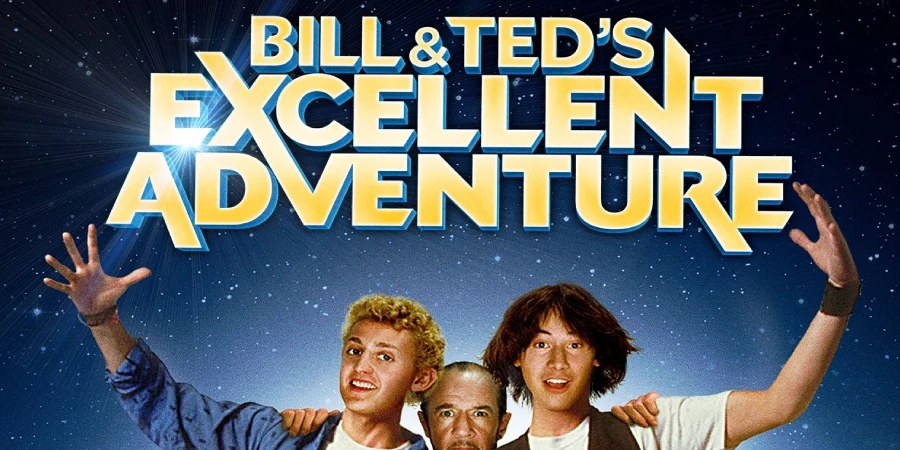

Two burnouts from San Dimas, California nearly fail history class and accidentally rewrite it by kidnapping Napoleon Bonaparte, Billy the Kid, and Sigmund Freud. Bill and Ted’s Excellent Adventure sounds like a bad pitch, yet it works with a sincerity that catches you completely off guard.
Keanu Reeves plays Ted with such committed, slack-jawed earnestness that every dumb line lands like a punchline written by someone much smarter. This is a genuinely funny, warmhearted comedy built on the radical premise that being kind and loving music might actually save the world.
Detailed Summary
San Dimas High School and the Stakes
Bill S. Preston, Esquire and Ted “Theodore” Logan are best friends, aspiring rock stars, and catastrophically bad students at San Dimas High School in 1988. Their band, Wyld Stallyns, has two members, zero musical skill, and infinite enthusiasm. Their history teacher, Mr. Ryan, gives them a final ultimatum: ace their oral history report or fail the class entirely.
Failing carries a real consequence for Ted. His father, Captain Logan, plans to ship him off to Alaskan military school if he flunks. That would end Wyld Stallyns and split the duo apart forever.
Rufus and the Phone Booth
From the far future, a man named Rufus arrives in San Dimas via a time-traveling phone booth. His mission, as we gradually learn, involves ensuring Bill and Ted stay together and eventually create music that shapes a utopian future civilization. He gives them almost no explanation. He just hands them the booth and lets them figure it out.
This is one of the film’s smartest structural choices. Rufus, played with dry warmth by George Carlin, says little and does less. His restraint makes the boys’ cluelessness funnier and keeps the time-travel mechanics loose enough that the film never has to fully justify them.
Napoleon Gets Left Behind
Bill and Ted’s first stop is Vienna in 1805, where they accidentally scoop up Napoleon Bonaparte. Napoleon ends up stuck in 1988 San Dimas while the boys continue their historical field trip, eventually spending the day with Ted’s younger brother Deacon. Napoleon eats ice cream, terrorizes a bowling alley, and attempts a waterslide with disastrous results at Waterloo (a water park, not the battle).
This subplot runs parallel to the main time-hopping adventure and functions as a comic pressure valve. Every cut back to Napoleon is a guaranteed laugh, partly because the film commits fully to playing his ego completely straight.
Collecting Historical Figures
Bill and Ted zip through history, picking up figures for their presentation. They grab Billy the Kid in 1879 New Mexico, then Sigmund Freud in Vienna, then Joan of Arc, Genghis Khan, Abraham Lincoln, and Beethoven, along with two medieval princesses named Elizabeth and Joanna, whom the boys promptly develop crushes on.
Each historical figure gets a distinct comedic personality. Genghis Khan absolutely demolishes a sporting goods store with a baseball bat. Beethoven discovers a music store and goes berserk at the keyboards. Joan of Arc hijacks an aerobics class. These sequences feel like very short sketches, and most of them land because the film respects its own absurd logic.
The Jail Cell and the Escape
Bill and Ted get arrested at one point, and the real genius of the film surfaces here. They realize they can use the time machine to plant objects in their past that will help them escape in the present. Ted says something like “put a trash can here yesterday,” and sure enough, it appears. This is a neat, low-key use of time-travel paradox played for laughs rather than drama.
It also shows a brief flash of wit in a screenplay that sometimes gets dismissed as pure fluff. The mechanics are silly but internally consistent enough to feel satisfying.
Movie Ending
Bill and Ted manage to corral all their historical guests and present their oral history report to the entire school. Each figure essentially demonstrates their era firsthand. Lincoln delivers the “be excellent to each other” address. Genghis Khan, Billy the Kid, Joan of Arc, Freud, and Beethoven all get their moment on stage, and the whole chaotic assembly works as both comedy and a surprisingly sweet payoff.
Bill and Ted pass. Ted avoids military school. The band lives on. Rufus watches from the back of the auditorium with a quiet smile, confirming that history has stayed on the right track.
The final moments pull back to show the future civilization that Wyld Stallyns will one day inspire, full of people quoting “be excellent to each other” and “party on, dudes.” It is an earnest, unironic conclusion, and the film earns it because it never once winked at its own silliness. George Carlin’s closing narration seals the warmth without overselling it.
Are There Post-Credits Scenes?
Bill and Ted’s Excellent Adventure has no post-credits scene. What you see during the ending is what you get. Given that 1989 was not yet deep into the post-credits-scene era, this is no surprise.
Type of Movie
This is a comedy science fiction adventure aimed squarely at teenagers but written with enough genuine warmth to play for adults who are willing to meet it halfway. The tone is silly, optimistic, and relentlessly good-natured. There is no real villain, no cynicism, and no mean-spiritedness anywhere in the runtime.
Think of it as a Saturday morning cartoon that somehow got a theatrical budget and two genuinely charming leads.
Cast
- Keanu Reeves – Ted “Theodore” Logan
- Alex Winter – Bill S. Preston, Esquire
- George Carlin – Rufus
- Terry Camilleri – Napoleon Bonaparte
- Dan Shor – Billy the Kid
- Tony Steedman – Socrates
- Rod Loomis – Sigmund Freud
- Al Leong – Genghis Khan
- Jane Wiedlin – Joan of Arc
- Robert V. Barron – Abraham Lincoln
- Clifford David – Ludwig van Beethoven
- Amy Stock-Poynton – Missy
- Bernie Casey – Mr. Ryan
- Hal Landon Jr. – Captain Logan
Film Music and Composer
David Newman composed the orchestral score, keeping it light and playful throughout. Newman came from a musical family (his father Alfred Newman was a legendary Hollywood composer) and had a solid track record with comedies by the late 1980s.
The film also leans heavily on period rock and pop songs to color each historical setting. Beethoven’s keyboard rampage in the music store functions as both a music cue and a comedic set piece, making diegetic and non-diegetic sound blur in a way that suits the film’s anarchic energy.

Filming Locations
Principal photography took place primarily in and around Scottsdale, Arizona, standing in for San Dimas, California. The wide desert streets and sunny suburban sprawl actually suit the boys’ world better than Southern California might have. There is something appropriately featureless about the environment that makes their big dreams feel both more ridiculous and more poignant.
Select sequences used actual California locations. The San Dimas setting is real (it is a city in Los Angeles County), but the film’s physical sense of place is largely Arizona-built.
Awards and Nominations
Bill and Ted’s Excellent Adventure was not a major awards circuit contender. It received recognition from youth-oriented outlets and became a box office success, but major nominations from bodies like the Academy Awards or BAFTA were never part of its story.
Behind the Scenes Insights
- Writers Chris Matheson and Ed Solomon originally conceived Bill and Ted as characters for improvisational comedy sketches before developing them into a screenplay.
- Keanu Reeves was reportedly hesitant about the role because he worried about being typecast after playing a similar slacker type in other projects, but he ultimately committed fully.
- George Carlin initially had reservations about appearing in a teen comedy, but the script’s genuine optimism won him over.
- Director Stephen Herek pushed to keep the historical figures’ comedy grounded in character logic rather than pure slapstick, which is why each figure’s joke connects to something real about their personality or era.
- The phone booth design was chosen partly as a nod to Doctor Who‘s TARDIS, though the production avoided anything too directly referential.
- Filming in Arizona during summer meant dealing with intense heat, which reportedly made some of the location shoots genuinely grueling for the cast.
Inspirations and References
The most direct antecedent is Doctor Who, particularly the concept of a time-traveling box piloted by someone who barely understands it. The writers have acknowledged awareness of the show, even if the film takes the concept in a completely different comedic direction.
A lighter influence is the Twilight Zone tradition of ordinary people suddenly dropped into extraordinary circumstances and forced to improvise. Bill and Ted are relentlessly ordinary, and that is the entire joke.
The film also taps into the 1980s California teen movie tradition established by films like Fast Times at Ridgemont High, using the slacker archetype but stripping away any cynicism or darkness.
Alternate Endings and Deleted Scenes
No widely documented alternate ending exists for the film. Some scenes featuring additional historical figure antics were trimmed during editing to keep the pacing from dragging, but specific details about what was cut have not been thoroughly documented in the public record.
The theatrical cut runs lean and efficient, suggesting the editing process involved significant pruning of individual historical figure segments to keep each one punchy rather than exhausting.
Book Adaptations and Differences
Bill and Ted’s Excellent Adventure is not based on a book. It originated as an original screenplay by Chris Matheson and Ed Solomon. A novelization was published alongside the film’s release, as was common practice in the 1980s, but the film was the source, not the adaptation.

Memorable Scenes and Quotes
Key Scenes
- Napoleon at Waterloo (the water park): Napoleon shoves children aside to get down the waterslide, eats multiple bowls of ice cream, and gets beaten up after cheating at bowling. It is the funniest sequence in the film and completely self-contained.
- Beethoven in the music store: Beethoven sits down at a row of electronic keyboards and starts playing, moving faster and faster as he discovers synthesizers and drum machines. The crew lets the sequence breathe just long enough to feel genuinely delightful.
- The jail cell escape: Bill and Ted use future knowledge of past actions to plant objects, a garbage can, a key, rope, to engineer their own escape. It is a small, clever sequence that rewards anyone paying close attention to the film’s internal logic.
- The history report presentation: All the historical figures get their moment, Genghis Khan rides through the school, Lincoln delivers his speech, and Joan of Arc leads the crowd. It is chaotic and warm and earns every second of its runtime.
- Rufus playing guitar at the end: George Carlin shreds on guitar in the closing moments, confirming that the future Wyld Stallyns inspired is genuinely good. It is a small grace note that lands harder than it should.
Iconic Quotes
- “Be excellent to each other.”
- “Party on, dudes.”
- “Strange things are afoot at the Circle K.”
- “How’s it going, royal ugly dudes?”
- “Bill, I think we’re in medieval England.”
- “Gentlemen, we’re history.”
Easter Eggs and Hidden Details
- The phone booth is a nod to British science fiction tradition, and eagle-eyed viewers will notice it is slightly larger on the inside than it appears from the outside, a very deliberate wink.
- Genghis Khan’s sporting goods store rampage features a brief moment where he holds up a Twinkie and sniffs it with genuine curiosity before discarding it.
- The name “Wyld Stallyns” is spelled with a deliberately incorrect “y” in “Wyld,” a detail consistent across all in-film signage and merchandise.
- During the history class scenes, the blackboard in the background contains actual (if simplified) historical notes that are period-accurate to the lessons being discussed.
- Rufus never directly explains the future to Bill and Ted; every piece of exposition he delivers is technically something they could have figured out themselves, keeping the film’s internal logic clean.
Trivia
- Jane Wiedlin, who plays Joan of Arc, was a member of the pop group The Go-Go’s, making her casting a subtle bit of rock-and-roll in-joke.
- Alex Winter and Keanu Reeves rehearsed their friendship chemistry extensively before shooting, which is why their rapport feels genuinely lived-in rather than performed.
- The film was released in February 1989 with relatively modest expectations and outperformed them significantly at the box office.
- Chris Matheson and Ed Solomon wrote the script in a very short period, basing the characters partly on people they knew in real life.
- George Carlin described the film in interviews as one of the more purely enjoyable shoots of his later career.
- A sequel, Bill and Ted’s Bogus Journey, followed in 1991, and a third film, Bill and Ted Face the Music, arrived in 2020.
- The “be excellent to each other” philosophy became a genuine cultural shorthand in online communities decades after the film’s release.
Why Watch?
Keanu Reeves plays Ted with a kind of unguarded physical commitment, mouth slightly open, eyes wide, never once checking whether the bit is working, that makes every scene feel alive. This is a film that genuinely believes niceness is cool, and it argues that case through pure comic sincerity rather than sentiment. Few comedies from this era hold up this cleanly without leaning on nostalgia to do the heavy lifting.
Director’s Other Movies
- Critters (1986)
- The Mighty Ducks (1992)
- 101 Dalmatians (1996)
- Rock Star (2001)