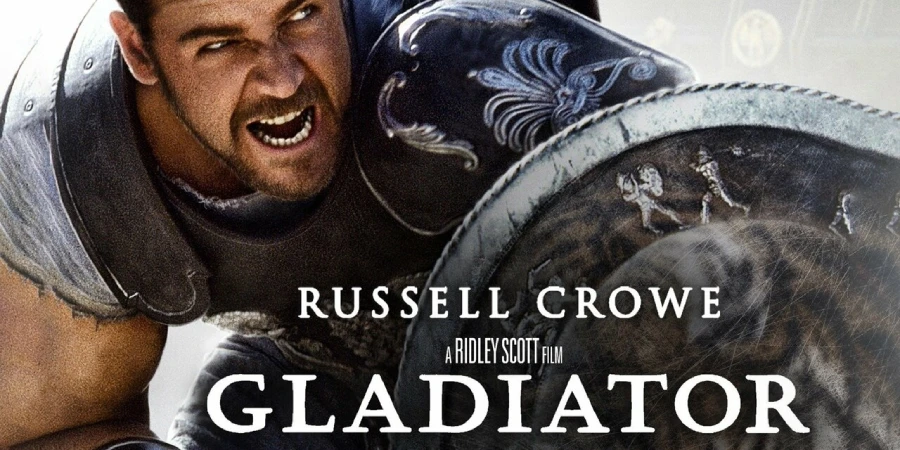

Russell Crowe’s Maximus does not beg for sympathy. He earns it with dirt under his fingernails, blood on his armor, and a line reading so flat and devastating that the Colosseum crowd goes completely silent: “Are you not entertained?” Ridley Scott’s 2000 epic plays a long game, opening in the mud and chaos of a Germanic battlefield and ending in the sand and politics of Rome’s most famous arena. Every step between those two points is a study in how revenge, when it finally arrives, feels less like triumph and more like release.
Detailed Summary
The Opening Battle in Germania
General Maximus Decimus Meridius leads Roman legions against Germanic tribes in 180 AD. Scott opens with a slow-motion sequence of wheat fields, sun-filtered and dreamy, before cutting to one of cinema’s most chaotic battle scenes. Fire catapults light the treeline. Dogs sprint into the smoke. Crowe barks orders with the quiet authority of a man who has done this a hundred times.
Emperor Marcus Aurelius, played by Richard Harris in a performance that makes the most of limited screen time, watches the victory from a distance. He is old, frail, and clearly dying. This battle is his last.
Marcus Aurelius Chooses Maximus
In private, Marcus Aurelius tells Maximus he wants him to become Protector of Rome, not his son Commodus. He asks Maximus to restore the republic and return power to the Senate. Maximus hesitates, then accepts the duty.
Commodus, played by Joaquin Phoenix, arrives and his father breaks the news. Phoenix does something remarkable here: he cries, kisses his father, and then strangles him in the same embrace. No weapon, no theatrical rage. Just a son’s grief curdling into murder in the space of ten seconds.
The Betrayal and Attempted Execution
Commodus immediately consolidates power and orders Maximus arrested. Praetorian guards escort Maximus into the woods for execution. Maximus fights his way free, killing his captors, and rides hard for Spain to reach his family.
He arrives too late. His wife and son have been crucified and burned. Scott does not linger gratuitously on the bodies; he shows just enough, a charred hand, scorched earth, and Crowe collapsing face-first into the ash. Maximus passes out from his wounds.
Slavery and the Gladiatorial Circuit
Slave traders find Maximus and sell him to Proximo, a former gladiator now running a gladiatorial school in North Africa. Oliver Reed plays Proximo with gruff pragmatism and a surprisingly layered sadness. Proximo won his freedom from Marcus Aurelius and keeps that wooden figure of the emperor as a quiet act of reverence.
Maximus fights in the provinces, first reluctantly and then with brutal efficiency. His military instincts turn the sand pit into a coordinated battlefield. He organizes his fellow slaves, shields them, and wins the crowd. Proximo notices that Maximus could be worth more in Rome’s Colosseum.
Rome and Commodus’s Political Troubles
Back in Rome, Commodus is failing as emperor. He is obsessed with popular approval and equally obsessed with his sister, Lucilla, played by Connie Nielsen. Lucilla clearly finds her brother’s affection disturbing and manipulative, and Nielsen plays her discomfort with impressive restraint throughout.
Commodus decides to reopen the Colosseum for a 150-day festival of games, a political spectacle designed to win back public loyalty. Senator Gracchus, played by Derek Jacobi, sees through it but can do little. Lucilla sees through it too. She is already in quiet contact with the Senate’s resistance.
Maximus Revealed in the Colosseum
Proximo brings his fighters to Rome. Maximus enters the Colosseum disguised, fighting in the re-enactment of the Battle of Carthage. He and his small group of slaves survive against a much larger, better-equipped force by acting like a Roman military unit rather than individual fighters. The crowd loves it.
Commodus descends into the arena to meet the survivors. He asks Maximus to reveal his name. Maximus turns slowly, removes his helmet, and delivers the famous declaration: “My name is Maximus Decimus Meridius, commander of the Armies of the North, General of the Felix Legions, loyal servant to the true emperor, Marcus Aurelius. Father to a murdered son, husband to a murdered wife. And I will have my vengeance, in this life or the next.”
Commodus cannot kill him there. The crowd is watching. This is the film’s fulcrum, the moment every subsequent scene orbits around.
Alliances in the Shadows
Lucilla contacts Maximus privately. She connects him with Senator Gracchus and a network plotting to free him before a scheduled fight, smuggle him out of Rome, and let him rejoin his legions for a march on the city. Maximus agrees, reluctantly, because he cares more about killing Commodus personally than about political liberation.
Proximo, initially resistant, agrees to help when Maximus appeals to his old loyalty to Marcus Aurelius. Reed’s final scenes carry real melancholy; you sense Proximo knows this plan ends badly for him.
The Plot Collapses
Commodus discovers the conspiracy through Cicero, Maximus’s former aide, who Commodus uses as bait. He has Cicero killed and arrests Gracchus. Proximo and his guards are slaughtered trying to help Maximus escape. Reed’s Proximo dies off-screen, which given the actor’s real-life death during production feels like an appropriate, unhurried farewell.
Maximus is now trapped. Lucilla is under Commodus’s control. Every escape route has closed.
Commodus Stabs Maximus Before the Final Fight
Facing no other option, Commodus challenges Maximus to a public duel in the Colosseum. Then, in private, he has Maximus brought to him and stabs him in the side while Maximus is still shackled. He sends him into the arena with a punctured lung, armor clasped over the wound to hide it from the crowd.
This moment defines Commodus as a character more cleanly than anything else in the film. He needs to win, desperately, but he cannot win fairly. Phoenix plays it with a trembling, childlike neediness that makes Commodus more pitiable than purely evil.


Movie Ending
Maximus fights Commodus in the arena while bleeding out. His wound slows him, and Commodus presses the advantage. Then Commodus’s concealed blade breaks, and he calls for a sword from his Praetorian guards. Every guard sheathes his weapon. No one moves. Quintus, Maximus’s old second-in-command, gives a small shake of his head. The arena enforces its own rules: no weapons for the emperor.
Maximus kills Commodus with his bare hands, more or less, driving the broken blade into Commodus’s neck before dying himself from the stab wound. It is not a clean victory. Crowe collapses incrementally, each step more labored, until he falls to the sand.
As he dies, Maximus has a vision of walking through a wooden door into golden fields, the same wheat-field imagery from the film’s opening. His wife and son wait on the other side. Scott holds on Maximus’s hand trailing through the wheat, echoing the film’s very first image. It is a quiet, earned payoff after two hours of violence and loss.
Lucilla oversees the moment. She asks that Maximus be given the honor of a soldier, ordering his body treated with respect. Senator Gracchus is freed. Lucilla tells Commodus’s young son, her nephew, to go home. Power will shift, slowly, back toward the Senate.
What makes this ending work is that Scott refuses to frame it as a win. Rome does not instantly become a republic. Maximus does not survive to see justice. His revenge costs him the very last thing he had: his life. The film earns the emotional release because it never pretends the cost was small.
Are There Post-Credits Scenes?
Gladiator has no post-credits scene. After Maximus falls, the film closes with a brief epilogue and then credits roll over Hans Zimmer’s score. Nothing follows. You can leave when the lights come up.
Type of Movie
Gladiator is a historical epic action drama. Its tone shifts between battlefield war film, prison-escape thriller, political intrigue, and revenge tragedy, often within the same act. Scott keeps the pacing punchy for an epic, rarely letting it sink into the stateliness that kills films like this.
At heart, this is a grief film. Everything Maximus does after his family’s murder flows from loss, not ambition. That emotional core gives the action sequences actual weight.
Cast
- Russell Crowe – Maximus Decimus Meridius
- Joaquin Phoenix – Emperor Commodus
- Connie Nielsen – Lucilla
- Oliver Reed – Proximo
- Richard Harris – Emperor Marcus Aurelius
- Derek Jacobi – Senator Gracchus
- Djimon Hounsou – Juba
- David Hemmings – Cassius
- Tommy Flanagan – Cicero
- Ralf Moeller – Hagen
Film Music and Composer
Hans Zimmer and Lisa Gerrard co-composed the score. Zimmer handles the propulsive orchestral framework while Gerrard’s vocals, wordless and ancient-sounding, carry the film’s emotional and spiritual weight. Her voice is the sound of Maximus’s grief made audible.
The track “Now We Are Free”, which plays over the ending and credits, became one of the most recognizable pieces of film music from that decade. It uses a constructed language, not Latin, that Gerrard invented to evoke something pre-verbal and universal.
Zimmer’s battle cues, particularly those driving the Germania sequence, use a percussive urgency that deliberately avoids the grandeur of old Hollywood scores. It feels dirty and immediate, which suits Scott’s visceral approach to combat.

Filming Locations
Principal photography took place in Malta, Morocco, and England. The Colosseum set was built partially on Malta’s Fort Ricasoli and completed with extensive CGI to create the full 50,000-seat structure.
Morocco provided the North African sequences, including Proximo’s training grounds and arena. The arid landscape reinforces Maximus’s exile; it is a world away from the green hills of Spain he mourns throughout the film.
The Germanic forest battle was shot in Bourne Wood in Surrey, England. The dense, dark canopy creates a claustrophobic contrast with Rome’s open, sun-bleached spaces, and Scott leans into that visual opposition deliberately.
Awards and Nominations
Gladiator won five Academy Awards at the 73rd ceremony, including Best Picture and Best Actor for Russell Crowe. It received twelve nominations in total.
Joaquin Phoenix received a nomination for Best Supporting Actor, and Hans Zimmer and Lisa Gerrard received a nomination for their score. The film also won BAFTA Awards and Golden Globe Awards, cementing its commercial success with critical recognition.
Behind the Scenes Insights
- Oliver Reed died of a heart attack in Malta during production, before completing all his scenes. The production used a combination of previously shot footage and CGI face replacement on a body double to complete Proximo’s arc.
- Russell Crowe famously clashed with the production over the script, famously refusing to deliver lines he felt were weak and rewriting dialogue on set. His relationship with screenwriters was reportedly tense throughout.
- The script went through numerous rewrites. David Franzoni wrote the original draft, with John Logan and William Nicholson doing significant additional work. Crowe complained that pages arrived the morning of shooting with no prior notice.
- Ridley Scott built his visual concept for the film partly around the painting Pollice Verso by Jean-Leon Gerome, which depicts a gladiatorial scene with the crowd’s thumbs-down gesture. He reportedly showed it to studio executives as his pitch.
- Djimon Hounsou’s character Juba was conceived as Maximus’s moral counterpart: a man also separated from his family, also enslaved, but who lacks the political destiny that drives Maximus forward.
- Scott shot the Germania battle in conditions of real mud, rain, and dense smoke. Many stuntmen and extras found the environment genuinely disorienting, which Scott encouraged.
Inspirations and References
The film draws on the historical record of Emperor Commodus, who genuinely fought in the Colosseum and was obsessed with gladiatorial spectacle. He considered himself a reincarnation of Hercules. The film compresses and fictionalizes his reign but preserves his narcissism and political instability.
Marcus Aurelius was a real Stoic philosopher-emperor whose Meditations survive to this day. His desire to restore the republic, as depicted in the film, is largely fictional; the real Marcus Aurelius supported dynastic succession and chose Commodus as his heir.
Stanley Kubrick’s Spartacus (1960) and Anthony Mann’s The Fall of the Roman Empire (1964) were clear reference points for the genre. Scott wanted to revive the Roman epic after decades of dormancy and prove the format could work for modern audiences without camp.
The screenplay also drew loose inspiration from the 1958 novel Those About to Die by Daniel P. Mannix, a non-fiction account of gladiatorial combat and Roman spectacle.
Alternate Endings and Deleted Scenes
An extended cut includes additional scenes of Maximus’s life in Spain before his family’s murder, giving those characters slightly more presence. In the theatrical cut, his wife and son exist mostly as memory and motivation. More screen time with them arguably makes the loss land harder, but Scott’s choice to keep them almost abstract works in its own way.
Several scenes of political dialogue between Lucilla and Gracchus were trimmed in post-production. Their conspiracy plot moves very quickly in the theatrical cut, and those deleted scenes would have slowed the second act considerably. Scott made the right call trimming them.
No radically different ending exists in any known version. The final duel and Maximus’s death were consistent across drafts.
Book Adaptations and Differences
Gladiator is not based on a specific novel or source text. It is an original screenplay by David Franzoni, with contributions from John Logan and William Nicholson. A novelization of the screenplay was published to accompany the film’s release, but the film came first.
Memorable Scenes and Quotes
Key Scenes
- The Germania battle sequence: fire catapults launch in slow motion, dogs vanish into smoke, and Maximus rides through the chaos ordering “At my signal, unleash hell.” The editing cuts between serene close-ups of Crowe’s face and absolute carnage.
- Commodus strangling Marcus Aurelius: Phoenix weeps, embraces his father, and then tightens his grip while the camera holds on Harris’s sandaled feet slowly going still against the tent floor.
- Maximus revealing his identity in the Colosseum: he turns, removes his helmet, and delivers his speech with his back half-turned to Commodus, addressing the crowd instead. A small but devastating power move.
- “Are you not entertained?”: after slaughtering a wave of opponents single-handedly, Crowe hurls his sword into the stands, chest heaving, and screams the line. It is fury and self-disgust in one gesture.
- Juba burying the figurines: in the final shot, Djimon Hounsou kneels in the arena sand and buries Maximus’s small clay figures of his wife and son, whispering that he will see Maximus again, but not yet. It is the most quietly affecting moment in a film full of loud ones.
Iconic Quotes
- “What we do in life echoes in eternity.” (Maximus, before the Germania battle)
- “My name is Maximus Decimus Meridius, commander of the Armies of the North, General of the Felix Legions, loyal servant to the true emperor, Marcus Aurelius. Father to a murdered son, husband to a murdered wife. And I will have my vengeance, in this life or the next.” (Maximus, in the Colosseum)
- “Are you not entertained? Is this not why you are here?” (Maximus, to the crowd)
- “I am Proximo. I shall be closer to a god than you will ever be.” (Proximo, to his gladiators)
- “You have a son. Tell me about him.” “He loves dogs. I have a dream that someday he will be able to own one.” (Maximus and Juba, in the gladiator barracks)
Easter Eggs and Hidden Details
- The wheat field imagery bookends the film precisely. Maximus runs his hand through wheat in the opening vision and again as he dies, linking his peace of mind before the war to his peace in death. Scott places both shots at the same time of day, golden hour, to make the visual rhyme unmistakable.
- Commodus wears white throughout the Roman sequences while Maximus consistently wears earth tones and leather. The color contrast is deliberate: one man performs power, the other inhabits it.
- The small carved figurines of Maximus’s wife and son appear in every location he inhabits, from the Germanic camp to the North African barracks. They are always placed carefully, not tossed aside, showing a man who maintains ritual when everything else has been stripped from him.
- Proximo’s wooden statuette of Marcus Aurelius echoes Maximus’s clay family figures. Both men carry physical objects as substitutes for the lives they have lost or the world they once believed in.
- During the Colosseum fight sequences, sharp-eyed viewers can spot anachronistic details in the crowd, including what appears to be a sneaker briefly visible under a toga in one wide shot. It has become one of the more famous accidental continuity errors in blockbuster filmmaking.
Trivia
- Oliver Reed completed roughly 95% of his scenes before his death. His final performance as Proximo is remarkable given the circumstances, and he received a posthumous BAFTA nomination for the role.
- Russell Crowe won the Academy Award for Best Actor, though he has stated in interviews that he believes his performance in The Insider (1999) deserved the award more.
- The film’s success directly revived the Hollywood historical epic genre, prompting productions like Troy (2004), Alexander (2004), and Kingdom of Heaven (2005).
- Joaquin Phoenix reportedly stayed in character between takes and avoided socializing with Russell Crowe during production to preserve the animosity between their characters on screen.
- Hans Zimmer recorded parts of the score with a 90-piece orchestra in London and then deliberately degraded the recordings, adding dirt and distortion to make the sound feel ancient rather than pristine.
- The Colosseum set built in Malta was reportedly about one-third scale, with the upper tiers and crowds added digitally. The physical set was large enough to feel real to the actors on the ground.
- Scott originally envisioned a darker, more ambiguous ending where Maximus survives but returns to farming in obscurity, unable to resume normal life. He ultimately rejected it as emotionally unsatisfying.
Why Watch?
Joaquin Phoenix’s Commodus is the reason to watch this film a second time. On first viewing, you track Maximus. On second viewing, you realize Phoenix is doing something much stranger and more difficult: playing a man who wants to be loved so badly that he will murder everyone who refuses to love him back. That specific flavor of neediness makes every political scene crackle with a tension that pure villainy never could.
Director’s Other Movies
- Alien (1979)
- Blade Runner (1982)
- Thelma & Louise (1991)
- Black Hawk Down (2001)
- Kingdom of Heaven (2005)
- American Gangster (2007)
- The Martian (2015)
- All the Money in the World (2017)
- The Last Duel (2021)
- Napoleon (2023)