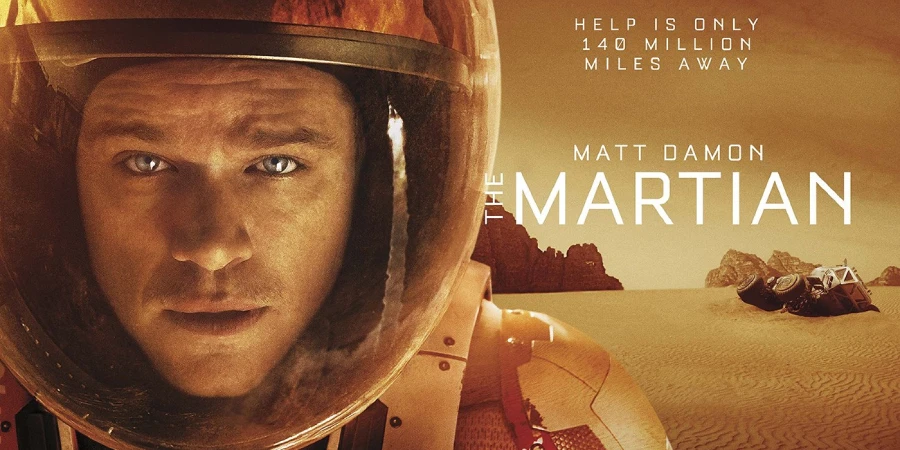

Mars has killed Mark Watney. At least, that is what his crew believes when they blast off and leave him behind in a dust storm. The Martian (2015) then spends two hours proving them wrong with duct tape, potatoes, and a sense of humor that refuses to die. Ridley Scott’s space survival story turns math into suspense and makes botany look heroic.
Detailed Summary
Sol 18: The Storm That Changes Everything
Mark Watney (Matt Damon) is the botanist and mechanical engineer on Ares III, NASA’s third crewed mission to Mars. On Sol 18, a violent dust storm threatens to tip over the crew’s ascent vehicle, the MAV. Commander Melissa Lewis (Jessica Chastain) orders an emergency evacuation.
As the crew staggers toward the MAV, a flying antenna strikes Watney and hurls him into the dark. His suit’s biomonitor goes offline. Lewis searches as long as she can, but with the MAV about to topple, she makes the agonizing call to launch. Five astronauts leave Mars. One stays behind, presumed dead.
Alone on an Entire Planet
Watney wakes buried in sand, with the antenna fragment lodged in his side. He drags himself back to the Hab, the crew’s pressurized living quarters, and performs surgery on himself with a mirror and a stapler. Then he takes stock.
His situation looks hopeless. The next mission, Ares IV, will not land for four years, and he has food for roughly a year even with careful rationing. He also has no way to contact Earth, because the storm wrecked the communications array. Instead of despairing, he starts a video log and makes a decision: he will “science the shit out of this.”
Growing Potatoes on Mars
Watney converts the Hab into a farm. He spreads Martian soil across the floor, fertilizes it with the crew’s vacuum-packed waste, and plants potatoes intended for a Thanksgiving dinner. Water presents a bigger challenge. He manufactures it by burning leftover hydrazine rocket fuel to release hydrogen, a process that nearly blows him up.
Sprouts appear. For the first time, survival seems possible. Moreover, Watney celebrates like a man who has just won the Olympics, which, in a sense, he has.
NASA Discovers He Is Alive
Back on Earth, NASA has already held Watney’s funeral. Satellite analyst Mindy Park (Mackenzie Davis) notices that equipment at the Ares III site has moved. Director of Mars Missions Vincent Kapoor (Chiwetel Ejiofor) realizes the truth, and NASA Director Teddy Sanders (Jeff Daniels) faces a dilemma.
Sanders decides to withhold the news from the Hermes crew, arguing that guilt could compromise the long trip home. Flight director Mitch Henderson (Sean Bean) objects loudly. Meanwhile, public relations chief Annie Montrose (Kristen Wiig) must explain to the world why NASA buried a living man.
Pathfinder and the Hexadecimal Breakthrough
Watney drives a rover to recover the 1997 Pathfinder probe, dormant in the Martian dust for decades. Once he powers it up, NASA’s Jet Propulsion Laboratory can rotate its camera. Communication begins with yes-or-no questions on handwritten cards.
That proves far too slow. Watney then arranges cards in a circle showing hexadecimal characters, and NASA spells out messages in ASCII. Soon they hack the rover’s software to enable text chat. Their first substantial exchange reveals that the crew does not know he survived, and Watney’s reaction is profane enough that NASA has to apologize to the public.
Disaster at the Hab
Sanders finally relents and informs the Hermes crew. Guilt hits all of them, especially Lewis. On Mars, the situation deteriorates when the Hab’s airlock fails catastrophically. The explosive decompression freezes the soil and kills every potato plant, erasing Watney’s harvest.
NASA rushes a resupply probe called Iris into production, skipping safety inspections to meet the schedule. On launch day, the rocket shakes itself apart, and the payload is lost. Watney’s timeline shrinks to a death sentence.
The Rich Purnell Maneuver
Astrodynamicist Rich Purnell (Donald Glover) calculates a bold alternative. If Hermes slingshots around Earth instead of stopping, it can return to Mars, pick up Watney, and still have enough supplies if China provides a booster rocket. Sanders rejects the plan as too risky for five lives.
Henderson quietly leaks the maneuver to the crew anyway. Lewis puts it to a vote, and all five agree to mutiny. Hermes alters course, and NASA has no choice but to support them. The Chinese National Space Administration donates its secret Taiyang Shen booster, and the resupply reaches Hermes successfully.
The Road to Schiaparelli
Watney must travel more than 3,000 kilometers to the Schiaparelli crater, where the Ares IV MAV already waits. He modifies the rover for the journey and sets out alone across the planet. Nothing goes smoothly, and the long drive leaves him gaunt and exhausted.
Worse news awaits at the destination. For the MAV to reach Hermes’s altitude, Watney must strip it of weight: the nose cone, windows, control panels, and even the airlock. He will launch sitting in what amounts to a convertible with a tarp for a roof. As he puts it, he is about to be the first person to ride a rocket with canvas over his head.
Movie Ending
Martinez pilots the stripped-down MAV remotely from Hermes while Watney straps in. Launch acceleration knocks him unconscious. When the vehicle reaches orbit, the numbers are bad: he is too low and too slow to intercept. Hermes vents its atmosphere through an airlock to slow down and blows the front hatch with a makeshift bomb built by Vogel from sugar and oxygen.
Lewis takes the tether and the maneuvering unit herself. She insists on being the one to bring him home. Even so, the gap remains too wide. Watney proposes something insane: he will puncture his glove and use the escaping air as a thruster, becoming, in his words, “Iron Man.”
Lewis refuses, and Watney does it anyway. He spins wildly toward her, she snags him, and the two tumble together before Beck reels them in on the tether. The crew erupts. On Earth, crowds in Times Square, Trafalgar Square, and Beijing cheer as one. Watney, floating in the airlock, simply says he is sorry and that Lewis did good.
Why does this moment land so hard? Scott builds the entire film on a single idea, which Watney spells out later: when everything goes wrong, you solve one problem, then the next, and if you solve enough of them, you get to go home. The rescue is the final problem, and it requires a collective effort across three space agencies and a crew willing to break the rules.
An epilogue follows. Watney, now back on Earth, teaches a class of astronaut candidates and warns them that space will try to kill them. Martinez commands the launch of Ares V. Beck and Johanssen have a baby. Lewis, Vogel, and the NASA team watch the rocket climb, and the story ends not with Mars but with humanity going back for more.
Are There Post-Credits Scenes?
No. The Martian has no scene after its credits, and nothing hides in the middle of them either. The epilogue plays before the credits roll, and Gloria Gaynor’s “I Will Survive” carries the audience out of the theater. Once Watney’s class ends and the Ares V launch fades, the story is over.
Type of Movie
The Martian is a science fiction survival drama with the pacing of a procedural and the heart of a comedy. Unlike most space films, it offers no aliens, no malfunctioning computers, and no villain. Physics is the antagonist, and ingenuity is the weapon.
Tone sets it apart from its genre cousins. Watney’s video logs provide constant wisecracks, and the film treats scientific problem-solving as a source of joy rather than dread. Admittedly, the Golden Globes classified it as a comedy, which raised eyebrows, but the label was not entirely unfair.
Cast
- Matt Damon – Mark Watney
- Jessica Chastain – Commander Melissa Lewis
- Chiwetel Ejiofor – Vincent Kapoor
- Jeff Daniels – Teddy Sanders
- Sean Bean – Mitch Henderson
- Kristen Wiig – Annie Montrose
- Michael Peña – Rick Martinez
- Kate Mara – Beth Johanssen
- Sebastian Stan – Chris Beck
- Aksel Hennie – Alex Vogel
- Donald Glover – Rich Purnell
- Benedict Wong – Bruce Ng
- Mackenzie Davis – Mindy Park
- Eddy Ko – Guo Ming
- Chen Shu – Zhu Tao
Film Music and Composer
Harry Gregson-Williams composed the original score, working with Ridley Scott for the first time since Kingdom of Heaven. His music leans on electronic textures and restrained orchestral swells, matching the clean, analytical mood of the storytelling. It rarely pushes emotion; instead, it lets the visuals breathe.
Disco steals the show. Commander Lewis left her music library behind on Mars, and Watney suffers through it, complaining constantly while the songs play. Highlights include ABBA’s “Waterloo,” Donna Summer’s “Hot Stuff,” Vicki Sue Robinson’s “Turn the Beat Around,” and The O’Jays’ “Love Train.” David Bowie’s “Starman” accompanies the preparation montage for the rescue mission, and it became the signature song of the marketing campaign.
Gregson-Williams built his career on action and adventure scores. His credits include the Shrek films, The Chronicles of Narnia: The Lion, the Witch and the Wardrobe, and multiple collaborations with Tony Scott, Ridley’s brother.


Filming Locations
Most of the film was shot at Korda Studios near Budapest, Hungary, where the production built the Hab, the rover interiors, the Hermes sets, and the NASA control rooms. One of the soundstages ranked among the largest in the world, which allowed the crew to construct a sizable Martian landscape indoors.
Exteriors came from Wadi Rum in Jordan, a desert valley with red sand and rock formations that look uncannily like NASA’s photographs of Mars. Digital effects extended the horizons and tinted the sky, but the ground under Damon’s boots was real. The same landscape has stood in for alien worlds in Prometheus and Rogue One.
Those choices matter. Watney’s isolation only works if Mars feels tangible, and the Jordanian desert gives the film a physical weight that pure CGI would lack. Furthermore, shooting in Budapest let Scott keep the NASA and Mars storylines under one roof, which helped him finish photography in roughly 70 days.
Awards and Nominations
The Martian received seven Academy Award nominations: Best Picture, Best Actor (Damon), Best Adapted Screenplay (Drew Goddard), Best Production Design, Best Sound Editing, Best Sound Mixing, and Best Visual Effects. It went home empty-handed.
At the Golden Globes, it won Best Motion Picture, Musical or Comedy, along with Best Actor in a Musical or Comedy for Damon. The category placement sparked debate, since the film is a survival drama with jokes rather than a true comedy. Ridley Scott also earned a Directors Guild of America nomination.
Behind the Scenes Insights
- Author Andy Weir originally posted the novel chapter by chapter on his website for free, then sold a 99-cent Kindle edition after readers asked for one. Crown Publishing bought the rights after it hit the Amazon bestseller lists.
- Drew Goddard originally planned to direct the adaptation himself but left to work on a different project, and Ridley Scott came aboard shortly after.
- Matt Damon did not undergo a dramatic weight loss for the late scenes; the production used a thinner body double for the shots showing Watney’s emaciated frame.
- NASA cooperated closely with the production, and Jim Green, the agency’s Director of Planetary Science at the time, served as a consultant.
- Jessica Chastain visited the Jet Propulsion Laboratory and the Johnson Space Center and spent time with astronaut Tracy Caldwell Dyson to prepare for the role of Lewis.
- Scott considered showing Watney’s survival only after NASA discovers it, but chose to reveal it immediately so the audience could follow the problem-solving from the start.
- Weir has admitted the opening dust storm is scientifically impossible; Martian air is far too thin to generate destructive winds, but he needed a dramatic reason to strand his hero.
Inspirations and References
The film adapts Andy Weir‘s novel The Martian, first self-published in 2011 and released in print by Crown in 2014. Weir, a software engineer and lifelong space enthusiast, wrote the book as a thought experiment about how a real astronaut might survive on Mars using only existing technology.
Weir built his story around actual NASA proposals, including the Mars Direct concept, which involves sending supplies and a return vehicle ahead of the crew. The Pathfinder mission and its Sojourner rover are real artifacts sitting on Mars today. Similarly, the Hermes spacecraft reflects real designs for rotating ships that generate artificial gravity.
Beyond the science, the film belongs to a long tradition of survival stories, from Robinson Crusoe onward. Watney even references Lord of the Rings and Iron Man, placing himself squarely within pop culture rather than outside it.
Alternate Endings and Deleted Scenes
An Extended Edition of the film adds roughly ten minutes of material, most of it small character beats rather than major plot changes. These include additional moments at NASA and extra footage of Watney’s daily routines on Mars.
No alternate ending exists on film. However, the ending itself is an addition. Weir’s novel closes on Hermes right after the rescue, while Scott and Goddard added the Earth-bound epilogue with the astronaut class and the Ares V launch. Several marketing shorts, such as the Ares III crew psych evaluations and a segment with Neil deGrasse Tyson, also expand the world without being part of the feature.
Book Adaptations and Differences
Yes, the film is based on Weir’s novel, and it stays remarkably faithful. Even so, several differences stand out.
The book includes a second dust storm during the long drive to Schiaparelli, which Watney detects and navigates around by measuring his solar panel output. The film cuts it entirely. Similarly, the novel features a rover rollover accident near the crater, and that is gone too, which makes the journey look easier than Weir intended.
Character choices also shift. In the book, Beck performs the final spacewalk retrieval; the film gives that job to Lewis to resolve her guilt dramatically. Watney’s “Iron Man” stunt only exists as a rejected suggestion on the page, whereas Scott lets him actually do it. Ejiofor’s character was named Venkat Kapoor in the novel and became Vincent Kapoor on screen. Finally, the novel offers far more detailed math and chemistry, which the film trims to keep the pace brisk.


Memorable Scenes and Quotes
Key Scenes
- Watney’s self-surgery in the Hab, removing the antenna fragment with a mirror and medical stapler while barely able to breathe.
- The first potato sprouts, a tiny green victory that Watney treats like a miracle.
- The hydrazine water-making experiment, which ends with Watney singed and laughing after a fireball.
- The hexadecimal circle around Pathfinder, the moment Earth and Mars finally talk in full sentences.
- The Hab breach, shot with brutal speed, as Watney’s months of work freeze and die in seconds.
- The crew’s silent vote to mutiny aboard Hermes.
- Watney’s launch in the stripped MAV, followed by the tether rescue and the “Iron Man” leap.
- The quiet epilogue in the classroom, where Watney explains how he survived.
Iconic Quotes
- “I’m gonna have to science the shit out of this.” (Watney)
- “In your face, Neil Armstrong.” (Watney)
- “Mars will come to fear my botany powers.” (Watney)
- “They say once you grow crops somewhere, you have officially colonized it. So, technically, I colonized Mars.” (Watney)
- “Houston, be advised: Rich Purnell is a steely-eyed missile man.” (Martinez)
- “At some point, everything’s going to go south on you, and you’re going to say, this is it. This is how I end. Now, you can either accept that, or you can get to work.” (Watney)
- “Every human being has a basic instinct to help each other out.” (Watney)
Easter Eggs and Hidden Details
- Sean Bean sits in the “Project Elrond” meeting, a direct wink to his role as Boromir in The Fellowship of the Ring, where the Council of Elrond takes place.
- Watney’s wisecrack about being a “space pirate” comes with a mock-legal argument that international maritime law applies to Mars, lifted almost word for word from the novel.
- Lewis’s love of 1970s culture extends to television; Watney grumbles about her Happy Days collection as well as her disco.
- Pathfinder and the Sojourner rover appear exactly as they were designed in 1997, down to the deflated airbags around the lander.
- Watney’s sol count, which he logs on camera, mirrors the real-world practice NASA uses to track Martian days on rover missions.
- Hermes’s rotating ring provides artificial gravity, and the film is careful to show weightlessness only in the central hub sections.
- Watney’s choice to grow potatoes rather than a more nutritious crop reflects a real detail: potatoes offer one of the highest calorie yields per square meter of any staple.
Trivia
- The film was shot in approximately 70 days, a fast schedule for a production of its size.
- Weir did not visit the set in Hungary because he has a fear of flying, but he consulted with the filmmakers remotely.
- Matt Damon and Jessica Chastain had just played astronauts together in Interstellar (2014), though they shared no scenes in that film.
- Andy Weir received the John W. Campbell Award for Best New Writer in 2016, largely on the strength of the novel.
- The production used real NASA mission control protocols, and several real JPL scientists appear in background roles.
- NASA released a wave of real Mars research announcements around the film’s release, including the discovery of evidence for liquid water on the surface, which the agency timed to coincide with public interest.
- Scott’s brother Tony had directed Gregson-Williams on numerous films, and Ridley’s hiring of the composer was partly a tribute to that collaboration.
Why Watch?
The Martian makes intelligence thrilling and optimism credible. It celebrates competence, teamwork, and stubborn good humor without a trace of cynicism. If you want a space film that makes you want to learn, build, and maybe plant something, this is the one.
Director’s Other Movies
- The Duellists (1977)
- Alien (1979)
- Blade Runner (1982)
- Legend (1985)
- Thelma & Louise (1991)
- Gladiator (2000)
- Hannibal (2001)
- Black Hawk Down (2001)
- Kingdom of Heaven (2005)
- American Gangster (2007)
- Prometheus (2012)
- Alien: Covenant (2017)
- All the Money in the World (2017)
- The Last Duel (2021)
- House of Gucci (2021)
- Napoleon (2023)
- Gladiator II (2024)