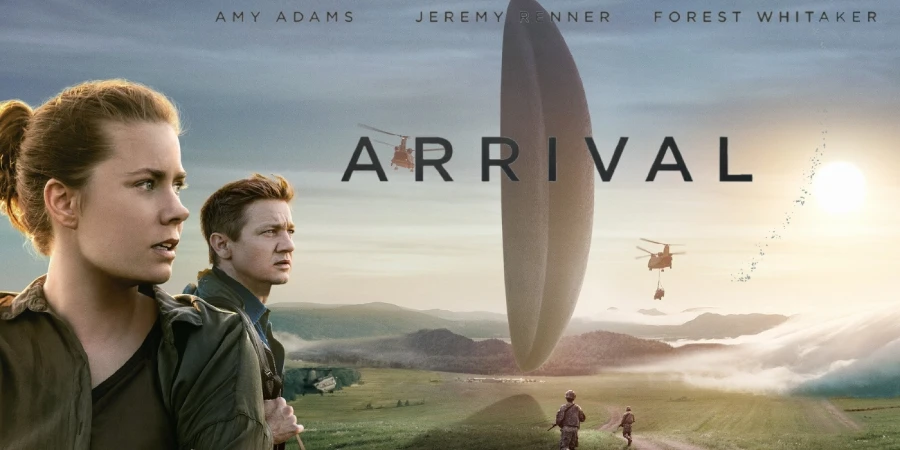

Amy Adams stands in a field, staring up at a shell-shaped alien spacecraft, and the film has already deceived you once without saying a word. Arrival (2016), directed by Denis Villeneuve, weaponizes grief and language against your assumptions about chronology, then asks whether you would still choose love knowing exactly how it ends.
This is a film where the twist is not a rug-pull but a revelation that recontextualizes every quiet, tender scene you already watched. Your second viewing will hurt more than your first.
Detailed Summary
Opening: “Before” or After
Linguist Louise Banks (Amy Adams) opens the film narrating what appears to be a flashback. We see her daughter Hannah at various ages, healthy and laughing, then sick, then gone. Louise says, “I used to think this was the beginning of your story.”
She is speaking to her daughter. She seems to be mourning. Everything about the framing tells you this is backstory, context for a grieving mother about to face a global crisis.
It is not backstory. It is the future. Villeneuve plants this deception quietly, with no music sting and no sleight-of-hand editing. He just lets you assume.
Twelve Shells Arrive
Twelve enormous alien vessels, shaped like smooth vertical stones, appear simultaneously at scattered locations across the planet. Governments go into immediate lockdown. Military camps spring up around each site.
Colonel Weber (Forest Whitaker) recruits Louise and physicist Ian Donnelly (Jeremy Renner) to join the American team in Montana. Their job is simple in theory: figure out why the aliens are here.
First Contact Inside the Shell
Every 18 hours, a door opens in the Montana shell. Louise and Ian suit up and enter. Gravity flips ninety degrees inside. They walk up a corridor and arrive at a transparent wall separating them from two massive, seven-limbed creatures Louise names heptapods.
She calls them Abbott and Costello. Ian finds that funny. It is the first moment of genuine warmth between them, and it matters more on a second viewing than it seems to on the first.
Communication begins with simple written symbols. Louise writes “human” on a whiteboard. One heptapod responds with a circular ink-like symbol on the glass. Progress is painstaking and methodical, which Villeneuve renders with real procedural patience that most sci-fi films skip entirely.
Global Paranoia and the Race to Decode
Twelve nations share data at first, but fear fractures the cooperation. China, led by General Shang, grows aggressive. Russia goes dark. Other teams attempt shortcut communication using number sequences, which Louise argues is dangerously reductive.
Louise insists the team learn the heptapod written language rather than relying on binary patterns. This is not a minor procedural disagreement. Her argument drives the entire film’s thesis: language shapes thought, and the heptapods are offering something far deeper than information.
Louise Starts Experiencing “Memories” That Do Not Fit
As Louise deepens her immersion in the heptapod language, visions of Hannah intensify. She sees Hannah in hospital. She hears her own voice speaking words she does not recognize yet.
She assumes these are flashbacks triggered by stress. Ian notices Louise behaving strangely. The audience, like Louise, has been given all the pieces but not yet the frame.
The Question: “What Is Your Purpose?”
Louise and Ian finally ask the central question. Abbott and Costello respond with a symbol that gets translated, ambiguously, as “offer weapon.” The world panics. China interprets it as a declaration of war.
Several soldiers inside the Montana shell plant a bomb, acting unilaterally. Abbott sacrifices itself to push Louise and Ian out before the explosion. Costello survives but pulls the ship high above Montana, seemingly retreating.
Louise Alone at the Ship
Costello lowers a small pod for Louise. She enters alone. Inside, Costello communicates in full immersive heptapod language. Louise now understands that the “weapon” is the language itself.
Learning heptapod allows the user to perceive time non-linearly. You do not experience events in sequence anymore; you experience all of time as simultaneous. Louise is already living this. Her “memories” of Hannah are not memories. They are visions of what has not happened yet.


Movie Ending
What we understood as Louise’s backstory becomes the film’s sucker punch once Costello explains the nature of the heptapod gift. Louise is already perceiving her future. Hannah is not a daughter she lost before the alien arrival. Hannah is a daughter she has not yet had.
Louise also sees a future memory: a UN gala where General Shang takes her hand, thanks her for calling him on his personal number, and tells her she spoke in Mandarin and quoted his dying wife’s final words to him. She has no idea how she knows those words yet.
Back in the present crisis, Louise uses that future knowledge. She finds Shang’s number, calls him, says the words. He stands down. China withdraws its attack. The global coalition holds. Twelve shells disperse peacefully into space.
Ian, back on the ground, tells Louise he loves her. She knows, with total clarity, every beat of what their life together will look like. She also knows Hannah will develop an incurable illness and die young. She knows Ian will eventually learn that Louise knew and chose parenthood anyway, and that revelation will end their relationship.
She chooses it all regardless. That choice is the moral and emotional center of the film. Villeneuve frames it not as tragedy but as acceptance. Louise does not fight fate. She walks toward it with open eyes.
A final voice-over from Louise to the not-yet-born Hannah closes the film: “If you could see your whole life laid out in front of you, would you change things?” She would not. The film ends on a shot of Louise holding infant Hannah.
The most quietly devastating moment is Louise whispering Hannah’s name to Ian for the first time, selecting it together, while we realize Louise already knows every single day that name will encompass.
Are There Post-Credits Scenes?
Arrival has no post-credits scene. Credits roll over a sparse musical cue and the screen goes dark. You sit in that silence for a while whether you want to or not.
Type of Movie
Arrival is a science fiction drama with strong elements of linguistic philosophy and quiet emotional tragedy. Its tone is meditative and deeply controlled. This is not a film about action or spectacle; it is a film about consciousness, grief, and choice.
Pacing is deliberate and patient. Villeneuve builds tension through bureaucratic and intellectual obstacles, not explosions. Think less Independence Day and far closer to Andrei Tarkovsky’s Solaris.
Cast
- Amy Adams – Louise Banks
- Jeremy Renner – Ian Donnelly
- Forest Whitaker – Colonel Weber
- Michael Stuhlbarg – Agent Halpern
- Mark O’Brien – Captain Marks
- Tzi Ma – General Shang
Amy Adams carries an extraordinary amount of this film through physical stillness. She communicates exhaustion, wonder, and private grief using almost no dialogue in the first act, and the performance is the most underrated in her career. She did not receive an Academy Award nomination for this role, which remains a genuine oversight.
Film Music and Composer
Composer Jóhann Jóhannsson used a blend of orchestral and electronic textures, with human voices processed into something alien and mournful.
The track “On the Nature of Daylight” by Max Richter opens and closes the film. Its placement is a deliberate emotional trap: you hear it first over footage of Hannah’s life, and you hear it again once you understand those images are of the future. Richter’s piece was not composed for the film, but Villeneuve’s use of it is inspired.
Jóhannsson’s original score underpins the alien contact sequences with low, humming textures that feel genuinely non-human. His work here is one of the most thoughtfully constructed science fiction scores of the 2010s.


Filming Locations
Principal photography took place in Montreal, Quebec, Canada. Several sequences were shot in the Eastern Townships region of Quebec, which provided wide, flat fields that visually isolate the spacecraft and emphasize its enormity against the landscape.
The military base set was constructed practically, giving the film a tactile, grounded atmosphere that CGI-heavy productions often lose. Louise’s house, positioned near water, reinforces the film’s recurring visual relationship between stillness and depth.
Villeneuve chose locations that feel emptied-out rather than dramatic. That choice matters. A landscape that looks like it is quietly waiting suits a film about inevitable futures.
Awards and Nominations
Arrival received eight Academy Award nominations, including Best Picture and Best Director for Denis Villeneuve. It won Best Sound Editing.
Jóhannsson received a nomination for Best Original Score at the Golden Globes. The film also earned nominations at BAFTA, the Saturn Awards, and the Critics’ Choice Movie Awards, with widespread recognition for its screenplay and direction.
Behind the Scenes Insights
- Denis Villeneuve deliberately kept Amy Adams away from most of the CGI details during production so her reactions to the heptapods would carry genuine uncertainty.
- Screenwriter Eric Heisserer spent years developing the script before it attracted Villeneuve’s attention; multiple studios passed on the project.
- The heptapod written language, called Heptapod B in the source story, was designed by a team of artists and linguists to be genuinely non-linear in its visual structure, with each symbol representing a complete sentence rather than sequential sounds.
- Villeneuve cited Andrei Tarkovsky as an influence on the pacing and visual grammar of alien contact in the film.
- Amy Adams did extensive research into linguistics and language acquisition before filming began.
- Jóhann Jóhannsson and Villeneuve had worked together previously, and their collaboration on Arrival was unusually close. Tragically, Jóhannsson passed away in 2018 at age 48.
Inspirations and References
The film adapts Ted Chiang’s short story “Story of Your Life”, published in 1998. Chiang’s story introduces the Sapir-Whorf hypothesis as a science-fictional premise: the idea that the language you use shapes how you perceive reality, including time itself.
Villeneuve and Heisserer expanded the global political dimension of the story significantly. Chiang’s original is more intimate and focused on the linguistic and philosophical mechanics. The film adds the geopolitical tension with China and the countdown structure to give the adaptation dramatic urgency.
Tarkovsky’s Solaris and Stalker are clear touchstones for the film’s mood and pacing. Kubrick’s 2001: A Space Odyssey looms over the alien-contact genre broadly, and Villeneuve consciously resists Kubrick’s detachment by centering emotional intimacy instead.
Alternate Endings and Deleted Scenes
No significant alternate ending has been made public for Arrival. Villeneuve has discussed tightening the film during editing, particularly in the early contact sequences, but no deleted scenes have been officially released in detail.
Heisserer has spoken about earlier drafts that made the non-linear structure more explicit earlier in the script. Villeneuve pushed to hold the reveal as long as possible, trusting the audience’s patience. That instinct was correct.
Book Adaptations and Differences
Arrival is based on Ted Chiang’s short story “Story of Your Life” from his 1998 collection Stories of Your Life and Others.
Chiang’s story is quieter and more technical. Much of it consists of Louise working through linguistic and mathematical theory, specifically the connection between Fermat’s Principle of Least Time and the heptapod understanding of physics. Ian is less developed as a character in the source material.
The geopolitical subplot, General Shang, the bomb inside the shell, and the countdown crisis are all inventions of Heisserer’s screenplay. Chiang’s story has no ticking clock. Screenwriter Heisserer added that layer to give the film conventional genre tension without abandoning the story’s philosophical core, which is a smart structural compromise rather than a betrayal of the source.
Hannah’s fate is also handled differently in pacing. Chiang’s story reveals the non-linear structure to the reader in a different order. Villeneuve’s version is more cinematically deceptive and, on purely emotional terms, more devastating.


Memorable Scenes and Quotes
Key Scenes
- The opening sequence: Max Richter’s “On the Nature of Daylight” plays over a montage of Hannah’s life, from birth to death, while Louise narrates. You watch it as a tearful backstory. Later you understand you were watching a prophecy.
- First entry into the shell: Gravity inverts. Louise and Ian walk up a dark corridor lit only by bioluminescent panels. No score, just footsteps and breathing. One of the most effectively staged first-contact moments in modern science fiction.
- Louise removes her hazmat mask: Against protocol, she pulls off her respirator inside the chamber so the heptapods can see her face. It is a small act of vulnerability with enormous communicative intent, and Adams plays it with total conviction.
- Louise inside the pod with Costello: The full heptapod language floods her perception. Past, present, and future collapse into one image. Villeneuve shows this as a sensory cascade rather than a tidy explained montage.
- Louise chooses: Knowing everything, she tells Ian she wants a baby. The camera holds on her face. Adams does not smile triumphantly; she looks like someone walking into a storm they have studied in detail.
- The phone call to Shang: Louise calls the Chinese general with words she heard in a future memory. She speaks them without fully understanding how she knows them. Quiet, understated, and completely earned by everything the film built before it.
Iconic Quotes
- “If you could see your whole life laid out in front of you, would you change things?” (Louise, voice-over)
- “Language is the foundation of civilization. It is the glue that holds a people together. It is the first weapon drawn in a conflict.” (Louise)
- “I used to think this was the beginning of your story.” (Louise to Hannah, opening narration)
- “We’re so bound by time. By its order.” (Louise)
Easter Eggs and Hidden Details
- Hannah is a palindrome. The name reads the same forwards and backwards. In a film about non-linear time and circular perception, that choice is deliberate and elegant.
- The heptapod symbols in the film were designed to have no clear start or end point, visually echoing the circular time perception the language grants. Each glyph is a closed loop.
- Louise’s house is positioned near a large body of water throughout the film. Water in Villeneuve’s films frequently functions as a visual metaphor for reflection and depth; its presence here is consistent with that pattern.
- During the opening contact sequences, the heptapods are never fully lit or fully revealed. Villeneuve keeps them partially obscured by fog and glass, a deliberate echo of how incomplete human understanding of the aliens remains for most of the film.
- Ted Chiang’s original story title, “Story of Your Life”, is embedded in the film’s final line, which addresses Hannah directly as Louise narrates her story to her unborn daughter.
Trivia
- Denis Villeneuve had already been announced as the director of Blade Runner 2049 before Arrival was released.
- Eric Heisserer, who wrote the screenplay, had previously worked almost exclusively on horror films. Arrival represents a dramatic shift in his career and earned him his first Academy Award nomination.
- Amy Adams learned basic Mandarin phonetics for one line in the film to ensure Louise’s phone call to General Shang felt phonetically authentic.
- The production design team created over a hundred distinct heptapod symbols for background use and concept development, though far fewer appear in the final film.
- Ted Chiang has a background in technical writing and computer science, which informs the mathematical precision in his original story’s treatment of language and physics.
- Villeneuve shot the film in the aspect ratio of 2.39:1, giving the wide Montana landscapes a stark horizontal emptiness that makes the vertical shell appear even more alien by contrast.
Why Watch?
Amy Adams builds an entire emotional architecture using micro-expressions and body language in a film where the screenplay withholds its biggest secret until the final act, and she never once tips the hand. Watching her navigate grief she cannot yet name, for a child she has not yet had, is the specific reason to sit with this one. Arrival asks a genuinely hard question and refuses to soften the answer.
Director’s Other Movies
- Incendies (2010)
- Prisoners (2013)
- Enemy (2013)
- Sicario (2015)
- Blade Runner 2049 (2017)
- Dune (2021)
- Dune: Part Two (2024)