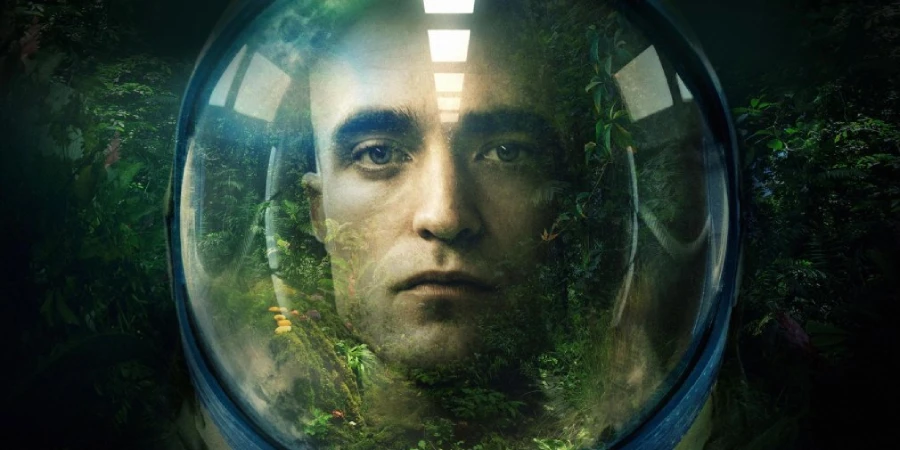

Robert Pattinson floats through deep space cradling an infant, and that single image tells you everything and nothing about what High Life is willing to give you. Claire Denis made this film in 2018 as her English-language debut, and she brought every instinct she developed across decades of uncompromising French cinema straight into the void.
This is a movie about sex, death, entropy, and fatherhood, set aboard a rusting spacecraft heading toward a black hole. It does not explain itself, and that refusal is the entire point.
Detailed Summary
Monte and the Baby, Alone in the Dark
Denis opens High Life in the middle, not at the beginning. We meet Monte (Robert Pattinson) already alone on the ship, methodically maintaining its systems while a baby girl named Willow gurgles in a makeshift crib. Everyone else on the crew is already dead. Monte disposes of body after body through the airlock with quiet efficiency, and the film gives us no immediate explanation.
This opening is one of Denis’s sharpest directorial choices. She trusts the audience to sit with confusion and unease rather than rushing toward clarity. Pattinson, for his part, does something very specific here: he holds Willow with a tenderness that reads as earned rather than instinctive, a man who chose love rather than being born into it.
The Mission and Its Prisoners
Gradually, through fragmented flashbacks, the film reveals the mission’s premise. Death-row convicts from Earth have been recruited, or rather coerced, into a deep-space program. Their stated mission is to reach a black hole and harvest its energy. Nobody expects them to come back.
Dr. Dibs (Juliette Binoche) runs the ship’s reproductive experiments. She is obsessed with achieving a successful pregnancy in space, using the male prisoners’ sperm and implanting embryos in the female prisoners without their full understanding. She murdered her own children on Earth. The film does not dwell on this detail; it drops it and moves on, which is somehow more disturbing than extended explanation.
The “Fuckbox” and Dibs’s Obsession
One of the film’s most discussed sequences centers on a padded, mirrored room the prisoners call the “fuckbox.” Dibs uses it herself in a scene of startling, explicit self-pleasure, shot by Denis with a deliberate, unapologetic directness. Binoche performs the scene with zero embarrassment and total commitment, and it ranks among the bravest pieces of acting in the film.
Dibs harvests Monte’s sperm while he sleeps. He has been celibate by choice, the only prisoner who refuses to engage in the ship’s sexual environment. His refusal is a form of control, the one thing left that belongs entirely to him.
Boyse’s Pregnancy and the Crew’s Unraveling
Boyse (Mia Goth) becomes pregnant through Dibs’s intervention. Her pregnancy and eventual death in childbirth mark the moment the crew begins collapsing inward. Other crew members die through violence, accident, and psychological deterioration. Tcherny (André Benjamin, credited as André 3000) is perhaps the most quietly affecting presence among the supporting cast, a gentle man who tends the ship’s small garden with near-religious devotion.
His death hits harder than it probably should, given how little screen time he receives. Benjamin plays Tcherny with such stillness and dignity that losing him feels genuinely costly to the film’s emotional atmosphere.
Willow’s Birth and Monte’s Choice
Boyse dies during delivery, and Monte ends up caring for Willow alone. He was the biological father, though Dibs arranged it without his consent. His decision to raise Willow rather than simply survive is the film’s quiet moral center.
Denis shoots Monte’s daily caregiving routines, the feeding, the bathing, the carrying, with the same unhurried attention she gives to the ship’s mechanical systems. She makes no distinction between nurturing a child and maintaining a spacecraft. Both are acts of sustained, unglamorous love.
The Final Stretch: Willow Grows Up
Time passes. Willow (played as a teenager by Jessie Ross) grows up knowing nothing but the ship and Monte. Their relationship carries an almost unbearable weight of isolation and mutual dependency. She asks Monte the questions any child would ask, but set against infinite darkness, those questions land differently.
Dibs eventually dies, either by Monte’s hand or by her own choice; Denis keeps this deliberately ambiguous. By this point, the film has stripped away almost every character until only Monte and Willow remain.


Movie Ending
Monte and Willow approach the black hole together, and they choose to fly a smaller shuttle directly into it. This is a conscious, shared decision. Willow makes clear she is not afraid. Monte follows her lead, and the film ends before they cross the event horizon.
Denis does not show us what happens inside the black hole. She gives us the approach: the ship bathed in amber and red light, the two of them sitting together, calm. There is a profound logic to this ending that the film has been building toward without announcing it.
Scientifically, a black hole means annihilation, but Denis is not making a science film. She is making a film about the impossibility of returning. Monte and Willow cannot go back to Earth. They were never meant to. Going forward, into the one thing in the universe that cannot be escaped, reads as a kind of ultimate freedom rather than defeat.
The ending also resolves the film’s central tension between isolation and connection. Monte spent the entire film learning to love one specific person, and Willow spent hers never knowing any other kind of love. Their willingness to face obliteration side by side completes both of those arcs. It is the most emotionally direct moment Denis allows herself in the entire runtime.
Are There Post-Credits Scenes?
High Life has no post-credits scene. Denis closes on the approach to the black hole and lets the credits run over darkness. There is nothing waiting for you on the other side.
Type of Movie
High Life occupies a very specific niche: art-house science fiction with strong existential horror undertones. Denis is not interested in space opera or thriller mechanics. This is closer to Solaris than to anything from a multiplex.
Tonally, the film is slow, cold, and uncomfortable, punctuated by sudden eruptions of violence and eroticism. It demands patience and offers genuine strangeness in return.
Cast
- Robert Pattinson – Monte
- Juliette Binoche – Dr. Dibs
- André Benjamin – Tcherny
- Mia Goth – Boyse
- Jessie Ross – Willow (teenage)
- Gloria Obianyo – Nansen
- Agata Buzek – Elektra
- Lars Eidinger – Chandra
- Scarlett Lindsey – Willow (infant)
Film Music and Composer
Stuart A. Staples, the lead vocalist and founder of Tindersticks, composed the score for High Life. Denis and Staples have a long creative relationship; he has scored several of her films, and their collaboration here is one of the most underrated elements of the entire production.
Staples’s score avoids the swelling orchestral clichés of mainstream science fiction. Instead, it drones, hums, and occasionally pulses with something that feels less like music and more like the ship itself breathing. There is one vocal piece that plays during a key sequence involving Willow as a child, and it lands with a quiet devastation that purely instrumental music could not have achieved.



Filming Locations
High Life was shot primarily on sets in Germany, at facilities that allowed Denis and her production designer to build the ship’s interior as a fully contained physical environment. Denis has spoken about wanting the ship to feel genuinely claustrophobic, not digitally expanded.
Some exterior sequences and the garden scenes were shot with a specificity that makes them feel almost more alien than the deep-space footage. A real garden growing inside a metal box is its own kind of surreal image. Denis and cinematographer Yorick Le Saux used long lenses and tight framing to reinforce the sense that the universe outside is irrelevant; what matters is what happens inside this narrow corridor.
Awards and Nominations
High Life received critical recognition primarily on the festival circuit, including attention at the Toronto International Film Festival in 2018 where it premiered. It did not accumulate major awards wins from the mainstream ceremony circuit, which is exactly the kind of oversight that should embarrass those circuits.
Behind the Scenes Insights
- Claire Denis had been developing High Life for over a decade before production began. It was a long-gestating project, and her decision to make it in English rather than French was partly driven by the casting of Pattinson and partly by the international financing requirements.
- Robert Pattinson has described the shoot as one of the most physically and emotionally demanding of his career, particularly the scenes involving the infant and the sequences requiring him to show sustained, quiet grief.
- Juliette Binoche lobbied for her role and pushed Denis to go further with the fuckbox sequence than Denis initially intended. Binoche’s willingness to commit fully to that scene shapes the entire film’s sexual atmosphere.
- André Benjamin (André 3000 of OutKast) was cast specifically because Denis wanted someone who could convey a particular kind of quiet masculinity, gentle and grounded without being passive.
- Yorick Le Saux, the cinematographer, lit the ship’s interior to feel perpetually uncertain, never quite day and never quite night, which amplifies the crew’s psychological disorientation.
- Denis consulted with scientists about black hole physics during pre-production, and while the film is not scientifically rigorous, some of the visual choices around the black hole approach reflect genuine research into gravitational lensing effects.
Inspirations and References
Denis has cited Samuel Beckett as a foundational influence. The film’s structure, fragmented, circular, stripped of conventional narrative momentum, carries clear echoes of Beckett’s theatrical minimalism. Characters wait, decay, and occasionally act with sudden, inexplicable violence.
Andrei Tarkovsky’s Solaris and Stalker are obvious touchstones, particularly in how Denis treats space as psychological environment rather than physical backdrop. She is less interested in where the ship is going than in what it is doing to the people inside.
Denis has also acknowledged an interest in Georges Bataille‘s writing on eroticism and death, and Dibs’s character reads almost as a Bataillean figure: someone for whom sexuality and mortality have collapsed into the same obsessive drive.
Alternate Endings and Deleted Scenes
Denis has not discussed specific deleted scenes in detail in major interviews, and no alternate ending has been officially confirmed or released. Given how precisely constructed the film feels, it is hard to imagine a radically different version exists.
Denis is known for shooting with a certain economy; she tends not to generate enormous amounts of footage that then gets cut. What ends up on screen generally reflects close to what she intended to capture.
Book Adaptations and Differences
High Life is not based on a book. Denis co-wrote the screenplay with Jean-Pol Fargeau and Geoff Cox. The story is entirely original, though Denis drew on literary and philosophical sources for thematic material rather than plot.


Memorable Scenes and Quotes
Key Scenes
- Monte disposing of bodies through the airlock: Shot matter-of-factly, with no score underneath, just the mechanical thud of the airlock cycling. It establishes the film’s emotional register immediately.
- The fuckbox sequence: Binoche alone in the padded room, red light, her face cycling through concentration and release. Denis frames it without judgment or titillation, which makes it more unsettling than either would be.
- Tcherny in the garden: Benjamin crouches among green plants in the middle of a steel corridor, and the image of that living color against the gray metal carries more weight than any expository dialogue about hope could.
- Monte bathing infant Willow: Water pouring over a baby’s head in a metal basin, Pattinson’s large hands moving with extreme care. A domestic act made strange by its setting, and one of the film’s most emotionally direct images.
- The approach to the black hole: Amber and deep red light flooding the shuttle as Monte and teenage Willow sit side by side, calm and deliberate. Denis holds the shot long enough that it stops being frightening and becomes something closer to peace.
Iconic Quotes
- “We are taboo for each other. You and I.” Monte to Willow, acknowledging the complicated nature of their bond and the incest anxiety the film deliberately courts without resolving.
- “Give it to me. Give me your energy.” Dibs, during her solo scene in the fuckbox, a line that connects her sexual obsession to her obsession with the black hole’s energy.
Easter Eggs and Hidden Details
- The ship’s garden contains plants that Denis and her production team selected partly for their symbolic resonance. Sunflowers appear periodically, a plant that literally tracks toward light in darkness, an image Denis plants without underlining.
- The names of several crew members carry mythological weight. Elektra references the Greek figure associated with father-daughter bonds and cycles of violence. Denis rarely explains these choices in interviews, preferring to let them operate subliminally.
- Dibs’s medical equipment is deliberately retro-looking, analog dials and worn surfaces, which reinforces the film’s suggestion that these prisoners were given secondhand, inferior technology by a society that considered them disposable.
- Monte’s celibacy is visually underscored by how Denis frames him in group scenes: consistently slightly apart from the other crew members, occupying negative space.
- The infant Willow’s eyes are kept in close-up several times early in the film, and Denis returns to that same framing with teenage Willow near the end. It is a quiet visual rhyme that suggests continuity of identity across the years of isolation.
Trivia
- High Life marked Claire Denis’s first English-language feature film after a career built entirely in French and French-language African cinema.
- Robert Pattinson was cast before Denis had secured full financing, which reflects how central his involvement was to making the film viable for international distributors.
- André Benjamin has appeared in relatively few films; Denis specifically sought him out for Tcherny rather than casting from a traditional Hollywood pool.
- Mia Goth shot her scenes before her profile rose significantly, and her performance here prefigures the intense physical commitment she would later bring to films like Pearl.
- Denis deliberately avoided computer-generated imagery for the ship’s interior, preferring practical sets to maintain the tactile, claustrophobic quality she wanted the audience to feel.
- A24 handled the North American distribution of High Life, continuing the company’s pattern of acquiring challenging arthouse projects that major studios would not touch.
- Denis shot portions of the film with a very small crew to preserve the sense of intimacy and confinement she wanted the actors to actually experience on set.
Why Watch?
Pattinson’s performance here deserves more attention than it receives in the ongoing conversation about his career resurgence. He communicates Monte’s grief and devotion almost entirely through posture and stillness, never once reaching for an obvious emotional beat. Denis builds a film around that restraint, and the combination produces something genuinely strange and genuinely moving. Watch it for the moment he washes his infant daughter in a metal bowl, because that single image earns everything the ending asks of you.
Director’s Other Movies
- Chocolat (1988)
- Beau Travail (1999)
- Trouble Every Day (2001)
- The Intruder (2004)
- 35 Shots of Rum (2008)
- White Material (2009)
- Bastards (2013)
- Both Sides of the Blade (2022)