Andrei Tarkovsky’s Stalker is less a science fiction story and more a cinematic pilgrimage. It transports viewers to a world drained of color, hope, and certainty. However, within this world lies the Zone, a mysterious territory that promises to grant one’s innermost desires. The film, therefore, becomes a treacherous journey into the human soul itself.
Detailed Summary
The Meeting
The film opens in a bleak, sepia-toned industrial landscape. We meet the Stalker, a guide who illegally leads people into the forbidden Zone. He is a man driven by a profound, almost spiritual, belief in the Zone’s power. Consequently, his wife begs him not to go, fearing for his safety and recalling the fate of a previous Stalker named Porcupine. Ignoring her pleas, he prepares for his next clients: a cynical, disillusioned Writer seeking inspiration and a quiet, stoic Professor with seemingly scientific motives.
Entering the Zone
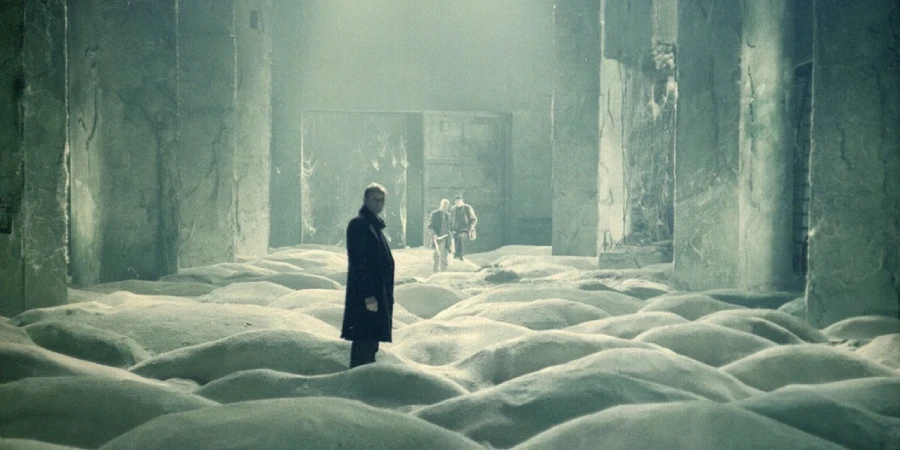
The trio’s entry into the Zone is tense and perilous. They must evade armed guards patrolling its perimeter. After a nerve-wracking ride on a railcar, they finally breach the border. At this moment, the film dramatically shifts from sepia to lush, saturated color. The Zone is not a futuristic wasteland; instead, it is an overgrown, beautiful, and eerily quiet natural environment. The Stalker then explains that the Zone is sentient and its paths are never direct, demanding respect and a specific, roundabout approach to travel.
The Journey Through the Zone
Their journey toward the central “Room” is a metaphysical ordeal, not a physical one. The Writer openly questions the Stalker’s faith, mocking his rituals. In contrast, the Professor remains reserved, meticulously following the Stalker’s strange instructions, such as throwing cloth-tied metal nuts to test the path. One of the most harrowing obstacles is a tunnel known as the “meat grinder,” which the Stalker claims has killed many.
After a tense argument, the Writer refuses to enter, and they ultimately find another way around. However, the greatest conflict arises when the Professor reveals his true purpose: he has brought a 20-kiloton bomb to destroy the Room, fearing humanity will abuse its power for evil.
The Threshold of the Room
Finally, the men arrive at the threshold of the dilapidated building housing the Room. The Stalker implores them to enter and make their deepest, most sincere wishes. However, their journey has irrevocably changed them. The Writer, for instance, confesses he has no noble desire left, realizing his wish for inspiration is a fraud. As a result, he refuses to enter. The Professor, moved by the Stalker’s desperate faith and his own changing convictions, disassembles his bomb. The Stalker is left in despair; his entire purpose was to bring suffering people to a place of hope, but no one has the faith to cross the final barrier.


Movie Ending
The trio returns from the Zone, and the film reverts to its original sepia tone. The journey has granted no wishes and offered no easy answers. Back in his small apartment, the Stalker has a breakdown, lamenting to his wife that humanity has lost its faith and spiritual organ. He feels his life’s work is meaningless. However, in a powerful and moving monologue, his wife comforts him. She tells him she knowingly chose a life of sorrow with him over a predictable, boring existence because she loves him. She sees beauty in his difficult, saint-like existence.
The final, enigmatic scene involves their daughter, nicknamed Monkey. She has crippled legs, supposedly a result of the Stalker’s exposure to the Zone. As she sits at a table reading a book, a train rumbles by outside, shaking the room. Three glasses on the table begin to move on their own, with one eventually falling off the edge. Monkey stares intently as this happens, implying she is moving them with telekinesis.
The film ends on this ambiguous miracle. It leaves the audience to wonder if this power is a gift from the Zone, a sign of a new leap in human evolution, or simply a final testament to the power of faith and love that exists outside the Zone’s influence.
Are There Post-Credits Scenes?
No, there are no post-credits scenes in Stalker. The film concludes definitively with the final shot of the Stalker’s daughter.
Type of Movie
Stalker is best classified as a philosophical science fiction film and a slow-burn metaphysical drama. Its tone is profoundly meditative, melancholic, and allegorical. The film prioritizes existential questions, spiritual discourse, and atmosphere over plot or action. Furthermore, its deliberate pacing and long takes create a hypnotic, almost trance-like viewing experience.
Cast
- Alexander Kaidanovsky – The Stalker
- Anatoly Solonitsyn – The Writer
- Nikolai Grinko – The Professor
- Alisa Freindlich – The Stalker’s Wife
- Natasha Abramova – “Monkey,” the Stalker’s Daughter
Film Music and Composer
The haunting and atmospheric score for Stalker was composed by Eduard Artemyev, a pioneer of electronic music in the Soviet Union. The score is minimalist, often blending with the rich sound design of wind, water, and dripping liquids. Artemyev masterfully combines synthesized ambient textures with traditional instruments, most notably a tar (a long-necked lute). The main theme, “Meditation,” is a centerpiece of the soundtrack.
Interestingly, fragments of classical compositions, such as Beethoven’s Ode to Joy and Ravel’s Boléro, are also woven faintly into the soundscape, adding another layer of cultural and emotional resonance.

Filming Locations
The film was shot primarily in Estonia, just outside the capital city of Tallinn. The crucial scenes within the Zone were filmed around the Jägala River, at a defunct hydroelectric power plant, and near a former chemical plant.
These locations were not soundstages; they were actual polluted industrial ruins. This choice was deliberate, as Andrei Tarkovsky wanted a tangible sense of decay and otherworldly beauty. Consequently, the toxic environment is believed to have contributed to the severe health problems later suffered by Tarkovsky, his wife, and several crew members.
Awards and Nominations
Upon its release, Stalker was not a massive awards contender. Nonetheless, its artistic merit was recognized at the 1980 Cannes Film Festival, where it won the prestigious Prize of the Ecumenical Jury. Over the decades, however, its critical stature has grown immensely, and it is now universally regarded as one of the greatest films ever made.
Behind the Scenes Insights
- The production was notoriously difficult. In fact, an entire year’s worth of shooting, representing a near-complete first version of the film, was lost when the film stock was improperly developed by the lab. Tarkovsky had to reshoot the entire movie from scratch with a new cinematographer and a revised, more philosophical script.
- The toxic filming locations had dire consequences. Tarkovsky, his wife Larisa Tarkovskaya, and actor Anatoly Solonitsyn all died from cancers that many linked to the chemical exposure they endured during the shoot.
- Tarkovsky was a notoriously demanding director. He often required dozens of takes for a single shot to achieve the precise metaphysical and aesthetic effect he envisioned.
Inspirations and References
Stalker is loosely based on the 1972 science fiction novel Roadside Picnic, written by brothers Arkady and Boris Strugatsky. Tarkovsky hired the authors to write the screenplay, but they went through numerous drafts as the director’s vision diverged significantly from the source material. Ultimately, the film retains the core premise of a forbidden Zone and a “Stalker” guide but transforms the novel’s gritty sci-fi adventure into a spiritual allegory.
Alternate Endings and Deleted Scenes
The most significant “deleted scene” is, in fact, the lost first version of the film. Reports from the crew suggest this initial attempt was more faithful to the action and plot of Roadside Picnic. However, after the film stock was destroyed, Tarkovsky embraced a more minimalist and spiritual direction for the reshoot. As a result, this original version of Stalker has become one of cinema’s most famous lost films, with no known footage surviving.
Book Adaptations and Differences
The film is a radical departure from its source novel, Roadside Picnic. While the book uses the Zone to explore humanity’s reaction to an unknowable alien intelligence, the film uses it as a canvas for exploring faith, doubt, and art. In the novel, the Zone is filled with dangerous and valuable alien artifacts, and “Stalkers” are essentially treasure hunters. In contrast, Tarkovsky stripped almost all of these sci-fi elements away.
Furthermore, the main character, Redrick “Red” Schuhart, from the book is a hardened, cynical anti-hero. The film’s Stalker, on the other hand, is a “holy fool,” a Christ-like figure driven by faith. The objective also differs greatly; the book’s climax involves a “Golden Sphere” that grants wishes, whereas the film’s “Room” is an empty, metaphysical space whose power is never explicitly shown. Ultimately, the book is a gritty sci-fi procedural, while the film is a spiritual poem.
Memorable Scenes and Quotes
Key Scenes
- Entering the Zone: The stark transition from monochromatic bleakness to the vibrant, lush colors of the Zone is a breathtaking visual and thematic shift that defines the entire film.
- The Wife’s Monologue: Alisa Freindlich’s raw, emotional speech about choosing a life of suffering and love over one of comfortable mediocrity provides the film’s powerful emotional core.
- The Moving Glasses: The final, quiet shot of Monkey seemingly demonstrating telekinesis is one of cinema’s most debated and haunting endings, offering a miracle in an otherwise desolate world.
Iconic Quotes
- “Weakness is a great thing, and strength is nothing. When a man is just born, he is weak and flexible. When he dies, he is hard and insensitive. When a tree is growing, it’s tender and pliant. But when it’s dry and hard, it dies. Hardness and strength are death’s companions. Pliancy and weakness are expressions of the freshness of being. Because what has hardened will never win.” – Stalker
- “My conscience wants vegetarianism to win over the world. And my subconscious is yearning for a piece of juicy meat. But what do I want?” – Writer
- “Let everything that’s been planned come true. Let them believe. And let them have a laugh at their passions. Because what they call passion actually is not some emotional energy, but just the friction between their souls and the outside world. And most important, let them believe in themselves. Let them be helpless like children, because weakness is a great thing, and strength is nothing.” – Stalker
Easter Eggs and Hidden Details
- A live fish is seen swimming in a puddle inside the Zone. This is a recurring ichthys (fish) symbol in Tarkovsky’s work, representing Christianity and faith.
- The story of Porcupine, the former Stalker who received a fortune from the Room only to hang himself, is a direct reference to a key plot point in the source novel, Roadside Picnic.
- Many of the objects seen half-submerged in the Zone’s waters—including religious icons, syringes, and weapons—symbolize the baggage of the outside world that the characters have brought with them.
Trivia
- The English term “stalker” gained a new meaning after the publication of Roadside Picnic and the release of this film, referring to a guide through a strange or forbidden place.
- Anatoly Solonitsyn (The Writer) was a favorite actor of Tarkovsky’s, having also starred in Andrei Rublev, Solaris, and Mirror.
- The film’s notoriously slow pace and long takes are a signature of Tarkovsky’s directorial style, which he called “sculpting in time.” The film has only 142 shots in its 163-minute runtime.
Why Watch?
This is not a film to be casually watched; it is an experience to be absorbed. For viewers who prefer profound philosophical questions over adrenaline, its haunting visuals and deep, existential dialogue offer a uniquely rewarding cinematic pilgrimage into the nature of faith itself.
Director’s Other Movies
- Ivan’s Childhood (1962)
- Andrei Rublev (1966)
- Solaris (1972)
- Mirror (1975)
- Nostalghia (1983)
- The Sacrifice (1986)