A twelve-year-old boy sues his parents for giving him life. That single sentence is the premise of Capernaum, and Lebanese director Nadine Labaki commits to it with a severity that never flinches. Shot across the slums of Beirut with a cast of mostly non-professional actors living versions of their own stories, the film plants its camera at ground level and refuses to look away.
Zain Al Rafeea, a Syrian refugee child with no formal acting training, carries nearly every frame on his narrow shoulders, and he does not buckle once.
Detailed Summary
The Courtroom Frame: A Child Demands Justice
Capernaum opens in a courtroom. Zain, roughly twelve years old, sits before a judge and announces he is suing his parents, Selim and Souad, for the crime of bringing him into the world without the means to care for him. This framing device structures the entire film: everything that follows is told as testimony, a brutal flashback to how Zain ended up in this courtroom.
Life in the Beirut Slums
Zain lives in a cramped, chaotic apartment in one of Beirut’s poorest neighborhoods. His parents, Selim and Souad, have multiple children they cannot feed or protect. Nobody knows Zain’s exact birth date because his birth was never formally registered. He has no documents, no school enrollment, no legal existence.
Zain hustles constantly. He delivers goods, mixes cough syrup into drinks to sell, and essentially functions as a small laborer keeping the household marginally afloat. He loves his younger sister Sahar fiercely, and their bond is one of the film’s most tender threads.
Sahar Is Sold Into Marriage
When Sahar begins her first menstrual period, Zain panics and helps her hide it from their parents, knowing what it will mean. His fear is justified. Their landlord, Assad, has been eyeing Sahar, and the parents arrange for her to marry him as a way to settle rent debt. Zain begs his parents not to go through with it. They ignore him completely.
Sahar is handed over to Assad. Zain, furious and heartbroken, runs away from home. He heads toward an amusement park he had heard about, with almost nothing in his pockets.
Rahil and Yonas
At the amusement park, Zain meets Rahil, an Ethiopian undocumented migrant worker played by Yordanos Shiferaw. Rahil has a toddler son, Yonas, who she hides each day in a locker at her workplace while she sells forged transit cards to survive. She lets Zain sleep in her tiny shack and the two form a fragile but genuine family unit.
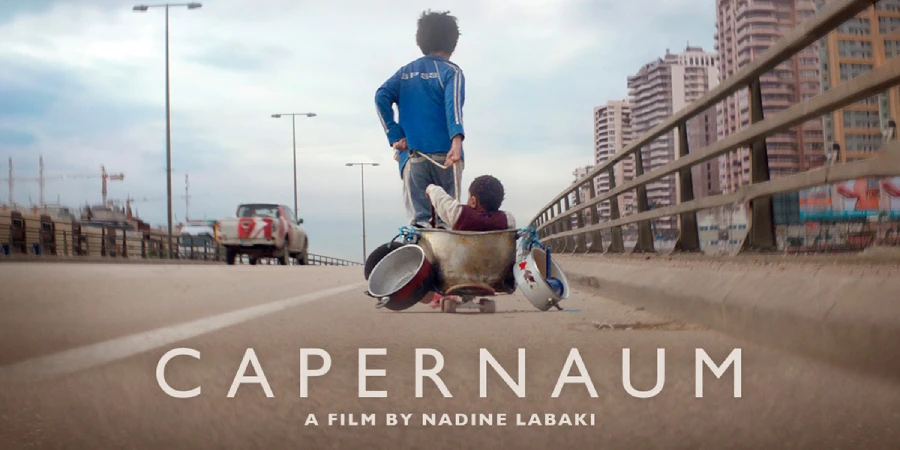
Zain essentially becomes Yonas’s caretaker while Rahil works. Watching him drag a makeshift cart with the toddler strapped inside through the streets of Beirut is one of the film’s most viscerally affecting images. He feeds the boy, sings to him, and protects him with a tenderness completely absent from his own upbringing.
Rahil’s Arrest and Zain’s Desperation
Rahil is suddenly arrested by immigration authorities. She disappears, leaving Zain alone with Yonas and no resources. Days stretch into weeks. Zain tries everything: he begs, he steals, he attempts to sell the forged cards Rahil had left behind. He dilutes powdered drink mix with water and calls it juice to sell to passersby.
Food runs out. Zain feeds Yonas shoe polish dissolved in water at one desperate point. He tries to reach the Swedish embassy after meeting a man named Aspro who promises to sell him forged Norwegian papers, but Zain needs a passport to proceed, and he has none. He contacts his parents for the first time since leaving, asking for his birth certificate. They tell him Sahar is dead.
Sahar’s Death and Zain’s Breaking Point
Sahar died from complications related to a pregnancy. She was a child. Zain learns this over the phone, and the weight of it is crushing. He leaves Yonas with Aspro, who he has no real reason to trust, and goes to find Assad.
Zain stabs Assad. He is arrested. Yonas, left with Aspro, is later found and placed in a care facility. The stabbing is not presented as a triumphant act of revenge; the film shoots it as a desperate, grief-fueled implosion from a child who had nowhere left to go.
The Lawsuit Takes Shape
From prison, Zain calls a television program and announces his intention to sue his parents. A lawyer named Nadine (played by the director herself) takes his case. The courtroom scenes weave through the flashback narrative, and we hear testimony from Selim and Souad, who do not present themselves as monsters. Souad speaks about her own suffering, her own lack of choices, her own childhood of poverty and abuse. Labaki deliberately makes their humanity legible, even as she refuses to excuse the harm they caused.


Movie Ending
Zain loses his lawsuit in any conventional legal sense: no court was going to find his parents criminally liable for birthing him into poverty. But the film never positions the lawsuit as something Zain could win in a courtroom. What he wins is a voice. He speaks. He is heard. A judge listens to a child who the entire system had rendered invisible.
In the final sequence, Zain gets his photograph taken for his first official identification document. He is being processed, finally, into legal existence. The photographer asks him to smile. For a long beat, Zain stares into the camera with that guarded, exhausted face we have watched for two hours. Then the smallest smile breaks across his lips.
Labaki freezes the frame on that smile. It is not a happy ending in any clean sense. Zain is still a poor child in Beirut. His sister is dead. His parents remain trapped in cycles of poverty. Yonas ends up reunited with Rahil after she is released, which the film confirms only briefly. The smile is not relief; it is recognition. Someone, finally, sees him.
What makes this ending so quietly devastating is its refusal to offer rescue. No NGO swoops in. No wealthy patron changes his fate. Zain gets a photograph taken, and the film treats this bureaucratic act as a form of grace, because for a child who did not officially exist, being documented means being real.
Are There Post-Credits Scenes?
Capernaum has no post-credits scenes. After the freeze-frame on Zain’s smile, the credits roll over real photographs and information about the cast members, many of whom were refugees or migrants living circumstances close to what they depicted on screen. Sitting through those credits is worth your time, not for a scene, but for context.
Type of Movie
Capernaum is a social realist drama with documentary-style aesthetics. Labaki shoots on location with handheld cameras and natural light, and the film frequently feels less like narrative fiction and more like witnessed reality. Its tone is unrelenting but not exploitative; grief and dark humor coexist in the same scenes.
Cast
- Zain Al Rafeea – Zain
- Yordanos Shiferaw – Rahil
- Boluwatife Treasure Bankole – Yonas
- Kawsar Al Haddad – Souad
- Fadi Yousef – Selim
- Cedra Izam – Sahar
- Alaa Chouchnieh – Assad
- Nadine Labaki – Nadine (the lawyer)
Film Music and Composer
Khaled Mouzanar, who is also Nadine Labaki’s husband, composed the score. Mouzanar built the music around sparse strings and percussion that mirror the film’s visual restraint. He avoids swelling orchestral manipulation, which is the right call; the film’s emotional weight does not need underlining.
Several tracks use Arabic vocal motifs that ground the music in the region without reducing it to atmospheric texture. Mouzanar had previously scored Labaki’s earlier films, and the collaboration is clearly a fluent one.



Filming Locations
Capernaum shot almost entirely in Beirut, primarily in the Sabra neighborhood and surrounding low-income districts. These are not dressed sets. Labaki filmed in actual homes, actual streets, and actual spaces inhabited by people in similar circumstances to her characters.
Shooting in these real spaces gives the film a texture no production designer could manufacture. Laundry lines cross between crumbling buildings. Sewage runs through alleyways. Children sleep on concrete floors covered by a single thin blanket. The locations are not background; they are argument.
Awards and Nominations
Capernaum won the Jury Prize at the Cannes Film Festival in 2018. It received an Academy Award nomination for Best Foreign Language Film at the 2019 ceremony. The film also earned widespread critics association nominations and wins internationally.
Behind the Scenes Insights
- Zain Al Rafeea was a Syrian refugee living in Beirut when cast. He had no acting experience. Labaki and her team found him through community outreach in refugee neighborhoods.
- Labaki conducted extensive research before shooting, spending time with undocumented migrants, refugees, and families living in Beirut’s poorest districts.
- The infant playing Yonas, Boluwatife Treasure Bankole, was genuinely only about one year old during production. Her mother, an undocumented Nigerian migrant in Beirut, played a small role in the film as well.
- Labaki and her team filmed for approximately six months, accumulating an enormous amount of footage. The edit took a very long time to shape into a coherent narrative structure.
- Many cast members were not given traditional scripts. Labaki used their real experiences as source material and guided scenes through improvisation-adjacent methods.
- Zain Al Rafeea and his family subsequently received refugee status in Norway after the film brought international attention to their situation.
Inspirations and References
Labaki has cited the real conditions of undocumented children in Lebanon as the direct inspiration. Lebanon hosts one of the highest per-capita refugee populations in the world, and the statelessness crisis, children with no birth certificates and no legal standing, is a documented and ongoing reality.
The film draws thematically from Italian Neorealism, particularly the tradition of shooting with non-professional actors in actual poverty-stricken environments as pioneered by directors like Vittorio De Sica in Bicycle Thieves. Labaki has not cited De Sica as a direct influence in interviews I can verify, but the lineage is visible on screen regardless.
Alternate Endings and Deleted Scenes
No officially confirmed deleted scenes or alternate endings have been released publicly. Given that the editing process reportedly involved hundreds of hours of footage, there are almost certainly substantial scenes that did not make the final cut. Labaki has spoken about the difficulty of editing down the material, but no specific cut content has been described in detail in sources I can confirm.
Book Adaptations and Differences
Capernaum is not based on a book. It is an original screenplay by Nadine Labaki, Jihad Hojeily, and Michelle Keserwany, developed from research and real-world testimonies rather than any pre-existing literary source.


Memorable Scenes and Quotes
Key Scenes
- Zain hiding Sahar’s menstrual blood-stained underwear, stuffing it under a mattress in a panic, knowing their parents cannot find out.
- Zain dragging the makeshift cart with Yonas strapped in through the streets of Beirut, the camera keeping low, following them at child-height.
- Zain attempting to make “juice” from powdered drink mix and dirty water to sell to strangers, then drinking what is left himself because he is starving.
- The phone call where Zain learns Sahar has died; he sits in silence for a moment, and then something behind his eyes shuts down.
- The final freeze-frame on Zain’s reluctant, barely-there smile for his ID photograph.
- Souad’s testimony in the courtroom, where she describes being beaten and abused herself since childhood. It does not exonerate her. It complicates everything.
Iconic Quotes
- “I want adults who can’t take care of their children to stop having kids.” (Zain, during his courtroom testimony)
- “My name is Zain. I’m about twelve years old. I don’t have papers.” (Zain’s self-introduction, which establishes the film’s entire moral landscape in three sentences)
Easter Eggs and Hidden Details
- The title Capernaum is the Arabic word for chaos or disorder. In English it also refers to a city in Galilee connected to the story of Jesus, adding a layer of abandoned innocence to the naming choice.
- Labaki appears on screen as the lawyer Nadine, a casting choice that places the director literally inside the system she is interrogating.
- Several of the background adults in the slum scenes are actual residents of those streets, not hired extras, which accounts for the naturalistic density of the crowd scenes.
- Yonas’s real mother appears briefly in the film, meaning the on-screen emotional bond between Yonas and his caretakers was anchored by an actual familial presence just off camera.
Trivia
- Zain Al Rafeea was reportedly discovered when Labaki’s team knocked on doors in refugee communities in Beirut. He had never seen a film set before shooting began.
- Cannes audiences gave the film a long standing ovation at its premiere, and Labaki wept during the reception.
- The film’s Arabic title, Capernaum, was kept in the international release because no single English word captures the full meaning of the chaos it describes.
- Boluwatife Treasure Bankole, who plays Yonas, won a special award at some international festivals for her performance, which is astonishing given she was barely a year old during filming.
- Zain Al Rafeea and his family relocated to Norway after the film premiered. He has continued working as an actor since.
Why Watch?
Watch this film specifically for the scene where Zain sits on a curb, Yonas strapped to his back with a piece of rope, and methodically counts the coins in his hand. Zain Al Rafeea performs exhaustion with a specificity no acting coach teaches. No other 2018 film put a child’s survival instinct on screen with this much unadorned honesty.
Director’s Other Movies
- Caramel (2007)
- Where Do We Go Now? (2011)
Recommended Films for Fans
- Bicycle Thieves (1948)
- City of God (2002)
- The Florida Project (2017)
- Beasts of the Southern Wild (2012)
- Slumdog Millionaire (2008)
- Wadjda (2012)
- The Teachers’ Lounge (2023)
- Persepolis (2007)
- Shoplifters (2018)