
Hirokazu Kore-eda spent years making quiet films about family, grief, and memory, but Shoplifters feels like the one where everything clicked into place simultaneously. A family of petty thieves scraping through Tokyo’s margins takes in an abandoned child, and what follows is two hours of slow-burn intimacy that eventually detonates. Kore-eda never lets you forget the cold. Every cramped room, every shared meal, every stolen bag of crisps carries a specific weight that no amount of plot summary can fully reproduce.
Detailed Summary
The First Shoplifting Run
We meet Osamu Shibata and his young companion Shota working a grocery store with practiced, unhurried ease. Osamu signals with hand gestures, Shota pockets items without breaking stride, and the whole operation has the relaxed choreography of people who have done this many times. It is immediately clear these two enjoy each other’s company, and that joy is part of what makes the film’s later revelations so devastating.
On the walk home through a freezing January night, they find a small girl named Yuri sitting alone on a balcony in the cold. Osamu’s first instinct is to leave her. His second instinct wins.
The Shibata Household
Home is a tiny, cluttered house occupied by five people living on the pension of elderly Hatsue, the family’s nominal grandmother. Nobuyo, Osamu’s partner, works at a laundry. Aki, a young woman who claims to be Hatsue’s granddaughter, earns money at a voyeuristic club where men pay to watch her through a pane of glass.
Kore-eda shoots this house from the inside, always tight, always warm-lit, always slightly claustrophobic. You feel the thinness of the walls and the closeness of these bodies sharing a single floor. It is one of the finest pieces of production design in any of his films.
Yuri, whom the family initially plans to return, keeps showing up with fresh bruises. When Nobuyo discovers cigarette burns on the girl’s skin, the decision is made: Yuri stays. They rename her Lin and absorb her into their routine without formal announcement.
Learning the Trade
Shota begins teaching Yuri how to shoplift. He follows Osamu’s logic that stealing from shops does not hurt any individual person. There is a tender, methodical quality to these lessons. Shota is serious, almost professorial, and Yuri watches him with enormous, cautious eyes.
A scene at the fishing spot is the film’s warmest stretch. Osamu and Shota sit side by side, rods out, saying almost nothing. Kore-eda holds the shot long enough that you feel the specific texture of that silence, the kind that only exists between people who are genuinely comfortable together.
Hatsue’s Secret Trips
Hatsue makes quiet, periodic visits to a well-off neighborhood where she sits on a bench and watches a house. We learn she has a complicated history with a man who remarried and built a comfortable life without her. She has been collecting pension money owed by that former arrangement, money that sustains the entire household.
Sakura Ando and Lily Franky carry most of the dramatic oxygen, but Kirin Kiki as Hatsue operates on a different frequency. Her performance is almost entirely in small physical gestures: a pause before answering, a glance held a beat too long. She is the most quietly heartbreaking element in a film full of heartbreak.
Aki and the Glass Booth
Aki’s job at the club is framed without judgment but with real attention. She presses her palm against the glass partition, and a male client on the other side mirrors the gesture. It is intimate in the way that things separated by barriers sometimes are, and the film uses it to sketch her loneliness without spelling it out.
A younger worker at the club starts appearing on television, claiming to be a missing person. Aki knows who this woman is. She recognizes the family connection, and the recognition sits on her face like a stone she cannot put down.
Cracks in the Surface
Shota begins to feel uneasy. He can see that Yuri is genuinely happy here, which unsettles him, partly because he understands better than she does what this family actually is. He deliberately gets caught shoplifting at the convenience store, a choice that reads as self-sabotage and, more accurately, as a sacrifice.
His arrest sets off the collapse. Police investigate. The family’s constructed identity begins to unravel almost immediately, because none of it was built to survive scrutiny.
Hatsue’s Death
Hatsue dies quietly at home. The family buries her in the dirt floor under the house rather than report the death, partly to keep collecting her pension. It is the film’s most morally difficult moment, and Kore-eda stages it without any dramatic score swelling. Just the act, and then the family eating dinner above her.
What makes this genuinely complex is that grief is present. These people loved her. Pragmatism and love occupy the same moment without canceling each other out.


Movie Ending
After Shota’s arrest, police unravel everything with clinical efficiency. Nobuyo confesses to taking Yuri, absorbing the charges to shield Osamu. She sits across from detectives and fields their questions with quiet, patient dignity. When a detective asks whether she loved the girl, Nobuyo pauses, and then says she showed her affection in the only way she knew. That pause is the best single acting beat in the film.
Yuri returns to her biological parents, who are presented to the press as a grieving family. A later shot shows Yuri alone on that same outdoor balcony, in the cold, the place where Osamu first found her. Nothing has changed for her. The camera simply watches her stand there.
Shota meets Osamu one last time through a bus window. Osamu calls out to him. Shota turns, sees him, and does not respond. He faces forward as the bus pulls away. Whether this silence is anger, grief, or a child finally choosing his own posture toward the world is left entirely open, and the film is right to leave it there.
Nobuyo, in custody, admits she wonders whether Yuri actually called her “mom” one time, or whether she imagined it. It is the kind of uncertainty that lands harder than any clean resolution would.
Are There Post-Credits Scenes?
Shoplifters has no post-credits scenes. Once the film ends, it ends fully. Kore-eda gives you silence, not supplemental material.
Type of Movie
Shoplifters is a social drama with strong elements of family character study. Its tone moves between warmth and dread with very little warning. It is slow-paced in the best sense: every scene builds something you will need later.
Genre purists might call it arthouse cinema. That label is accurate but sells short how accessible and emotionally direct the film actually is.
Cast
- Lily Franky – Osamu Shibata
- Sakura Ando – Nobuyo Shibata
- Kirin Kiki – Hatsue
- Mayu Matsuoka – Aki
- Jyo Kairi – Shota
- Miyu Sasaki – Yuri / Lin
Film Music and Composer
Haruomi Hosono composed the score. Hosono is a foundational figure in Japanese popular music, best known internationally as a member of Yellow Magic Orchestra. His work here is stripped down and deliberately understated.
The music rarely announces itself. It drifts in at the edges of scenes like ambient sound, then withdraws. This restraint suits Kore-eda’s direction perfectly. A more conventionally emotional score would have undercut the film’s refusal to sentimentalize its characters.

Filming Locations
Principal photography took place in Tokyo, primarily in cramped residential neighborhoods that suggest the city’s less photographed interior. The production built the family’s home as a set, but it was designed to feel structurally specific, low ceilings, narrow corridors, a floor plan that forced actors into each other’s physical space.
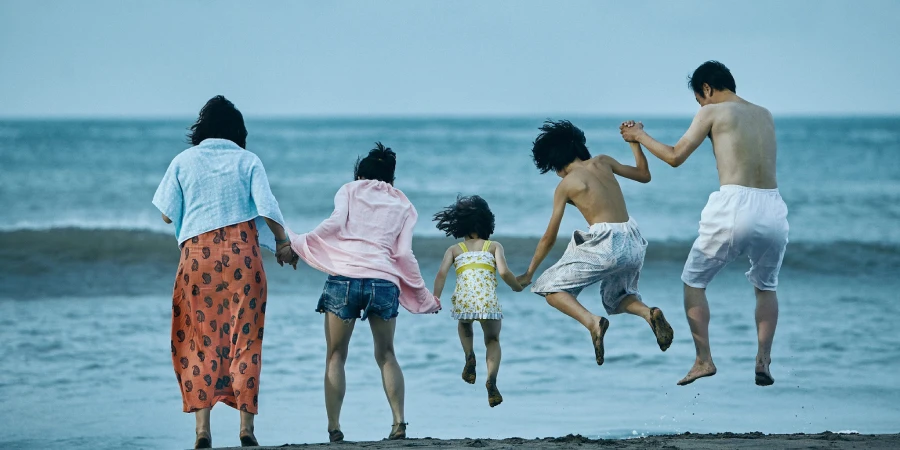
The beach sequence was shot at an actual coastal location and serves as the film’s one moment of spatial release. Open sky, wide sand, children running. Kore-eda uses that openness deliberately, giving you room to breathe precisely before the film begins to tighten its grip.
Awards and Nominations
Shoplifters won the Palme d’Or at the 2018 Cannes Film Festival, the highest prize in world cinema. It also received an Academy Award nomination for Best Foreign Language Film and won the BAFTA for Best Film Not in the English Language.
Kirin Kiki received widespread recognition for her performance before her death in September 2018. Her notices were entirely deserved.
Behind the Scenes Insights
- Kore-eda wrote, directed, and edited the film himself, maintaining tighter creative control than most directors work with on productions of this profile.
- Kirin Kiki was seriously ill during production. Kore-eda knew this, and her death came shortly after the film’s Cannes premiere.
- Child actor Miyu Sasaki had very limited prior acting experience. Kore-eda reportedly spent significant time with her before filming, building the comfort level visible on screen.
- Jyo Kairi, who plays Shota, was cast partly for a quality of self-containment that Kore-eda wanted the character to project. That quality is present in every scene he appears in.
- Kore-eda has discussed conducting interviews with people living in poverty in Japan as part of his research process for this film. He did not treat the material as an outsider looking in.
Inspirations and References
Kore-eda drew from real news stories about families in Japan living off the pensions of deceased relatives, a phenomenon that attracted public attention and moral controversy in the country. The burying of Hatsue’s body under the floorboards connects directly to documented cases.
He has cited an interest in what constitutes a family outside legal and biological definitions. This preoccupation runs through much of his earlier work, but Shoplifters pushes it further into ethically uncomfortable territory than any of his previous films did.
Some critics have drawn comparisons to Italian Neorealism, particularly the way Shoplifters uses non-professional or semi-professional actors and specific real-world locations to anchor an emotional story in material reality.
Alternate Endings and Deleted Scenes
No alternate endings or significant deleted scenes have been officially released or confirmed in detail. Kore-eda is a precise editor of his own material, and the film does not feel as though sequences were removed.
He has spoken in interviews about the difficulty of calibrating how much information to withhold about each character’s backstory and for how long. Some backstory presumably landed on the cutting room floor, but specifics are not publicly documented.
Book Adaptations and Differences
Shoplifters is an original screenplay, not an adaptation. Kore-eda did publish a novelization of the story in Japan, which he wrote himself after completing the film. So the relationship between the film and the book runs in the opposite direction from most literary adaptations.



Memorable Scenes and Quotes
Key Scenes
- The opening shoplifting sequence, where Osamu and Shota work the supermarket in near-total silence, communicating through glances and tiny nods.
- Nobuyo burning Yuri’s coat in the courtyard, the garment curling and blackening in the fire while she watches without expression.
- The fishing scene, Osamu and Shota sitting side by side with rods in the water, the city noise absent, a rare pocket of peace in the film.
- Hatsue alone on the beach, watching the children play from a distance, whispering something to herself that the camera does not let us hear.
- Shota on the bus, turning toward Osamu’s voice through the glass and then turning away again as the vehicle moves.
- Nobuyo’s police interrogation, where Sakura Ando delivers every answer with the measured stillness of someone who has already processed her own guilt privately.
Iconic Quotes
- “If I had given birth to you, you would have been born.” (Nobuyo to Shota, reframing what makes parenthood real.)
- “We don’t hit here. We use words.” (Nobuyo explaining to Yuri, without fanfare, what this household offers that her birth home did not.)
- Hatsue, quietly, to the children on the beach: “Thank you.” She says it so softly it barely registers, which is entirely the point.
Easter Eggs and Hidden Details
- The name Lin that the family gives Yuri means “companion” in one reading of the kanji. Whether intentional or not, it fits her function in Shota’s emotional arc exactly.
- Hatsue’s visits to the bench outside the affluent house mirror the way the film frames the Shibata family itself: always watching comfort from the outside.
- Shota’s habit of reading quietly in the corner of scenes positions him as an observer before we fully understand that observation is his primary mode of self-protection.
- The laundry where Nobuyo works appears in the background of a news broadcast in a different scene, a quiet reminder that the city contains these people without noticing them.
- The glass partition in Aki’s club echoes the bus window through which Shota and Osamu have their final non-conversation. Kore-eda seems genuinely interested in barriers that allow looking without touching.
Trivia
- This was Kirin Kiki’s final completed film role. She died in September 2018, months after the Cannes premiere.
- Kore-eda is both writer and director, but he also served as editor on this film, which is unusual for a director at his level of international recognition.
- Shoplifters became one of the highest-grossing Japanese films in France in recent memory, finding a particularly strong audience there.
- Lily Franky and Kirin Kiki had previously worked together with Kore-eda on Like Father, Like Son (2013), so their on-screen comfort was built on an existing professional relationship.
- Kore-eda chose not to use a traditional narrative score for several key emotional scenes, relying instead on ambient sound design to carry the mood.
Why Watch?
Sakura Ando’s performance in the interrogation scene alone justifies the runtime. She answers questions about whether she loved a stolen child with a stillness that is more precise and more honest than any tearful confession a less confident film would have reached for. Kore-eda trusts his actors and his audience in equal measure, and that trust is exactly what separates this film from the dozens of poverty dramas that mistake misery for insight.
Director’s Other Movies
- Maborosi (1995)
- After Life (1998)
- Distance (2001)
- Nobody Knows (2004)
- Still Walking (2008)
- Like Father, Like Son (2013)
- Our Little Sister (2015)
- After the Storm (2016)
- The Truth (2019)
- Broker (2022)
- Monster (2023)
Recommended Films for Fans
- Nobody Knows (2004)
- Still Walking (2008)
- Parasite (2019)
- Capernaum (2018)
- Umberto D. (1952)
- A Simple Life (2011)
- The Florida Project (2017)
- Welfare (1975)