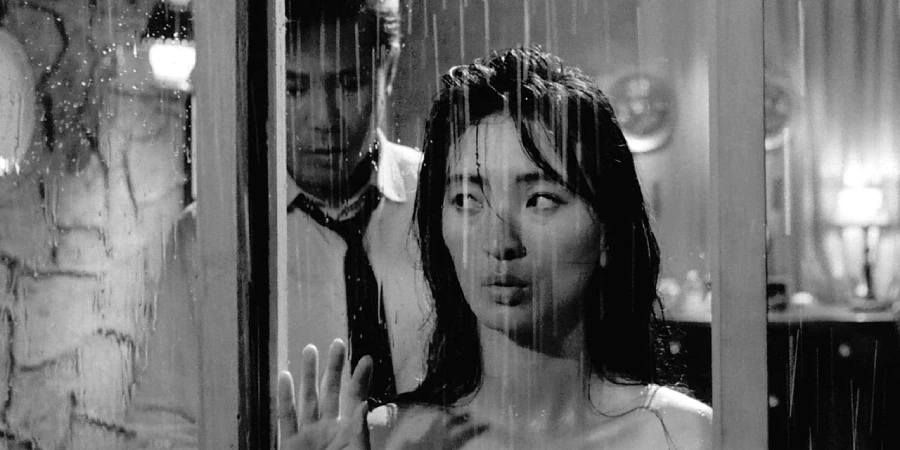

Kim Ki-young’s 1960 Korean film about a piano teacher, his family, and their new housemaid sounds almost quaint on paper. Watch the first twenty minutes and that assumption collapses completely. A woman arrives in a household and proceeds to unravel it from the inside out, using desire, manipulation, and sheer psychological pressure as her tools. What Ki-young delivers is a film about class anxiety so sharp it still draws blood.
Detailed Summary
A Factory, a Dream, and a New Home
Dong-sik is a piano and music teacher who works part-time teaching female factory workers. His family lives in a modest two-story home that his wife has paid off through grueling sewing work. Dong-sik’s ambition is simple: fill that home with refinement, music, and a sense of upward mobility.
One of his factory students, Kyung-hee, develops a crush on him and begins writing him letters. When a colleague discovers the letters and warns Dong-sik, that colleague is pressured out of her factory job. She later comes to Dong-sik and suggests he hire a housemaid to help his overworked wife.
The Housemaid Arrives
Dong-sik hires a young woman whose name is never fully emphasized but who becomes the film’s consuming center of gravity. She is intense, emotionally unstable, and immediately fascinated by Dong-sik. Her behavior unsettles the children from the start, particularly the sharp-eyed daughter.
Small incidents pile up quickly. The housemaid kills a rat with a terrifying and almost gleeful focus. She begins inserting herself into the family’s routines in ways that feel just slightly off, hovering, watching, waiting for an opening.
Seduction and Submission
Dong-sik eventually gives in to the housemaid’s persistent advances and begins an affair with her. Ki-young frames this not as pure predatory seduction from her side, but as a failure of will on his part. He is a weak man who mistakes his own passivity for innocence, and the film never lets him forget it.
When the housemaid becomes pregnant, the power dynamic in the household shifts violently. She uses the pregnancy as leverage, demanding recognition and a permanent place in the family. Dong-sik’s wife, now aware of everything, is forced into a horrifying calculation.
The Miscarriage and Its Aftermath
Dong-sik’s wife coerces the housemaid into drinking a concoction intended to cause a miscarriage. It works. The housemaid loses the baby after a scene filmed with a clinical, almost documentarian coldness that makes it far more disturbing than melodrama ever could.
This is arguably the film’s most morally complex stretch. Nobody in that house occupies clean moral ground. The wife acts from survival instinct, Dong-sik stands by and watches, and the housemaid’s grief tips her into something far more dangerous than before.
Escalation and Violence
Grief curdles into rage. The housemaid begins terrorizing the family openly, refusing to leave and making daily life a sustained nightmare. She pushes the couple’s young son down the stairs, killing him. Ki-young films the moment with a cold precision that refuses to let the audience look away or feel protected by stylization.
At this point the film becomes a home-invasion horror story told in the language of domestic melodrama. The housemaid owns the space now in every psychological sense, even as the family scrambles to contain the damage she keeps inflicting.



Movie Ending
Cornered and out of options, Dong-sik’s wife and daughter give the housemaid rat poison dissolved in a drink. She drinks it knowingly. This is the detail that Ki-young refuses to let pass quietly: the housemaid understands what she is drinking and chooses to drink it anyway, turning her death into an act of defiant self-destruction rather than a simple murder.
She dies upstairs. The family seems, for a moment, to have survived. Then Ki-young pulls the camera back and delivers one of the most startling structural choices in Korean cinema history.
Dong-sik wakes up. It was a dream, or at least the film now frames it as one. He sits with his wife, they look at the audience directly, and Dong-sik addresses the camera. He tells the viewer that a man who lets temptation into his home deserves everything that follows. It is a morality-tale epilogue delivered with a smirk that makes it feel deeply insincere, almost satirical.
Ki-young uses this ending to have it both ways, and brilliantly so. He gives the censors and the moral majority their tidy lesson while simultaneously winking at the audience. The dream framing does not erase what we watched. It makes the nightmare feel more present, not less, because we understand that this is the shape of Dong-sik’s fear. His guilt is the story, whether it happened or not.
Audiences most often ask whether the events were real or a dream. Ki-young never resolves this cleanly, and that ambiguity is clearly intentional. The more interesting question the film poses is why Dong-sik’s subconscious punishes the women around him rather than himself.
Are There Post-Credits Scenes?
No. There are no post-credits scenes. The film ends with its unsettling direct-address epilogue before the credits, not after.
Type of Movie
The Housemaid sits at an unusual intersection of domestic melodrama, psychological horror, and social satire. Its genre is genuinely hard to pin down, which is part of why it still generates discussion.
The tone oscillates deliberately. Some scenes play like a family melodrama from the 1950s, others function as pure horror, and the ending tilts into something closer to dark comedy. Ki-young holds all three registers simultaneously without letting any one of them fully win.
Cast
- Kim Jin-kyu – Dong-sik, the music teacher
- Eom Aeng-ran – The Housemaid
- Ju Jeung-nyeo – Dong-sik’s wife
- Ahn Seon-young – Kyung-hee, the factory girl
Film Music and Composer
Music sits at the center of the film’s thematic architecture rather than decorating its edges. Dong-sik teaches piano, and the sound of lessons and practice runs through the early scenes as a marker of the family’s aspirations.
Ki-young used a score that leans on tension and unease rather than conventional melodramatic swells. The contrast between the domesticity of piano music in the home and the psychological violence happening inside that same home is one of the film’s sharpest ironies.



Filming Locations
The Housemaid takes place almost entirely within a single domestic space: the family’s two-story house. Ki-young shot the film on sets rather than real locations, and this confinement was a deliberate choice.
The house becomes a character. Its staircase, in particular, carries enormous symbolic weight. Characters climb and descend it repeatedly, and the son’s death on those stairs makes the architecture feel permanently contaminated by the time the film ends.
Shooting in post-war South Korea in 1960, Ki-young was working in a country still rebuilding its identity. The anxious striving of the family, their pride in their new home, their terror of losing it, all of this is rooted in that specific historical moment.
Awards and Nominations
The Housemaid did not receive major international awards attention upon its original release, largely because Korean cinema had minimal distribution in Western festival circuits in 1960. Its critical rehabilitation and recognition came decades later, after restoration efforts made the film widely accessible again.
Behind the Scenes Insights
- Director Kim Ki-young had a reputation for intense, unconventional working methods that unnerved cast and crew alike.
- Ki-young reportedly insisted on the confined domestic setting partly for budget reasons and partly because he wanted the claustrophobia to feel physically real to the actors.
- Eom Aeng-ran’s performance as the housemaid required her to modulate between pitiable vulnerability and genuinely frightening volatility, sometimes within a single scene. The casting was Ki-young’s most inspired production decision.
- The film was produced at a time when Korean cinema was experiencing a commercial boom, and Ki-young positioned The Housemaid partly as a response to the sanitized melodramas dominating Korean screens.
- The rat-killing scene early in the film was reportedly shot with an actual rat and was not a comfortable shoot for anyone involved.
Inspirations and References
Ki-young drew on a real newspaper story about a housemaid who poisoned a family as the seed for the script. He transformed that news item into a much wider meditation on class, desire, and domestic instability.
The film also reflects anxieties that were circulating broadly in 1960 Korean society: rapid urbanization, the emergence of a new middle class, and the instability underneath that newly constructed comfort. Ki-young was not making a film about one household. He was diagnosing a nation.
Bong Joon-ho has cited The Housemaid as a significant reference point for his own work, and the class-warfare architecture of Parasite owes an obvious debt to Ki-young’s film.
Alternate Endings and Deleted Scenes
No reliably documented alternate endings or deleted scenes from the original 1960 production are publicly available. The film was lost for many years before being recovered and restored, and detailed production records from that era are scarce.
Im Sang-soo directed a remake in 2010 that reimagines the story with significant differences in tone and resolution, but that is a separate work rather than an alternate version of Ki-young’s original.
Book Adaptations and Differences
The Housemaid was not adapted from a book. Ki-young wrote the screenplay himself, drawing from the newspaper incident and his own preoccupations with class and domestic psychology.

Memorable Scenes and Quotes
Key Scenes
- The rat killing: Early in the film, the housemaid corners and kills a rat with an efficiency and focus that makes everyone in the room, including the audience, deeply uncomfortable. Ki-young holds on her face just long enough.
- The forced miscarriage: Dong-sik’s wife hands the housemaid a drink in a scene filmed with almost no music and very little camera movement. The stillness makes it more brutal than any dramatic score could.
- The son’s death on the staircase: The boy falls and the camera does not cut away at the comfortable moment. Ki-young lets the scene breathe past the point where conventional melodrama would have ended it.
- The direct-address ending: Dong-sik looks into the camera and speaks to the viewer. For 1960, this is a startling formal rupture, and it lands like a cold hand on the back of the neck.
- The housemaid drinking the poison: She raises the glass and her eyes tell us she knows exactly what is in it. She drinks anyway. This single gesture is the film’s most haunting image.
Iconic Quotes
- “A man who invites temptation into his home deserves what follows.” (Dong-sik, in the epilogue address to the audience, paraphrased from the film’s concluding monologue.)
Easter Eggs and Hidden Details
- The staircase in the home appears in nearly every scene involving a shift in power between characters. When the housemaid begins to dominate the household, she is almost always filmed at the top of the stairs looking down.
- Dong-sik’s piano teaching is framed in the early scenes as a civilizing force. By the film’s midpoint, nobody plays the piano anymore. Ki-young never calls attention to this absence; he simply lets it disappear.
- The daughter is consistently the most perceptive character in the film. She reads the housemaid correctly from the first day, and every adult ignores her. Ki-young seems to be making a pointed observation about whose warnings get dismissed in a patriarchal household.
- The housemaid’s name is deliberately kept vague and understated in the narrative. Ki-young seems to position her as a force rather than a fully individuated person, which is a provocative choice that can be read as either critical or sympathetic depending on your angle.
Trivia
- The Housemaid was one of the most commercially successful Korean films of 1960, which made its dark and subversive content all the more remarkable for its time.
- Ki-young made two quasi-sequels that revisited similar themes: Woman of Fire (1971) and a later version in 1982. None of these are direct sequels but rather reworkings of the same obsessions.
- The film was largely inaccessible internationally for decades due to a combination of poor archival practices and limited distribution. A restoration project brought it back to visibility and introduced it to a global audience.
- Bong Joon-ho programmed the restored Housemaid as part of a Cannes retrospective presentation, directly crediting Ki-young as a foundational influence on his own filmmaking.
- The direct-address epilogue was required partly to satisfy censors who demanded moral closure. Ki-young delivered the letter of that requirement while subverting its spirit entirely.
Why Watch?
Eom Aeng-ran’s performance alone justifies the two hours: she makes the housemaid simultaneously pathetic, terrifying, and oddly sympathetic without ever softening any of those qualities. Ki-young uses a single staircase to map a complete collapse of domestic order. No other Korean film from this era puts class anxiety on screen with this much venom and this little sentimentality.
Director’s Other Movies
- Yangsan Province (1955)
- Woman of Fire (1971)
- Io Island (1977)