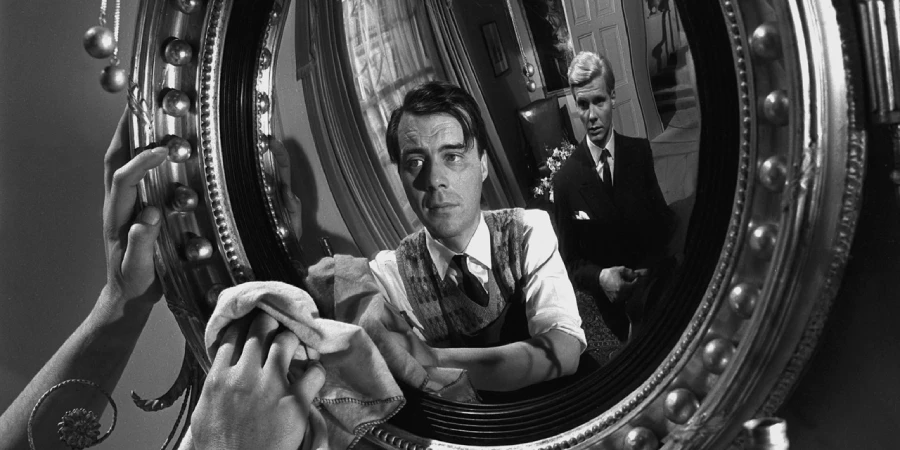

Power does not announce itself. In Joseph Losey’s The Servant, it seeps through the floorboards of a Chelsea townhouse and floods every room before the owner notices he is already drowning.
Harold Pinter’s screenplay strips the class warfare subtext bare with surgical precision, and what Dirk Bogarde does with the role of Barrett is one of the most controlled, quietly predatory performances British cinema has ever produced. This film will make you distrust anyone who refills your glass without being asked.
Detailed Summary
Tony Arrives and Barrett Sizes Him Up
A young, wealthy, and frankly spineless man named Tony moves into a crumbling Chelsea townhouse. He hires Hugo Barrett as his manservant, and from the first meeting the dynamic is already tilted. Barrett arrives composed, methodical, and quietly assessing every weakness Tony presents.
Tony has money and a fiancee named Susan, but he has no spine, no discipline, and no real grip on his own life. Barrett clocks all of this within minutes. He begins arranging the household with an efficiency that flatters Tony while simultaneously making Tony dependent on him.
Susan Smells a Rat
Susan dislikes Barrett almost immediately, and the film rewards her instincts by proving her completely right. She senses the power imbalance but cannot fully articulate it to Tony, who dismisses her discomfort as snobbery or jealousy. Pinter’s script gives Susan sharp, suspicious dialogue, yet Tony consistently chooses comfort over her warnings.
This tension between Susan’s clarity and Tony’s willful blindness drives the first half. Losey frames their arguments in tight interiors, the walls of the house closing in, the space feeling smaller every time Barrett appears in the background of a shot.
Vera Enters the House
Barrett introduces Vera into the household under the pretense that she is his niece, brought in to assist with domestic duties. Tony accepts this without scrutiny. Vera is young, sexually provocative, and she begins a deliberate seduction of Tony almost immediately.
Susan eventually discovers Tony and Vera in bed together. She ends the engagement and walks out. It is the pivotal rupture of the film, and it is entirely engineered by Barrett. Vera is not his niece; she is his girlfriend, planted inside the house to destroy Tony’s most stabilizing relationship.
Barrett Is Dismissed, Then Returns
Tony fires Barrett once the Vera deception is exposed. For a brief moment the film seems to reset, giving Tony a chance to reclaim himself. He stumbles through an attempt at independence, but the house feels wrong without Barrett in it, and Tony has lost the organizational will to function alone.
Barrett returns. Tony lets him back in, and this decision is the point of no return. From here, the balance of power flips completely and never recovers. Losey shoots Barrett’s return with a quiet confidence that feels genuinely chilling.
The Reversal Completes Itself
Barrett begins drinking openly. He brings disreputable company into the house. He addresses Tony with casual insolence, sometimes barely bothering to perform deference at all. Tony, dissolving into alcohol and lethargy, accepts every degradation.
Vera reappears. Tony slides into a fog of drink, sex, and passivity so complete that he can no longer distinguish servant from master. Barrett now runs the house, runs Tony, and exercises power with an ease that reads as both triumph and contempt.

Movie Ending
By the final act, the Chelsea townhouse has become a kind of hell with good plumbing. Tony sits slumped and vacant while strangers drift through rooms that are no longer his in any meaningful sense. Barrett hosts, commands, and occasionally mocks Tony to his face without consequence.
Susan makes one last attempt to reach Tony. She visits the house and finds him so far gone that genuine connection is impossible. Losey stages their final exchange as a kind of autopsy on a relationship that Barrett efficiently killed months earlier. Tony cannot follow her out.
The film ends without a dramatic confrontation or a redemption arc. Tony is simply lost, sitting in the wreckage of his own class assumptions, having handed his autonomy to the one person his world told him was beneath him. Barrett wins by watching his employer choose dissolution over effort, and Losey refuses to soften that conclusion with any redemptive gesture.
What Pinter and Losey understood, and what makes the ending so airless and uncomfortable, is that nobody forced Tony into any of this. Every door he walked through, he opened himself. The film’s final image of Tony passive in his own home is not a shock ending but a quiet, inevitable arrival at the destination the first scene was already pointing toward.
Are There Post-Credits Scenes?
The Servant contains no post-credits scenes. It is a 1963 film, and the concept was not part of filmmaking convention at that time. When it ends, it ends, and frankly the weight of that ending needs no appendix.
Type of Movie
The Servant is a psychological drama with strong undertones of class satire and social horror. Its tone is cold, controlled, and suffocating. Losey works in a naturalistic register that makes the film’s power dynamics feel disturbingly plausible rather than theatrical.
There is also a distinct strain of psychosexual tension running through the film. Critics have long read the Barrett and Tony relationship as carrying repressed homoerotic charge, and the film does nothing to discourage that reading.
Cast
- Dirk Bogarde – Hugo Barrett
- James Fox – Tony
- Wendy Craig – Susan
- Sarah Miles – Vera
- Catherine Lacey – Lady Mounset
- Richard Vernon – Lord Mounset
- Patrick Magee – Bishop
Film Music and Composer
John Dankworth composed the score for The Servant. Dankworth was one of Britain’s leading jazz musicians and composers, and his background in jazz gives the score an unsettled, improvisational quality that suits the film’s creeping unease perfectly.
The music avoids grand orchestral statement. It insinuates itself into scenes rather than underlining them, which is exactly the right instinct for a film about a man who takes over your life before you realize what is happening. Cleo Laine, Dankworth’s partner, contributed vocals that add a haunting texture to certain sequences.



Filming Locations
The Servant was shot primarily in London, with the Chelsea townhouse setting central to the film’s identity. Much of the interior work took place on location in actual London properties rather than studio sets, which gives the architecture a genuine weight and claustrophobia that a constructed set would struggle to replicate.
Chelsea in the early 1960s carried specific class associations: aspirational, moneyed, socially anxious. Losey chose the location deliberately. A house in Chelsea communicates Tony’s background and pretensions without a single line of expository dialogue.
The house itself becomes almost a character. Its narrow staircase, its basement kitchen, its mirrored rooms all function as spatial arguments about hierarchy and who actually controls the territory. The downstairs and upstairs geography makes every scene a visual commentary on class position.
Awards and Nominations
Dirk Bogarde received a BAFTA nomination for his performance as Barrett. The Servant also received recognition from the British Film Academy in additional craft categories, and it performed strongly with British critics upon release.
Harold Pinter’s screenplay brought him significant critical attention, cementing his reputation as a major voice in British dramatic writing beyond the stage.
Behind the Scenes Insights
- Joseph Losey was an American director who had relocated to Britain after being blacklisted in Hollywood during the McCarthy era. His outsider perspective on British class structure arguably sharpened The Servant‘s satirical edge considerably.
- Dirk Bogarde reportedly considered The Servant the most important film of his career and spoke about it as a turning point that allowed him to abandon his earlier matinee idol persona entirely.
- The Servant was the first of three collaborations between Losey and Pinter, followed by Accident and The Go-Between.
- James Fox was relatively inexperienced at the time of filming, and Losey reportedly used that quality deliberately, allowing Fox’s natural uncertainty to feed into Tony’s characterization.
- Sarah Miles has spoken about the shoot as intensely demanding, with Losey pushing the cast through multiple takes to find the right register of unease rather than overt menace.
- Bogarde prepared for Barrett by studying the physical economy of professional servants, working to suppress any gesture that might read as theatrical or overstated.
Inspirations and References
The Servant adapts a 1948 novella of the same name by Robin Maugham, nephew of Somerset Maugham. Maugham’s source material already contained the class inversion at its core, but Pinter’s adaptation sharpened and deepened it considerably.
Losey and Pinter were also both deeply interested in Harold Pinter’s own theatrical preoccupations: menace beneath mundane surfaces, language used as a weapon, and power exercised through silence as much as speech. Those obsessions fit Maugham’s premise with almost frightening precision.
Losey’s experience as a blacklisted American in Britain gave him a personal relationship to questions of social belonging and exclusion that Maugham’s story clearly activated. His status as an outsider watching British class performance from close proximity informed every directorial choice.
Alternate Endings and Deleted Scenes
No well-documented alternate endings or significant deleted scenes from The Servant are part of the public record. Losey was a precise filmmaker who prepared thoroughly, and the film does not appear to have generated the kind of test-screening controversy that typically produces alternate cuts.
If additional material was shot and not used, it has not surfaced in any widely available form or been discussed in depth by the principal collaborators in documented interviews.
Book Adaptations and Differences
Robin Maugham’s 1948 novella The Servant is the source material. In the novella, the story arrives through a framing device: a narrator who knows Tony reconstructs events after the fact, giving the tale a retrospective, almost elegiac quality.
Pinter strips that framing device entirely. His screenplay places the audience inside events in real time, which ratchets up the tension considerably. We cannot observe from a safe narrative distance; we watch it happen.
Pinter also deepened the psychosexual dimension that Maugham’s novella only sketched. The film makes the Barrett and Tony dynamic far more charged and ambiguous than the source text, and that choice is what gives the adaptation its lasting grip.

Memorable Scenes and Quotes
Key Scenes
- Barrett’s first interview with Tony: Bogarde sits completely still, answers every question with precise pleasantness, and yet every line reading carries a faint trace of appraisal. You can watch him calculating.
- The ball game in the stairwell: Barrett and Tony toss a ball back and forth in the narrow staircase. Losey frames it so their physical positions constantly shift between above and below, making the spatial metaphor literal without announcing it.
- Susan finds Tony and Vera: Shot with cold economy, no melodrama, no score swell. Craig’s face does all the work, and the scene ends before you expect it to.
- Barrett’s return to the house: He walks back in as though the dismissal never happened. Tony’s body language collapses into relief, and the audience understands that everything afterward is already decided.
- The final party sequence: Strangers fill Tony’s house, Barrett moves among them like a host, and Tony sits glassy-eyed at the margins of his own life. Losey shoots it with a wide, roaming camera that makes the house feel infinite and Tony feel very small inside it.
Iconic Quotes
- “I can manage perfectly well by myself, thank you.” Barrett to Tony, early in the film, in a line that will read very differently on a second viewing.
- “What’s happened to you, Tony?” Susan, in the final act, a question the film refuses to answer with anything neat.
Easter Eggs and Hidden Details
- The mirrored surfaces Losey uses throughout the film appear with increasing frequency as the power dynamic shifts. Early scenes have few reflections; the degraded final act is full of them, as though Tony has fractured into images of himself with no stable original remaining.
- Barrett’s uniform fits him perfectly from the first scene. Tony’s clothing becomes progressively more disheveled as the film advances, a costuming choice that quietly tracks his psychological unraveling.
- The basement kitchen, Barrett’s domain, is always sharply lit and organized. Tony’s rooms grow darker and more cluttered as his authority erodes. Losey uses these two spaces as a running visual contrast between who is actually in control.
- The ball-tossing scene in the staircase is framed so that whichever man stands higher on the stairs changes throughout the sequence, a deliberate visual argument about shifting hierarchy that Losey executes without a single word of dialogue.
- Vera’s introduction mirrors Barrett’s in structure: both arrive presenting one identity while concealing another. Pinter patterns their entrances so that an attentive viewer on a second watch can catch the echo.
Trivia
- James Fox was so shaken by the experience of playing Tony that he stepped away from acting for several years after the film, eventually pursuing religious work before returning to the screen.
- Dirk Bogarde had spent much of his earlier career playing conventional leading men in commercial British films. The Servant cracked that image permanently and opened the second, more critically serious phase of his career.
- The Servant was shot in black and white, a choice that in 1963 already carried a deliberate aesthetic statement, since color film was standard for prestige productions. Losey and cinematographer Douglas Slocombe used the format to emphasize texture, shadow, and the starkness of the class divide.
- Harold Pinter and Joseph Losey became close friends during the production, a relationship that sustained two further film collaborations over the following decade.
- Robin Maugham sold the rights to his novella for a modest sum and reportedly expressed admiration for what Pinter and Losey did with the material.
- Cinematographer Douglas Slocombe shot the film, and his work here is among the most disciplined of his career. Slocombe later went on to shoot the original Indiana Jones trilogy, a stylistic distance that makes his work on The Servant all the more striking in context.
Why Watch?
Watch this film specifically to see Dirk Bogarde do more with a pause and a half-smile than most actors do with a monologue. Barrett’s seduction of Tony happens almost entirely through implication, through what Bogarde withholds, and watching him dismantle a man’s autonomy without ever raising his voice is a masterclass in screen performance that no film school clip reel does justice.
Director’s Other Movies
- The Sleeping Tiger (1954)
- The Criminal (1960)
- The Damned (1963)
- King and Country (1964)
- Modesty Blaise (1966)
- Accident (1967)
- Boom! (1968)
- The Go-Between (1971)
- The Assassination of Trotsky (1972)
- Mr. Klein (1976)
Recommended Films for Fans
- Accident (1967)
- The Go-Between (1971)
- Teorema (1968)
- The Talented Mr. Ripley (1999)
- Sleuth (1972)
- The Ruling Class (1972)
- Death and the Maiden (1994)
- Parasite (2019)
- The Hand of God (2021)