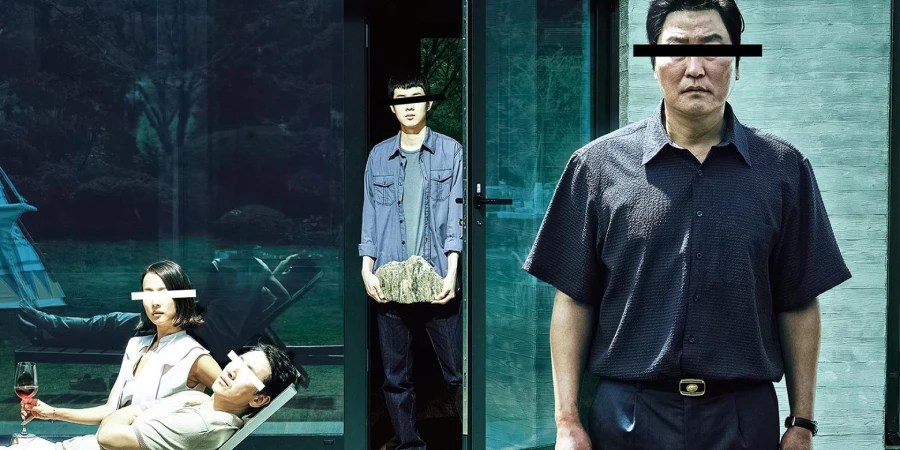

Bong Joon-ho opens Parasite with a shot of a semi-basement window at ankle height, and that framing tells you everything about who the Kim family is before a single line of dialogue lands. Released in 2019, the film follows two Korean families whose lives collide with comic precision and then catastrophic violence. Bong wrote the script with Han Jin-won, and every plot beat feels both inevitable and genuinely surprising. This is a film where a scholar’s rock becomes a murder weapon and a birthday party becomes a massacre.
Detailed Summary
The Kim Family and Their Semi-Basement Life
We meet the Kims folding pizza boxes in their cramped semi-basement apartment, hunting for wifi signals near the ceiling. Ki-woo (Choi Woo-shik) and his sister Ki-jung (Park So-dam) are sharp, funny, and completely broke. Their father Ki-taek (Song Kang-ho) and mother Chung-sook (Jang Hye-jin) share the same resourceful, slightly desperate energy.
Ki-woo’s college friend Min-hyuk drops off a scholar’s rock as a gift and recommends Ki-woo for a tutoring gig with the wealthy Park family. Ki-woo forges his credentials without a flicker of guilt. He lands the job instantly.
Infiltrating the Park Household
Ki-woo tutors Park Da-hye (Jung Ji-so), the teenage daughter of tech CEO Park Dong-ik (Lee Sun-kyun) and his bubbly, naive wife Yeon-kyo (Cho Yeo-jeong). He quickly spots an opportunity and recommends his sister as an art therapist for the Parks’ troubled young son Da-song (Jung Hyeon-jun), presenting her as a different person entirely.
Ki-jung, performing as “Jessica,” reads the household with terrifying accuracy. She manufactures a crisis to get the Parks’ existing driver fired, which opens a slot for Ki-taek. Then the family engineers the dismissal of Moon-gwang (Lee Jung-eun), the longtime housekeeper, by planting a fake peach allergy reaction and framing her for tuberculosis.
Chung-sook slides into the housekeeper role. All four Kims now work inside the Park house, none of them knowing the others are related. Bong plays this sequence for laughs, and the comedy is genuinely sharp. The scheming is so fluid and precise that you root for people doing objectively terrible things.
The Discovery in the Bunker
When the Parks leave for a camping trip, the Kims throw an informal party in the house, drinking the Parks’ wine and sprawling across their furniture. This is the film’s most relaxed and joyful stretch, and Bong lets it breathe before detonating it.
Moon-gwang returns to the house late at night, claiming she left something in the basement. Chung-sook reluctantly lets her in. Moon-gwang reveals a hidden bunker beneath the house, where her husband Geun-se (Park Myung-hoon) has been secretly living for years, hiding from loan sharks.
Geun-se is gaunt, pasty, and wholly devoted to Mr. Park, whom he worships from underground. He has been sneaking upstairs at night to raid the fridge. The revelation reframes the entire film: the Kims are not the only parasites.
Blackmail, Panic, and the Rain
Moon-gwang catches the four Kims together and realizes the con. She films them on her phone and threatens to expose everything. A brutal, ugly struggle follows on the basement stairs. Chung-sook locks Moon-gwang in the bunker and the Kims flee just as the Parks return early from their trip.
Ki-taek, Ki-woo, and Ki-jung hide under the coffee table while Mr. and Mrs. Park sit directly above them. What follows is an excruciating scene of involuntary eavesdropping. Mr. Park whispers that Ki-taek smells, using the phrase “like someone who takes the subway,” and Ki-taek hears every word.
That smell comment is, in my view, the single most important line in the film. It does not humiliate Ki-taek physically; it humiliates him at the molecular level, in front of his children, spoken by a man who does not even know he is there.
Torrential rain floods the semi-basement while the Kims are still hiding. By the time they escape, their home is submerged. Ki-jung’s carefully faked certificates wash away in the flood. Neighbors scramble around them while Da-song’s birthday party is still being planned upstairs, indifferent to the disaster below.
The Birthday Party Massacre
Da-song’s outdoor birthday party at the Park house becomes the site of total collapse. Ki-woo goes back into the bunker, ostensibly to deal with Moon-gwang and Geun-se. Geun-se smashes Ki-woo’s skull with the scholar’s rock, the same decorative stone Min-hyuk gave as a gift of prosperity.
Ki-jung arrives and gets stabbed by Geun-se before Chung-sook kills him. Chaos erupts across the lawn. Mr. Park’s driver, now Ki-taek, watches as his daughter bleeds and his son lies with a cracked skull. Mr. Park, seeing Geun-se collapse, tosses his car keys and shouts at Ki-taek to drive the injured man to hospital.
Ki-taek does not move toward the car. He stands over his bleeding daughter, watching Mr. Park hold his nose at the smell of Geun-se’s body. Something breaks in Ki-taek at that moment, visibly, quietly, before he explodes. He stabs Mr. Park dead.
Bong shoots the violence with a matter-of-fact speed that makes it more disturbing than any slow-motion gore could. Ki-taek vanishes. Ki-jung dies from her stab wound. Ki-woo survives with brain damage. Chung-sook is arrested. The Park family is shattered.


Movie Ending
Ki-woo wakes up in a hospital with a cracked skull and fragments of memory. He walks back to what used to be his semi-basement home, which now belongs to a German family who had no idea what happened there. He accepts this with an almost eerie calm.
From a neighbor’s hill, Ki-woo spots a light blinking in Morse code from the Park house. Ki-taek has been living in the bunker since the massacre, the same underground room where Geun-se spent years worshipping a rich man through a crack in the ceiling. Ki-taek has become the new basement dweller.
Ki-woo writes his father a letter in his head. He promises to make enough money someday to buy the Park house and walk his father up those stairs into the light. It is a beautiful fantasy, and Bong presents it with full sincerity before pulling back to show Ki-woo still standing on the hill outside, still broke, still underground in every sense that matters.
Ki-taek will not be rescued. Ki-woo knows it too, even if he cannot say it. The fantasy of upward mobility and the reality of vertical imprisonment share the same frame, and neither blinks first. This is where the film lands its sharpest point: the architecture of class is not just economic, it is physical, spatial, and almost geological.
Are There Post-Credits Scenes?
Parasite has no post-credits scene. Once the film ends on Ki-woo’s quiet devastation outside the house, it is done. There is nothing waiting after the credits. Bong earns his ending and does not undercut it with an appendix.
Type of Movie
Parasite resists easy genre labels, which is part of why it hit so hard. It opens as a dark comedy, pivots into thriller territory around the bunker reveal, and tips into tragedy by the final act. Bong himself called it “a comedy without clowns and a tragedy without villains,” which is an unusually accurate self-description.
Tonally, the film demands a lot from its audience. You laugh at the Kims’ scheming and then feel sick about laughing when the consequences arrive. That tonal whiplash is not a bug; it is the whole mechanism.
Cast
- Song Kang-ho – Ki-taek, the Kim family patriarch
- Choi Woo-shik – Ki-woo, the son
- Park So-dam – Ki-jung, the daughter
- Jang Hye-jin – Chung-sook, the mother
- Lee Sun-kyun – Park Dong-ik, the wealthy CEO
- Cho Yeo-jeong – Yeon-kyo, Mrs. Park
- Lee Jung-eun – Moon-gwang, the housekeeper
- Park Myung-hoon – Geun-se, Moon-gwang’s husband
- Jung Ji-so – Park Da-hye, the Parks’ daughter
- Jung Hyeon-jun – Park Da-song, the Parks’ son
- Park Seo-joon – Min-hyuk, Ki-woo’s friend
Film Music and Composer
Jung Jae-il composed the score, and his work here is one of the most underrated elements of the entire film. He uses strings with a waltz-like lightness during the comic infiltration sequences, which makes the violence land harder when the music shifts.
The track “The Belt of Faith” accompanies Ki-woo’s fantasy sequence near the end with a kind of aching sweetness. It makes the impossible dream feel real for about ninety seconds, which is exactly how long Bong needs it to work before the cut to reality.
Jung Jae-il also worked with Bong on Okja, so the collaboration was established before Parasite. His background spans orchestral composition and indie rock, and that range shows in how varied the score feels across the film’s tonal shifts.


Filming Locations
Most of Parasite was shot in and around Seoul, South Korea. Bong worked with production designer Lee Ha-jun to build the Park family mansion as a custom set on a studio lot. They did not find a real house that fit the script; they constructed one from scratch.
That decision paid off. Every spatial detail, the long driveway, the garden, the staircase down to the bunker, serves the story’s obsession with vertical class hierarchy. You cannot separate the architecture from the themes. The house is the argument the film is making.
The Kim family’s semi-basement was also a constructed set, designed to feel genuinely claustrophobic. Real semi-basements of that type exist across Seoul’s older neighborhoods, and Bong’s team researched them extensively to get the proportions and light right.
Awards and Nominations
Parasite made history at the 92nd Academy Awards by becoming the first non-English-language film to win Best Picture. It also won Best Director, Best Original Screenplay, and Best International Feature Film that same night.
At the Cannes Film Festival, it won the Palme d’Or, the top prize, with a unanimous jury vote. BAFTA awarded it Best Film Not in the English Language and Best Original Screenplay. The film’s awards run was one of the most complete in recent memory for a foreign-language title.
Behind the Scenes Insights
- Bong Joon-ho and co-writer Han Jin-won spent about four years developing the script before production began.
- Production designer Lee Ha-jun built the Park mansion set on a Seoul studio lot because no real location matched Bong’s spatial requirements for the story.
- The flooding sequence required a highly complex water rig, and the cast performed much of it practically rather than relying entirely on visual effects.
- Song Kang-ho and Bong have a long collaborative relationship going back to Memories of Murder in 2003, and Bong reportedly wrote Ki-taek with Song specifically in mind.
- Park So-dam auditioned for a different role initially before Bong cast her as Ki-jung.
- Bong has said the film grew from a single image he could not shake: a family living below a wealthy family, separated by floors and a staircase.
- Cho Yeo-jeong prepared for Mrs. Park by studying the behavior of wealthy Korean housewives, aiming for specificity rather than caricature.
Inspirations and References
Bong cited Joseph Losey’s The Servant (1963) as a reference point for class dynamics between employer and domestic staff. Both films are interested in how power shifts invisibly inside a household. Losey’s film is colder and more overtly sinister; Bong’s version is warmer before it is merciless.
The spatial logic of the film, wealthy people living above, poor people living below, draws on a long tradition of Korean social commentary in literature and cinema. Bong has also pointed to his own experiences of class anxiety growing up as an influence.
The scholar’s rock, or suseok, carries genuine cultural weight in Korea as a symbol of prosperity and good fortune. Bong deliberately weaponizes that symbolism by the end of the film.
Alternate Endings and Deleted Scenes
Bong has not released or publicly detailed any significant alternate ending for Parasite. He has spoken about how the script went through extensive revision, but the core ending, Ki-woo’s fantasy letter and the return to reality, was present relatively early in the writing process.
No official deleted scenes package has been released as of this writing. Given how tightly constructed the final film is, the absence of visible bloat suggests Bong cut material that would have disrupted pacing rather than added depth.
Book Adaptations and Differences
Parasite is not based on a book or any prior source material. Bong Joon-ho and Han Jin-won wrote the original screenplay. A graphic novel adaptation was published after the film’s release, illustrated by Tony Stella and adapted by Bong Joon-ho himself, but that came after the film rather than before it.


Memorable Scenes and Quotes
Key Scenes
- The wifi hunt: Ki-woo and Ki-jung hold their phones near the ceiling to catch a neighbor’s signal. This one image establishes the family’s ingenuity and their precariousness without a word of exposition.
- The coffee table scene: Ki-taek, Ki-woo, and Ki-jung lie rigid beneath the Parks’ glass coffee table while Mr. and Mrs. Park sit above, whispering. Mr. Park’s comment about Ki-taek’s smell filters down to the man it describes.
- The flood: The Kims return home to find their semi-basement drowning in sewage water. Ki-jung sits on the toilet lid in the rising water, smoking, with a kind of furious composure. Park So-dam plays this perfectly, every muscle doing something.
- The bunker reveal: Moon-gwang opens the concealed basement door and leads the camera into a space that should not exist. Bong holds the shot of Geun-se long enough for comedy to tip into genuine dread.
- Ki-taek’s murder of Mr. Park: No slow motion, no dramatic score surge. Ki-taek simply pivots and stabs. The speed of it is what makes it so unsettling.
- Ki-woo’s fantasy letter: The camera tracks up through the Park house as Ki-woo imagines his father walking out into sunlight. It is generous and gorgeous before the cut snaps you back to the hill.
Iconic Quotes
- “You know what kind of plan never fails? No plan. No plan at all.” Ki-taek, late in the film, articulating the film’s thesis about class and aspiration.
- “She’s not naive. She’s rich.” Ki-taek describing Mrs. Park, one of the sharpest lines in the screenplay.
- “It’s so metaphorical.” Ki-woo, upon receiving the scholar’s rock, a line that becomes darkly funny in retrospect.
- “I follow your line. Whatever line you draw, I follow.” Ki-taek, explaining his philosophy to Mr. Park, which doubles as the saddest summary of a life spent accommodating wealth.
Easter Eggs and Hidden Details
- Da-song’s paintings of a “ghost” throughout the film are actually portraits of Geun-se, whom the child had spotted sneaking upstairs at night. Da-song knew something was wrong in the house long before the adults did.
- The scholar’s rock that Min-hyuk gives Ki-woo as a gift of prosperity ultimately cracks Ki-woo’s skull. Bong inverts the symbolism precisely.
- Geun-se’s Morse code signal from the basement, turning the lights on and off for Mr. Park, is visible in earlier scenes of the film if you watch closely. The film plants the clue before it explains it.
- Ki-jung’s fake name “Jessica” comes from a song she invents on the spot, built on a repeating rhyme scheme. The song is later used as a coded signal between the Kims, and Geun-se weaponizes it during the party.
- The architectural design of the Park house puts every room at a different elevation, reinforcing the film’s obsession with vertical hierarchy. Even within the wealthy household, position is measured by height.
- When the Kims celebrate in the Park house while the family is away, they drink and eat with a casualness that mirrors how the Parks treat their own space. For one night, they occupy the same register. It does not last.
Trivia
- Parasite made history as the first South Korean film to win the Palme d’Or and the first non-English language film to win the Academy Award for Best Picture.
- It was the first non-English-language film to win the Screen Actors Guild Award for Outstanding Performance by a Cast in a Motion Picture.
- Bong Joon-ho wore a pin of the late director Kim Ki-young on his lapel during awards season, citing Kim’s 1960 film The Housemaid as a key inspiration.
- The film’s Korean title is the same as the English one, which is unusual for Korean productions that often use adapted titles for international markets.
- Song Kang-ho received widespread awards attention for his performance as Ki-taek but was not nominated for an Oscar, a decision that drew significant criticism from film commentators at the time.
- Bong completed the script before securing financing, a risk that paid off when the project attracted major backing from CJ Entertainment.
- The production built a fully functional indoor plumbing system for the flooding sequence to ensure the water behaved correctly on camera.
Why Watch?
Park So-dam’s performance as Ki-jung alone justifies the ticket price: watch how she manufactures tears on command during the peach allergy scene, then casually wipes her face and walks away. Bong trusts his cast to carry the film’s class argument in their bodies, not just their dialogue. Few films about inequality make the point this efficiently and this entertainingly.
Director’s Other Movies
- Barking Dogs Never Bite (2000)
- Memories of Murder (2003)
- The Host (2006)
- Mother (2009)
- Snowpiercer (2013)
- Okja (2017)
- Mickey 17 (2025)