Park Chan-wook once called Burning “a film about young men with no future,” and that label does not begin to cover it. Director Lee Chang-dong takes a deceptively simple missing-person story and turns the screws so slowly you barely notice the room getting smaller. Yoo Ah-in plays Lee Jong-su, a man so passive he almost disappears from his own film, and that passivity is the whole trap. Watch closely: every unanswered question in this movie is a deliberate wound.
Detailed Summary
Jong-su Meets Haemi
Jong-su, a young aspiring writer from rural Paju, bumps into Haemi, a childhood neighbor, outside a clothing store in Seoul where she works as a promotional model. She is bright, impulsive, and a little reckless. She asks him to feed her cat while she travels to Africa.
Jong-su agrees. He visits her tiny apartment repeatedly, but he never once sees the cat. Haemi insists it is shy. Whether the cat exists at all is the film’s first planted doubt, and Lee Chang-dong plants it without fanfare.
The Africa Trip and Ben’s Arrival
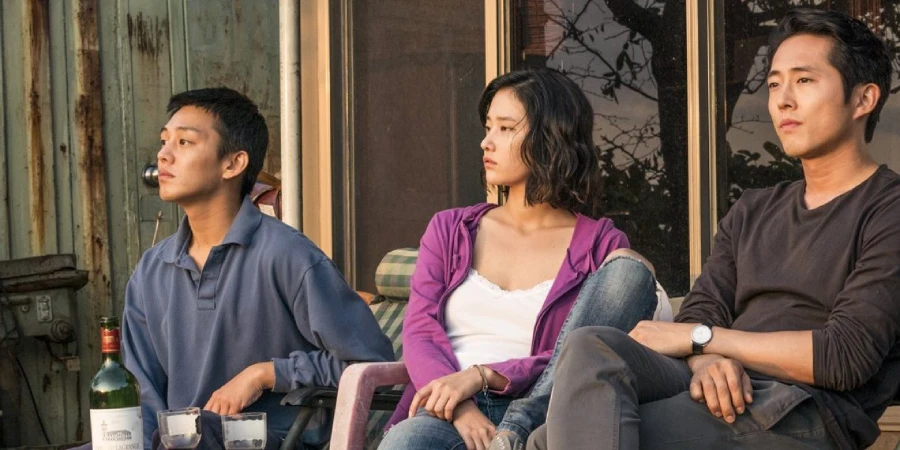
Haemi returns from Africa with Ben, a wealthy, magnetic stranger played by Steven Yeun. Ben drives a Porsche, laughs at everything, and never seems to work. Jong-su is immediately unsettled by him, and that unease reads on Yoo Ah-in’s face like a slow bruise forming.
Haemi performs a pantomime dance she learned in Africa, pretending to peel and eat a tangerine that does not exist. Ben watches with a polite, glassy smile. Jong-su watches with hunger. The triangle is set.
The Greenhouse Confession
Ben invites Jong-su to his sleek, expensive Seoul apartment. There, surrounded by beautiful people who laugh at private jokes, Ben makes a stunning confession: he burns down greenhouses. He calls it a hobby, describes finding a greenhouse “ripe” for burning, and says he has burned one near Paju. Jong-su obsessively checks every greenhouse near his family’s farm but finds nothing destroyed.
This is the film’s pivot point. From here, Jong-su starts watching Ben the way you watch someone you cannot quite accuse. Steven Yeun plays Ben with a stillness that is genuinely chilling, a performance built almost entirely on what the character does not say.
Haemi Disappears
Haemi vanishes. She stops answering her phone. She vacates her apartment. Jong-su goes to Ben, who shrugs and mentions she “just left,” the way you might describe losing a pen. Ben has a new girlfriend. Life, for Ben, continues without a ripple.
Jong-su begins to believe Ben killed Haemi. He cannot prove it. He has no evidence, no body, no witness. What he has is a feeling, a greenhouse that never burned, and a watch he later finds in Ben’s bathroom that he believes belonged to Haemi.
Jong-su Stalks Ben
Jong-su starts surveilling Ben obsessively, parking outside his apartment building, following his Porsche through Seoul streets. He keeps a journal. He tries to write a novel. His father’s trial for assaulting a government official runs in the background, a detail that quietly confirms Jong-su’s sense that powerless men do not get justice through official channels.
Lee Chang-dong refuses to give Jong-su, or the audience, a single concrete clue. No blood. No confession. No body. Just Ben’s bottomless calm and Jong-su’s mounting rage.


Movie Ending
Jong-su drives to Ben’s apartment one evening. He calls Ben out to a quiet, isolated road near Paju, under a cold night sky. When Ben arrives, Jong-su stabs him repeatedly with a kitchen knife. He burns Ben’s Porsche with Ben’s body inside it and drives away naked, leaving his own blood-soaked clothes behind.
Lee Chang-dong holds the shot of the burning car as Jong-su pulls away. It mirrors Ben’s described greenhouse burnings almost exactly. Jong-su has become the thing he feared, or perhaps the thing he always contained.
What the film refuses to confirm: whether Ben actually killed Haemi. Jong-su finds a watch in Ben’s bathroom that looks like Haemi’s, plus lipstick and women’s items that could belong to any of Ben’s companions. It is not proof of murder. It is only proof that Ben is the kind of man who discards women.
Haemi’s cat never appears on screen. The film’s final image offers no resolution, only the burning car in the dark and Jong-su driving away. Lee Chang-dong wants you sitting in that ambiguity. Did Jong-su commit murder or execute justice? The film’s answer is: both, and neither question matters as much as the conditions that made it inevitable.
Are There Post-Credits Scenes?
No. Burning has no post-credits scene of any kind. Once the credits roll, that’s it. Sit with the discomfort instead.
Type of Movie
Burning is a psychological thriller with heavy literary and existentialist undertones. Its pacing is closer to slow cinema than conventional thriller, and audiences expecting a traditional mystery will find the film deliberately resists that shape.
Tonally, it is cold, tense, and suffused with class anxiety. It functions equally well read as social realism, as an unreliable-narrator character study, and as a parable about generational despair in contemporary South Korea.
Cast
- Yoo Ah-in – Lee Jong-su
- Steven Yeun – Ben
- Jeon Jong-seo – Shin Haemi
- Choi Seung-ho – Jong-su’s friend
Film Music and Composer
Mowg composed the score for Burning. His work here sits at the edge of ambient music and jazz, never quite resolving into melody, which perfectly mirrors the film’s refusal to resolve its central mystery.
A key musical moment comes during Haemi’s sunset dance near Jong-su’s family farm. She dances to Miles Davis’s “Générique” as the golden light drops behind the hills. It is one of the most quietly devastating sequences in recent Korean cinema, and the Davis choice is not incidental: it signals a world just out of Jong-su’s economic and emotional reach.


Filming Locations
Principal photography took place across South Korea, including Paju, near the North Korean border, and Seoul. The contrast between these locations is doing real narrative work.
Jong-su’s family farm in Paju sits under open sky, wind-bitten and poor. Ben’s apartment in Seoul gleams. Shooting on actual locations rather than sets makes that class gap feel visceral rather than symbolic.
The greenhouse landscape around Paju is central to the film’s atmosphere. Those glass-and-metal structures catching light in the distance are both literal and figurative containers for things that might, at any moment, burn.
Awards and Nominations
Burning received enormous critical recognition. It competed for the Palme d’Or at the 2018 Cannes Film Festival, where it earned the FIPRESCI Prize (the critics’ award), and it received a record-breaking score from the Cannes jury’s weekly critics poll at the time.
South Korea selected it as its submission for the Academy Award for Best International Feature Film. It was shortlisted but did not receive a nomination. Steven Yeun’s performance also generated considerable awards conversation internationally, which feels overdue given how few English-language productions had recognized his range before this.
Behind the Scenes Insights
- Lee Chang-dong spent years developing the project after reading Haruki Murakami’s short story, reshaping it substantially to address South Korean class dynamics.
- Steven Yeun, best known at the time for The Walking Dead, actively sought out Korean-language film roles. His casting was a genuine coup for the production.
- Jeon Jong-seo had almost no prior film experience before Burning. Her performance as Haemi is a debut that many veteran actors cannot match.
- Lee Chang-dong has described the film as a response to the frustration of young Koreans who feel structurally invisible, locked out of economic mobility.
- Yoo Ah-in largely improvised Jong-su’s physical stillness and deflated posture, a choice the director encouraged rather than scripted.
Inspirations and References
Burning adapts Haruki Murakami’s short story “Barn Burning,” collected in The Elephant Vanishes. Lee Chang-dong also drew explicitly on William Faulkner’s story “Barn Burning,” which gives the film its class-rage subtext and its title’s double meaning.
Faulkner’s story centers on a poor boy watching his father destroy the property of wealthy landowners. That dynamic, powerlessness expressed through destruction, runs through Burning from start to finish.
Albert Camus’s The Stranger is another clear touchstone. Jong-su’s affectless narration and his final act of violence recall Meursault’s logic, or rather his absence of conventional logic.
Alternate Endings and Deleted Scenes
Lee Chang-dong has not publicly discussed alternate endings or significant deleted scenes in detail. No official extended cut or alternate version of Burning has been released.
Given the film’s meticulous, minimalist construction, it is hard to imagine the ending functioning any other way. The ambiguity is not a loose thread; it is the entire structure.
Book Adaptations and Differences
Burning is based primarily on Murakami’s short story “Barn Burning.” The core premise, a wealthy man who confesses to burning barns, and a woman who disappears, comes directly from Murakami’s text.
Lee Chang-dong makes several decisive departures. Murakami’s story offers no resolution and focuses more on erotic obsession and surreal unease. Lee Chang-dong sharpens it into a class critique, giving Jong-su a specific economic context, a struggling writer from a poor farming family, that Murakami’s narrator lacks.
The film also adds the Faulkner layer consciously, making the act of burning property a gesture of class warfare rather than pure enigma. That addition is what gives the film its political spine.



Memorable Scenes and Quotes
Key Scenes
- Haemi’s sunset dance: Haemi strips to the waist and dances near the farm at dusk, Miles Davis playing on a portable speaker, Jong-su watching with aching longing, Ben watching with the same glassy smile he wears for everything. Three people, three entirely different interior experiences, all in one unbroken shot.
- The greenhouse confession: Ben leans back in his chair, completely relaxed, and describes burning greenhouses the way someone might describe a yoga practice. Steven Yeun’s flat, pleasant delivery makes the scene far more disturbing than any conventional villain speech could.
- Jong-su visits Haemi’s empty apartment: He sits alone in the dark of her stripped room. The silence runs longer than comfortable. Yoo Ah-in does not perform grief; he just sits there, and the blankness reads as something worse.
- The tangerine pantomime: Haemi performs her African pantomime, telling Jong-su the trick is not to imagine the tangerine exists, but to forget that it doesn’t. This moment functions as the film’s thesis statement.
- The final killing: Jong-su waits in the dark by the roadside. When Ben arrives, the murder is quick, unglamorous, and shot without score. Lee Chang-dong refuses to make it cathartic.
Iconic Quotes
- “The trick isn’t imagining there’s a tangerine. It’s forgetting that there isn’t one.” (Haemi, on pantomime and, by implication, on belief itself)
- “There’s always a greenhouse near me waiting to be burned. Ones that nobody would miss.” (Ben, confessing his hobby with infuriating calm)
- “I’ve never cried since I was a kid. I want to cry, but I can’t.” (Haemi, in a moment of unguarded vulnerability that makes her disappearance hit harder in retrospect)
Easter Eggs and Hidden Details
- Haemi’s unseen cat mirrors her own potential nonexistence. Several viewers and critics have argued she may herself be a projection of Jong-su’s imagination, though the film never commits to this reading.
- Ben never eats on screen. He attends meals, he pours drinks, but he never actually consumes food. It is a subtle, consistent choice that quietly codes him as something predatory and not-quite-human.
- The women’s items Jong-su finds in Ben’s bathroom, including the watch he believes is Haemi’s, are shot without close-up emphasis. Lee Chang-dong trusts the audience to catch them without underlining.
- Jong-su’s copy of The Great Gatsby sits visible in his apartment. The class-obsessed, mysterious wealthy man who destroys others is not a subtle reference, but it rewards attention.
- Haemi’s Bobo doll, which she mentions being bullied over as a child, connects to Jong-su’s childhood memory of rescuing her from a well, a memory she later claims never happened.
Trivia
- Burning marked Steven Yeun’s first major Korean-language film role.
- Jeon Jong-seo was cast after Lee Chang-dong saw something in her audition that he described as both present and unreachable, which is exactly what Haemi needs to be.
- Lee Chang-dong took roughly eight years between Poetry (2010) and Burning (2018). He is not a director who rushes.
- The film runs approximately two and a half hours, which some reviewers found too long. Those reviewers missed the point: the length is the suffocation.
- Murakami’s original story “Barn Burning” is quite short, roughly 20 pages. The expansion into a feature film required Lee Chang-dong to essentially build a new architecture around a single eerie premise.
- During the Cannes premiere, the film received a lengthy standing ovation from critics and audiences.
Why Watch?
Steven Yeun’s Ben is one of the great screen villains of the decade, precisely because he never does anything a villain would do on screen. Yeun builds the character entirely through what he withholds: a half-second delay before laughing, a glance that lands just slightly wrong. If that kind of performance, quiet, patient, and deeply unsettling, sounds like your idea of two hours well spent, watch this film immediately.
Director’s Other Movies
- Green Fish (1997)
- Peppermint Candy (1999)
- Oasis (2002)
- Secret Sunshine (2007)
- Poetry (2010)