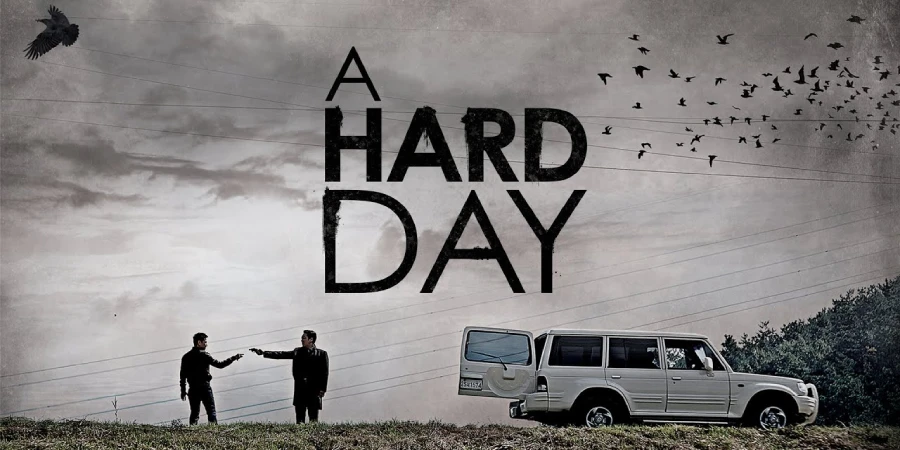
Korean cop Lee Gun-su hits a pedestrian with his car, panics, and buries the body in his mother’s grave during her funeral. That single horrible decision drives one of the most entertainingly vicious thrillers to come out of South Korea in the 2010s. Director Kim Seong-su wrings two hours of escalating dread from a premise that sounds almost comedic on paper, and somehow makes you root for a man who absolutely does not deserve your sympathy.
Detailed Summary
The Accident and the Desperate Cover-Up
Gun-su is already having the worst day imaginable. He is driving home exhausted, distracted, and emotionally wrecked by his mother’s death, when he strikes a man on a dark, rain-slicked road.
He does not call the police. Instead, panic takes over completely. He checks the body, sees no wallet or ID on the man, and makes the catastrophically stupid choice to load the corpse into his trunk.
His mother’s funeral is the same day. Gun-su arrives at the cemetery still carrying a dead body in his car, and in one of the film’s most audaciously dark sequences, he lowers the stranger’s wrapped body into the grave beneath his mother’s coffin before the burial is completed.
The Body That Won’t Stay Buried
Gun-su thinks he has gotten away with it. He goes through the funeral, plays the grieving son, and tries to move on. Then the dead man’s phone rings.
A voice on the other end tells Gun-su he saw everything. Someone watched the burial happen. Gun-su’s cover-up has barely lasted a few hours before it collapses into something far more dangerous.
Park Chang-min Enters the Picture
Park Chang-min is the man Gun-su killed on the road. He turns out not to have been an innocent bystander. Chang-min was a corrupt ex-cop, and someone with a grudge against him has been watching.
That someone is Oh Jae-cheol, a detective and former colleague of Chang-min. Jae-cheol witnessed the accident from a distance and recognized what happened. Rather than report it, he decides to use the situation as personal leverage.
Jae-cheol calls Gun-su and makes his intentions clear: he wants money, and he wants silence, in exchange for keeping what he knows to himself. Gun-su, a detective himself, knows exactly how badly this can go.
Gun-su Tries to Fight Back
Gun-su does not simply pay up and pray. He investigates Jae-cheol, trying to find leverage of his own. He discovers that the man he accidentally killed, Chang-min, had a criminal history tied to Jae-cheol.
Gun-su starts piecing together that Jae-cheol may have wanted Chang-min dead anyway. That connection becomes a potential weapon. Gun-su begins feeding Jae-cheol false information and setting small traps, trying to buy time and shift the power balance.
The Grave Gets Opened
Jae-cheol keeps escalating his demands. He wants proof the body is actually where Gun-su says it is. In a sequence that plays on the audience’s nerves like a violin string about to snap, Gun-su is forced to return to the cemetery at night.
Digging up your mother’s grave to prove a murder victim is beneath her coffin is one of the most darkly specific images Korean cinema has put on screen. Lee Sun-kyun plays the scene with shaking hands and controlled hyperventilation, and it works completely.
Colleagues Close In
Gun-su’s fellow detectives start connecting Chang-min’s disappearance to other ongoing investigations. They do not suspect Gun-su directly at first, but the pressure inside the precinct builds steadily. Gun-su has to keep performing normalcy while managing a blackmailer and hiding a corpse.
His colleague Detective Kim gets uncomfortably close to the truth on more than one occasion. Each near-miss lands with real tension because the film never lets you forget how thin Gun-su’s cover actually is.
The Confrontation
Jae-cheol and Gun-su eventually stop circling each other through phone calls and meet face to face. Their dynamic shifts from blackmailer-and-victim into something more physically dangerous. Jae-cheol is bigger, colder, and more experienced with violence.
Gun-su survives the encounter through desperation rather than competence, which is entirely consistent with who the character is. He is not an action hero. He is a flawed, frightened man making worse and worse decisions.
Movie Ending
Gun-su finally turns the tables on Jae-cheol by using the evidence he has gathered about the detective’s criminal past. He feeds Jae-cheol a carefully constructed trap, luring him into a position where the corrupt detective incriminates himself further while trying to cover his own tracks.
Jae-cheol ends up dead. The exact circumstances involve Gun-su maneuvering him into a situation where the violence Jae-cheol brought to the table turns back on him. It is not a clean hero’s victory. Gun-su survives, but he has committed acts beyond his original accidental killing.
The film’s final beat is quietly devastating. Gun-su sits with the knowledge of everything he has done across this single day and night. He is technically safe, but the accumulated weight of his choices sits on his face like a mask he cannot take off.
What audiences debate most is whether the ending offers genuine escape or just delayed punishment. The film does not reassure you. Gun-su does not confess, does not face legal consequences within the narrative, and does not redeem himself in any conventional sense. He simply endures.
Director Kim Seong-su earns the ambiguity honestly. By keeping the camera close on Lee Sun-kyun’s face in the final scene, he refuses to editorialize. You decide how to feel about a man who buried a stranger under his mother, then killed again to protect that secret.
Are There Post-Credits Scenes?
A Hard Day has no post-credits scene. Once the film ends, it ends. There is no additional footage, no tease, no coda hiding after the title cards.
Type of Movie
A Hard Day is a Korean crime thriller with strong elements of dark comedy running underneath the tension. It belongs to a very specific Korean tradition of films where a morally compromised protagonist digs himself into deeper and deeper trouble through each bad decision.
The tone balances genuine suspense with moments of bleak absurdity. It never fully tips into comedy, but the premise is so extreme that laughter and dread coexist throughout. Think of it as a pressure cooker with occasional bursts of jet-black humor.
Cast
- Lee Sun-kyun – Lee Gun-su
- Cho Jin-woong – Oh Jae-cheol
- Kim Dai-myung – Detective Kim
- Shin Dong-mi – Lee Yeon-hee
Film Music and Composer
Mowg composed the score for A Hard Day. His work on the film is one of its most underrated elements, keeping the music tight and functional rather than melodramatic. The score amplifies paranoia without ever spelling out the emotional subtext for the audience.
Mowg built a reputation in Korean cinema for economical, tension-forward scoring. His music rarely announces itself, which suits a film where the visuals and performances are doing most of the heavy lifting.


Filming Locations
A Hard Day was shot primarily in South Korea. The rain-soaked road where the accident occurs sets the film’s nocturnal, slippery visual register from the very first minutes.
The cemetery sequences were filmed at an actual Korean cemetery location, and that authenticity matters. The stone markers, the cold light, the tight rows of graves give the scenes a specificity that a studio set could not replicate.
Much of the film takes place in mundane institutional spaces: police precincts, parking garages, hospital corridors. Kim Seong-su uses fluorescent lighting and beige interiors to strip away any glamour from Gun-su’s situation. This is a story about bureaucratic suffocation as much as physical danger.
Awards and Nominations
A Hard Day received attention at several Korean film awards and performed strongly at genre-focused festivals internationally. It earned nominations at the Grand Bell Awards and the Blue Dragon Film Awards, two of Korea’s most prominent film honors.
Cho Jin-woong’s performance as the villain drew particular recognition from critics and awards bodies, which is entirely fair given what he does in the role.
Behind the Scenes Insights
- Director Kim Seong-su has spoken about wanting the film to function as a single relentless unit of time, compressing Gun-su’s nightmare into something that feels almost real-time in its momentum.
- Lee Sun-kyun spent significant preparation time working on physical exhaustion, wanting Gun-su to look genuinely depleted rather than conventionally heroic in the action sequences.
- Cho Jin-woong reportedly brought considerable improvisation to his line readings as Jae-cheol, giving the character an unpredictable quality that keeps you off-balance in every scene he appears.
- The coffin burial sequence required careful logistical planning to shoot practically, and the production team constructed a partial grave set to allow the camera angles Kim Seong-su wanted.
- Kim Seong-su cited American crime films as a structural influence while insisting on keeping the tone specifically Korean in its relationship to institutional corruption and social pressure.
Inspirations and References
A Hard Day draws broadly from the American “one bad day” thriller tradition, films where a single catastrophic mistake sends an ordinary person into freefall. The DNA of something like After Hours or Changing Lanes runs through the premise.
Korean institutional corruption is another clear source of inspiration. Gun-su is a cop covering up a crime against a corrupt ex-cop, being blackmailed by another corrupt cop. The film draws on real anxieties in Korean society about police misconduct and moral compromise within institutions.
Kim Seong-su has noted the Coen Brothers as a tonal reference point, specifically their ability to balance genuine menace with a kind of grim, situational humor.
Alternate Endings and Deleted Scenes
No officially documented alternate endings or significant deleted scenes from A Hard Day have been made public. Kim Seong-su has not disclosed alternate cuts in interviews I can confirm with confidence.
Given the film’s tight, purposeful structure, it reads as a production that locked its ending relatively early in the editing process.
Book Adaptations and Differences
A Hard Day is an original screenplay, not an adaptation of any novel or existing source material. Kim Seong-su wrote the script directly for the screen.
Memorable Scenes and Quotes
Key Scenes
- The burial: Gun-su lowering a wrapped body into his mother’s grave while mourners wait nearby is the film’s defining image, a moment that commits fully to its own horrible premise.
- The midnight exhumation: Gun-su returning to the cemetery alone with a shovel, the camera staying close on his face as he digs, is where Lee Sun-kyun’s performance peaks. His hands shake. He does not look at the grave as he works.
- The first phone call from Jae-cheol: The shift from grief to panic happens in one phone call, and the scene is shot in a single tight frame on Gun-su’s face so we catch every micro-expression.
- The coffin confrontation: Gun-su and Jae-cheol meeting inside the actual grave space is a staging choice of genuine nerve, using the physical space of burial as an arena for violence.
- The final shot: Gun-su sitting still, alive, technically free, staring at nothing. Kim Seong-su holds on him for several seconds longer than comfort allows.
Iconic Quotes
- “I saw everything.” Jae-cheol’s opening line on the phone, delivered flatly, is the sentence that destroys Gun-su’s brief illusion of escape.
- “You buried him under your mother. That’s actually impressive.” Jae-cheol saying this with something close to admiration captures exactly how the film balances horror with dark comedy.
Easter Eggs and Hidden Details
- The dead man’s phone, which initiates the blackmail chain, has a cracked screen from the accident. That detail keeps reappearing in close-up as a visual callback to the crash.
- Gun-su’s car interior throughout the film shows progressive damage and cleaning attempts that track his cover-up efforts without any dialogue drawing attention to them.
- Jae-cheol is first seen in the film’s background well before he formally introduces himself, a detail that rewards second viewings and suggests he has been watching Gun-su longer than the narrative initially implies.
- The cemetery lighting shifts subtly between Gun-su’s daytime visit for the funeral and his nighttime return, moving from overcast grey to a colder blue-green that signals the moral temperature of his choices.
Trivia
- A Hard Day was remade in India as Maamanithan in 2022, demonstrating the original screenplay’s cross-cultural adaptability.
- Lee Sun-kyun later became internationally recognized for his role in Bong Joon-ho’s Parasite, but A Hard Day showcases a physically demanding, sweat-soaked performance that is quite different from his work in that film.
- Cho Jin-woong is one of the most reliably excellent character actors in Korean cinema, and many critics consider his villain in A Hard Day among his best work.
- Kim Seong-su shot much of the nighttime material practically, using available and minimal artificial light to keep the visual texture rough and immediate.
- The film’s Korean title translates more literally to something closer to “A Good Day to Have a Hard Day,” which sharpens the dark irony of the premise.
Why Watch?
Lee Sun-kyun’s performance is the reason to show up. He plays complete moral collapse with such specific physical detail, the trembling, the bad posture, the eyes that keep scanning for exits, that you stay locked in even when you want to look away from what he is doing. No other recent Korean thriller puts its protagonist through this particular kind of sustained, intimate humiliation. That is worth two hours of your life.
Director’s Other Movies
- Beat (1997)
- The Berlin File (2013)