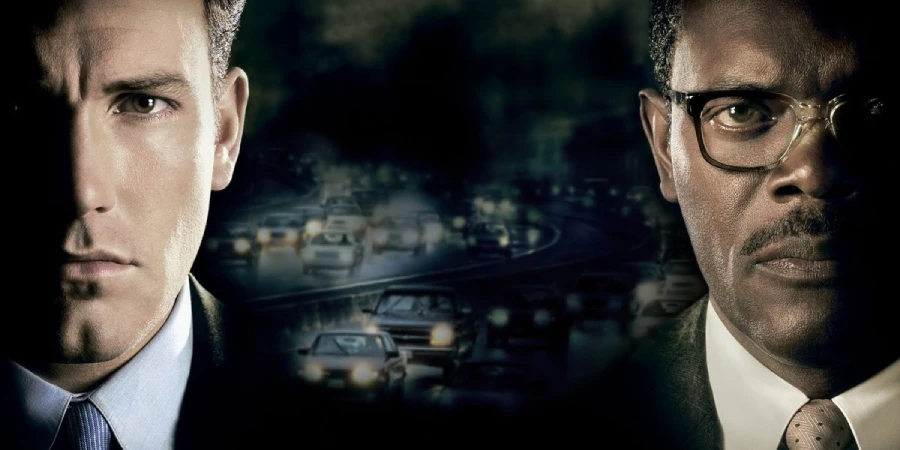

Two men collide on the FDR Drive one ordinary Friday morning, and what follows is one of cinema’s most underrated portraits of moral disintegration. Changing Lanes (2002) is not a thriller about a car accident; it is about two men who spend a single day becoming the worst versions of themselves, then scrambling back from the edge. Director Roger Michell stages everything in real New York daylight, which makes the ugliness feel bracingly close to home.
Detailed Summary
The Accident on the FDR Drive
Gavin Banek (Ben Affleck) is a young Manhattan attorney rushing to a courthouse hearing. Doyle Gipson (Samuel L. Jackson) is an insurance salesman driving to the same courthouse to finalize a custody arrangement for his sons. Their cars clip each other on the FDR Drive, and both men end up on the shoulder.
Gavin, late and panicking, scribbles a blank check and tells Doyle to “sort this out later.” Doyle refuses to be dismissed that easily; he wants to exchange information properly. Gavin drives off without him, leaving Doyle stranded. Gavin also leaves behind a legal file containing a signed document called a Deed of Assignment, and this is the document that will unravel his entire career.
The Courthouse Standoff
Doyle misses his custody hearing because Gavin abandoned him. The judge rules against him, and Doyle loses the chance to keep his sons in New York before his estranged wife moves them away. His day, already fragile, collapses completely.
Gavin arrives at the hearing and presents the case on behalf of the Dunleavy Foundation, a charitable trust his firm controls. Without the Deed of Assignment, he cannot prove legal authority over the trust’s assets. He improvises, citing the document as misfiled, and the judge grants a brief continuance.
Gavin’s World Cracks Open
Back at the firm, Gavin’s father-in-law and senior partner Stephen Delano (Sydney Pollack) reveals the full truth. The Deed of Assignment Gavin lost was obtained by fraud; the elderly man who signed it, Doyle’s client Hadley, was manipulated into transferring control of his own charitable foundation to Delano’s firm. Gavin has been unknowingly participating in a financial scheme that exploits a vulnerable old man.
Delano treats this as a simple cleanup job and sends a fixer to create a forged replacement document. Gavin is rattled but goes along, at least initially. His moral discomfort sits just below the surface, and Affleck plays it with visible sweat and fidgeting rather than speeches.
Doyle’s Escalating Retaliation
Doyle finds Gavin’s file and realizes its legal importance. He calls Gavin and offers to return the document, but Gavin’s attempt to retrieve it goes badly. Each exchange between the two men slides into hostility.
Doyle uses a contact to sabotage Gavin’s credit, effectively freezing his financial life. Gavin retaliates by hiring someone to drain Doyle’s bank account. Both men keep pulling threads, and both lives keep unraveling faster than either anticipated.
Spiraling Toward Violence
Doyle, a recovering alcoholic, falls off the wagon during this nightmare of a day. He visits his AA sponsor and tries to hold himself together, but the chaos Gavin set in motion keeps hitting him from every angle. Jackson plays these scenes with a clenched physicality, his jaw tight, his silences doing more work than most actors’ monologues.
Gavin, for his part, discovers that the forged document his firm created is legally useless if Doyle presents the authentic Deed of Assignment to the court. He arranges to have Doyle’s car sabotaged, a plan that could have gotten Doyle killed on the highway. When Gavin learns what actually happened to the car, the guilt lands on him like a physical blow.


Movie Ending
Gavin cannot live with nearly killing a man, and that guilt becomes the pivot on which the film turns. He goes to find Doyle in person rather than continuing to fight through proxies and phone calls. By the time these two men stand face to face without the intermediary of lawyers or fixers, the film has stripped them both down to something raw and honest.
Gavin confronts his father-in-law Delano and refuses to let the fraud stand. He hands the authentic Deed of Assignment over, which effectively destroys his career at the firm and exposes the scheme against Hadley. Delano’s reaction is cold and transactional, which makes the choice feel even more costly for Gavin. Affleck’s best moment in the film comes right here: he looks less like a hero making a grand gesture and more like a man who has simply run out of ways to lie to himself.
Doyle, for his part, chooses not to destroy Gavin entirely. He withdraws the document from the court before it can be used to dismantle Gavin’s life completely. He makes this choice not because Gavin deserves mercy, but because continuing the war would make Doyle into something he does not want to be. His custody situation remains unresolved in any clean sense; he has to start rebuilding from a very bad position.
Both men walk away damaged. Neither gets a triumphant ending. The film closes without tying a bow on either storyline, which feels completely right: one bad morning cracked two lives open, and one good afternoon did not fully fix them.
Are There Post-Credits Scenes?
Changing Lanes has no post-credits scenes. Once the film ends, it ends. No teases, no codas, nothing extra. You can leave when the credits roll.
Type of Movie
Changing Lanes sits in a tight overlap between psychological thriller and moral drama. Its pacing borrows from thriller mechanics, a ticking clock, escalating stakes, a single day structure, but its real interest is character psychology rather than plot mechanics.
The tone stays grounded and gritty throughout. Roger Michell resists any temptation toward stylish action. Everything feels mundane and sun-bleached, which makes the cruelty between these two men hit harder.
Cast
- Ben Affleck – Gavin Banek
- Samuel L. Jackson – Doyle Gipson
- Sydney Pollack – Stephen Delano
- Toni Collette – Michelle
- Amanda Peet – Cynthia Banek
- Richard Jenkins – Valerie’s Attorney
- William Hurt – Sponsor
Film Music and Composer
David Arnold composed the score for Changing Lanes. Arnold, known for his work on multiple James Bond films, takes a deliberately understated approach here. He strips away the orchestral grandeur you might expect from his Bond work and delivers something tense and minimal.
Brian Eno also contributed to the film’s sonic landscape, and his ambient, unresolved textures suit the film’s refusal to offer easy emotional payoffs. The music never tells you how to feel, which is the right call for a film this morally ambiguous.



Filming Locations
Changing Lanes shot on location in New York City, and that choice matters enormously. Real Manhattan streets, real courthouses, real FDR Drive traffic: the city itself functions as a pressure cooker that these two men cannot escape.
New York in this film is not glamorous. It is fluorescent-lit offices, gridlocked highways, and AA meeting rooms in church basements. Michell shoots it like a place where lives actually fall apart, not a backdrop for prestige cinema.
Awards and Nominations
Changing Lanes did not collect major awards attention despite strong performances. Its theatrical success and critical reception were solid but it largely missed the awards circuit, which has always felt like an oversight given what Jackson does in this film.
Behind the Scenes Insights
- Roger Michell, a British director best known for Notting Hill, took on Changing Lanes as a deliberate departure from romantic comedy. He wanted to work in a grittier, more morally complex register.
- Samuel L. Jackson has spoken about Doyle Gipson as one of the roles he felt most connected to personally, particularly the character’s struggle with alcoholism and the feeling of being dismissed by a system that does not see him.
- Ben Affleck took the role partly because he wanted to play a character with genuine moral failings rather than a conventional hero. Gavin is not sympathetic in easy ways.
- Sydney Pollack, primarily known as a director himself, brings an authority to Delano that no purely acting-focused hire could have matched. His scenes with Affleck carry the weight of someone who genuinely understands power.
- The screenplay was written by Chap Taylor and Michael Tolkin. Tolkin, the writer of The Player, brought his characteristic interest in moral compromise among privileged professionals.
- Production leaned heavily on real New York locations rather than sets, which kept the budget grounded and the visual texture authentic.
Inspirations and References
Michael Tolkin’s previous work on The Player (Robert Altman, 1992) provides a clear creative DNA for this story. Both films examine how otherwise functional, even charming people excuse their own corruption one small step at a time.
Thematically, the film owes something to the tradition of urban moral fables that ran through American cinema in the late 1980s and 1990s. Films like Falling Down (1993) explored similar territory: a city as pressure cooker, ordinary men pushed past their stated values.
The single-day structure also recalls classical dramatic unities, the idea that confining action to one day forces maximum compression and moral intensity. Whether the filmmakers consciously invoked Aristotle is unknowable, but the effect is the same.
Alternate Endings and Deleted Scenes
No officially documented alternate endings or notable deleted scenes for Changing Lanes appear in public record. The film’s ending, with its deliberately unresolved, low-key resolution, was apparently the intended conclusion from early drafts. No studio-mandated happy ending was grafted on, which is genuinely surprising for a studio picture of this size.
Book Adaptations and Differences
Changing Lanes is an original screenplay, not adapted from a novel or other published source. Chap Taylor and Michael Tolkin wrote the script directly for the screen. There is no source book to compare it against.


Memorable Scenes and Quotes
Key Scenes
- The FDR Drive accident: Two cars, two men, one abandoned on the shoulder. Gavin’s casual dismissal of Doyle in this scene sets every domino falling. Michell shoots it in harsh daylight with no musical drama, which makes it feel genuinely accidental and genuinely awful.
- Doyle in the AA meeting: Jackson sits in a circle of folding chairs and describes his day to people who cannot fully understand its specifics. His hands grip his knees. He speaks in a flat, controlled voice that makes the collapse underneath it more visible, not less.
- Gavin and Delano’s confrontation: Pollack delivers a masterclass in civilized menace. He never raises his voice. He explains fraud and manipulation with the calm of a man describing a filing system, and it is genuinely chilling to watch Affleck try to hold his ground against it.
- The sabotaged car: When Gavin realizes that his retaliation against Doyle could have caused a fatal crash, the film shifts registers completely. Up to this point, both men have been petty. This is the moment the pettiness turns dangerous, and Affleck physically crumbles under the knowledge.
- The final face-to-face meeting: No courtrooms, no lawyers, no fixers. Just two men on a sidewalk, deciding what kind of people they want to be going forward. The scene has almost no score under it, just city noise, and that choice by Michell is exactly right.
Iconic Quotes
- “I’m going to give you something better than a check. I’m going to give you a chance.” Gavin’s hollow offer to Doyle at the accident site, which Doyle correctly reads as nothing.
- Delano’s explanation of institutional ethics: Sydney Pollack’s Delano tells Gavin that the world runs on a kind of moral math where individual sins disappear into institutional good. The speech is paraphrased rather than a single quotable line, but Pollack delivers it as though he has believed it for thirty years.
- Doyle to his AA sponsor: Jackson’s character tries to articulate why this particular day broke him when worse days did not. The line lands differently for anyone who has ever been told their time does not matter.
Easter Eggs and Hidden Details
- The Deed of Assignment that drives the entire plot is shown clearly enough that attentive viewers can read key details, foreshadowing how legally fragile Gavin’s position really is before the film explicitly states it.
- Background details in Gavin’s office reflect his moral compromise before the script articulates it: his desk is expensive, his walls are full of awards from the very foundation he is helping to defraud.
- Doyle’s car is modest and slightly beaten up from the start, a visual contrast to Gavin’s sleek vehicle that quietly establishes the class dynamic before a single line of dialogue does the same work.
- The courthouse where both men are headed serves as a recurring visual anchor. Michell cuts back to it at key moments, reminding the audience that the law is theoretically present but practically absent from everything happening between these two men.
Trivia
- The film takes place almost entirely within a single business day in New York City, a structural constraint that gives it a compressed, pressure-cooker energy.
- Sydney Pollack, who plays Delano, directed films including Tootsie and The Firm. His casting as the morally compromised senior partner adds an extra layer for cinephiles who know his directorial work.
- Michael Tolkin, co-writer of the screenplay, previously wrote The Rapture and The Player. Moral corruption among the comfortable is a recurring preoccupation across his writing career.
- William Hurt appears in a small but pivotal role as Doyle’s AA sponsor, and he brings a quietude to the part that grounds the film’s most emotionally raw scenes.
- Roger Michell directed the film between Notting Hill (1999) and Enduring Love (2004), making Changing Lanes a tonal outlier in his filmography at that stage of his career.
- Toni Collette, at the time not yet the household name she became after Hereditary, plays a supporting role that is smaller than her talent warrants, though she makes every scene count.
Why Watch?
Watch this film for Samuel L. Jackson’s performance, which ranks among his most controlled and devastating work. He plays a man being ground down in real time without ever begging for the audience’s sympathy. Jackson makes Doyle’s anger completely understandable and completely dangerous in the same breath, and that is a genuinely difficult needle to thread.
Director’s Other Movies
- Persuasion (1995)
- Notting Hill (1999)
- Enduring Love (2004)
- Venus (2006)
- Hyde Park on Hudson (2012)
- Le Week-End (2013)
- My Cousin Rachel (2017)
- The Duke (2020)