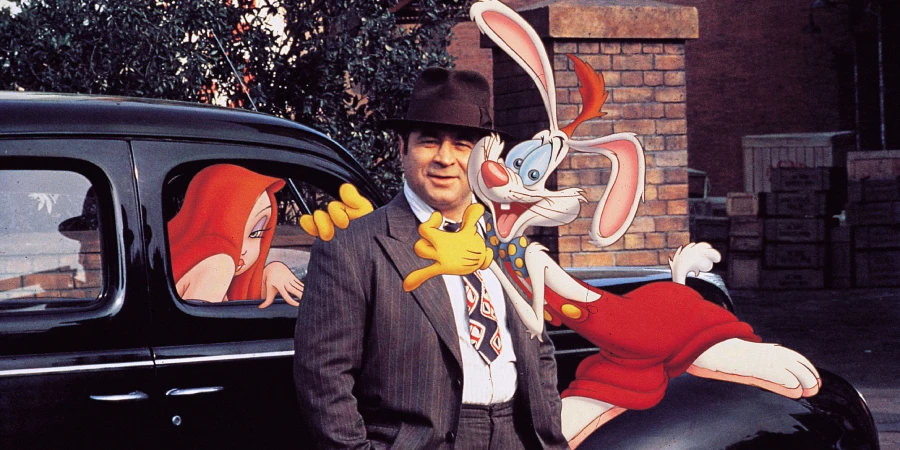

Few films have pulled off something as audacious as blending hard-boiled noir detective fiction with Looney Tunes-style cartoon chaos, and making both feel completely at home together. Who Framed Roger Rabbit arrived in 1988 and promptly rewrote the rulebook on what live-action and animation could achieve side by side. It is funny, dark, surprisingly emotional, and technically staggering. Moreover, it remains one of Hollywood’s most ambitious productions to this day.
Detailed Summary
A Toon in Trouble
In a version of 1947 Hollywood where cartoon characters, called Toons, coexist with humans, washed-up private detective Eddie Valiant reluctantly takes a job from R.K. Maroon of Maroon Cartoons. Maroon wants Eddie to dig up dirt on Marvin Acme, the owner of Toontown, who Maroon suspects of having an affair with Roger Rabbit’s wife, Jessica Rabbit. Eddie despises Toons after a Toon killed his brother Teddy years earlier, so this assignment sits badly with him from the start.
Eddie photographs Jessica playing patty-cake (literally patty-cake) with Acme and delivers the evidence to Maroon. Roger sees the photographs and spirals into heartbreak. Meanwhile, someone murders Marvin Acme that same night, and Roger becomes the prime suspect.
Eddie Gets Pulled In
Judge Doom, a sinister and powerful figure who controls the weasel police force, launches a manhunt for Roger. He carries a horrifying weapon called The Dip, a chemical solution capable of permanently destroying Toons. Roger, desperate and frightened, finds Eddie and begs for help.
Eddie initially refuses. However, Roger hides in his apartment anyway, and the two are forced into an uneasy partnership. A series of comic and genuinely tense encounters follow as Eddie tries to keep Roger alive while piecing together what actually happened to Acme.
Jessica Rabbit and the Real Picture
Eddie eventually meets Jessica Rabbit in person at the Ink and Paint Club. She is not what he expects: she is fiercely loyal to Roger and insists she was set up. Jessica reveals that Acme and Maroon coerced her into the patty-cake photos as part of a larger scheme.
Maroon, it turns out, wanted to buy Toontown from Acme. In addition, someone else wanted Toontown for an even darker reason. Jessica hands Eddie a clue pointing toward a will that Acme supposedly left behind, a document that would transfer Toontown’s ownership to the Toons themselves.
Cloverleaf and the Conspiracy Unfolds
Eddie digs deeper and uncovers a corporate conspiracy involving a company called Cloverleaf Industries. Cloverleaf has been buying up the Pacific Electric Railway, the beloved Red Car trolley system that services Los Angeles. Nobody can figure out why a company would pay so much for a perfectly functional transit network.
Maroon eventually reveals the full picture to Eddie before someone shoots and kills him. Cloverleaf plans to demolish Toontown and build a freeway in its place, forcing Angelenos to buy cars instead of riding the trolley. It is a cynically brilliant scheme, and it has a very specific architect.
Judge Doom Is Unmasked
Eddie races to a Toon-themed warehouse, where Judge Doom has captured Roger and Jessica. Doom reveals himself as the true power behind Cloverleaf. Then comes the film’s most chilling moment: Doom steps in front of a steamroller and survives, revealing himself to be a Toon in disguise.
Furthermore, Doom confirms he is the Toon who murdered Eddie’s brother Teddy years ago. His eyes spin out in classic cartoon fashion, his voice shifts into a deranged falsetto, and the horror of the moment lands with real impact. He also confirms he killed Acme personally to prevent the will from surfacing.
Movie Ending
Doom activates a massive Dip machine mounted on a truck, aiming it directly at Toontown’s tunnel entrance. His plan is simple and brutal: spray Toontown with Dip, annihilate every Toon inside, and clear the land for his freeway. Eddie, still bound, has to think fast.
In a genuinely clever sequence, Eddie leans into his long-abandoned talent for slapstick and starts performing cartoon gags to distract Doom’s weasel henchmen. Laughing literally kills weasels, so one by one they collapse, incapacitated by their own hysteria. It is funny and cathartic in equal measure.
Eddie and Doom face off in a brutal physical confrontation. Eddie redirects the Dip nozzle and soaks Doom in his own weapon. Doom melts, screaming, and the machine crashes into a wall and explodes, destroying itself before it can reach Toontown.
Roger finds Acme’s missing will at the last possible moment: it was written in disappearing ink on a blank sheet of paper he had carried all along. Toontown belongs to the Toons. Justice, in the most cartoonishly perfect way imaginable, wins out.
Consequently, the film closes on an emotional note as Toons pour out of Toontown to celebrate. Eddie’s grief begins to lift. His partnership with Roger, built on mutual distrust, has quietly become something resembling friendship. Baby Herman delivers a surprisingly poignant final line, and the film ends with a Toon kiss, a hat tip, and a Looney Tunes-style iris-out.
Are There Post-Credits Scenes?
No, Who Framed Roger Rabbit does not include any post-credits scenes. Once the credits roll, the film is done. You can safely leave your seat without missing anything.
Type of Movie
At its core, this is a neo-noir comedy mystery wrapped inside a live-action/animation hybrid. It draws heavily from 1940s detective fiction in tone and setting, while simultaneously functioning as a family-friendly adventure. On the other hand, its darker moments, including Doom’s Dip executions and genuine threat of mass Toon genocide, give it real edge that most family films avoid entirely.
In contrast to the slapstick surface, the film carries genuine emotional weight about grief, prejudice, and justice. It works as a comedy, a thriller, and a technical showcase all at once.
Cast
- Bob Hoskins – Eddie Valiant
- Christopher Lloyd – Judge Doom
- Joanna Cassidy – Dolores
- Charles Fleischer – Roger Rabbit (voice)
- Kathleen Turner – Jessica Rabbit (voice)
- Richard Williams – Droopy (voice and animation director)
- Lou Hirsch – Baby Herman (voice)
- Stubby Kaye – Marvin Acme
- Alan Tilvern – R.K. Maroon
Film Music and Composer
Alan Silvestri composed the film’s score, and it ranks among his finest work. Silvestri blended classic Hollywood orchestration with playful Toon-appropriate chaos, matching the film’s dual identity perfectly. His main theme carries a sense of nostalgic melancholy underneath its jazzy swagger.
Notable tracks include the lush, romantic arrangement accompanying Jessica Rabbit’s lounge performance of “Why Don’t You Do Right”, performed in the film by Kathleen Turner’s vocal stand-in. The score shifts fluidly between tension and comedy, supporting the film’s tonal tightrope walk without ever losing its footing.
Filming Locations
Production shot primarily on studio backlots in Los Angeles, particularly at Amblin Entertainment’s facilities. Recreating 1947 Hollywood on a backlot allowed the crew to control every frame, which was essential given the extraordinary technical demands of integrating animated characters into live-action footage.
Some street-level scenes used actual Los Angeles locations dressed to period specification. Notably, the film’s visual evocation of postwar LA serves the story thematically: the city’s real history of dismantling its Red Car trolley network directly inspired the Cloverleaf conspiracy at the film’s center.
Awards and Nominations
Who Framed Roger Rabbit won four Academy Awards at the 1989 ceremony, including Best Film Editing, Best Sound Editing, Best Visual Effects, and a Special Achievement Award for Richard Williams for his animation direction. It also received a nomination for Best Cinematography.
The Academy’s Special Achievement Award for Williams was a direct acknowledgment that the film’s animation existed outside any existing category. Furthermore, the film swept technical awards across multiple ceremonies that year, cementing its legacy as a landmark in filmmaking craft.
Behind the Scenes Insights
- Charles Fleischer insisted on wearing a full Roger Rabbit costume on set, even though no one could see him, because he felt it helped him stay in character.
- Director Robert Zemeckis and his crew had to plan every camera move in advance so the animated characters could be integrated later; improvised shots were essentially impossible.
- Bob Hoskins spent so much time acting against invisible cartoon partners that he reportedly began seeing hallucinations of cartoon characters in his peripheral vision for months after filming wrapped.
- Animators had to painstakingly ensure that every Toon reacted to real light sources in every frame, a task that required an enormous team working for years in post-production.
- Both Warner Bros. and Disney agreed to allow their characters to appear together in the film, a historic and unprecedented moment of studio cooperation; the negotiation required strict rules ensuring neither studio’s characters received more screen time than the other’s.
- Steven Spielberg produced the film through Amblin Entertainment, and his involvement helped broker the inter-studio character agreements.
Inspirations and References
The film is based directly on Gary K. Wolf’s 1981 novel Who Censored Roger Rabbit? Wolf’s original book used a darker, more explicitly adult noir setting, and the Toons in his world communicated via comic strip speech bubbles rather than speaking aloud. The film adaptation shifted the concept considerably to suit a cinematic and more broadly appealing format.
The real-world dismantling of the Pacific Electric Railway in Los Angeles served as the basis for the Cloverleaf freeway conspiracy. Historians and urban planners have long debated the circumstances of that transit system’s decline, and the film dramatizes a particularly villainous version of events. In addition, the entire visual aesthetic draws heavily from classic Hollywood noir films of the 1940s, particularly the work of directors like Howard Hawks and Billy Wilder.
Alternate Endings and Deleted Scenes
Several early production discussions involved a darker resolution for Judge Doom, though the steamroller-and-Dip finale was always the preferred approach once the creative team committed to revealing Doom as a Toon. No significantly alternate ending reached an advanced stage of production.
Some deleted and extended scenes from the film have circulated among enthusiasts over the years, primarily involving additional Eddie Valiant character moments and minor comedic Toon gags. These scenes were trimmed for pacing rather than content reasons. No drastically different version of the film’s story exists in any known cut.
Book Adaptations and Differences
Who Censored Roger Rabbit? by Gary K. Wolf differs substantially from the film. In Wolf’s novel, the Toons exist in a world of comic strips rather than cartoons, and they communicate through physical speech bubbles that appear around them. Roger Rabbit actually dies early in the book, and a duplicate “doppelganger” Toon becomes central to the mystery.
Jessica Rabbit’s character is notably less sympathetic in the novel. Screenwriters Jeffrey Price and Peter Seaman overhauled the adaptation substantially, creating a more cinematic and emotionally accessible story while retaining Wolf’s core concept of a human detective navigating a world shared with cartoon characters.
Memorable Scenes and Quotes
Key Scenes
- Judge Doom slowly lowers a terrified cartoon shoe into a vat of Dip, establishing his cruelty in a scene that genuinely disturbed younger audiences.
- Jessica Rabbit performs “Why Don’t You Do Right” at the Ink and Paint Club, a scene that instantly established her as one of cinema’s most iconic characters.
- Roger Rabbit and Eddie Valiant become accidentally handcuffed together and must navigate the city while physically attached, generating the film’s most sustained comic sequence.
- Judge Doom reveals himself as a Toon, his eyes spinning, his voice shifting, in a scene that remains one of the most memorably unsettling villain reveals in mainstream cinema.
- Eddie performs a full slapstick routine to make the weasels laugh themselves to death, reclaiming his identity as a physical comedian after years of grief-driven suppression.
- Roger reads a Shave-and-a-Haircut knock that Eddie taps on a wall and cannot stop himself from completing the phrase, nearly blowing their hiding spot.
Iconic Quotes
- “I’m not bad. I’m just drawn that way.” (Jessica Rabbit)
- “A laugh can be a very powerful thing. Why, sometimes in life, it’s the only weapon we have.” (Roger Rabbit)
- “Valiant, the last time I saw a suit like that, it was on a dead weasel.” (Jessica Rabbit)
- “I’ll catch the bastard who did this to me.” (Baby Herman, in a moment of startling contrast to his infant appearance)
- “My whole life I’ve been waiting to say that.” (Eddie Valiant, after delivering a classic cartoon punchline during the final confrontation)
Easter Eggs and Hidden Details
- Both Bugs Bunny and Mickey Mouse appear in a skydiving scene together, marking a historic first in which characters from rival studios shared the screen simultaneously.
- Daffy Duck and Donald Duck perform a dueling piano number together, another unprecedented inter-studio crossover moment buried inside what plays as a simple nightclub act.
- Careful viewers can spot Dumbo and other Disney characters in the background of various crowd scenes.
- A blink-and-miss-it gag shows Droopy operating an elevator, a small but perfectly executed cameo.
- The Acme Corporation, Wile E. Coyote’s famously useless supplier in Looney Tunes, appears throughout the film as a real and plot-significant business, rewarding fans of the cartoons.
- Eddie’s office building number and certain background details contain subtle references to classic Warner Bros. cartoon episode titles and production numbers recognizable to dedicated animation historians.
- During the Ink and Paint Club sequence, several background Toons are partially hidden in shadow, allowing the production to save budget while still populating the frame with licensed characters.
Trivia
- Kathleen Turner performed Jessica Rabbit’s voice without receiving an on-screen credit at the time of the original release.
- Bob Hoskins was not the first choice for Eddie Valiant; several other actors were considered before he secured the role.
- The animation team worked for approximately two years completing the post-production animation after principal photography wrapped.
- Charles Fleischer recorded his vocal performance at a higher speed so it could be slowed down slightly in post, giving Roger’s voice its distinctive hyperactive quality.
- Richard Williams, who directed the animation, spent years afterward attempting to complete his passion project The Thief and the Cobbler, a film that ultimately had a troubled and incomplete release.
- The production cost approximately 70 million dollars, making it one of the most expensive films ever made at that point in Hollywood history.
- Spielberg and Zemeckis agreed early on that the Toons would always follow real physics in terms of lighting and shadow, a rule that required revolutionary techniques to execute.
Why Watch?
Who Framed Roger Rabbit earns its place in cinema history not just as a technical marvel but as a genuinely great film with wit, warmth, and a villain terrifying enough to haunt you. It operates on multiple levels simultaneously, satisfying children and adults in completely different ways. Furthermore, nothing made before or since has replicated its specific magic.
Director’s Other Movies
- I Wanna Hold Your Hand (1978)
- Used Cars (1980)
- Romancing the Stone (1984)
- Back to the Future (1985)
- Death Becomes Her (1992)
- Forrest Gump (1994)
- Contact (1997)
- What Lies Beneath (2000)
- The Walk (2015)
- Allied (2016)
- Welcome to Marwen (2018)
- Here (2024)
Recommended Films for Fans
- Chinatown (1974)
- Cool World (1992)
- The Big Lebowski (1998)
- Enchanted (2007)
- Looney Tunes: Back in Action (2003)
- Space Jam (1996)
- Pleasantville (1998)
- The Mask (1994)
- Sunset Boulevard (1950)
- Mulholland Drive (2001)