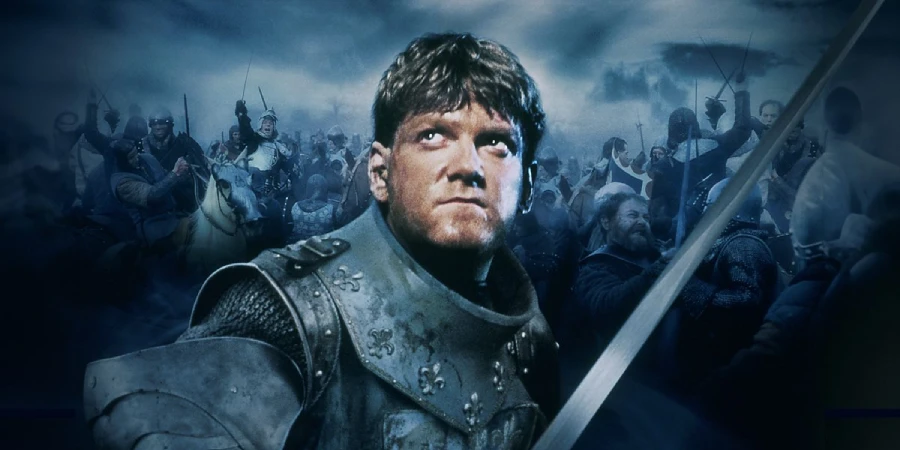

Kenneth Branagh was just 28 years old when he stepped in front of the camera as King Henry V, and the result is one of the most electrifying Shakespeare adaptations ever committed to film. This is not a stately, dusty heritage production. Branagh drags the Bard into the mud, the blood, and the moral complexity of real warfare, delivering a Henry who is genuinely frightening in his charisma and his ruthlessness. Few films based on a stage play feel this visceral.
Detailed Summary
The Chorus Sets the Stage
Derek Jacobi appears as the Chorus in a modern film studio, wearing a long coat and surrounded by scaffolding and artificial darkness. He directly addresses the audience, asking them to use their imagination to fill in the gaps of what cinema cannot show. This framing device immediately signals that Branagh wants viewers to think about the act of storytelling itself, not just the story.
Henry Asserts His Claim to France
Henry receives the Archbishop of Canterbury and the Bishop of Ely, who lay out a lengthy legal argument supporting his claim to the French throne. Canterbury delivers the Salic law speech, effectively giving Henry religious and legal cover to pursue war. Henry listens with calculated patience, and Branagh plays the scene with a quiet intensity that makes it clear Henry has already made up his mind.
French ambassadors then arrive and deliver a mocking gift from the Dauphin: a chest of tennis balls, implying Henry is a frivolous young man unfit for kingship. Henry responds with cold, precise fury, turning the insult into a declaration of war. In contrast to the Dauphin’s contempt, Henry’s restraint here is chilling rather than reassuring.
Falstaff, Betrayal, and the Price of Power
Branagh weaves in a series of flashback sequences that do not exist in the original play as written, drawing on material from Henry IV Part 1 and Henry IV Part 2. These sequences show Henry’s former life as Prince Hal, carousing with the fat, roguish Sir John Falstaff, played warmly by Robbie Coltrane. They give the film an emotional backstory that the play assumes audiences already carry with them.
Henry’s rejection of Falstaff, shown in a brief but devastating flashback, resonates throughout the film as a symbol of what becoming king costs a person. Moreover, the film uses these memories to humanize Henry rather than simply glorify him. We see a man who sacrificed genuine affection and friendship on the altar of political necessity.
Traitors Unmasked
Before the fleet sails for France, Henry discovers a conspiracy against his life involving three men he trusted: Lord Scroop, Sir Thomas Grey, and Richard, Earl of Cambridge. He handles their exposure with theatrical cruelty, first presenting them with sealed documents he claims are pardons, then revealing the documents actually contain evidence of their own treachery. Branagh delivers Henry’s confrontation with Scroop as a deeply personal wound, not simply a legal matter.
The Siege of Harfleur
Henry rallies his troops before the walls of Harfleur with the famous “Once more unto the breach” speech, and Branagh performs it as a raw, urgent war cry rather than a polished oration. Mud, noise, and chaos surround him. This production refuses to make war look heroic in any clean or comfortable sense.
After Harfleur falls, Henry orders the governor to surrender and threatens brutal consequences if resistance continues. He then shows mercy when the city yields. However, the film does not let the audience relax into simple admiration; Henry’s mercy is also a military calculation.
Comic Relief and Human Texture
Characters like Pistol, Nym, Bardolph, and Mistress Quickly provide moments of genuine humor and pathos alongside the grander political action. Mistress Quickly, played by Judi Dench, delivers a heartbreaking account of Falstaff’s death that stops the film cold. Her description of his final moments is tender, funny, and deeply sad all at once.
Bardolph, an old companion from Henry’s riotous past, faces execution for looting from a church during the campaign. Henry, despite knowing him personally, refuses to intervene. It is one of the film’s most uncomfortable moments, illustrating the iron discipline Henry imposes on himself and on those around him.
Agincourt: The Night Before
Henry disguises himself and walks among his common soldiers the night before the Battle of Agincourt, listening to their fears and their resentments. His exchange with the soldier Williams is particularly sharp; Williams argues that if the king’s cause is unjust, the king bears the guilt for every soul lost. Henry cannot fully answer this charge, and Branagh wisely does not pretend that he can.
Alone, Henry delivers the “Upon the King” soliloquy, a genuinely anguished meditation on the burden of royal responsibility. This is not a triumphant king; this is an exhausted, frightened man trying to carry an impossible weight. Consequently, the battle that follows carries genuine dramatic stakes.
The St. Crispin’s Day Speech
On the morning of Agincourt, facing a French army vastly superior in numbers, Henry delivers the St. Crispin’s Day speech. Branagh builds it slowly and quietly, starting almost at a whisper before it erupts into full-throated battle cry. It is arguably the finest delivery of that speech ever captured on film.
Notably, Branagh does not play the speech as a rally purely for the audience’s benefit. He plays it for the men around him, and the camera stays close to their faces as the words land. You believe these soldiers would follow this man into catastrophic odds.
Movie Ending
Agincourt itself arrives with brutal, muddy ferocity rather than cinematic glory. Henry fights alongside his men rather than directing from a safe distance, and Branagh stages the combat as ugly, exhausting, and terrifying. When the French launch a rear attack on the English baggage train and kill the boys guarding it, Henry orders all French prisoners executed, a morally devastating command that Branagh does not shy away from or excuse.
After the battle, Henry carries the body of a dead boy across the field himself, in one of the film’s most haunting images, set against Patrick Doyle’s swelling “Non Nobis Domine” and “Te Deum”. The camera holds on this long, slow procession through the carnage. Victory looks nothing like triumph.
Henry’s wooing of the French princess Katherine, played by Emma Thompson, provides the film’s final movement. It is charming, funny, and deliberately awkward. Henry, so commanding in war, is almost boyishly uncertain in courtship, and Thompson plays Katherine’s wariness with real intelligence.
The Chorus returns at the end to remind the audience, soberly, that Henry’s conquests did not last. His son would lose France and plunge England into civil war. Therefore, the film refuses a triumphant ending; instead, it frames the entire story as a brief, brilliant, ultimately tragic chapter in history. This final note transforms the film from a war epic into something more elegiac and honest.
Are There Post-Credits Scenes?
No. Henry V contains no post-credits scenes of any kind. After the Chorus delivers his closing lines and the credits roll, the film is done. There is nothing to wait around for.
Type of Movie
This film occupies the intersection of historical drama, war film, and literary adaptation. Its tone shifts deliberately and skillfully between epic grandeur, intimate character study, and dark comedy. In contrast to more reverent Shakespeare adaptations, Branagh leans into the grim and the human throughout.
Cast
- Kenneth Branagh – King Henry V
- Derek Jacobi – Chorus
- Emma Thompson – Princess Katherine
- Judi Dench – Mistress Quickly
- Robbie Coltrane – Sir John Falstaff
- Ian Holm – Fluellen
- Brian Blessed – Exeter
- Paul Scofield – King of France
- Michael Maloney – Dauphin
- Christian Bale – Boy
- Alec McCowen – Ely
- Charles Kay – Archbishop of Canterbury
- Robert Stephens – Pistol
- Geraldine McEwan – Alice
Film Music and Composer
Patrick Doyle composed the score for Henry V, marking his feature film debut. Doyle was already associated with Branagh through the Renaissance Theatre Company, and this collaboration launched a long creative partnership. His musical instincts matched the film’s ambition perfectly.
The standout piece is “Non Nobis Domine”, the hymn of thanksgiving sung after Agincourt, which Doyle himself performs on screen as a soldier. It begins quietly with a single voice and expands into a full choral and orchestral swell. Furthermore, the score threads genuine liturgical grandeur with emotional restraint, never tipping into sentimentality.
Filming Locations
Production took place primarily at Shepperton Studios in Surrey, England, with location work carried out at sites including Blenheim Palace in Oxfordshire. Blenheim provided the imposing stone architecture needed for the French court sequences. Shooting largely on sets and controlled locations gave Branagh tight command over the film’s visual atmosphere.
The Agincourt sequence used a large stretch of English countryside dressed to suggest the French fields of 1415. Keeping production in England on a relatively modest budget required creative discipline. However, the result looks far more expensive than its actual cost.
Awards and Nominations
Branagh received an Academy Award nomination for Best Director, a remarkable achievement for a first-time feature director. The film also received an Oscar nomination for Best Costume Design. Phyllis Dalton won the Academy Award for Best Costume Design for her work on the film.
Branagh additionally received a BAFTA nomination for Best Actor for his performance. The film’s critical reception was enthusiastic, and it announced Branagh as a major filmmaking talent almost immediately. In addition, Patrick Doyle’s score received wide praise, helping to launch his career in earnest.
Behind the Scenes Insights
- Branagh both directed and starred in the film, a dual role that required him to rehearse scenes with other actors and then step in front of the camera to perform them, often on the same day.
- Christian Bale, then a teenager, played the Boy, one of his earliest significant film roles, predating his later international fame by many years.
- Patrick Doyle performed his own composition on screen, singing the opening of “Non Nobis Domine” as a soldier walking through the aftermath of Agincourt.
- Branagh had previously directed and starred in stage productions of the play before making the film, giving him unusually deep familiarity with the material.
- The production budget was modest by Hollywood standards, which pushed the creative team toward practical, grounded solutions rather than large-scale spectacle.
- Derek Jacobi, who plays the Chorus, had been one of Branagh’s mentors and a major influence on his approach to classical acting.
- Branagh made a deliberate choice to contrast his version with Laurence Olivier’s celebrated 1944 adaptation, aiming for rawness and psychological realism over pageantry.
Inspirations and References
The film’s primary source is William Shakespeare’s play Henry V, written around 1599. Branagh also drew on material from Henry IV Part 1 and Henry IV Part 2 for the Falstaff flashback sequences, which he incorporated to give audiences an emotional grounding in Henry’s past. This was a significant creative choice for viewers unfamiliar with the earlier plays.
Laurence Olivier’s 1944 film adaptation of Henry V loomed large as both an inspiration and a point of deliberate departure. Olivier’s version was produced as wartime propaganda, emphasizing triumph and national glory. Branagh, in contrast, was more interested in ambiguity, trauma, and the human cost of war.
Historically, the real Battle of Agincourt took place on October 25, 1415, and was a genuine English victory against a much larger French force. Shakespeare’s play takes considerable historical liberties, and Branagh’s film follows the play rather than strict historical record. The emotional and moral questions the film raises, however, connect to real debates about just war and the responsibilities of leaders.
Alternate Endings and Deleted Scenes
No widely documented alternate endings or significant deleted scenes for this film are on record. Branagh’s version of the screenplay was tight and purposeful from the outset. The flashback sequences involving Falstaff represent the most substantial creative addition to Shakespeare’s text, but these were always part of Branagh’s plan rather than material later removed.
Book Adaptations and Differences
This film adapts a stage play rather than a prose novel. Shakespeare’s Henry V presents events through dialogue, with the Chorus filling narrative gaps that a stage cannot show. Branagh translates these theatrical devices into cinematic ones, using the Chorus as a self-aware narrator and replacing described action with dramatized scenes.
The most notable difference from the source play is the addition of Falstaff flashback scenes. Shakespeare’s play refers to Falstaff’s death but does not show his friendship with Henry directly within Henry V itself. Branagh borrows from the earlier history plays to make that relationship visceral and visible on screen, giving the film a richness the play alone cannot deliver to uninitiated audiences.

Memorable Scenes and Quotes
Key Scenes
- Henry’s cold, controlled response to the Dauphin’s tennis balls insult, in which contempt and menace coexist perfectly in Branagh’s delivery.
- Mistress Quickly’s account of Falstaff’s death, performed by Judi Dench with heartbreaking tenderness and Shakespearean comic rhythm combined.
- The execution of Bardolph, Henry’s former companion, which plays out in near silence and forces the audience to reckon with the king’s transformation.
- Henry’s night disguise among the common soldiers and his exchange with Williams about royal guilt and the justice of war.
- The “Upon the King” soliloquy, shot in close-up in near darkness, stripping Henry of all royal armor.
- The St. Crispin’s Day speech, built from a whisper to a roar, with Branagh holding every soldier, and every viewer, in the palm of his hand.
- The post-Agincourt procession, with Henry carrying the dead boy through the carnage while “Non Nobis Domine” swells around him.
- Henry’s awkward, charming courtship of Katherine, which plays as genuine romantic comedy after so much darkness.
Iconic Quotes
- “Once more unto the breach, dear friends, once more; or close the wall up with our English dead.”
- “We few, we happy few, we band of brothers; for he today that sheds his blood with me shall be my brother.”
- “Upon the King! Let us our lives, our souls, our debts, our careful wives, our children, and our sins lay on the King.”
- “Every subject’s duty is the King’s; but every subject’s soul is his own.”
- “I am not covetous for gold… but if it be a sin to covet honour, I am the most offending soul alive.”
Easter Eggs and Hidden Details
- The Chorus’s costume and the film studio setting in the opening sequence deliberately evoke a behind-the-scenes atmosphere, reminding viewers that they are watching a constructed narrative, not simply a historical record.
- Branagh frames many of the Agincourt scenes to echo visual compositions from classic war paintings, grounding the chaos in a recognizable pictorial tradition.
- Patrick Doyle’s on-screen appearance as the singing soldier after Agincourt is easy to miss if you do not know to look for the composer himself delivering the film’s most emotionally significant musical moment.
- The Falstaff flashbacks, shot in a warmer, slightly softer visual palette, subtly distinguish memory from present action, rewarding attentive viewers who notice the tonal shift.
- Several members of the cast, including Derek Jacobi and Brian Blessed, had personal connections to Branagh’s theatrical background, making the ensemble a kind of extended theatrical family captured on film.
Trivia
- Branagh became one of the youngest directors to receive an Academy Award nomination for Best Director at the time of the film’s release.
- Emma Thompson and Kenneth Branagh were married in real life at the time of filming, adding an extra layer of genuine chemistry to their courtship scenes.
- The film was made on a budget of approximately four million pounds, extraordinarily low for a production of its scope and ambition.
- Laurence Olivier, who directed and starred in the 1944 version of Henry V, reportedly praised Branagh’s stage work, giving the younger actor a sense of continuity with the classical tradition he was entering.
- Christian Bale’s role as the Boy who is killed in the French attack on the baggage train foreshadowed a career built on intense, physically and emotionally demanding performances.
- The film is credited with sparking a broader renaissance of Shakespeare on screen during the 1990s, encouraging studios to back subsequent adaptations including Branagh’s own later Shakespeare films.
Why Watch?
Branagh’s Henry V earns its place among the essential war films of its era, not because it glorifies conflict but because it refuses to. It offers magnetic performances, a genuinely affecting score, and a portrait of leadership that is simultaneously inspiring and deeply uncomfortable. Anyone interested in Shakespeare, military drama, or simply great acting has compelling reasons to seek this film out.
Director’s Other Movies
- Dead Again (1991)
- Peter’s Friends (1992)
- Much Ado About Nothing (1993)
- Mary Shelley’s Frankenstein (1994)
- Hamlet (1996)
- Love’s Labour’s Lost (2000)
- As You Like It (2006)
- Thor (2011)
- Cinderella (2015)
- Murder on the Orient Express (2017)
- Artemis Fowl (2020)
- Belfast (2021)
- Death on the Nile (2022)
Recommended Films for Fans
- Henry V (1944)
- Hamlet (1996)
- Much Ado About Nothing (1993)
- Braveheart (1995)
- The Lion in Winter (1968)
- Ran (1985)
- Richard III (1995)
- Patton (1970)
- Othello (1995)