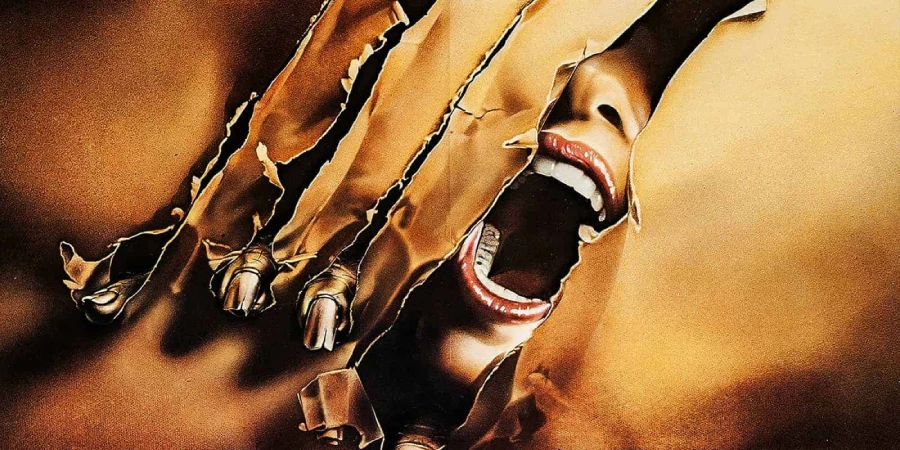

Joe Dante’s The Howling does not ease you in gently. It opens with a news reporter walking into a peep show booth to meet a serial killer, and things only get stranger from there. This 1981 werewolf film is simultaneously a sharp satire of television culture and a genuinely unsettling horror experience. It stands as one of the genre’s finest entries, built on practical effects wizardry and a screenplay that earns every one of its scares.
Detailed Summary
Karen’s Harrowing Encounter with Eddie Quist
News anchor Karen White volunteers to help police catch a serial killer named Eddie Quist. She meets him in a sleazy adult video booth, and the encounter leaves her traumatized and amnesiac about what she actually saw. Police shoot Eddie dead at the scene, giving Karen and the audience a false sense of relief.
However, Karen’s psychological damage is severe. Her therapist, Dr. George Waggner, recommends she retreat to a secluded therapeutic community called The Colony. Her husband Bill Neill accompanies her, hoping the rural setting will help her heal.
Strange Behavior at The Colony
The Colony sits deep in a forested area and houses a collection of deeply eccentric individuals. Karen and Bill quickly notice that the residents behave oddly, particularly a seductive woman named Marcia. Something feral runs beneath the surface of every interaction.
Meanwhile, Bill wanders into the woods one night and encounters Marcia. She seduces him and bites him during the encounter. He returns shaken and, in the days that follow, begins changing in disturbing ways.
Karen notices Bill growing increasingly aggressive and withdrawn. His appetite shifts and his behavior becomes predatory. She tries to connect with him, but something has already begun replacing the man she married.
Colleagues Investigate Eddie Quist
Back in Los Angeles, Karen’s colleagues Terry Fisher and Chris Halloran investigate the Eddie Quist case independently. They visit the morgue and make a startling discovery: Eddie’s body has vanished. In addition, his personal files reveal disturbing artwork filled with werewolf imagery.
Terry tracks leads to a bookstore run by a quirky horror enthusiast named Ernie. Ernie points her toward werewolf lore, specifically the idea that only silver or fire can kill one. Consequently, Terry and Chris begin piecing together a theory that feels insane but fits every available fact.
The Horror Escalates at The Colony
Terry arrives at The Colony to check on Karen. She discovers Eddie’s severed finger and then, in a devastating sequence, finds Eddie himself very much alive. He transforms in front of her in one of horror cinema’s most jaw-dropping practical effects sequences, his body grotesquely reshaping into a massive werewolf.
Eddie kills Terry. Her death confirms that the werewolf threat is entirely real, not metaphorical. Chris races to The Colony with silver bullets after learning of Terry’s fate.
Karen, meanwhile, uncovers the full truth. Dr. Waggner leads a community of werewolves trying to integrate into society. Notably, Waggner himself believes werewolves must suppress their nature rather than embrace it, putting him at odds with more feral members like Erle Kenton and the rest of the pack.
The Pack Turns on Waggner
Bill, now fully transformed into a werewolf, abandons any remaining humanity. Waggner attempts to maintain order over his fractious pack, but they reject his philosophy. The pack kills Waggner, demonstrating that no amount of therapy suppresses their predatory instincts for long.
Chris arrives and uses silver bullets to dispatch several werewolves, including Bill. Karen escapes the burning Colony after Chris sets it ablaze. Fire, as the folklore promised, works just as effectively as silver.
Movie Ending
Karen survives the Colony and returns to her life as a television news anchor. She uses her broadcast platform to warn the public about werewolves, understanding that nobody will believe a simple verbal account. On live television, she bites herself and triggers her own transformation in front of millions of viewers.
Karen had been bitten at some point during the Colony’s chaos, and her transformation on camera is her desperate attempt to force the world to confront an inconvenient truth. Audiences see a partial, small-scale transformation, notably less monstrous than Eddie’s spectacular change earlier. This contrast raises an immediate question: did Karen receive a weaker strain, or does her transformation simply reflect a different stage?
Chris watches from the studio and shoots Karen with a silver bullet, ending her life before she fully turns. It is an act of mercy and necessity. The news producer cuts the broadcast, and the station immediately plays footage of a normal-looking woman transforming into a werewolf, framing it as a trick.
In the final moments, a woman at a diner orders a rare burger after watching Karen’s broadcast. Her eyes catch the light in a distinctly inhuman way. This closing shot confirms that werewolves exist throughout society, hiding in plain sight, completely undisturbed by Karen’s sacrifice. Her warning failed. The world laughed it off, and the predators simply kept eating.
This ending delivers a punishing statement about media skepticism and the public’s willingness to dismiss uncomfortable truths as entertainment. Karen died for nothing, and the monsters won. It is bleak, sharp, and genuinely haunting.
Are There Post-Credits Scenes?
The Howling contains no post-credits scene. Once the credits roll, the film is finished. You do not need to stay seated.
Type of Movie
The Howling occupies a fascinating tonal space. At its core it is a supernatural horror film, grounded in werewolf mythology. However, it simultaneously functions as a dark satire of television news culture and media credulity.
Joe Dante injects dry wit throughout without undermining the scares. In contrast to other werewolf films of the era, this one trusts its audience to hold humor and horror in the same hand. The tone stays tense and unsettling even when the film is being clever.
Cast
- Dee Wallace – Karen White
- Patrick Macnee – Dr. George Waggner
- Dennis Dugan – Chris Halloran
- Christopher Stone – Bill Neill
- Belinda Balaski – Terry Fisher
- Kevin McCarthy – Fred Francis
- John Carradine – Erle Kenton
- Slim Pickens – Sam Newfield
- Elisabeth Brooks – Marcia
- Robert Picardo – Eddie Quist
- Dick Miller – Walter Paisley
- Kenneth Tobey – Charlie Barton
Film Music and Composer
Pino Donaggio composed the score for The Howling. Donaggio was already well established in horror after scoring Brian De Palma’s Carrie and Dressed to Kill. His work here blends orchestral tension with unsettling, almost romantic undertones that make the horror feel deeply personal.
His score for The Howling avoids the blunt percussion of typical slasher music. Instead, it builds dread incrementally, complementing the film’s slow-burn structure. The music during Eddie’s transformation sequence amplifies the body horror without overwhelming the remarkable practical effects on screen.


Filming Locations
Principal photography took place primarily in California. The Colony scenes used rural Northern California locations to create an authentically isolated, slightly off-kilter atmosphere. That sense of geographic remoteness is essential to the story because it strips Karen of easy escape routes and outside help.
Los Angeles locations grounded the film’s opening act in a recognizable urban reality. Shooting in actual city environments made Karen’s television world feel credible and mundane, which sharpens the contrast when the supernatural erupts into it. Moreover, the city-versus-wilderness dynamic reinforces the film’s thematic tension between civilized facades and feral reality.
Awards and Nominations
The Howling received recognition primarily within the horror genre community. It earned Saturn Award nominations from the Academy of Science Fiction, Fantasy and Horror Films, including recognition for its special effects work. Rob Bottin’s transformation effects generated significant industry conversation, even if major mainstream awards ignored the film entirely.
Behind the Scenes Insights
- Rob Bottin created the groundbreaking practical transformation effects. He was only around 21 years old during production, making his achievement even more extraordinary.
- Joe Dante populated the film with deliberate cameos from horror film legends, including Roger Corman, as a tribute to the genre’s history.
- Dee Wallace found the role physically and emotionally demanding, particularly the scenes requiring her to react to effects that were only partially completed during filming.
- The film was shot on a tight budget, which forced creative solutions that often enhanced the horror rather than limiting it.
- Dante and screenwriter John Sayles made extensive changes from the source novel, deliberately steering the story in a different direction from Gary Brandner’s book.
- Dick Miller’s character, Walter Paisley, shares a name with Miller’s character in Roger Corman’s A Bucket of Blood, a deliberate in-joke from Dante.
Inspirations and References
The Howling is based on Gary Brandner’s 1977 novel of the same name. Brandner’s book provided the basic setup: a woman retreating to a strange community after trauma, discovering it harbors werewolves. However, screenwriters John Sayles and Terence H. Winkless transformed the story significantly.
Dante and Sayles layered in references to classic werewolf cinema throughout. Character names nod to directors of classic horror and science fiction films, a running joke woven into the fabric of the screenplay. Furthermore, the film engages directly with werewolf folklore traditions rather than inventing its own mythology.
The satire of television news culture reflects anxieties about media manipulation that were very much alive in early 1980s America. Karen’s career as a news anchor is not incidental; it positions the entire film as a commentary on what audiences choose to believe and what institutions choose to suppress.
Alternate Endings and Deleted Scenes
No widely documented alternate ending for The Howling exists in the public record. The released ending appears to reflect Dante’s intended vision from an early stage of production. Specific deleted scenes have not been a significant focus of official home media releases.
Some footage variations exist between different international cuts of the film. However, these differences involve minor trims rather than substantive alternate narrative directions. No lost ending or major cut sequence has surfaced that would fundamentally change how audiences interpret the story.
Book Adaptations and Differences
The Howling is based on Gary Brandner’s 1977 novel. In the book, Karen is not a television journalist. Her profession and the entire media satire angle are inventions of the screenplay. This shift fundamentally changes the film’s thematic concerns.
Brandner’s novel focuses more straightforwardly on horror and survival. Sayles and Dante added the satirical layer, the Colony’s pseudo-therapeutic framing, and the devastating irony of the ending. In contrast to the book, the film uses werewolves as a vehicle for social commentary rather than pure genre thrills.
Several characters and subplots differ between page and screen. Nonetheless, both versions share the essential setup of a traumatized woman retreating to a community with a monstrous secret. That core premise is where the similarity largely ends.
Memorable Scenes and Quotes
Key Scenes
- Karen meets Eddie in the peep show booth: A masterclass in building dread through shadow, sound, and suggestion. What Karen sees remains partially obscured, making it more frightening.
- Eddie Quist’s transformation: Rob Bottin’s practical effects work reaches a peak here. Eddie’s body elongates, his skull reshapes, and fur erupts from his skin in a sequence that still holds up as a landmark of body horror.
- Terry’s death: Abrupt, brutal, and genuinely shocking. Killing a sympathetic protagonist-adjacent character without warning forces the audience to accept that nobody is safe.
- Karen’s on-air transformation: Quiet, tragic, and deeply uncomfortable. Karen chooses public sacrifice and the world repays her with disbelief and a quick channel change.
- The final diner shot: Barely three seconds of screen time. A woman’s eyes glinting in an inhuman way over a rare burger delivers one of horror cinema’s most economical gut-punches.
Iconic Quotes
- “I want to give you something. I want to open your eyes.” – Eddie Quist, a line chilling in its ambiguity.
- “You can’t tame what’s meant to be wild.” – spoken within The Colony, encapsulating the film’s central thematic conflict between civilization and instinct.
Easter Eggs and Hidden Details
- Character names throughout the film reference directors of classic werewolf and horror films. For instance, George Waggner shares his name with the director of the 1941 The Wolf Man, and Sam Newfield references a prolific B-movie director of the same era.
- Dick Miller’s character is named Walter Paisley, identical to his role in Roger Corman’s A Bucket of Blood from 1959, a deliberate tribute embedded by Dante.
- A television in the background plays Invasion of the Body Snatchers at one point, thematically echoing the film’s ideas about hidden monsters living among ordinary people.
- Roger Corman appears in a brief cameo, one of several genre veterans Dante cast as a loving nod to horror cinema history.
- Forrest J Ackerman, the legendary horror enthusiast and publisher of Famous Monsters of Filmland, also appears in a cameo role.
- John Carradine’s casting as Erle Kenton references the actual director Erle C. Kenton, who directed several Universal monster films in the 1940s.
Trivia
- The Howling and An American Werewolf in London both released in 1981, creating an extraordinary year for werewolf cinema and a friendly rivalry over whose transformation effects were superior.
- Rob Bottin subsequently worked on John Carpenter’s The Thing the following year, producing another landmark of practical horror effects.
- John Sayles, who co-wrote the screenplay, later became a celebrated independent film director in his own right.
- Dee Wallace and Christopher Stone, who played married couple Karen and Bill, were actually married to each other in real life at the time of filming.
- The film spawned numerous sequels, none of which involved Joe Dante or the core creative team, and most are considered significantly inferior to the original.
- Joe Dante has cited his affection for classic horror films as a primary motivation for filling The Howling with references and in-jokes aimed at genre enthusiasts.
- Patrick Macnee, best known as John Steed in the British television series The Avengers, brought considerable gravitas to the role of Dr. Waggner.
Why Watch?
The Howling earns its place in horror history through genuine craft, not nostalgia. Rob Bottin’s practical effects remain viscerally impressive, and Joe Dante’s satirical intelligence elevates the material far above standard creature-feature territory. Consequently, it rewards viewers who want both thrills and ideas from their horror. Few werewolf films have matched its combination of wit, dread, and genuine bite.
Director’s Other Movies
- Piranha (1978)
- Gremlins (1984)
- Explorers (1985)
- Innerspace (1987)
- The ‘Burbs (1989)
- Gremlins 2: The New Batch (1990)
- Matinee (1993)
- Small Soldiers (1998)
- Looney Tunes: Back in Action (2003)
Recommended Films for Fans
- An American Werewolf in London (1981)
- The Thing (1982)
- Wolfen (1981)
- Silver Bullet (1985)
- Near Dark (1987)
- Fright Night (1985)
- Videodrome (1983)
- Dog Soldiers (2002)
- Ginger Snaps (2000)