
Sleep is supposed to be safe. Invasion of the Body Snatchers (1956) turns that assumption into a slow-building nightmare, suggesting that the person who wakes up beside you might not be a person at all. Director Don Siegel crafted one of the most unsettling science fiction films of its era on a modest budget, delivering a story that hit audiences harder than most big-budget spectacles. Its paranoia has never really gone away.
Detailed Summary
Miles Bennell Returns to Santa Mira
Dr. Miles Bennell (Kevin McCarthy) returns to his small California town of Santa Mira after a brief trip away. He quickly notices something is wrong: patients are canceling appointments, and locals are reporting that their loved ones seem subtly different, somehow hollow.
His old friend Becky Driscoll (Dana Wynter) tells him her cousin swears her uncle is not really her uncle anymore. Miles dismisses it initially as a shared psychological episode, a kind of mass hysteria sweeping the town.
The Pod in the Greenhouse
Friends Jack Belicec and his wife Teddy discover a strange body in their home, one that lacks distinct features but resembles Jack in a rough, unfinished way. Miles examines it and finds no fingerprints, no blemishes, essentially a blank human template.
Meanwhile, Becky’s father discovers a similar pod-like form growing in his basement. Miles begins to piece together the terrifying reality: giant seed pods from outer space are replicating human beings while they sleep. Once a person falls asleep next to their pod, the duplicate takes over and the original disintegrates.
The Town Closes In
Miles tries to call for help but finds his phone calls rerouted or ignored. He contacts a psychiatrist friend, Dr. Danny Kaufman (Larry Gates), who arrives and calmly reassures him. However, Kaufman himself has already been replaced, and he works to lull Miles into a false sense of security.
Townspeople begin organizing quietly, distributing pods to neighboring communities. The replication spreads efficiently and without emotion. In contrast to the frantic fear Miles feels, the pod people move with an eerie, collective calm.
Miles and Becky Fight to Stay Awake
Miles and Becky hide and desperately try to avoid sleeping. They witness a town meeting where pods are handed out like supplies, loaded into trucks to spread the invasion to nearby cities. Staying awake becomes an act of resistance.
Miles sedates Becky briefly to keep her calm during their escape, which turns out to be a fatal miscalculation. She falls into a light sleep during their flight through the hills, and when Miles kisses her, he realizes with horror that she has already been replaced. Her eyes are vacant, her emotion gone.

Movie Ending
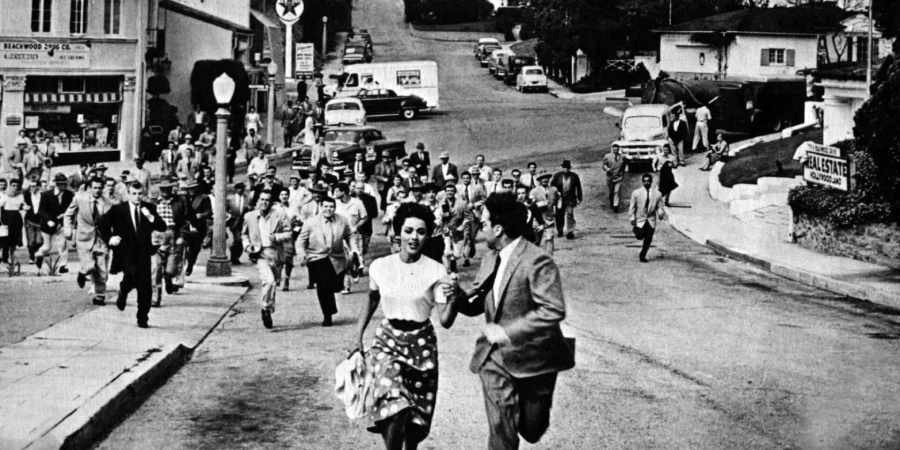
Miles runs onto a highway in a frantic, desperate state, screaming at passing cars to stop. Nobody listens. Drivers swerve around him; he looks unhinged, just another madman on the road. This sequence, shot with raw urgency, puts the audience directly inside his terror.
He is eventually picked up and taken to a hospital, where he tells his story to disbelieving doctors and a psychiatrist. The framing device of the film places us in that hospital interrogation room from the very beginning, so we understand his desperation before we even see the invasion unfold.
Then comes the turning point. A truck driver arrives at the hospital reporting that his vehicle was buried in strange pods, pods matching everything Miles described. Suddenly, the doctors believe him. Federal authorities are alerted, and the film closes on a note of cautious hope: help is on the way.
This ending matters enormously because it almost did not exist. The studio added the framing device and the final hopeful scene after test screenings, fearing the original ending was too bleak. In the original cut, Miles screams at the camera directly, with no resolution, no cavalry coming. That version remains the more chilling one by most critical accounts.
Ultimately, even the softened ending carries weight. The system barely believed Miles. One lucky coincidence, a truck driver with the right cargo, saved him. The film asks quietly how many others did not get that lucky break.
Are There Post-Credits Scenes?
No. Invasion of the Body Snatchers (1956) contains no post-credits scene. Credits roll and the film is done. Given the story’s themes of sleepless paranoia, perhaps that is fitting.
Type of Movie
This is a science fiction horror thriller, though it also functions as a deeply effective paranoia drama. The tone is tense and increasingly suffocating, with dread building through suggestion rather than graphic horror.
Scholars frequently read it as a Cold War allegory, though whether it targets McCarthyism or communist conformism remains a genuinely open debate. Both readings hold up, which is part of what makes the film endure.
Cast
- Kevin McCarthy – Dr. Miles Bennell
- Dana Wynter – Becky Driscoll
- Larry Gates – Dr. Danny Kaufman
- King Donovan – Jack Belicec
- Carolyn Jones – Teddy Belicec
- Jean Willes – Sally Withers
- Ralph Dumke – Police Chief Nick Grivett
- Virginia Christine – Wilma Lentz
- Tom Fadden – Uncle Ira Lentz
- Whit Bissell – Dr. Hill
Film Music and Composer
Carmen Dragon composed the score for the film. His work leans heavily on dissonance and eerie orchestration, reinforcing the creeping dread without tipping into outright monster-movie bombast.
Dragon was a respected conductor and arranger in Hollywood, which gave his work here a sophistication that elevated the material. The score does not call attention to itself; it operates under the surface, much like the pods themselves.

Filming Locations
Principal photography took place in Sierra Madre, California, a quiet, small-scale suburb east of Los Angeles. The choice was deliberate: Sierra Madre looks exactly like the kind of town where nothing bad should happen.
That ordinariness is the point. Using a real, recognizable American suburb instead of a constructed set made the threat feel immediate and personal. Audiences across the country could see their own neighborhoods in Santa Mira.
Additional scenes used nearby Los Angeles-area locations to fill in the highway and urban sequences. The practical, low-budget approach to location shooting gave the film a documentary texture that heightened its realism.
Awards and Nominations
Invasion of the Body Snatchers did not receive major awards recognition upon its initial release. However, its critical reputation grew substantially over the decades, and it now appears on numerous lists of the greatest science fiction films ever made.
Behind the Scenes Insights
- Director Don Siegel shot the film in approximately 23 days, an extremely tight schedule even by B-movie standards of the era.
- Siegel himself strongly preferred his original ending, with Miles screaming directly at the audience, and openly resented the studio’s decision to add the framing device.
- Producer Walter Wanger pushed for the softer ending and the hospital framing, believing audiences needed some reassurance to leave the theater.
- Kevin McCarthy reportedly found the physical demands of the film, particularly the highway running sequence, genuinely exhausting to shoot.
- Siegel made a cameo appearance in the film as a cab driver, a small nod to his presence in the story he was trying to tell.
- Dana Wynter later said that the moment her character is revealed as a pod person ranks among the most memorable acting challenges of her career.
Inspirations and References
The film adapts Jack Finney’s serialized novel The Body Snatchers, published in Collier’s magazine in 1954 and then as a book. Finney’s story provided the core concept: alien pods replacing sleeping humans with emotionless duplicates.
The Cold War cultural atmosphere shaped how the story resonated with audiences. Conformity, loss of individual identity, and the fear of an invisible enemy were all live anxieties in 1950s America. Finney’s source material tapped directly into that collective dread.
Some critics also connect the film to broader post-World War II fears about totalitarian systems, where individuals are absorbed into an unfeeling collective. Finney himself downplayed overt political intent, but the allegory proved too resonant for audiences to ignore.
Alternate Endings and Deleted Scenes
The most significant alternate version is effectively the original cut of the film. Without the studio-mandated framing device and the final hospital scene, the film ends with Miles alone on the highway, screaming at the camera with no hope of rescue.
That original ending turns the film into something closer to a tragedy, where civilization loses and one man’s warning goes unheard. Siegel’s preferred version remains more artistically coherent with the film’s tone, even if it denies the audience comfort.
No substantial deleted scenes from the production have entered wide public circulation. The framing device additions represent the most documented divergence between Siegel’s vision and the released version.
Book Adaptations and Differences
The film adapts Jack Finney’s novel The Body Snatchers (1955). Finney’s book ends on a more explicitly optimistic note: the pods, sensing human resistance and emotion, eventually give up and leave Earth. The film omits this resolution entirely in both its versions.
In addition, Finney’s novel develops the romance between Miles and Becky more gradually. The film compresses their relationship for pacing, which slightly reduces the emotional impact of Becky’s eventual replacement.
Finney’s prose style is warmer and more nostalgic than the film’s paranoid atmosphere suggests. Siegel pushed the material toward something harder and more unsettling, which served the film well even if it moved away from the novel’s spirit.


Memorable Scenes and Quotes
Key Scenes
- Miles examines the blank, featureless body on Jack’s pool table and realizes it is a forming duplicate, a slow-burn reveal that sets the film’s horror in motion.
- Becky’s pod is discovered growing in her father’s basement, shifting the threat from abstract to immediate and personal.
- Miles witnesses the town square distribution of pods, loaded into trucks for transport, which visualizes the scale of the invasion in a single chilling image.
- Miles kisses Becky during their escape and realizes she is gone, replaced; her blank expression as she looks at him delivers the film’s most devastating emotional blow.
- Miles runs screaming onto the highway, desperate and ignored, in one of 1950s cinema’s most raw and unnerving sequences.
Iconic Quotes
- “You’re next! You’re next!” (Miles Bennell, screaming at passing traffic on the highway)
- “In my practice, I’ve seen how people have allowed their humanity to drain away. Only it happened slowly instead of all at once.” (Dr. Kaufman)
- “There’s no need for love.” (Pod-replaced Becky)
- “Someday we’ll know if we’re not already too late.” (Miles Bennell)
Easter Eggs and Hidden Details
- Director Don Siegel appears briefly as a cab driver early in the film, a blink-and-miss-it cameo for attentive viewers.
- Screenwriter Daniel Mainwaring also reportedly appears in a small background role, making the film a quiet double cameo from its key creators.
- The pods are deliberately kept visually vague for much of the film, forcing audiences to project their own fears onto them rather than react to a concrete monster design.
- Santa Mira as a town name carries no direct real-world reference, but its generic pleasantness reinforces the idea that this invasion could happen anywhere.
- The lack of music during several key scenes was intentional; silence signals to the audience that something is profoundly wrong even before the characters realize it.
Trivia
- The film was shot in black and white, which was a deliberate cost-saving measure, but the grainy, shadowy aesthetic ended up serving the paranoid tone exceptionally well.
- Kevin McCarthy reprised his role as Miles Bennell in a cameo appearance in Philip Kaufman’s 1978 remake, running and warning people on the street in a direct callback to the original film.
- Director Don Siegel also appeared in the 1978 remake as a cab driver, mirroring his cameo in the original.
- The film’s budget was extremely low, roughly under $400,000, yet it performed well at the box office and became one of Allied Artists’ most successful releases.
- Jack Finney reportedly approved of the film adaptation despite the tonal differences from his source novel.
- The film completes its entire story in under 80 minutes, a testament to how much dread Siegel packed into a tight runtime.
Why Watch?
Invasion of the Body Snatchers remains essential viewing because it turns a simple science fiction premise into something genuinely philosophical, raising questions about identity, conformity, and what makes us human. Its paranoia feels current regardless of when you watch it. Few films from any era pack this much unsettling intelligence into such a lean package.
Director’s Other Movies
- Riot in Cell Block 11 (1954)
- Crime in the Streets (1956)
- Baby Face Nelson (1957)
- The Lineup (1958)
- Flaming Star (1960)
- Hell Is for Heroes (1962)
- The Killers (1964)
- Madigan (1968)
- Coogan’s Bluff (1968)
- Dirty Harry (1971)
- Escape from Alcatraz (1979)
Recommended Films for Fans
- Invasion of the Body Snatchers (1978)
- The Thing (1982)
- They Live (1988)
- The Stepford Wives (1975)
- Rosemary’s Baby (1968)
- Village of the Damned (1960)
- The Manchurian Candidate (1962)
- Get Out (2017)