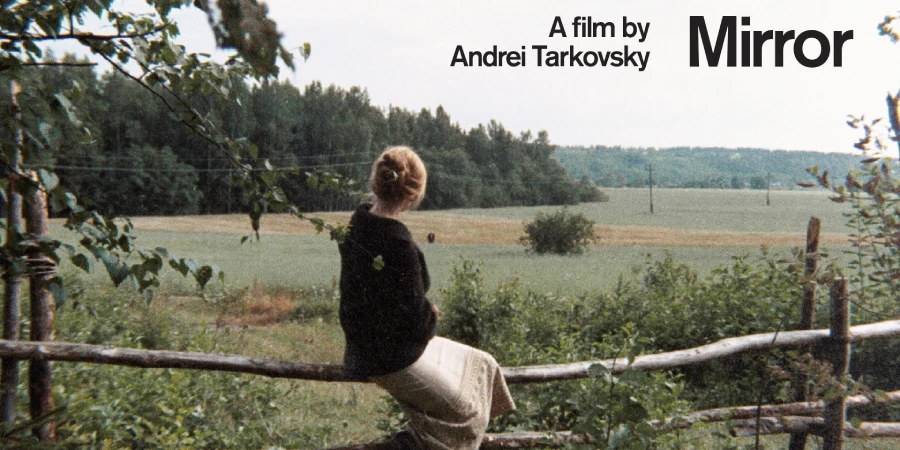
Andrei Tarkovsky’s The Mirror is less a movie and more a cinematic séance, summoning ghosts from the past in a fractured, beautiful dream. The film rejects traditional storytelling; instead, it offers a stream of consciousness from a dying narrator. Consequently, watching it feels like leafing through someone else’s soul.
Detailed Summary
Understanding The Mirror requires abandoning the need for a linear plot. The film is a collage of memories, dreams, and historical newsreels, all from the perspective of an unseen narrator, Alexei. These fragments constellate around key moments in his life, jumping between three time periods: his pre-war childhood in the 1930s, his adolescence during the war, and his present-day reality in the 1970s.
The Pre-War Idyll
The film frequently returns to a sun-drenched dacha, a country house where a young Alexei lives with his mother, Maria, and his sister. His father has recently left the family, a wound that clearly never heals. These scenes are impressionistic and full of potent symbols. For instance, a barn suddenly catches fire, watched with a strange calm by the family. In another sequence, Maria believes she sees her estranged husband returning, only for him to be a passing doctor. Furthermore, this period is depicted as a lost paradise, a source of both warmth and deep-seated melancholy for the adult Alexei.
Wartime and Adolescence
In contrast, the wartime sequences are stark and tense. The family has been evacuated from their home, and the relationship between Maria and her children is strained. One notable scene involves Alexei and his sister at a military training facility where he accidentally drops a dummy grenade. Subsequently, his harsh instructor berates him with a political tirade. These memories are tinged with fear and the harsh realities of Soviet life. They also show Maria’s struggle as a single mother working at a printing press, terrified of making a costly error.
The Fractured Present
Meanwhile, in the present, the adult Alexei is dying from an unnamed illness. We only hear his voice, often in strained conversations. He argues with his ex-wife, Natalia, who is strikingly played by the same actress as his young mother. This deliberate choice suggests Alexei is forever replaying his maternal relationships. Moreover, his own son, Ignat, is distant. An important scene finds Ignat alone in the apartment when a mysterious woman asks him to read a letter from Pushkin. This moment, like many others, blurs the line between reality, memory, and spiritual visitation. Ultimately, Alexei’s present is defined by regret and a desperate attempt to make sense of his past.
Newsreels and Poems
Tarkovsky constantly weaves documentary newsreel footage into the narrative. For instance, we see soldiers crossing Lake Sivash, the Spanish Civil War, and the Sino-Soviet border conflict. These public histories serve as a backdrop to Alexei’s private one, suggesting that personal memory cannot be separated from the sweep of history. In addition, the narrator’s voice periodically recites poems written by Tarkovsky’s own father, Arseny Tarkovsky. These poems act as the film’s philosophical spine, articulating themes of time, love, and mortality.
Movie Ending
The ending of The Mirror is a sublime convergence of all its timelines. The film flows into its final sequence, which takes us back to the idyllic countryside of Alexei’s childhood. We see his elderly mother, now looking frail, walking with the young children. However, the camera then glides through the trees and tall grass to reveal the young, pregnant Maria lying on the ground. She looks towards her husband, Alexei’s father, who is smoking nearby. This is a moment before Alexei’s birth, a pre-memory.
Ultimately, the ending signifies a return to the origin. It is a moment of peace before the separation and suffering that will define the family’s life. By concluding with an image of his parents together and in love, the dying Alexei finds a form of spiritual resolution. The fractured self, scattered across time, is finally made whole at its source. It is not an ending of plot, but one of poetic and emotional closure.
Are There Post-Credits Scenes?
No. Mirror has no post-credits scenes. Tarkovsky’s films are complete in their own right, and Mirror ends with its final images of memory and nature.
Type of Movie
Mirror is a poetic, autobiographical art film. It’s not a linear narrative but rather a meditation on memory, history, and identity. Many critics describe it as part memoir, part historical reflection, and part dream cinema.
Cast
- Margarita Terekhova – Maria (The Mother) / Natalia (The Wife)
- Ignat Daniltsev – Ignat / Young Alexei
- Oleg Yankovsky – The Father
- Alla Demidova – Liza
- Larisa Tarkovskaya – Nadezhda
- Anatoly Solonitsyn – Pedestrian Doctor
- Maria Tarkovskaya – The Mother (as an old woman)
- Arseny Tarkovsky – The Narrator (voice)
Film Music and Composer
The score was composed by Eduard Artemyev, a frequent collaborator with Andrei Tarkovsky and a pioneer of electronic music in the Soviet Union. His atmospheric, synthesized soundscapes create a haunting, otherworldly feel. However, Artemyev’s score is brilliantly juxtaposed with classical pieces. Notably, music from Johann Sebastian Bach (especially from the St. John Passion), Giovanni Battista Pergolesi, and Henry Purcell anchors the film’s spiritual and timeless qualities, providing a powerful contrast to the deeply personal and temporal nature of memory.
Filming Locations
- Moscow and the surrounding rural areas – The countryside settings are deeply personal to Tarkovsky, reflecting his own childhood landscapes.
- Novgorod region – Provided the wind-swept fields and forests that serve as recurring backdrops.
These locations are central: the natural world is as important as the characters, embodying memory and emotion.
Awards and Nominations
Mirror did not win major international awards upon release. In the Soviet Union, it faced censorship and criticism for being too obscure. However, retrospectively, it is now considered one of the greatest films ever made and regularly appears in “Greatest Films of All Time” polls (including Sight & Sound).
Behind the Scenes Insights
- The film’s screenplay, originally titled A White, White Day after a poem by Arseny Tarkovsky, underwent over twenty different versions as the director grappled with how to structure his memories.
- Tarkovsky was so committed to authenticity that he cast his own mother, Maria Vishnyakova, to appear as the elderly mother in the film.
- The director’s wife, Larisa Tarkovskaya, also appears in the film as Nadezhda, the wealthy doctor’s wife.
- Many on the crew reportedly found the non-linear script baffling. The cinematographer, Georgi Rerberg, and Tarkovsky apparently had major creative disagreements about how to visually represent the abstract concepts.
- Soviet authorities were deeply troubled by the film’s perceived elitism, ambiguity, and lack of a clear propagandistic message. They
Inspirations and References
- Based on Tarkovsky’s own memories and dreams, making it semi-autobiographical.
- Inspired by Russian poetry, particularly his father Arseny’s works.
- Echoes of Dostoevsky and Pushkin can be felt in the spiritual and philosophical tone.
- The film is often seen as Tarkovsky’s response to the Soviet era, reflecting on collective trauma through personal memory.
Alternate Endings and Deleted Scenes
Tarkovsky reportedly shot additional scenes of Aleksei’s adult life, but chose not to include them, keeping the protagonist unseen to preserve the film’s dreamlike ambiguity. No official alternate ending exists, but early drafts were more biographical and less poetic.
Book Adaptations and Differences
The film is not directly adapted from a book. However, it is steeped in Arseny Tarkovsky’s poetry, which serves as a narrative spine. In some ways, the film feels like a cinematic adaptation of poetry rather than prose.
Memorable Scenes and Quotes
Key Scenes
- The Stuttering Boy: The film opens with a televised clip of a therapist curing a teenage boy of a severe stutter through hypnosis, ending with the boy declaring clearly, “I can speak.” This sets the stage for the narrator’s own struggle to articulate his past.
- The Levitation: In a dreamlike memory, Alexei’s mother Maria washes her hair. Afterwards, as she lies on a bed, she and the bed slowly levitate, a sublime visual metaphor for the transcendent power of memory and maternal love.
- The Burning Barn: The family watches with detached stillness as their wet, wooden barn is consumed by flames on a rainy day. This surreal, beautiful image captures a sense of inevitable loss.
- The Printing Press Error: A flashback shows Maria in a panic at her job at a printing press, fearing she let a typo slip into an article about Stalin. The scene is a masterclass in table.
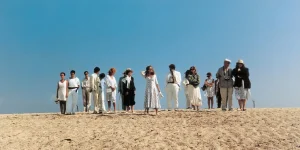
- The family walking together at the film’s end.
Iconic Quotes
- “Words can’t express what you mean to me. And if they could, I wouldn’t use them.”
“At last I have you, my unruly river. Flow on, flow on through your clay banks, and gnaw them, and be merry.”
“Childhood is the most important thing in life. It is the most influential time in a person’s life. It is the place where one’s future is shaped.”
“And you have dreams at night? I don’t. It’s only the unhappy who have dreams.” all my life…” - Ignat’s line: “How could you live without remembering?”
Easter Eggs and Hidden Details
- The Dual Casting: The most significant detail is Margarita Terekhova playing both the mother and the ex-wife. This masterstroke visualizes the narrator’s psychological pattern of seeking his mother’s image in his romantic partner.
- The Collapsed Generations: Similarly, actor Ignat Daniltsev plays both Alexei as a boy and Alexei’s son, Ignat. This collapses time and identity, suggesting that sons are doomed to repeat or reflect their fathers’ lives.
- Recurring Motifs: Pay close attention to recurring elements like wind blowing through grass, spilled milk, and reflections in water and mirrors. Each one is a symbolic key to the film’s emotional landscape.
- Leonardo da Vinci Poster: A poster of Leonardo da Vinci’s portrait of Ginevra de’ Benci is seen in one scene. Tarkovsky was deeply influenced by Renaissance art and saw a connection between the portrait and the mysterious nature of his characters.
Trivia
- The working title of the film, Confession, was rejected for being too provocative to Soviet authorities. It was then changed to A White, White Day before Tarkovsky settled on The Mirror.
- Famed director Sergei Bondarchuk publicly condemned the film, calling it self-indulgent. On the other hand, many audience members in the Soviet Union wrote passionate letters to Tarkovsky, thanking him for putting their own feelings and memories on screen.
- Tarkovsky hypnotic-style directing led to some strange occurrences, including an unscripted moment where
Why Watch?
Mirror is not a film you watch for plot—it’s an experience. It’s for viewers who want cinema that feels like poetry made visual, blending dreams, history, and memory into one of the most unique works of art ever created. If you are open to abstract, non-linear storytelling, Mirror is a life-changing film.
Director’s Other Movies
- Ivan’s Childhood (1962)
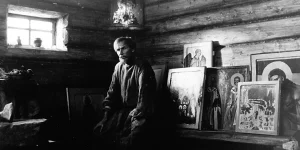
- Andrei Rublev (1966)
- Solaris (1972)
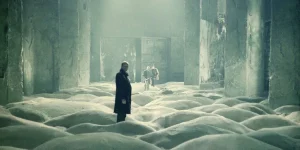
- Stalker (1979)
- Nostalghia (1983)
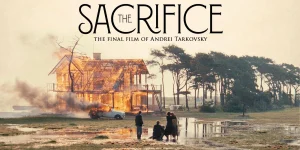
- The Sacrifice (1986)