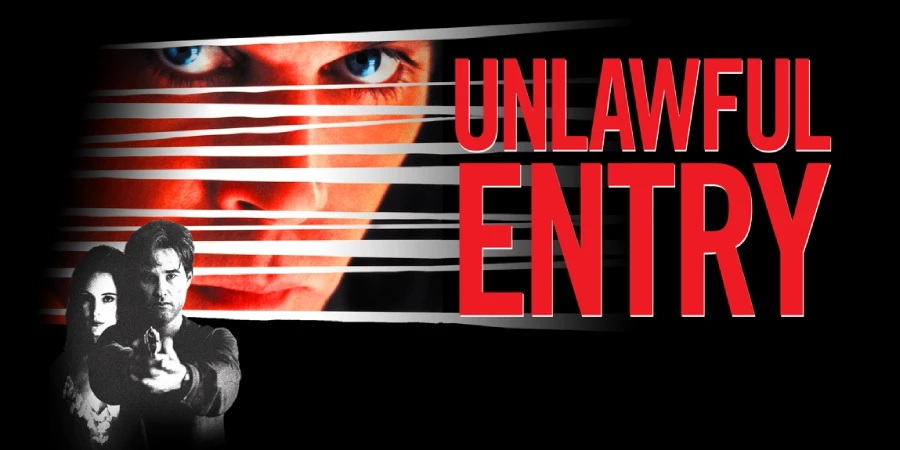

Kurt Russell plays a good man pushed to his absolute limit, but Ray Liotta steals every frame as one of cinema’s most disturbingly charming villains. Unlawful Entry (1992) turns a home invasion into a slow-burning nightmare of obsession, manipulation, and suburban paranoia. Director Jonathan Kaplan crafts a thriller that works precisely because it earns its menace gradually, letting Liotta simmer before he boils over.
Detailed Summary
A Break-In Changes Everything
Michael and Karen Carr, played by Kurt Russell and Madeleine Stowe, live a comfortable life in Los Angeles. One night, a burglar breaks into their home, terrifying Karen and leaving Michael feeling powerless. Two patrol officers respond to the call: the amiable Pete Davis and the steady, professional Officer Roy Cole.
Pete Davis, played by Ray Liotta, immediately fixates on Karen. He is warm, helpful, and attentive in a way that reads, at first, as simple professional kindness. However, something in his eyes signals that his interest runs far deeper than duty.
Officer Pete Worms His Way In
Davis invites Michael on a ride-along, ostensibly to show him how law enforcement handles the neighborhood. Michael is impressed and genuinely grateful. Meanwhile, Davis uses every interaction to get closer to Karen, complimenting her, lingering, making himself indispensable.
Davis also helps Michael track down the burglar, Roger Graham. He stages a brutal, unofficial beating of Graham in a back alley, forcing Michael to witness it. This moment is crucial: it bonds Michael to Davis through shared moral compromise while also revealing Davis’s willingness to operate entirely outside the law.
The Friendship Curdles
Davis begins showing up uninvited. He uses his badge and police connections to dig into every corner of Michael and Karen’s lives. Michael grows uneasy and starts pulling back from the friendship, sensing that something is deeply wrong with Davis.
Davis, in contrast, escalates. He visits Karen alone, calls frequently, and frames their closeness as something Michael should celebrate. His partner, Roy Cole, grows increasingly uncomfortable with Davis’s behavior but remains reluctant to act against a fellow officer.
Davis Plants Evidence and Destroys Michael
When Michael confronts Davis directly and demands he stay away, Davis retaliates with precision. He plants cocaine in Michael’s truck during a traffic stop, leading to Michael’s arrest. The charge is serious enough to put Michael’s career, reputation, and marriage under immediate strain.
Karen, shaken and confused, momentarily questions her husband. Davis exploits that doubt ruthlessly. He positions himself as a source of stability and sympathy for Karen, further isolating Michael at his most vulnerable point.
Roy Cole Pays the Price
Roy Cole finally decides to act on his concerns about Davis. He begins compiling evidence of Davis’s erratic and criminal behavior. Consequently, Davis learns of Cole’s intentions and kills him, staging the scene to look unrelated to their conflict.
Cole’s death removes the one institutional check on Davis. It also signals the film’s shift into full-throttle danger, making clear that Davis will eliminate anyone standing between him and Karen.
Michael Fights Back
Michael, desperate and legally compromised, works to expose Davis despite having almost no credibility left. Karen begins seeing through Davis’s facade as his behavior grows more erratic and possessive. She realizes that her husband was right all along.
Davis, sensing he is losing control of the situation, decides to force the confrontation he has been building toward. He abandons any remaining pretense of sanity or self-restraint. The final act kicks into motion.


Movie Ending
Davis breaks into Michael and Karen’s home, armed and fully unhinged. He has shed every last layer of the charming, helpful cop persona that carried him this far. What remains is pure, violent obsession.
Karen is alone in the house when Davis arrives. He makes his intentions brutally clear: he wants Karen, and he intends to eliminate everything standing in the way. Michael races home after realizing the danger she faces.
Michael arrives and a violent confrontation erupts inside the house. The fight is raw and desperate, not a slick action sequence but a brutal struggle for survival. Michael ultimately kills Davis, ending the threat by force after every legal and institutional avenue failed him completely.
The film’s final beat is quiet after the violence. Michael and Karen survive, but the ending carries no triumphant glow. It asks an uncomfortable question: what does it mean that the system Davis represented protected him until the last possible moment, and that only private violence resolved what official channels could not?
Audiences frequently ask whether Karen ever truly believed Davis over Michael. The film is careful here: her doubt is brief and based on manufactured evidence, not genuine attraction to Davis. Moreover, her turning point feels earned rather than abrupt, which keeps her character sympathetic throughout.
Are There Post-Credits Scenes?
Unlawful Entry contains no post-credits scenes. Credits roll and the film is over. There is nothing extra waiting for patient viewers.
Type of Movie
Unlawful Entry is a psychological thriller with strong elements of erotic thriller and home invasion drama. Its tone is tense and increasingly suffocating, prioritizing dread over jump scares. Jonathan Kaplan keeps the pacing deliberate, letting anxiety accumulate rather than relying on cheap jolts.
In contrast to flashier thrillers of its era, this film stays grounded in behavioral realism. Ray Liotta’s performance gives it a genuinely unsettling psychological texture. It sits comfortably alongside early-1990s paranoia thrillers like Pacific Heights and Single White Female.
Cast
- Kurt Russell – Michael Carr
- Ray Liotta – Officer Pete Davis
- Madeleine Stowe – Karen Carr
- Roger E. Mosley – Officer Roy Cole
- Ken Lerner – Roger Graham
- Deborah Offner – Penny
- Carmen Argenziano – Jerome Lurie
- Andy Romano – Capt. Hayes
Film Music and Composer
James Horner composed the score for Unlawful Entry. Horner was one of Hollywood’s most prolific and versatile composers, known for blending emotional orchestration with genre-specific tension. His work here leans into creeping unease rather than overt horror.
Horner’s score uses strings to mirror Davis’s unstable psychology, building tension underneath scenes that appear superficially calm. This musical irony reinforces the film’s core idea: danger hiding behind a friendly, trustworthy surface. It is subtle work that rewards attention.



Filming Locations
Unlawful Entry was filmed primarily in Los Angeles, California. Shooting on location in L.A. gives the film an authentic suburban texture that feels lived-in and recognizable. For instance, the Carr home’s comfortable, middle-class setting makes the intrusion into it feel genuinely violating.
Los Angeles also carries thematic weight here. It is a city with a complex relationship between its residents and its police force, and the film uses that context deliberately. Davis’s abuse of his badge feels rooted in a specific civic reality rather than abstract villainy.
Awards and Nominations
Unlawful Entry did not receive major awards recognition or prominent nominations. Ray Liotta’s performance generated considerable critical praise, but formal awards attention largely passed the film by.
Behind the Scenes Insights
- Ray Liotta has spoken about approaching Pete Davis not as a monster but as a man who genuinely believes he is doing the right thing, which makes the performance far more chilling than a straightforwardly evil reading would allow.
- Director Jonathan Kaplan wanted to avoid turning the film into a simple cops-are-corrupt polemic; he was more interested in one specific broken individual than in institutional critique.
- Madeleine Stowe worked to ensure Karen was not simply a passive object of obsession; she pushed for moments that showed Karen’s active decision-making throughout the story.
- Kurt Russell reportedly welcomed the relatively reactive role, which required him to portray helplessness and frustration rather than heroic competence for much of the running time.
- Kaplan shot many of Davis’s early scenes in bright daylight, deliberately using warmth and openness to mask the character’s danger.
Inspirations and References
Lewis Colick wrote the screenplay, drawing on the broader cultural anxiety around home security and police authority that circulated in late-1980s and early-1990s America. No single documented real-world case served as the direct source, but the premise tapped into very real public fears about who holds power and who can be trusted.
The film clearly belongs to a cycle of early-1990s obsession thrillers that includes Fatal Attraction and Pacific Heights. However, Unlawful Entry distinguishes itself by placing the threat inside a figure of official authority rather than a stranger or ex-lover. That specific angle gives it a sharper political edge.
Alternate Endings and Deleted Scenes
No widely documented alternate endings or significant deleted scenes from Unlawful Entry have entered the public record. Kaplan delivered a film that largely reflects his intended vision. No major studio-mandated reshoots or alternate cuts are documented in accessible production histories.
Book Adaptations and Differences
Unlawful Entry is not based on a book. Lewis Colick wrote the screenplay as an original work. There is no source novel to compare it against.


Memorable Scenes and Quotes
Key Scenes
- The alley beating of Roger Graham, where Davis forces Michael into silent complicity with extrajudicial violence.
- Davis slow-dancing with Karen while Michael watches, a scene loaded with possessive menace that Davis performs as innocent friendliness.
- Michael’s arrest after Davis plants cocaine in his truck, a gut-punch moment where the full scope of Davis’s willingness to destroy an innocent man becomes undeniable.
- Roy Cole’s death, which strips away any last hope that the system will self-correct before catastrophe strikes.
- Davis breaking into the Carr home in the final act, abandoning all pretense and arriving as the predator he always was.
Iconic Quotes
- “You think about her all the time, don’t you? So do I.” – Davis, making his obsession explicit to Michael in a moment of cold candor.
- “I just want to make sure you’re safe.” – Davis, deploying protection as a tool of control throughout the film.
Easter Eggs and Hidden Details
- Kaplan frequently frames Davis in doorways and thresholds early in the film, visually foreshadowing his later literal violation of the Carr home’s boundaries.
- Davis’s patrol car is visible outside the Carr house in a background shot before his surveillance of Karen is explicitly confirmed in the narrative, rewarding attentive viewers on a rewatch.
- Roy Cole’s body language around Davis shifts subtly in small background moments well before his concerns become a plot point, suggesting he has noticed something wrong for longer than he admits.
- Karen’s gardening hobby, introduced early in the film, quietly establishes her as someone who cultivates and nurtures, which makes Davis’s invasion of her domestic space feel even more violating thematically.
Trivia
- Ray Liotta was reportedly one of the first choices for the role of Davis, with his earlier work in GoodFellas demonstrating his ability to make likable characters suddenly terrifying.
- Unlawful Entry opened at number one at the U.S. box office during its release weekend in June 1992.
- The film was released just weeks after the Los Angeles riots following the Rodney King verdict, giving its story of police abuse of power an uncomfortably timely context for audiences.
- Jonathan Kaplan previously directed The Accused (1988), which also centered on institutional failure to protect victims, suggesting a recurring thematic interest across his work.
- Madeleine Stowe and Kurt Russell had no prior screen chemistry to rely on; their convincing portrayal of a long-established marriage came purely from performance work during production.
Why Watch?
Ray Liotta delivers one of the great unhinged villain performances of the 1990s, and that alone justifies the runtime. Furthermore, the film uses its thriller mechanics to ask genuinely uncomfortable questions about authority, trust, and institutional protection. It is tense, smart, and nastier than its mainstream packaging suggests.
Director’s Other Movies
- Project X (1987)
- The Accused (1988)
- Heart Like a Wheel (1983)
- Over the Edge (1979)