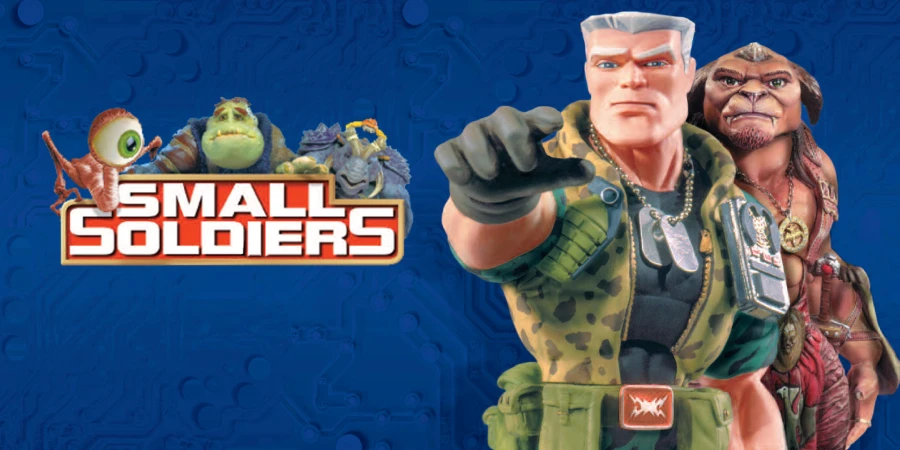
Toy soldiers that actually want to kill you sounds like a nightmare fuel premise, and Small Soldiers delivers exactly that. Released in 1998 and directed by Joe Dante, this film takes a satirical swipe at militarism, corporate greed, and the toy industry all at once. It wraps those ideas inside an action-comedy that genuinely does not pull its punches, giving audiences a kids’ movie where the protagonists bleed and the villains are disturbingly competent. For a film marketed to children, it carries a surprisingly sharp edge.
Detailed Summary
The Globotech Acquisition and the Chip That Changes Everything
Globotech Industries, a massive defense contractor, acquires the toy company Heartland Toy Company. Two competing toy lines are in development: the heroic Gorgonites and the militaristic Commando Elite. Larry Hemming, an ambitious product developer played by Jay Mohr, secretly installs X1000 military-grade microprocessors into the toy prototypes without authorization.
These chips, originally designed for military targeting systems, grant both toy lines genuine artificial intelligence, problem-solving capabilities, and an unrelenting drive to fulfill their programmed objectives. For the Commando Elite, that objective is to destroy the Gorgonites. Consequently, what Globotech intended as premium interactive toys becomes something far more dangerous.
Alan Abernathy Gets the Toys Early
Alan Abernathy, a teenager played by Gregory Smith, works at his father’s struggling toy store. He intercepts a delivery of the new toy lines before their official release date, hoping to boost the store’s sales. His father, Stuart Abernathy, runs the shop with idealism but little profit.
Alan takes a set of both lines home. He quickly realizes the Gorgonites are peaceful, curious, and frightened. In contrast, the Commando Elite, led by Archer and Chip Hazard respectively, are actively planning.
Archer and the Gorgonites Seek Their Homeland
Archer, the noble Gorgonite leader voiced by Frank Langella, explains to Alan that the Gorgonites are searching for their mythical homeland of Gorgon. Alan realizes, with some sadness, that the Gorgonites have been programmed to believe Gorgon exists, even though it does not. Archer accepts this with quiet dignity, choosing to believe regardless.
The Gorgonites are a wonderfully designed group: misfit creatures including Ocula, Insaniac, Punch-It and Scratch-It, and others. Alan hides them and grows genuinely fond of Archer, whose intelligence and courage are evident throughout their interactions.
Chip Hazard Declares War
Chip Hazard, the Commando Elite leader voiced by Tommy Lee Jones, organizes his squad with terrifying military efficiency. He commandeers power tools, weaponizes household objects, and establishes tactical command. His squad includes Butch Meathook, Nick Nitro, Kip Killigan, Link Static, and Brick Bazooka, all voiced by real actors.
Chip Hazard launches his first assault on Alan’s house. Nick Nitro gets destroyed during the attack when he overloads his battery pack, providing one of the film’s more startling moments for younger viewers. However, the Commando Elite adapt quickly and plan a larger offensive.
Christma Duncow’s Barbies Become Soldiers
Alan’s neighbor, Christma Duncow (also spelled Christy in some materials), played by Kirsten Dunst, has her home targeted by Chip Hazard’s forces. The Commando Elite capture her Gwendy Dolls, reprogrammed versions of Barbie-like figures, and surgically alter them using kitchen tools to become grotesque soldiers loyal to Chip Hazard. This sequence remains one of the film’s most unsettling visual moments.
Christma herself becomes a hostage. Alan works to rescue her while also protecting the Gorgonites, balancing both responsibilities under genuine pressure.
The Parents Are Oblivious (Until They Are Not)
Both sets of parents remain unaware of the escalating toy war for much of the film. Alan’s parents, Stuart and Irene Abernathy, return home to find their house under siege. Meanwhile, Globotech executives, including the calculating Gil Mars played by Denis Leary, begin to realize the catastrophic liability the X1000 chips represent.
Gil Mars prioritizes damage control over safety, which fits the film’s satirical portrait of corporate indifference. His concern is the company’s image, not the endangered children.
Movie Ending
Chip Hazard rallies every Commando Elite unit he can activate, launching a full-scale assault on the Abernathy house. Alan and Archer coordinate a defense together, with the Gorgonites demonstrating their own surprising resourcefulness when pushed to a wall.
Alan uses an electromagnetic pulse generator, rigged from a satellite dish, to fry the X1000 chips powering the Commando Elite. The pulse sweeps through Chip Hazard’s forces and disables them permanently, ending the attack. Chip Hazard himself survives long enough to deliver one final defiant speech before his systems shut down, giving his character a memorably theatrical exit.
Gil Mars arrives with a Globotech cleanup crew. He attempts to suppress the entire incident and offers the Abernathy family a settlement. Stuart Abernathy, finally showing backbone, refuses the hush money and demands accountability. Mars, facing potential legal and public exposure, backs down and concedes to a proper resolution.
Alan says goodbye to Archer and the Gorgonites. Rather than keeping them, he launches them in a small boat down a river, sending them on their journey toward Gorgon. It is a genuinely poignant farewell. Archer, always the philosopher of the group, faces the horizon with hope intact even though Gorgon does not technically exist.
This ending matters because it resists easy comfort. Alan does not get to keep his new friends. The corporation faces consequences but no real punishment. Furthermore, the Gorgonites sail toward a home that may be more metaphor than destination, which speaks directly to the film’s quiet theme: the stories we need are sometimes more important than the facts.
Are There Post-Credits Scenes?
Small Soldiers does not include any post-credits scenes. Once the credits roll, the film is complete. Viewers who stay seated will not find any bonus footage or hidden content.
Type of Movie
Small Soldiers occupies a genuinely interesting genre space. It functions as a science fiction action-comedy with strong satirical undertones. Its tone shifts between slapstick humor and tense, legitimately threatening action sequences.
Joe Dante intended the film as a commentary on militarism and toy marketing culture. On the surface it plays like an adventure for older kids and teenagers; underneath, it critiques corporate war-profiteering with a fairly blunt hand.
Cast
- Gregory Smith – Alan Abernathy
- Kirsten Dunst – Christma Duncow
- Jay Mohr – Larry Hemming
- Denis Leary – Gil Mars
- Kevin Dunn – Stuart Abernathy
- Ann Magnuson – Irene Abernathy
- Frank Langella – Archer (voice)
- Tommy Lee Jones – Chip Hazard (voice)
- Ernest Borgnine – Kip Killigan (voice)
- Jim Brown – Butch Meathook (voice)
- Bruce Dern – Brick Bazooka (voice)
- George Kennedy – Link Static (voice)
- Clint Walker – Nick Nitro (voice)
- Christina Ricci – Gwendy Doll (voice)
- Sarah Michelle Gellar – Gwendy Doll (voice)
- Phil Hartman – Phil Fimple
- Wendy Schaal – Marion Fimple
Film Music and Composer
Jerry Goldsmith composed the score for Small Soldiers. Goldsmith was one of Hollywood’s most prolific and respected film composers, with a career spanning decades and including scores for films like Chinatown, Alien, and Patton. His work here blends martial energy with adventurous, playful orchestration to match the film’s dual tone.
The score effectively shifts between comedic passages and genuine tension during the action sequences. In addition to Goldsmith’s original compositions, the film’s soundtrack features rock and pop songs that anchor its late-1990s sensibility. Notably, the soundtrack includes tracks by artists like Fatboy Slim and covers of classic rock songs performed by the fictional Commando Elite, which adds a darkly comedic layer to several scenes.

Filming Locations
Principal photography on Small Soldiers took place primarily in Los Angeles, California. The suburban neighborhood setting was central to the film’s premise, grounding the fantastical toy war in a recognizable, everyday American environment. Specific residential streets in the Los Angeles area provided the domestic backdrop that makes the violence feel both absurd and oddly plausible.
Shooting in suburban Southern California gave the production easy access to studio facilities while maintaining the look of a generic middle-American neighborhood. This visual ordinariness amplifies the satirical contrast between normal family life and military-grade toy warfare.
Awards and Nominations
Small Soldiers did not receive significant awards recognition during its release. It earned no major nominations from prominent industry bodies, which reflects its reception as a commercially oriented summer blockbuster rather than a prestige production.
Behind the Scenes Insights
- Joe Dante cast the Commando Elite voices using actors famous for roles in classic war and Western films, including Tommy Lee Jones, Ernest Borgnine, Jim Brown, Bruce Dern, George Kennedy, and Clint Walker. This was an intentional nod to the war movie genre the Commando Elite parody.
- Similarly, the Gorgonites were voiced by performers associated with more thoughtful dramatic roles, with Frank Langella lending Archer genuine gravitas.
- Phil Hartman, who voiced neighbor Phil Fimple, died before the film’s release. The film was dedicated to his memory.
- Joe Dante publicly expressed frustration that DreamWorks marketed the film primarily toward young children despite its PG-13 rating and darker content. He felt the studio undersold its satirical dimension.
- The Commando Elite toys required sophisticated animatronic and puppet work in addition to CGI, making the production technically demanding for its era.
- Dante drew on his experience directing Gremlins (1984) when constructing the film’s balance between comedic mayhem and genuine menace.
- The Gwendy Doll transformation sequence required extensive practical effects work. The production team built multiple altered doll versions for different stages of the modification shown on screen.
Inspirations and References
Joe Dante cited his own Gremlins as a tonal reference point: a fantasy concept played with real threat. The film also draws from classic war movie tropes, specifically to satirize them. Chip Hazard and his squad echo the language and iconography of films like Patton and The Dirty Dozen, deliberately.
On a broader level, Small Soldiers engages with anxieties about military-industrial culture permeating civilian life and specifically children’s entertainment. The X1000 chip storyline is a direct metaphor for defense contractors diversifying into consumer markets. Moreover, the Globotech corporation clearly references real-world defense company acquisitions of consumer brands that occurred throughout the 1990s.
Alternate Endings and Deleted Scenes
No officially released alternate endings for Small Soldiers have been widely documented or made publicly available. Some deleted scenes exist and have circulated in various home video releases, primarily involving extended character moments with the Gorgonites and additional exchanges between Alan and Archer.
Joe Dante indicated in interviews that the film’s final cut involved studio pressure to soften certain sequences. Some originally planned moments were reportedly more violent or darker in tone, consistent with Dante’s preference for edgier content.
Book Adaptations and Differences
Small Soldiers is not based on a book. It is an original screenplay written by Gavin Scott, Adam Rifkin, Ted Elliott, and Terry Rossio. Several novelizations and tie-in books for younger readers were published after the film’s release, but these adapt the film rather than precede it.

Memorable Scenes and Quotes
Key Scenes
- Chip Hazard’s first rally, where he assembles the Commando Elite and delivers a speech declaring war on the Gorgonites with chilling conviction.
- Nick Nitro’s battery overload and destruction during the initial assault, which signals to the audience that these toys genuinely pose a lethal threat.
- The Gwendy Doll transformation sequence, where the Commando Elite surgically alter Christma’s dolls into grotesque hybrid soldiers using kitchen implements.
- Archer and Alan’s conversation about Gorgon, where Alan gently explains that Gorgon does not exist and Archer chooses to believe anyway.
- The electromagnetic pulse climax, where Alan fires up the satellite dish and the Commando Elite shut down one by one across the neighborhood.
- Archer’s farewell on the boat, sailing away toward a horizon that represents hope more than geography.
Iconic Quotes
- “We are the Commando Elite. Everything else is just a toy.” (Chip Hazard)
- “The Gorgonites are alive. We are alive. We must find Gorgon.” (Archer)
- “We are not violent by nature. We are simply looking for our home.” (Archer)
- “Terminate with extreme prejudice.” (Chip Hazard)
Easter Eggs and Hidden Details
- The Commando Elite voice cast is composed entirely of actors known for war films and Westerns, a deliberate in-joke referencing the genres they parody.
- Posters and props inside Alan’s room reference other genre films, consistent with Joe Dante’s habit of embedding film culture into his sets.
- The Gorgonites’ design deliberately echoes classic fantasy creature aesthetics, contrasting visually with the hyper-realistic military design of the Commando Elite.
- Gil Mars’s corporate dialogue uses actual defense contractor terminology, grounding the satire in recognizable real-world language.
- The X1000 chip packaging briefly visible in early scenes uses design language that mimics real military-spec electronics labeling.
- Joe Dante cameos in the film, continuing his tradition of brief appearances in his own work.
Trivia
- The film received a PG-13 rating, which surprised some parents who expected a straightforwardly family-friendly toy adventure.
- Phil Hartman completed his role as Phil Fimple shortly before his death in May 1998. The film, released in July 1998, carries a dedication to him.
- Four credited screenwriters worked on the script: Gavin Scott, Adam Rifkin, Ted Elliott, and Terry Rossio. Elliott and Rossio would later write Pirates of the Caribbean.
- The film grossed approximately 54 million dollars domestically against a production budget estimated significantly higher, making it a financial disappointment for DreamWorks.
- Joe Dante considered Small Soldiers a spiritual cousin to Gremlins, both films featuring small creatures causing large-scale suburban chaos.
- The Commando Elite action figure line featured in the film was produced as actual retail toys to coincide with the film’s release.
- Hasbro partnered with DreamWorks on the toy line, though the partnership involved some tension over how militaristic the toys’ branding should be.
Why Watch?
Small Soldiers delivers smart satire wrapped inside genuinely exciting action, with creature effects that still hold up and a voice cast of extraordinary caliber. Joe Dante never condescends to his audience, trusting viewers of any age to catch the film’s pointed commentary on militarism and corporate cynicism. Furthermore, Archer remains one of cinema’s most unexpectedly moving toy characters.
Director’s Other Movies
- Piranha (1978)
- The Howling (1981)
- Gremlins (1984)
- Explorers (1985)
- Innerspace (1987)
- The ‘Burbs (1989)
- Gremlins 2: The New Batch (1990)
- Matinee (1993)
- The Hole (2009)
Recommended Films for Fans
- Gremlins (1984)
- Toy Story (1995)
- Batteries Not Included (1987)
- Toys (1992)
- Innerspace (1987)
- The Iron Giant (1999)
- Short Circuit (1986)
- RoboCop (1987)