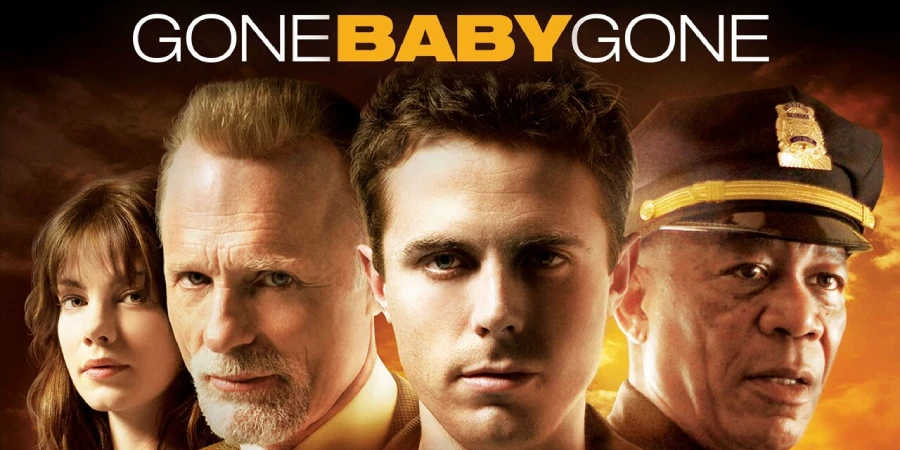

Ben Affleck made his directorial debut with a film that asks you to decide whether a man did the right thing, then refuses to let you feel good about either answer. Gone Baby Gone drops you into the grim row houses of Dorchester, Boston, where a four-year-old girl named Amanda McCready has vanished and every adult in her orbit is compromised in some way.
Casey Affleck plays Patrick Kenzie with a quiet, watchful intensity that makes you forget his brother directed him. This is a film that earns its brutal final shot.
Detailed Summary
Introducing Dorchester and the McCready Case
Patrick Kenzie and his partner Angie Gennaro work as private investigators in their own Boston neighborhood. They know the streets, the accents, the unspoken codes. That local knowledge is exactly why Bea McCready hires them when her niece Amanda goes missing.
Amanda’s mother, Helene McCready, is a wreck of a parent. She snorts cocaine, leaves her daughter alone, and seems more interested in her own drama than in finding her child. Patrick and Angie take the case despite their reservations about working alongside the police.
The Drug Money Angle
Detectives Remy Bressant and Nick Poole are the lead investigators on Amanda’s disappearance. Patrick starts digging and discovers that Helene’s boyfriend, Skinny Ray Likanski, stole drug money from a local dealer named Cheese. Cheese is violent, connected, and not the kind of man who forgets a debt.
Patrick suspects Amanda’s disappearance ties directly to that stolen money. He arranges a meeting with Cheese and negotiates a deal: return the money, get the girl back. The exchange is set for a quarry in the middle of the night.
The Quarry Disaster
This is the film’s first gut punch. At the quarry, the exchange goes wrong fast. Gunfire erupts. Cheese and his men are killed. Detective Bressant shoots one of Cheese’s men. Patrick watches in horror as another man runs and goes over the edge of the quarry into the water below, taking Amanda with him.
Amanda is presumed dead. Patrick and Angie are devastated. The police close the case, and Helene McCready spirals further. Patrick cannot let it go.
The Investigation Deepens
Patrick keeps pulling threads. He learns that Lionel McCready, Helene’s brother, had actually been secretly working with someone to stage Amanda’s disappearance. The quarry incident looks less like a botched rescue and more like a coordinated cover-up.
Captain Jack Doyle, the head of the missing children’s unit and a sympathetic figure who lost his own daughter, becomes a key suspect. Patrick follows the evidence toward Doyle’s home in a quiet suburban neighborhood, nowhere near Dorchester.
The Truth About Amanda
Patrick finds Amanda alive inside Doyle’s house. She is healthy, well cared for, and playing in a warm home. Doyle confesses everything. He orchestrated the fake kidnapping, staged the quarry death, and set up the whole scheme to rescue Amanda from Helene’s genuinely dangerous neglect.
Doyle argues that Amanda deserves a real life, a clean home, a guardian who actually loves her. He is not wrong about Helene. He is not wrong about what Amanda’s life will look like if she goes back. Patrick calls the police anyway.

Movie Ending
Patrick makes the phone call. He does it alone. Angie already told him she could not support bringing Amanda back, and that choice fractures their relationship in a way that feels permanent. Patrick dials, Doyle is arrested, and Amanda is returned to Helene.
Bressant, it turns out, was complicit in the scheme. He is exposed and faces consequences. Doyle’s entire operation collapses. The people who genuinely wanted to protect Amanda are punished, and the woman who failed her gets her daughter back through the law.
Casey Affleck’s face in the final scene is the whole movie compressed into a single expression. Patrick sits in Helene’s living room babysitting Amanda while Helene goes out, presumably to party. Amanda sits across from him watching television, and Patrick watches her with a look that contains no satisfaction at all. He did the legal thing. He did the moral thing, arguably. Whether he did the right thing is a question the film leaves entirely open.
Affleck directs that final shot with real restraint. No swelling score. No close-up designed to guide your emotions. You sit in that living room alongside Patrick and feel the weight of a choice that cannot be undone. That ambiguity is not a flaw in the screenplay; it is the entire point.
Are There Post-Credits Scenes?
There are no post-credits scenes. Gone Baby Gone ends when it ends. The final image does its job and the screen cuts to black.
Type of Movie
Gone Baby Gone is a crime thriller with strong elements of moral drama. It operates in the tradition of Boston-set noir, grounded by a documentary-style visual approach and naturalistic performances from non-professional locals mixed with seasoned actors.
The tone is serious, cold, and relentlessly honest. There are moments of violence, but the film is far more interested in ethical discomfort than in action sequences.
Cast
- Casey Affleck – Patrick Kenzie
- Michelle Monaghan – Angie Gennaro
- Morgan Freeman – Captain Jack Doyle
- Ed Harris – Detective Remy Bressant
- John Ashton – Detective Nick Poole
- Amy Madigan – Bea McCready
- Amy Ryan – Helene McCready
- Titus Welliver – Devin Quinn
- Michael K. Williams – Cheese
Film Music and Composer
Harry Gregson-Williams composed the score. His work here is deliberately understated, sitting beneath the action rather than commenting on it loudly. Gregson-Williams is a British composer with a wide range of credits, and Gone Baby Gone shows his ability to strip back and serve a film’s atmosphere without grandstanding.
The score leans on spare, low-register strings and ambient texture. It never tells you how to feel, which suits a film that refuses to do that either.

Filming Locations
Ben Affleck insisted on shooting in Dorchester, Massachusetts, the real neighborhood where Dennis Lehane’s novel is set. This was not a studio approximation. Actual bars, streets, and row houses from the area appear throughout the film.
That decision pays off visibly. Faces in the background are real neighborhood faces. The brick and the grime and the particular way light falls on those streets in winter read as authentic because they are authentic. Casting local non-actors in supporting roles deepened that texture considerably.
Awards and Nominations
Amy Ryan received an Academy Award nomination for Best Supporting Actress for her performance as Helene McCready, and it was entirely deserved. She also received nominations from the Screen Actors Guild, BAFTA, and multiple critics circles for the same role.
Ben Affleck received attention from critics groups for his direction, helping reframe the conversation around his career at a pivotal moment.
Behind the Scenes Insights
- Ben Affleck cast many real Dorchester residents in smaller roles to preserve the neighborhood’s authentic feel on screen.
- Casey Affleck reportedly spent significant time in Dorchester before filming to absorb the community’s rhythms and speech patterns.
- Amy Ryan prepared for Helene by researching the specific behavioral and social patterns of neglectful parents in working-class urban environments.
- Ben Affleck had been attached to the Dennis Lehane source material for years before he decided to direct it himself rather than hand it to someone else.
- Morgan Freeman, as a producer on the film through his company, played a role in getting the project made, which makes his casting as Doyle a layered production choice.
- Ed Harris was drawn to Bressant specifically because the character operates from a warped but internally consistent moral code, not from simple corruption.
Inspirations and References
Gone Baby Gone draws its story directly from Dennis Lehane’s 1998 novel of the same name, the fourth book in his Kenzie-Gennaro series. Lehane is a Boston writer whose work is rooted in the specific class tensions and neighborhood loyalties of working-class Irish-American Boston.
Lehane’s broader body of work, which includes Mystic River and Shutter Island, repeatedly returns to questions of justice, community complicity, and whether good intentions excuse harmful actions. Gone Baby Gone sits squarely in that thematic territory.
The film also echoes real cases of child welfare failures in American urban environments, though it is not based on a specific incident.
Alternate Endings and Deleted Scenes
No widely documented alternate endings or significant deleted scenes have been made public for Gone Baby Gone. Ben Affleck has spoken about the difficulty of adapting Lehane’s novel and compressing its plot into a workable runtime, which implies cuts were made, but no specific deleted material has been released or detailed in interviews.
Book Adaptations and Differences
The screenplay, written by Ben Affleck and Aaron Stockard, adapts Lehane’s 1998 novel faithfully in its central moral dilemma and major plot beats. Some of the novel’s subplot complexity was trimmed to sharpen the film’s focus.
In the novel, the Kenzie-Gennaro series spans multiple books, so Patrick and Angie carry more backstory than the film develops. Their relationship history, personal wounds, and prior cases give the novel versions of these characters additional weight that the film cannot fully recreate in one sitting.
The core ending, Patrick making the call and facing Angie’s departure, is consistent with the source material. Lehane has spoken positively about the adaptation.

Memorable Scenes and Quotes
Key Scenes
- The quarry exchange: Night-black water, flashlights cutting across rock, and the sudden catastrophic rupture of a plan that was already rotten from the start. The scene moves from tense negotiation to chaos in seconds, and the image of a child going into that dark water is viscerally horrible.
- Patrick confronting Cheese: Casey Affleck holds his body very still during this scene. He is clearly outmatched physically, and the stillness reads as controlled fear rather than bravado. Michael K. Williams plays Cheese as genuinely dangerous without resorting to caricature.
- Doyle’s confession: Morgan Freeman is heartbreaking here. Doyle explains his reasoning in a soft, patient voice while Amanda plays in another room. Freeman lets the character’s conviction show through without turning him into a villain delivering a monologue.
- The final babysitting scene: Patrick sits across from Amanda in Helene’s apartment. No score, no close-up on Amanda, just Casey Affleck’s face making a quiet argument for everything the film has been building toward.
- Angie tells Patrick she cannot support his decision: Michelle Monaghan does not shout or cry. She simply tells him, clearly, that she will not be part of what he is about to do. The conversation is short and devastating.
Iconic Quotes
- “I always believed it was the things you don’t choose that makes you who you are.” (Patrick Kenzie, narration)
- “When I was young, I asked my priest how you could get to heaven and still protect yourself from all the evil in the world. He told me what God said to His children: ‘You are sheep among wolves. Be wise as serpents, yet innocent as doves.'” (Patrick Kenzie, narration)
- “Some crimes you can’t see clearly until you’re standing far enough away.”
Easter Eggs and Hidden Details
- Several background extras in bar scenes and street scenes are actual Dorchester residents with no professional acting experience, giving those environments a documentary texture that trained extras typically cannot replicate.
- Ben Affleck grew up in Cambridge, Massachusetts, adjacent to the neighborhoods depicted, and the film’s precise handling of local dialect and social geography reflects genuine insider knowledge rather than research from a distance.
- Captain Doyle’s house sits in stark visual contrast to every other location in the film: brighter, cleaner, warmer in color temperature. That contrast is doing quiet but deliberate work, making Doyle’s argument visually before he ever opens his mouth.
- Helene’s apartment is dressed with specific, unglamorous detail. Fast food containers, cheap furniture, a television left on during conversations. Each element reinforces the environment’s damage without a single line of dialogue pointing to it.
Trivia
- This was Ben Affleck’s feature directorial debut.
- Dennis Lehane, the novel’s author, has a small cameo appearance in the film as a bar patron.
- Casey Affleck was not the first choice for Patrick Kenzie; Ben Affleck considered other actors before deciding his brother fit the role’s specific physical and emotional register.
- Amy Ryan’s performance as Helene was so convincing that some early viewers assumed she was a non-professional local rather than an experienced stage and screen actress.
- Morgan Freeman’s production company, Revelations Entertainment, co-produced the film, which is how Freeman came aboard both as a producer and as an actor.
- The film was shot on location in winter, and that cold, grey quality of Boston in the off-season was a deliberate atmospheric choice rather than a scheduling accident.
Why Watch?
Casey Affleck’s performance as Patrick Kenzie is the reason to sit down with this film. He plays a man whose moral certainty destroys the things he loves, and he does it without a single moment of actorly self-congratulation. Watch the final ten minutes and see if you can confidently say Patrick did the right thing.
Director’s Other Movies
- The Town (2010)
- Argo (2012)
- Live by Night (2016)
- Air (2023)