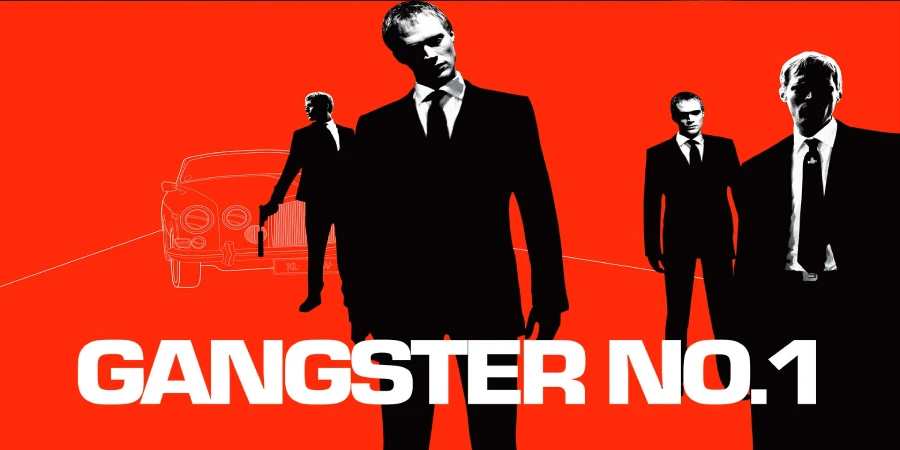

Gangster No. 1 is one of British cinema’s most unsettling portraits of pure, joyless ambition. Paul McGuigan’s 2000 film strips the gangster genre of its usual romanticism and replaces it with something colder, more psychotic, and genuinely disturbing. Malcolm McDowell and Paul Bettany share the screen across two timelines, playing the same ruthless criminal at different ages. What connects them is not charm or charisma, but a hollow, terrifying need to dominate.
Detailed Summary
1999: The Old Man Watches His Past Return
Paul opens in 1999, played by Malcolm McDowell as an aging, powerful gangster at a boxing match in London. He sits surrounded by associates, projecting cold authority. News arrives that his old rival, Freddie Mays, has been released from prison after thirty years.
This news visibly unsettles Paul. He retreats into memory, and the film drops back to 1968 to show us exactly what happened between these two men. From here, the bulk of the story unfolds in flashback.
1968: A Nobody Enters Freddie’s World
In 1968, the young Gangster (referred to in the film simply as “the Gangster,” played by Paul Bettany) is a small-time criminal with enormous hunger and zero loyalty. He attaches himself to Freddie Mays, played by David Thewlis, who runs a successful criminal operation in London. Freddie is respected, stylish, and genuinely liked by his men.
The young Gangster studies Freddie obsessively. He does not admire Freddie so much as he covets everything Freddie represents: the suits, the power, the deference from others. This obsession quickly curdles into something dangerous.
Karen and the Point of No Return
Freddie begins a relationship with Karen, played by Saffron Burrows. He falls genuinely in love with her, and his happiness becomes a source of rage for the young Gangster. Freddie’s emotional connection to Karen reveals something the Gangster cannot comprehend: that power alone is not what makes Freddie who he is.
Meanwhile, a rival gang boss named Tommy puts out a contract on Freddie. Most of Freddie’s men see this as the end, but Freddie prepares to confront it directly. The Gangster sees his opportunity.
The Betrayal and the Slaughter
Instead of warning Freddie or standing by him, the young Gangster tips off Tommy’s crew and deliberately steps aside. Freddie walks into the ambush. However, Freddie survives, though he is badly wounded and arrested in the aftermath of the violence.
With Freddie out of the picture, the Gangster moves swiftly to consolidate power. He absorbs Freddie’s operation, his connections, and his reputation. He never looks back.
The Murder of Roland Miller
One of the film’s most disturbing sequences involves the Gangster visiting Roland Miller, a rival associate played by Eddie Marsan. What follows is an extended, graphic act of torture and murder. The Gangster commits the act alone, methodically, and the film does not look away.
Notably, the Gangster steals Roland’s clothes and wears them afterward. This detail is not incidental; it reinforces the Gangster’s pattern of consuming the identities of those he destroys. He does not just kill rivals; he absorbs them.
Freddie Goes to Prison
Freddie receives a long prison sentence. Karen waits for him. The Gangster, now in control, watches this from a distance with something that looks almost like grief, but is really resentment.
Over the following three decades, the Gangster builds his empire. He becomes “Paul,” a name that signals his complete reinvention. In contrast, Freddie rots in prison, loyal to Karen, loyal to a life that no longer exists outside.

Movie Ending
Freddie’s release in 1999 forces Paul to confront something he has spent thirty years avoiding. Freddie returns not as a threat, but as a reminder. He still has Karen. He still has his dignity. Consequently, Paul cannot tolerate Freddie’s existence.
Paul visits Freddie, and the confrontation between McDowell and Thewlis is the emotional centerpiece of the film’s final act. Paul expects Freddie to be broken. Instead, Freddie is calm, almost serene. He has made peace with his life.
Paul confesses, in his own oblique way, that he engineered Freddie’s downfall. He wants credit. He wants Freddie to acknowledge that Paul won. Freddie’s refusal to be impressed, or even particularly moved, is Paul’s true punishment.
Paul has Freddie killed. However, even this act gives him no satisfaction. The film ends with Paul alone, surrounded by wealth and power, having achieved everything he wanted, and finding it entirely empty. McDowell conveys this hollowness without melodrama, which makes it hit harder than any explosive finale could.
The final note of the film is not violence or triumph; it is vacancy. Paul looks into nothing, and the audience understands that this man has never felt anything real. He won the game and the game meant nothing.
Are There Post-Credits Scenes?
Gangster No. 1 contains no post-credits scenes. The film ends and the credits roll without any additional footage. Nothing follows.
Type of Movie
Gangster No. 1 is a British crime thriller with strong elements of psychological drama. Its tone is cold, stylized, and deliberately unsettling. McGuigan frames it more as a character study than a conventional crime narrative.
In contrast to the warmth or dark humor found in many British gangster films of the same era, this one is relentlessly bleak. It belongs alongside the more austere end of the genre.
Cast
- Malcolm McDowell – Gangster (1999)
- Paul Bettany – Gangster (1968)
- David Thewlis – Freddie Mays
- Saffron Burrows – Karen
- Eddie Marsan – Roland Miller
- Jamie Foreman – Lennie Taylor
- Andrew Lincoln – Maxie King
Film Music and Composer
The score for Gangster No. 1 was composed by John Dankworth, a prominent British jazz musician and composer with decades of film and television work behind him. His score leans into a cool, jazzy menace that suits the 1968 sequences especially well.
The music never swells dramatically or telegraphs emotion; instead, it maintains an almost detached quality that mirrors the Gangster himself. This restraint makes the more violent scenes feel even more destabilizing.
Filming Locations
Principal photography took place in London, and the city’s geography shapes the film’s identity. The 1968 sequences use locations that emphasize a grimy, stylish version of period London, full of clubs, back streets, and smoky interiors.
The 1999 sequences present a sleeker, more modern London, which reinforces the visual contrast between the two eras. Furthermore, this split helps the audience feel the passage of time without relying on dialogue to explain it.
Awards and Nominations
Paul Bettany received significant critical attention for his performance, and the film earned recognition on the British awards circuit. Bettany won the BAFTA Award for Best Actor in a Supporting Role for his work in Gangster No. 1.
Behind the Scenes Insights
- Paul Bettany has spoken about the physical and psychological intensity of preparing for the role, particularly the scenes involving extreme violence.
- Director Paul McGuigan deliberately wanted to avoid making the Gangster sympathetic at any point, which shaped nearly every creative decision on set.
- Malcolm McDowell and Paul Bettany reportedly never rehearsed together extensively, which kept their shared scenes feeling genuinely tense and unresolved.
- The film was produced by Pagoda Film and represented a high-profile project for British independent cinema at the turn of the millennium.
- McGuigan used stylized, almost expressionistic camera work during the 1968 sequences to heighten the Gangster’s distorted perception of the world around him.
Inspirations and References
Gangster No. 1 is based on a stage play of the same name. Louis Mellis and David Scinto wrote both the play and the screenplay. Their collaboration had previously produced Sexy Beast, another landmark of British crime cinema.
Thematically, the film draws on a long tradition of British crime literature and theatre that interrogates class, identity, and the cost of ambition. It has clear echoes of Jacobean tragedy in its structure and its punishing final act.
Alternate Endings and Deleted Scenes
No officially documented alternate endings or significant deleted scenes have been confirmed for Gangster No. 1 in reliable public sources. McGuigan’s final cut appears to reflect his original vision closely.
Book Adaptations and Differences
Gangster No. 1 is not based on a novel. It adapts a stage play, as noted above. The theatrical origins are visible in the film’s reliance on performance and monologue over action-driven plotting.
McGuigan and the writers opened up the play considerably for the screen, adding visual texture and expanding the violence that on stage would have been largely implied. Moreover, the dual-timeline structure works more effectively on film than it could on a single stage.


Memorable Scenes and Quotes
Key Scenes
- The young Gangster watching Freddie dress before a night out, studying every detail with a mixture of worship and hatred.
- The Roland Miller sequence: a prolonged, methodical act of violence that reveals the full horror of the Gangster’s psychology.
- Paul Bettany’s Gangster wearing Roland’s stolen clothing, calm and satisfied, in the immediate aftermath of the murder.
- The 1999 confrontation between McDowell and Thewlis, where Freddie’s quiet dignity completely disarms Paul’s desire for recognition.
- The final image of Paul alone, his victory hollow and his expression utterly empty.
Iconic Quotes
- “I’m not a person. I’m not a human being. I’m a gangster.”
- “You think I’m going to be another one of your little pets? I don’t think so.”
- “Look at me. Look at me now. I’m number one.”
Easter Eggs and Hidden Details
- The Gangster’s habit of stealing and wearing the clothes of men he kills functions as a consistent, understated motif for his identity theft throughout the film.
- McGuigan uses tight close-ups on Bettany’s eyes during scenes where the Gangster watches Freddie, visually echoing classic obsession narratives in cinema.
- The boxing match setting that opens and closes the 1999 framing device is not accidental; it positions Paul’s entire life as a spectator sport he can never fully win.
- Color temperature shifts subtly between the 1968 and 1999 timelines, with warmer tones in the past and cooler, bleaker hues in the present.
Trivia
- Paul Bettany was relatively unknown before this film; his performance here launched him into mainstream international attention.
- David Thewlis and Malcolm McDowell share very little screen time together, yet their characters’ relationship drives the entire film.
- Louis Mellis and David Scinto wrote Sexy Beast around the same time, making the pair one of the most distinctive voices in British crime writing of that era.
- McGuigan went on to direct music videos and television episodes, including work on Sherlock, after establishing himself with this film.
- The film’s title is never spoken as a line of dialogue; it exists as a statement the film makes about its protagonist through action alone.
Why Watch?
Gangster No. 1 offers something rare: a crime film that refuses to glamorize its central figure at any point. Paul Bettany’s performance alone justifies the viewing. For fans of cold, psychologically precise British cinema, this film is essential.
Director’s Other Movies
- The Acid House (1998)
- Wicker Park (2004)
- Lucky Number Slevin (2006)
- Push (2009)