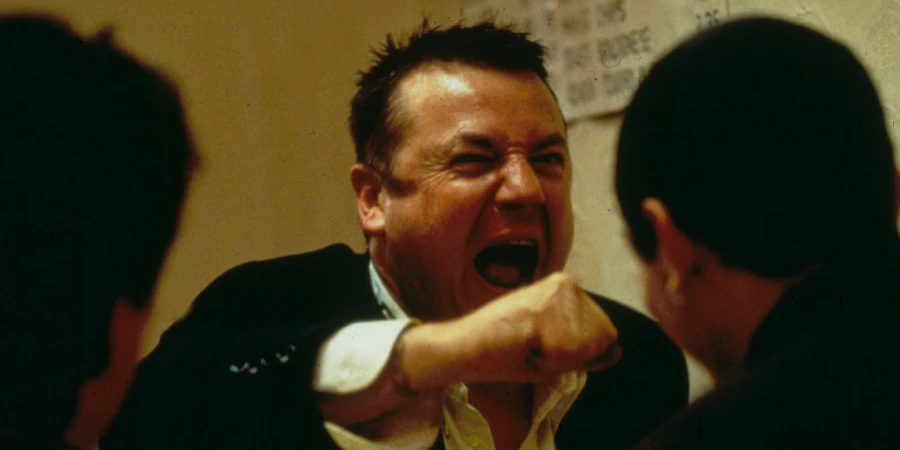

Nil by Mouth does not ease you in gently. Gary Oldman’s directorial debut drops you into a South London council estate and holds your face there, refusing to let you look away from the violence, addiction, and fractured love that define these lives. This is raw, semi-autobiographical filmmaking at its most unsparing, drawing directly from Oldman’s own childhood experiences. Few British films of the 1990s hit this hard, or this honestly.
Detailed Summary
Introducing the Estate: A World of Pubs and Pent-Up Rage
The film opens on a working-class South London estate, establishing its world through noise, alcohol, and casual aggression. We meet Ray, played by Ray Winstone, holding court in a pub with his friends. His charisma is undeniable, but an undercurrent of menace runs beneath every word he speaks.
Ray’s wife Valerie, played by Kathy Burke, lives in a state of tense normalcy. She manages the household, absorbs Ray’s moods, and tries to hold things together. Meanwhile, her brother Billy, played by Charlie Creed-Miles, slides deeper into heroin addiction.
Billy’s Addiction and the Downward Spiral
Billy is young, directionless, and utterly consumed by heroin. His addiction is not romanticised; Oldman presents it as a grinding, degrading cycle. Billy steals, lies, and borrows money he will never repay.
His relationship with his grandmother Janet, played by Laila Morse, is one of the film’s quieter emotional threads. She loves him, but her love cannot anchor him. Consequently, Billy’s descent accelerates without anything strong enough to slow it.
Ray’s Violence Erupts at Home
Ray’s rage, always simmering, eventually boils over onto Valerie in a scene of devastating brutality. He beats her savagely, leaving her hospitalised and barely recognisable. Winstone plays this not as a cartoon villain but as a damaged man who genuinely believes his own distorted logic.
This is the film’s seismic centre of gravity. Everything before it builds toward this moment; everything after deals with its fallout. Oldman does not linger exploitatively, but he does not flinch either.
The Aftermath and Valerie’s Return
Valerie recovers in hospital, battered but resilient. In a heartbreaking detail, she defends Ray to her family, insisting she provoked him. This is not weakness; it is a portrait of how domestic abuse warps perception and erodes agency over years.
She returns home to Ray, a choice that frustrates and devastates in equal measure. However, the film refuses to judge her. Oldman understands that leaving is rarely as simple as outsiders believe.
Ray’s Breakdown and Confession
Ray’s emotional collapse comes in a lengthy, extraordinary monologue late in the film. He sits with a friend and speaks, incoherently at first, about his father, his loneliness, and the hollow violence of his own life. Winstone delivers this with terrifying authenticity.
Ray reveals that his father never told him he loved him. In this moment, the cycle of inherited damage becomes painfully visible. Oldman traces the roots of Ray’s destruction back through generations without excusing a single act of cruelty.
Billy’s Rock Bottom
Billy’s addiction reaches its lowest point as he loses everything of value in his life. His relationships collapse; his body suffers. Creed-Miles plays him with a hollowed-out fragility that makes Billy genuinely pitiable rather than merely pathetic.
By this point, the film has woven together three parallel devastations: Ray’s violence, Billy’s addiction, and Valerie’s suffering. None of them resolve neatly. In contrast to films that reward endurance with catharsis, Nil by Mouth offers only ambiguity.



Movie Ending
Valerie is pregnant, and this detail carries enormous weight in the film’s closing movements. Ray and Valerie exist in a brittle, unresolved state, not reconciled in any meaningful sense, but not fully separated either. The question the film refuses to answer is whether the cycle will break or repeat.
Ray’s tearful confession to his friend does something unexpected: it makes him comprehensible without making him forgivable. Oldman is precise about this distinction. Ultimately, the film ends without punishment for Ray and without rescue for Valerie.
Billy remains lost in his addiction, and Janet continues to love her fractured family from a position of helpless devotion. The final mood is one of exhausted continuation. Life, the film argues, simply goes on in these circumstances, grinding forward without resolution or redemption.
What makes this ending resonate so deeply is its refusal of easy comfort. Audiences hoping for a moment of triumph or escape will find none. Moreover, that deliberate denial is precisely the point: Oldman insists on the truth of these lives above all else.
Are There Post-Credits Scenes?
Nil by Mouth contains no post-credits scenes. The film ends without any additional footage or supplementary material following the credits. Given the film’s unsparing tone, a post-credits sequence would feel wildly out of place.
Type of Movie
Nil by Mouth sits firmly in the tradition of British social realist drama. Its closest cinematic relatives are the kitchen-sink films of the 1960s, updated with a raw, almost documentary energy. The tone is relentlessly bleak, occasionally punctuated by moments of dark, uncomfortable humour.
It functions simultaneously as a domestic drama, an addiction study, and a character portrait. There are no genre conventions to soften the impact. Every scene feels carved from lived experience rather than constructed from plot mechanics.
Cast
- Ray Winstone – Ray
- Kathy Burke – Valerie
- Charlie Creed-Miles – Billy
- Laila Morse – Janet
- Edna Doré – Kath
- Chrissie Cotterill – Paula
Film Music and Composer
Eric Clapton composed the score for Nil by Mouth, a somewhat surprising but deeply effective choice. His music avoids sentimentality, instead providing a spare, understated accompaniment that never competes with the film’s raw performances. Clapton’s connection to themes of addiction and personal loss gave the collaboration an authentic emotional foundation.
The score does not announce itself loudly. It sits beneath the action, supporting rather than directing the audience’s emotional responses. For a film this committed to restraint, that approach was exactly right.



Filming Locations
Nil by Mouth was filmed primarily in South London, specifically in areas that reflect the working-class estate environments central to the story. Oldman insisted on authentic locations rather than constructed sets. This decision gives the film its lived-in, claustrophobic texture.
The pubs, flats, and streets feel genuinely inhabited. Using real South London environments meant the actors could respond to actual spaces rather than dressed studio backdrops. In addition, shooting on location grounded the film’s semi-autobiographical truth in visible, recognisable reality.
Awards and Nominations
Kathy Burke won the Best Actress award at the Cannes Film Festival in 1997 for her performance as Valerie, a fully deserved recognition of one of the finest British screen performances of that decade. The film also received a BAFTA nomination for Best British Film. These honours brought significant critical attention to what might otherwise have remained a small, difficult film.
Behind the Scenes Insights
- Gary Oldman drew directly from his own South London childhood and family experiences when writing the script, making this a deeply personal project.
- Laila Morse, who plays Janet, is Gary Oldman’s real-life sister, making her casting a significant personal and artistic choice.
- Ray Winstone has spoken about the emotional difficulty of filming the violence scenes, describing them as some of the most demanding work of his career.
- Oldman spent years developing the script before the film finally went into production.
- Much of the dialogue has an improvised quality, though the script was formally written; Oldman encouraged naturalistic delivery throughout.
- Kathy Burke drew on her own background and understanding of working-class South London life to inform her portrayal of Valerie.
Inspirations and References
Oldman has been open about the film’s autobiographical roots. His own father was an alcoholic, and the portrait of Ray reflects aspects of the violence and emotional absence Oldman witnessed growing up. The film therefore functions partly as a reckoning with his own history.
British social realist cinema provided a clear formal influence, particularly the work of directors like Ken Loach and Mike Leigh. However, Oldman pushes further into visceral, unflinching territory than much of that tradition. The American cinema of John Cassavetes also appears to have shaped the film’s interest in raw, performance-driven emotional truth.
Alternate Endings and Deleted Scenes
No widely documented alternate endings or significant deleted scenes for Nil by Mouth are part of the public record. Given that this was Oldman’s deeply personal debut, it seems unlikely he pursued radically different narrative directions in the editing room. The film’s ending feels entirely deliberate and essential to its meaning.
Book Adaptations and Differences
Nil by Mouth is not based on a book. Gary Oldman wrote the original screenplay himself, drawing entirely from personal experience and observation. No source novel or published work exists to compare it against.

Memorable Scenes and Quotes
Key Scenes
- Ray’s savage beating of Valerie, a scene of almost unbearable brutality that forms the film’s devastating emotional core.
- Ray’s late-night monologue to his friend about his father and his own inadequacy, delivered by Winstone in a single, extraordinary stretch of performance.
- Valerie in hospital, defending Ray to her family, capturing the psychological complexity of domestic abuse with quiet, devastating accuracy.
- Billy’s heroin scenes, presented without glamour, showing the physical and social degradation of addiction in close, uncomfortable detail.
- Janet’s interactions with Billy, where love and helplessness exist in the same breath, showing how families absorb but cannot always survive addiction.
Iconic Quotes
- “You’re never gonna change, are you? You’re never gonna change.” (Valerie to Ray, carrying the weight of everything left unsaid)
- Ray’s monologue about his father: “He never said he loved me. Not once. Not one fuckin’ time.” (A line that reframes the entire film’s violence as inherited damage)
Easter Eggs and Hidden Details
- Laila Morse using her real surname (a partial anagram of Oldman’s) was itself a subtle nod to the film’s autobiographical DNA, for viewers who noticed the connection.
- Several background extras in the pub scenes were reportedly drawn from the local community, adding an unscripted authenticity to the environment.
- The film’s title, Nil by Mouth, references both a medical instruction and a metaphor for the silences and communication failures that destroy these relationships.
- Oldman’s dedication of the film to his father is a quietly significant moment in the closing credits, reframing the entire project as an act of complicated mourning.
Trivia
- Nil by Mouth marked Gary Oldman’s debut as both writer and director; it remains his only directorial feature to date.
- Kathy Burke’s Cannes Best Actress win made her one of a select group of British actresses to receive that honour.
- Ray Winstone has cited this film as a career-defining performance and a turning point in his professional reputation.
- Gary Oldman dedicated the film to his father, despite, or perhaps because of, the film’s portrait of paternal damage and absence.
- The film’s budget was modest, which reinforced the stripped-back, location-based shooting approach Oldman favoured.
- Eric Clapton and Oldman had a personal friendship that made the musical collaboration possible on what was a low-budget production.
Why Watch?
Few films capture the texture of working-class urban life with this level of honesty and care. Winstone and Burke deliver career-best performances that demand your full attention. For anyone willing to sit with discomfort, Nil by Mouth rewards that patience with something rare: genuine, unvarnished human truth.
Director’s Other Movies
- Nil by Mouth (1997) is Gary Oldman’s only directorial feature film.
Recommended Films for Fans
- Secrets & Lies (1996)
- Ladybird Ladybird (1994)
- Naked (1993)
- Trainspotting (1996)
- Meantime (1983)
- Fish Tank (2009)
- This Is England (2006)