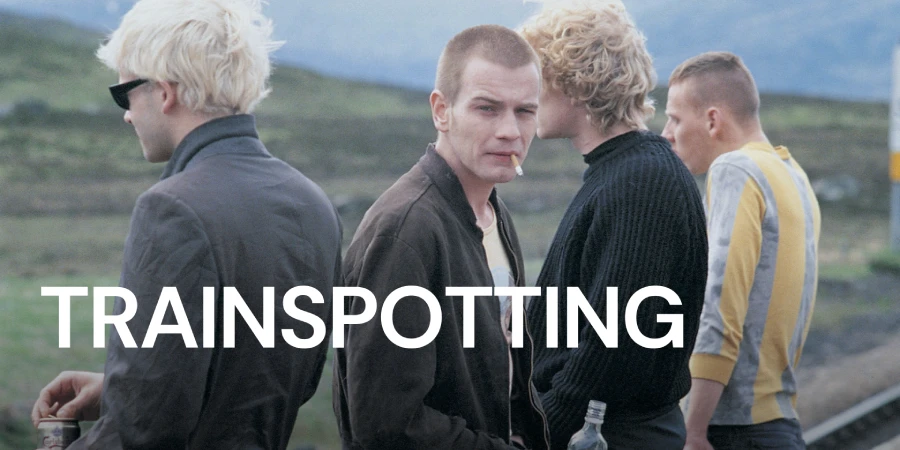

Heroin has never looked so seductive and so absolutely horrifying at the same time. Danny Boyle’s Trainspotting lands like a fist to the chest, dragging audiences through the squalor, dark comedy, and surprising humanity of Edinburgh’s drug scene with relentless energy. It made Ewan McGregor a star, sparked moral outrage in tabloids, and somehow managed to be one of the most life-affirming films of the 1990s.
Detailed Summary
Choose Life: Mark Renton’s World
Mark Renton opens the film by running from security guards while delivering his now-legendary “Choose Life” monologue, a sardonic rejection of mainstream consumerism. He is a young man in Edinburgh who has chosen heroin over ambition, comfort, and frankly most other human beings. His circle of friends includes the volatile Begbie, the cheerful but dim Spud, the sharp-dressing Sick Boy, and the gentle Tommy.
Renton narrates with sharp wit, making his addiction sound almost reasonable, almost logical. However, Boyle never lets the audience fully buy into that reasoning. Each moment of euphoria carries a visible price tag.
The Depths of Addiction
Renton and his friends shoot up regularly, funding their habits through petty theft and benefit fraud. His lowest point arrives in a harrowing sequence inside the worst toilet in Scotland, where he retrieves suppositories from a filthy bowl and slips into a surreal, womb-like underwater reverie. It is disgusting, dreamlike, and oddly poetic all at once.
Sick Boy shoots a stray dog in a park, escalating the sense that this group operates entirely outside normal moral boundaries. Meanwhile, the tragedy deepens when baby Dawn, the child of Allison (one of the group’s associates), dies in her crib while her mother and the group remain oblivious in a drug haze. Renton’s guilt over Dawn’s death becomes a turning point, even if he cannot act on it immediately.
Renton’s First Attempt at Withdrawal
After the baby’s death, Renton’s parents physically lock him in his childhood bedroom to force him through cold turkey withdrawal. Boyle stages these scenes as a full-blown nightmare, complete with hallucinations: a baby crawling across the ceiling, dead-eyed friends appearing at the foot of the bed. Renton survives, but the sequence makes clear just how brutal the process truly is.
London and a Fresh Start
Renton moves to London and finds work as a property letting agent. He stays clean for a meaningful stretch, earning money legitimately and living quietly. For a while, the film teases the possibility of redemption playing out neatly and without further catastrophe.
However, Sick Boy, Spud, and Begbie all arrive in London, and Renton slides back into drug use almost immediately. The pull of old company undoes months of progress in a matter of scenes. Boyle films this relapse not with judgment but with a kind of exhausted inevitability.
Tommy’s Decline
Back in Edinburgh, Tommy had been the one clean member of the group, a fitness-obsessed young man with a girlfriend and actual prospects. After his girlfriend leaves him, he turns to heroin, partly after Renton loses his private videotape in an early, almost throwaway scene. Tommy deteriorates rapidly, and by the time Renton visits him, he is skeletal and living in filth, with a kitten and HIV. Tommy later dies off-screen, a quiet devastation that the film does not overplay.
The Deal and Renton’s Choice
In London, Begbie arranges a major heroin deal. Renton, Sick Boy, Spud, and Begbie pool their resources to purchase a large quantity of heroin from a dealer named Swanney and plan to sell it for a significant profit. The deal goes through, and suddenly the group holds a substantial sum of money.
Tension builds immediately, since Begbie is violently unpredictable and Sick Boy is entirely self-interested. Renton recognizes that he is the only one in a position to act decisively. Consequently, the final act pivots on a single moral question: will he do right by these people, or will he save himself?

Movie Ending
Renton makes his move while the others sleep. He takes all the cash from the hotel safe, leaving Spud’s share in a locker at a train station, a small but significant gesture of loyalty toward the one member of the group he still genuinely cares about. Sick Boy gets nothing. Begbie gets nothing.
Begbie wakes and realizes what has happened, erupting into fury, but it is too late. Renton is already gone, walking toward the camera through central London with a slight smile, delivering a revised version of the “Choose Life” monologue. This time, however, the words carry actual meaning rather than ironic deflection. He is choosing a life, his own, on his own terms, finally.
Audiences often debate whether this ending is triumphant or morally troubling. Renton abandons and steals from his friends, one of whom (Spud) has been loyal throughout. Yet the film positions his escape as genuinely hopeful rather than villainous. Boyle and writer John Hodge suggest that staying would have meant death, prison, or endless repetition. In contrast to the nihilism audiences might expect, the film ends on something surprisingly close to optimism.
The fact that Spud receives his cut is crucial. It signals that Renton has not completely surrendered his humanity. Moreover, it distinguishes his betrayal of Begbie and Sick Boy as a calculated, almost justifiable severance rather than pure greed.
Are There Post-Credits Scenes?
Trainspotting contains no post-credits scenes. Boyle ends the film on that final walking shot and does not return. There is nothing to wait for after the credits roll, aside from more of the excellent soundtrack.
Type of Movie
Trainspotting is a black comedy drama with strong elements of social realism and surrealist horror. Its tone shifts rapidly, moving from dark humor to genuine tragedy within single scenes. It never settles into one emotional register, which is precisely what makes it so relentlessly watchable.
Cast
- Ewan McGregor – Mark Renton
- Robert Carlyle – Francis Begbie
- Jonny Lee Miller – Sick Boy
- Ewen Bremner – Spud
- Kevin McKidd – Tommy
- Kelly Macdonald – Diane
- Peter Mullan – Swanney
- Eileen Nicholas – Renton’s Mother
Film Music and Composer
Trainspotting does not rely on a traditional orchestral score. Instead, it uses a curated soundtrack that became one of the most celebrated album releases of the 1990s. Underworld’s “Born Slippy .NUXX” closes the film and became a genuine anthem of British culture almost overnight.
Other key tracks include Iggy Pop’s “Lust for Life” over the opening sequence, Pulp’s “Mile End,” and Lou Reed’s “Perfect Day,” used with devastating irony during Renton’s overdose scene. Brian Eno contributed “Deep Blue Day,” which plays during the infamous toilet dive. The music functions as character commentary throughout, reinforcing tone without ever becoming wallpaper.

Filming Locations
Principal photography took place in Glasgow, not Edinburgh, largely for practical and financial reasons. Glasgow’s urban landscape stood in convincingly for the Leith area of Edinburgh, where the story is set. Boyle and his team dressed locations carefully to maintain the illusion.
Some scenes were also shot in London, particularly for the second half of the film when Renton relocates south. Notably, the iconic opening footchase was filmed on Princes Street in Edinburgh itself. Using real Edinburgh geography for that specific scene grounds the film’s identity even as most of it was staged elsewhere.
Awards and Nominations
Trainspotting earned a BAFTA Award for Best Adapted Screenplay for John Hodge. It also received an Academy Award nomination for Best Adapted Screenplay, a remarkable achievement for a low-budget British film about heroin addiction. Additionally, it won multiple awards from various critics’ circles across the UK and internationally.
Behind the Scenes Insights
- The film had a very modest budget of approximately 1.5 million pounds, which forced Boyle and his team into inventive, energetic filmmaking choices that ultimately defined the film’s visual style.
- Ewan McGregor lost a significant amount of weight to play the gaunt, wasted Renton convincingly.
- Robert Carlyle based Begbie on real people he had encountered growing up in Glasgow, and his portrayal required no prosthetics or extensive prep, just raw, controlled aggression.
- Kelly Macdonald was making her feature film debut as Diane, and Boyle cast her after an open audition.
- The baby-on-the-ceiling hallucination sequence required a specially rigged set to achieve the rotating, gravity-defying effect.
- Boyle deliberately shot the film with a handheld, kinetic style to mirror the characters’ chaotic mental states.
- The toilet sequence used a specially constructed prop toilet that was not actually connected to plumbing, making the shoot unpleasant but not quite as revolting as it appears on screen.
Inspirations and References
Trainspotting is directly adapted from Irvine Welsh’s 1993 novel of the same name. Welsh drew heavily from his own experiences and observations of Edinburgh’s working-class drug culture during the 1980s. The novel’s fragmented, dialect-heavy structure gave Boyle and Hodge the raw material they then shaped into a linear, cinematic narrative.
Boyle has cited films like A Clockwork Orange and Midnight Cowboy as tonal reference points. Furthermore, the film’s irreverent approach to addiction carries echoes of Requiem for a Dream’s source material (Hubert Selby Jr.’s work), though Trainspotting predates Aronofsky’s film adaptation and takes a far less punishing approach to its audience.
Alternate Endings and Deleted Scenes
No widely documented alternate ending exists for Trainspotting. Boyle and Hodge committed to the ending as written from an early stage in production. However, the adaptation process necessarily involved cutting substantial portions of Welsh’s episodic novel, including several subplots and characters that did not make it to screen.
Some scenes featuring secondary characters from the novel were reduced or removed entirely to keep the film’s pace taut. Welsh himself appears briefly in the film as a drug dealer named Mikey Forrester, a fun piece of casting that functions almost as a cameo nod to the source material.
Book Adaptations and Differences
Welsh’s novel is structured as a series of loosely connected episodes, written in thick Scottish dialect, and told from multiple characters’ perspectives. Hodge’s screenplay linearizes the story considerably, centering Renton far more firmly as the protagonist and primary narrator. Several chapters from the book that belong to Spud, Sick Boy, and others are either condensed or folded into Renton’s storyline.
Tommy’s arc remains largely faithful to the novel. However, the book’s ending differs from the film’s: Renton’s betrayal and escape play out similarly, but the novel does not close on the same note of qualified optimism. Welsh’s version carries more ambiguity and less of the triumphant walking-into-the-future imagery that Boyle crafted visually.

Memorable Scenes and Quotes
Key Scenes
- The opening footchase through Edinburgh accompanied by Iggy Pop’s “Lust for Life” and Renton’s “Choose Life” monologue, one of cinema’s great introductions.
- Renton’s overdose to the sound of Lou Reed’s “Perfect Day,” a sequence that contrasts beauty and near-death with stunning cruelty.
- The descent into the worst toilet in Scotland, followed by the surreal underwater dive for the suppositories.
- Baby Dawn’s death discovered by the group in a drug-induced stupor, a scene that cuts through the film’s comedy like a blade.
- The cold turkey withdrawal hallucination sequence in Renton’s childhood bedroom, complete with the baby crawling across the ceiling.
- Renton walking away from the camera in London in the final shot, revised “Choose Life” monologue playing over the image.
Iconic Quotes
- “Choose life. Choose a job. Choose a career. Choose a family. Choose a big television…” (Renton, opening monologue)
- “Doesn’t it make you proud to be Scottish?” (Renton, in the pub)
- “I haven’t felt that good since Archie Gemmill scored against Holland in 1978.” (Renton)
- “There are no more choices. You’re an addict. Be addicted. Just be addicted and stop pretending otherwise.” (Renton, internal monologue)
- “I’m going to be just like you. The job, the family, the big television…” (Renton, closing monologue)
Easter Eggs and Hidden Details
- Irvine Welsh himself appears on screen as Mikey Forrester, the dealer who sells Renton suppositories, directly connecting the source material’s author to the film’s most notorious scene.
- The film’s poster and marketing deliberately used vibrant, almost pop-art colors, which stood in stark contrast to the film’s dark subject matter and served as its own ironic commentary.
- Several visual compositions during the withdrawal sequence mirror classic horror film framing, a deliberate nod to the idea that addiction itself is a monster-movie scenario.
- The underwater shot when Renton dives into the toilet is lit and composed to resemble a birth canal, suggesting both escape and regression simultaneously.
- Boyle includes a quick shot of a Scottish National Party poster in the background of one scene, quietly nodding to the broader political context of Thatcher-era Scotland without making it a plot point.
Trivia
- Trainspotting grossed over 72 million dollars worldwide against its tiny budget, making it one of the most profitable British films of its decade.
- The film’s title refers to a scene in the original novel involving a disused train station, a scene that did not make it into the film at all.
- Ewan McGregor, Jonny Lee Miller, Ewen Bremner, and Kevin McKidd all reprised their roles in the 2017 sequel, T2 Trainspotting.
- Boyle and producer Andrew Macdonald followed Trainspotting almost immediately with A Life Less Ordinary, reuniting with McGregor for a very different kind of film.
- The UK censors initially raised concerns about the film glamorizing drug use, but it ultimately received its certification without significant cuts.
- Welsh reportedly approved of the film enthusiastically, which is not always the case when novelists see their work adapted for the screen.
Why Watch?
Trainspotting is one of those rare films that grabs you by the collar and refuses to let go for its entire runtime. It balances genuine horror and genuine humor without cheapening either, and its performances are extraordinary across the board. Moreover, it changed British cinema permanently, proving that working-class stories told with style and ferocity could conquer global audiences.
Director’s Other Movies
- Shallow Grave (1994)
- A Life Less Ordinary (1997)
- The Beach (2000)
- 28 Days Later (2002)
- Millions (2004)
- Slumdog Millionaire (2008)
- 127 Hours (2010)
- Trance (2013)
- Steve Jobs (2015)
- T2 Trainspotting (2017)
- Yesterday (2019)
Recommended Films for Fans
- Requiem for a Dream (2000)
- Christiane F. (1981)
- The Basketball Diaries (1995)
- Shallow Grave (1994)
- Human Traffic (1999)
- Pulp Fiction (1994)
- Kids (1995)
- Nil by Mouth (1997)
- Berlin Calling (2008)
- Drugstore Cowboy (1989)
- Snatch (2000)
- Buffalo ’66 (1998)