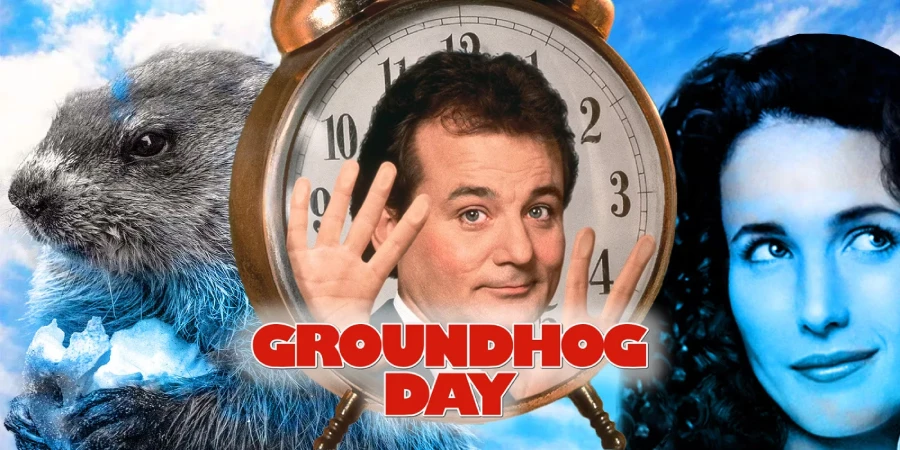

A cynical weatherman wakes up on the same day, over and over again, until he either learns to be a decent human being or loses his mind trying. Groundhog Day (1993) is not just a clever comedy; it is a genuinely profound meditation on self-improvement, mortality, and what it means to live a life worth living. Director Harold Ramis and star Bill Murray somehow turned a one-joke premise into one of the most re-watchable films ever made.
Detailed Summary
Phil Connors Arrives in Punxsutawney
We meet Phil Connors, a Pittsburgh TV weatherman played by Bill Murray, and he is immediately insufferable. He treats his cameraman Larry and his new producer Rita Hanson with open contempt, making no effort to hide how far beneath him he considers this assignment.
Phil, Larry, and Rita drive to Punxsutawney, Pennsylvania to cover the annual Groundhog Day ceremony on February 2. Phil files his report, mocks the entire event, and desperately tries to leave town. A blizzard he incorrectly predicted would miss the area traps all three of them overnight.
The Loop Begins
Phil wakes up the next morning and something is very wrong. His clock radio plays Sonny and Cher’s “I Got You Babe” at 6:00 a.m., exactly as it did the day before. Every encounter, every conversation, every detail of the day repeats itself with perfect fidelity.
At first, Phil assumes he is losing his mind. He tries to tell Rita and a local doctor what is happening, but neither takes him seriously. Consequently, he faces the impossible situation entirely alone.
Phil Exploits the Loop
Once Phil grasps that there are no consequences to his actions, he leans into pure selfishness. He learns everything about a local woman named Nancy Taylor over successive loops and uses that knowledge to seduce her. He eats whatever he wants, steals money from an armored car, and drives recklessly through town.
This section of the film is genuinely funny, but it also functions as a sharp critique. Phil treats the loop as an excuse to indulge every shallow impulse he has ever had. However, the thrill fades fast.
Phil Pursues Rita
Phil shifts his attention to Rita, played by Andie MacDowell. She is kind, warm, and everything Phil is not, which naturally makes him want to possess rather than appreciate her. He spends loop after loop learning her likes, dislikes, and deepest thoughts, then parrots them back to her in elaborate manufactured moments of connection.
Rita always slaps him by the end of the day. She cannot articulate why something feels off, but her instincts are correct. Phil is performing connection rather than experiencing it, and she feels the difference every time.
Despair and the Suicide Loops
Phil eventually breaks. He kidnaps Punxsutawney Phil the groundhog, drives off a quarry, and dies. He wakes up at 6:00 a.m. again. He tries electrocution, steps in front of a truck, and leaps from a building. Nothing works; the loop simply resets each time.
This sequence is played with a darkly comic edge, but its emotional weight is real. Phil is experiencing a form of existential torture that no person around him can recognize or acknowledge. Moreover, the film earns its pivot to something deeper precisely because it refuses to skip over this darkness.
Phil Chooses to Become Better
Something shifts. Phil stops trying to escape the loop and starts trying to fill it with meaning. He learns to play jazz piano from a local instructor. He memorizes the lives of Punxsutawney’s residents and quietly helps them at just the right moments throughout the day.
He catches a boy falling from a tree. He saves a man choking at dinner. He fixes a flat tire for a group of elderly women. None of these people know he has been preparing for years; to them, he is simply a good person in the right place at the right time.
The Town Falls for Phil
Rita witnesses a transformed Phil on what feels to her like a single day. He plays piano beautifully at a party, sculpts ice with practiced skill, and shows genuine warmth toward every person in town. She bids her savings at a charity bachelor auction just to spend the evening with him.
Phil tells Rita the truth about the loop that night. For the first time, she believes him, or at least believes that he believes it. She falls asleep beside him, and Phil, now genuinely at peace, simply watches her sleep with quiet contentment rather than calculation.
Movie Ending
Phil wakes up on February 3. Sonny and Cher do not play. Rita is still beside him, and the date has actually changed for the first time in what the film strongly implies has been an enormous span of time. Phil runs outside into fresh snow, genuinely delighted by a world that is new again.
He tells Rita he wants to live in Punxsutawney. It is a remarkable line, because the town once represented his imprisonment. Now it represents the community he spent countless loops learning to love and serve. His desire to stay is the clearest possible proof that he has changed.
Audiences have long debated how long Phil was trapped in the loop. The film never gives an explicit answer. However, director Harold Ramis suggested in interviews that the loop likely lasted for decades, given the skills Phil accumulates, including fluent piano, ice sculpting, and encyclopedic knowledge of every resident in town. Some fans estimate the loop at around 10,000 years, though Ramis considered that figure too extreme and preferred something closer to tens of years.
What matters is not the exact number. What matters is that Phil used an eternity of solitude to become genuinely good, and love arrived only once that transformation was real. Rita does not fall for the Phil who memorized her coffee order; she falls for the Phil who no longer needs to.
Are There Post-Credits Scenes?
Groundhog Day contains no post-credits scenes. The film ends cleanly and with intention. Staying in your seat will reward you only with credits and the warm feeling of a story told exactly as long as it needed to be.
Type of Movie
Groundhog Day is a fantasy comedy drama. Its tone shifts significantly across its runtime, opening as a sharp workplace comedy before descending into something close to existential horror, then arriving at something genuinely touching.
In contrast to most comedies of its era, the film takes its premise with philosophical seriousness. Critics and scholars have read it through Buddhist, Christian, Nietzschean, and existentialist lenses, and none of those readings feel forced. It is rare for a comedy to earn that kind of attention.
Cast
- Bill Murray – Phil Connors
- Andie MacDowell – Rita Hanson
- Chris Elliott – Larry
- Stephen Tobolowsky – Ned Ryerson
- Brian Doyle-Murray – Buster Green
- Marita Geraghty – Nancy Taylor
- Angela Paton – Mrs. Lancaster
- Rick Ducommun – Gus
- Rick Overton – Ralph
Film Music and Composer
George Fenton composed the film’s score. Fenton brought warmth and wit to the music, matching the film’s tonal range without ever overplaying the comedy or the melancholy. His orchestral work feels light but never thin.
Notably, “I Got You Babe” by Sonny and Cher functions almost as a secondary score. Its relentless return at 6:00 a.m. transforms a cheerful pop song into something faintly menacing, then eventually into something Phil seems to make peace with. The song does a tremendous amount of narrative work with no dialogue required.
Phil also performs jazz piano standards in the later sections of the film. Bill Murray actually learned enough piano to make his performance look credible on screen, which adds a layer of genuine accomplishment to those scenes.



Filming Locations
Despite the story being set in Punxsutawney, Pennsylvania, most of the film was shot in Woodstock, Illinois. Woodstock’s town square stood in convincingly for the real Punxsutawney, and its streets were compact enough to make the recurring geography feel believable.
A specific corner in Woodstock, near the town square, became famous as the spot where Phil steps into an icy puddle every single morning. Fans have since made pilgrimages to the location. The real Punxsutawney also hosted some of the groundhog ceremony footage.
Woodstock’s architecture suited the film’s slightly timeless quality. Nothing in the town square reads as definitively modern, which helps the film avoid feeling anchored to a specific decade. That visual ambiguity reinforces the story’s universal themes.
Awards and Nominations
Groundhog Day received surprisingly few major awards nominations at the time of its release, a fact that has aged poorly given the film’s towering reputation. Stephen Tobolowsky received a Saturn Award nomination for Best Supporting Actor.
In subsequent years, the film has received considerable recognition for its cultural impact. The Writers Guild of America ranked the screenplay among the greatest ever written. The film also earned selection for preservation in the United States National Film Registry by the Library of Congress.
Behind the Scenes Insights
- Bill Murray and director Harold Ramis had a significant falling out during production, reportedly over the film’s tone. Murray wanted to push the film toward something more serious and philosophical, while Ramis leaned toward comedy. Their friendship did not recover for many years.
- Murray trained with a piano coach to make his piano scenes look authentic. He did not become a concert pianist, but his hands are genuinely playing in several shots.
- Harold Ramis appeared in the film as a neurologist Phil consults about his condition, a small cameo that is easy to miss.
- Ramis’s nephew played the boy Phil repeatedly catches falling from the tree.
- The production team had to source a groundhog handler because the animal, also named Phil, reportedly bit Bill Murray twice during filming.
- Danny Rubin wrote the original screenplay, and his initial draft did not reveal how Phil entered the loop. Ramis and Rubin rewrote the structure significantly before shooting began.
Inspirations and References
Screenwriter Danny Rubin has said the concept emerged from his interest in time loops and the philosophical implications of reliving experience. He was not directly adapting any single existing work. However, the premise has clear resonances with Nietzsche’s concept of eternal recurrence, the idea that one should live as if forced to repeat every moment forever.
Buddhist interpretations of the film have been widely noted. Phil’s arc, from ego-driven suffering through despair to selfless compassion, maps onto a rough sketch of the Buddhist path toward liberation. Ramis himself acknowledged this reading and found it meaningful.
Similarly, Christian readings are easy to construct. Phil essentially experiences a form of purgatory from which he escapes through genuine moral transformation. Ramis welcomed multiple interpretations rather than endorsing one specific framework.
Alternate Endings and Deleted Scenes
Danny Rubin’s original screenplay took a notably different structural approach. His draft began with Phil already deep inside the loop, with no explanation of how it started. Audiences would have had to piece together the situation alongside Phil, which would have created a more disorienting opening experience.
Rubin has also discussed an early draft in which the cause of the loop was hinted at through a jilted ex-girlfriend with supernatural abilities. This element was cut entirely, and wisely so; the film’s power depends on the loop having no explained origin. Removing the cause keeps the story universal rather than anecdotal.
No major alternate ending for the film’s final scene has been widely documented or released. The conclusion audiences saw in theaters appears to have been the intended resolution throughout production.
Book Adaptations and Differences
Groundhog Day is not based on a book. It originated as an original screenplay by Danny Rubin, later revised with Harold Ramis. There is no source novel to compare it against.
Interestingly, Rubin later wrote a novelization called Groundhog Day: The Novel, published in 2012. That book expands on the internal experience of the loop and explores Phil’s psychology in greater depth than the film’s runtime allowed.
Memorable Scenes and Quotes
Key Scenes
- The first loop morning: Phil’s dawning realization that yesterday is repeating, punctuated by the return of “I Got You Babe,” sets the film’s entire tone in under two minutes.
- The Jeopardy scene: Phil answers every question before the contestants can, demonstrating the absurd advantages of infinite repetition in a single comic beat.
- The piano recital at the party: Phil performs jazz piano for a delighted crowd, and Rita watches him with genuine admiration for the first time. The scene marks the film’s emotional turning point.
- The groundhog kidnapping: Phil steals Punxsutawney Phil and drives off a cliff in a moment of spectacular, darkly comic despair.
- The homeless man dying: Phil repeatedly tries to save an old beggar’s life and fails every time, establishing that his power is not unlimited and that some grief is simply unavoidable.
- The bachelor auction: Rita bids everything she has to spend the evening with Phil, a moment of quiet emotional reversal after dozens of loops in which Phil tried to purchase her affection through manipulation.
Iconic Quotes
- “I’m a god. I’m not the God… I don’t think.” (Phil to Rita, with remarkable comic timing from Murray)
- “It’s gonna be cold, it’s gonna be grey, and it’s gonna to last you for the rest of your life.” (Phil’s bleak weather forecast for his own situation)
- “Don’t drive angry.” (Phil’s absurdly calm instruction to the groundhog while driving off a cliff)
- “What would you do if you were stuck in one place, and every day was exactly the same, and nothing that you did mattered?” (Phil’s confession to two strangers at a bar, delivered as casual small talk)
- “I think people place too much emphasis on their careers.” (Phil, after abandoning all professional ambition)
Easter Eggs and Hidden Details
- Director Harold Ramis appears briefly as the neurologist Phil visits. Watch carefully or you will miss him entirely.
- Phil’s room number at the bed and breakfast is Room 19. Some fans have noted recurring appearances of the number throughout the film, though the production has not confirmed intentional significance.
- The diner clock in the background of several scenes shows slightly different times across what are supposed to be identical mornings, a small continuity quirk that some viewers interpret as evidence that the loop is not perfectly identical each time.
- Ned Ryerson’s insurance pitch changes in subtle ways across different loops, suggesting Phil’s responses subtly alter the conversation even when he is not trying to manipulate it.
- The song on the clock radio is always “I Got You Babe,” but the DJ patter that follows it also repeats verbatim, functioning as an unacknowledged running gag for attentive viewers.
- Brian Doyle-Murray, who plays the festival coordinator Buster, is Bill Murray‘s real-life brother. Their scenes together carry a natural ease that is hard to manufacture.
Trivia
- The real Groundhog Day ceremony does take place in Punxsutawney, Pennsylvania every February 2, and the event grew significantly in popularity after the film’s release.
- “Groundhog Day” has entered the English language as a common phrase describing any situation that feels inescapably repetitive. Few films achieve that level of cultural penetration.
- Bill Murray and Harold Ramis reportedly did not speak for years after filming concluded. They reconciled before Ramis’s death in 2014.
- Murray wore the same wardrobe throughout production to maintain visual continuity across the repeating day. Wardrobe continuity was one of the film’s significant logistical challenges.
- The film’s working title was simply Groundhog Day from the earliest stages of development; no alternate title was seriously pursued.
- Philosophers and theologians have assigned Groundhog Day as required viewing or reading material in actual academic courses. It is one of the few mainstream comedies to achieve that distinction.
- A stage musical adaptation of Groundhog Day opened in London’s West End in 2016 and later transferred to Broadway.
Why Watch?
Groundhog Day is one of those rare films that genuinely gets better with every viewing, because knowing the loop exists lets you catch everything Phil is quietly doing in the background of scenes. It works as a comedy, a romance, a philosophical fable, and a study of grief and reinvention. Moreover, Bill Murray’s performance is one of the finest comic turns ever committed to film. You will laugh, then feel something you did not expect to feel.
Director’s Other Movies
- Caddyshack (1980)
- National Lampoon’s Vacation (1983)
- Club Paradise (1986)
- Multiplicity (1996)
- Analyze This (1999)
- Bedazzled (2000)
- Analyze That (2002)
- The Ice Harvest (2005)
- Year One (2009)