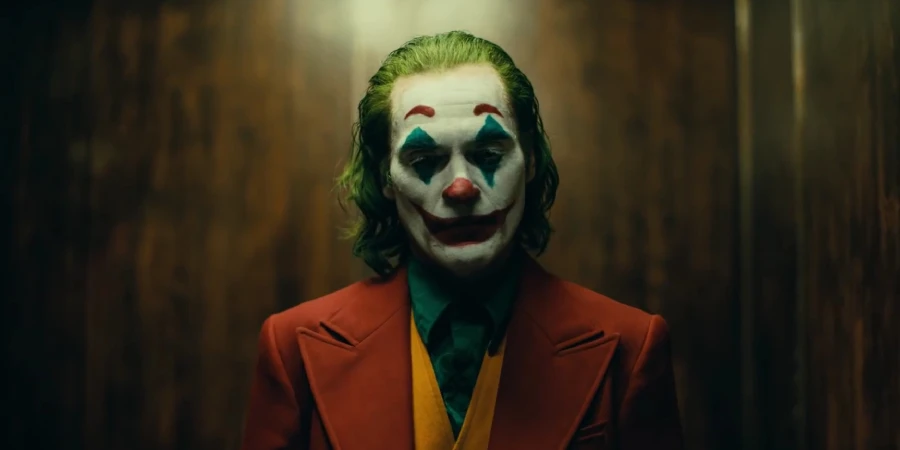

Arthur Fleck does not simply become the Joker; he unravels, one humiliation at a time, until Gotham gets exactly the monster it deserves. Todd Phillips‘s 2019 film is a slow-burn character study disguised as a comic book movie, and it hits harder than most people expected. Joaquin Phoenix delivers a performance so uncomfortably committed that it almost feels wrong to watch. Almost.
Detailed Summary
Arthur’s Painful Everyday Life
Arthur Fleck works as a party clown in a decaying, garbage-strike-era Gotham City. He lives with his ailing mother, Penny Fleck, in a cramped apartment, caring for her while barely holding himself together. He carries a card explaining his condition: a neurological disorder that causes uncontrollable, involuntary laughter at the worst possible moments.
Arthur aspires to become a stand-up comedian. He attends therapy sessions, relies on multiple prescription medications, and keeps a journal filled with dark jokes and darker thoughts. His life, however, is a series of indignities stacked on top of each other.
The First Act of Violence
Colleagues at the clown agency set Arthur up. A coworker gives him a gun, which Arthur later brings accidentally into a children’s hospital gig. As a result, he loses his job.
On the subway, three drunken Wayne Enterprises employees attack and beat Arthur. He shoots all three of them. This moment is crucial: it is simultaneously an act of self-defense and the first crack in whatever remained of his restraint.
Murray Franklin and the Comedy Dream
Murray Franklin, played by Robert De Niro, hosts a late-night talk show that Arthur idolizes. Arthur fantasizes about Murray noticing him, inviting him on stage, and treating him like a son. Murray, in Arthur’s daydream, represents warmth and recognition he has never received.
Murray does eventually play a clip of Arthur’s disastrous stand-up set on his show, but only to mock him. Millions laugh at Arthur. Murray even calls him “Joker” as a joke. Arthur, however, begins to embrace the name.
The Revelation About His Mother
Arthur investigates his possible connection to Thomas Wayne, Gotham’s wealthy mayoral candidate. He finds documents suggesting he may be Thomas Wayne’s illegitimate son, adopted by Penny. He begins to believe he finally has a real identity.
Thomas Wayne denies everything. He tells Arthur that Penny was delusional and that Arthur himself was adopted. Arthur then obtains Penny’s sealed medical records from Arkham State Hospital. The records reveal that Penny neglected and allowed the abuse of young Arthur, who suffered serious head trauma as a child. Her delusions, not reality, created the story of Thomas Wayne.
Arthur smothers Penny with a pillow in her hospital bed. It is a devastating, almost quiet scene that strips away any remaining sympathy, yet somehow does not entirely extinguish it.
The Neighbor Sophie and the Illusion
Arthur develops what appears to be a romantic relationship with his neighbor, Sophie Dumond, played by Zazie Beetz. They go on dates. She attends his stand-up performance. She seems to genuinely care about him.
Later, Arthur visits Sophie’s apartment unannounced. She is confused and frightened. Consequently, the film reveals that their entire relationship existed only in Arthur’s mind. He fabricated it completely. Sophie survives the scene, but the revelation reframes everything the audience thought they understood.
The Final Transformation
Arthur fully adopts the Joker persona. He dyes his hair green, paints his face, and wears the now-iconic red suit. Meanwhile, protests and riots inspired by his subway killings spread across Gotham, with people in clown masks embracing him as a symbol of anti-establishment rage.
His old coworker Randall, who gave him the gun and lied to protect himself after the subway incident, gets killed. Arthur’s other coworker, Gary, the only person who ever treated Arthur with decency, gets spared.

Movie Ending
Arthur accepts Murray’s invitation to appear on the live talk show. He asks to be introduced as Joker, and Murray obliges, not realizing what is coming. Arthur walks out to applause, sits down, and begins behaving erratically.
He confesses on live television to the subway killings. Murray pushes back, and Arthur shoots him point-blank in the head, live on air. It is shocking, deliberately paced, and almost operatic in its ugliness.
Chaos erupts across Gotham. Rioters in clown masks flood the streets. In one of the film’s most pointed moments, Thomas and Martha Wayne are shot and killed in an alley by one of those rioters, with a young Bruce Wayne watching. The film essentially presents the origin of Batman as a direct consequence of Gotham’s failure to care for people like Arthur.
Police cars crash into the vehicle carrying Arthur, and rioters pull him from the wreckage. He stands on the car, arms outstretched, reveling in it all. For a moment, he has everything he wanted: recognition, a crowd, a purpose.
In the final sequence, Arthur sits in Arkham State Hospital, being interviewed by a social worker. He laughs to himself and says he was thinking of a joke she would not understand. He then runs barefoot through the white corridors, leaving bloody footprints behind him. Whether this entire film was a fabrication inside Arthur’s mind at Arkham, or a real sequence of events, remains deliberately unresolved. Phillips intends the ambiguity. Both readings are valid, and that ambiguity is precisely the point.
Are There Post-Credits Scenes?
Joker does not include any post-credits scenes. No additional footage appears after the credits roll. Given that this film operates entirely outside the traditional comic book movie framework, the absence feels entirely appropriate.
Type of Movie
Joker is a psychological drama and character study with elements of crime and tragedy. Its tone is dark, suffocating, and deliberately uncomfortable. In contrast to typical superhero films, it offers no action sequences, no heroics, and no reassuring moral resolution.
Phillips positions it closer to 1970s and early 1980s prestige cinema than to anything in the contemporary comic book genre. Its pacing is slow and intentional. Viewers looking for spectacle will find none; viewers looking for psychological weight will find it in abundance.
Cast
- Joaquin Phoenix – Arthur Fleck / Joker
- Robert De Niro – Murray Franklin
- Zazie Beetz – Sophie Dumond
- Frances Conroy – Penny Fleck
- Brett Cullen – Thomas Wayne
- Shea Whigham – Detective Burke
- Bill Camp – Detective Garrity
- Glenn Fleshler – Randall
- Leigh Gill – Gary
- Douglas Hodge – Alfred Pennyworth
- Dante Pereira-Olson – Young Bruce Wayne
Film Music and Composer
Hildur Guonadottir composed the original score for Joker, and her work is extraordinary. She recorded much of the music before filming even began, allowing Phoenix to perform to her compositions on set. This approach gave the score an unusually organic relationship with the performance.
Her cello-driven compositions feel visceral and mournful. Tracks like “Bathroom Dance” and “Defeated Clown” amplify Arthur’s emotional states without overexplaining them. Guonadottir won the Academy Award for Best Original Score for this work, a thoroughly deserved recognition.
Several pre-existing tracks also appear in the film. “Send in the Clowns” and “That’s Life” by Frank Sinatra add layers of bitter irony to key scenes. Gary Glitter’s “Rock and Roll Part 2” plays during the iconic staircase dance sequence.


Filming Locations
Principal photography took place in New York City. Specifically, the filmmakers used neighborhoods including the Bronx, Brooklyn, and Newark, New Jersey, to construct their version of Gotham. These locations gave the film a gritty, lived-in texture that a studio backlot could not have replicated.
The famous staircase dance sequence was filmed on real steps in the Highbridge neighborhood of the Bronx. After the film’s release, those stairs became an unexpected tourist destination. Furthermore, the subway sequences used real New York City transit infrastructure, reinforcing the film’s naturalistic visual language.
Shooting in real urban environments grounded the film’s fantasy in something recognizable. Gotham, in Phillips’s vision, is not an invented city; it is America, barely disguised.
Awards and Nominations
Joker received eleven Academy Award nominations, including Best Picture. It won two: Best Actor for Joaquin Phoenix and Best Original Score for Hildur Guonadottir.
Phoenix also won the BAFTA and the Golden Globe for Best Actor. In addition, the film won the Golden Lion at the Venice Film Festival, the top prize at one of cinema’s most prestigious competitions. For a comic book origin story, that is a remarkable award haul.
Behind the Scenes Insights
- Joaquin Phoenix lost approximately 52 pounds for the role, a physical transformation that directly influenced his performance and physicality as Arthur.
- Phillips and Phoenix developed Arthur’s character together over an extended pre-production period, building his psychology from the ground up rather than relying solely on existing comic book lore.
- Hildur Guonadottir composed portions of the score before filming began, and Phoenix listened to her music while shooting certain scenes to guide his emotional state.
- The bathroom dance scene, one of the film’s most celebrated moments, was largely improvised by Phoenix on the day of shooting.
- Phoenix reportedly stayed in character between takes throughout production, making the set an unusually intense environment.
- Todd Phillips originally developed the project as part of a broader initiative at Warner Bros. to create standalone, filmmaker-driven DC stories outside the main continuity.
- The film’s Venice Golden Lion win generated significant awards-season momentum before the film even opened in theaters.
Inspirations and References
Joker draws heavily from two Martin Scorsese films. Taxi Driver (1976) provides the template of an isolated, mentally unstable man constructing a violent identity in an uncaring city. The King of Comedy (1982) supplies the talk-show obsession and the blurring of fantasy and reality.
Robert De Niro’s casting as Murray Franklin directly invokes both films; he played the lead in Taxi Driver and in The King of Comedy. This is not subtle, and it is not meant to be. Phillips uses the casting as a deliberate signal.
In terms of comic book source material, the film draws loosely from Alan Moore and Brian Bolland‘s Batman: The Killing Joke, which also presents the Joker as a failed comedian who has one bad day. However, Phillips and co-writer Scott Silver constructed their own original narrative rather than adapting that story directly.
Alternate Endings and Deleted Scenes
No official alternate ending has been released for Joker. Todd Phillips has discussed various ideas that changed during development, but no finalized alternate cut has surfaced publicly.
Several scenes were trimmed during editing to maintain pacing. Some additional footage involving Sophie and Arthur was reportedly cut, which would have made the reveal of his delusion even more elaborate. Phillips has indicated that the theatrical cut reflects his intended vision for the film.
Book Adaptations and Differences
Joker is not based on a specific book or graphic novel. It is an original screenplay written by Todd Phillips and Scott Silver. While it draws inspiration from various comics and cinematic sources, no single source text underlies its narrative.
A Joker novelization was published alongside the film’s release, but it adapts the screenplay rather than the other way around. Consequently, the film itself remains the primary creative document.

Memorable Scenes and Quotes
Key Scenes
- The Staircase Dance: Arthur, now fully embracing his Joker identity, dances alone on a steep Bronx staircase to Gary Glitter’s “Rock and Roll Part 2.” It is joyful, disturbing, and visually iconic.
- The Subway Shootings: Arthur kills three Wayne Enterprises employees on a late-night train. It is chaotic and ugly, yet the film refuses to frame it as purely monstrous, which is exactly what makes it so unsettling.
- The Bathroom Dance After the Killings: Arthur retreats to a public bathroom and performs a slow, fluid, almost meditative dance. Phoenix improvised the movement, and it perfectly captures a man discovering who he is.
- The Murray Franklin Shooting: Arthur shoots Murray live on national television. The moment is preceded by a monologue that functions as the film’s thesis statement about neglect, class, and invisibility.
- Smothering Penny: Arthur kills his mother quietly in her hospital bed. It is filmed with restraint, which makes it more disturbing than any graphic scene could have been.
- The Sophie Revelation: Arthur visits Sophie and she answers the door, clearly terrified and confused. In a single scene, the film recontextualizes everything the audience believed about Arthur’s emotional life.
Iconic Quotes
- “I used to think that my life was a tragedy, but now I realize, it’s a comedy.”
- “Is it just me, or is it getting crazier out there?”
- “For my whole life, I didn’t know if I even really existed. But I do, and people are starting to notice.”
- “What do you get when you cross a mentally ill loner with a society that abandons him and treats him like trash? You get what you deserve!”
- “The worst part of having a mental illness is people expect you to behave as if you don’t.”
Easter Eggs and Hidden Details
- Robert De Niro’s casting as the talk-show host directly mirrors his role in The King of Comedy, where he played an obsessive fan desperate for television fame. In Joker, the roles are reversed.
- Arthur’s apartment building number and various set details echo visual elements from Taxi Driver, paying homage to Scorsese’s 1976 film throughout.
- The graffiti visible in Gotham’s streets includes text and imagery that foreshadows the riot sequences later in the film.
- Young Bruce Wayne appears behind a gate at Wayne Manor, visually mirroring the image of a prisoner or someone trapped, foreshadowing his own future as a figure defined by trauma.
- The film is set in 1981, which aligns with a specific era of urban decay in New York City, grounding its fictional world in a recognizable historical moment.
- Arthur’s journal contains drawings and writing that echo imagery associated with classic comic book Joker iconography, even though the film deliberately distances itself from direct comic adaptation.
- Murray Franklin’s show set design closely resembles the set of The Tonight Show from the early 1980s, reinforcing the film’s period authenticity.
Trivia
- Joaquin Phoenix was not the only actor considered for the role; however, once he committed, the film was built specifically around his interpretation.
- Joker became one of the highest-grossing R-rated films in history, earning over one billion dollars at the global box office.
- Todd Phillips co-wrote the script with Scott Silver, whose previous credits include 8 Mile (2002).
- The film generated significant controversy before its release, with some critics and security officials expressing concern about its potential influence on real-world violence. No such incidents materialized.
- Phoenix won virtually every major Best Actor award during the 2019-2020 awards season, making his Oscar win widely anticipated.
- The production used real Gotham City subway cars that were sourced and dressed to match the early 1980s period setting.
- Hildur Guonadottir became only the third solo female composer to win the Academy Award for Best Original Score.
Why Watch?
Phoenix delivers one of cinema’s great performances, full stop. Joker asks genuinely difficult questions about mental illness, class, and institutional failure, and it refuses to offer easy answers. For anyone willing to sit with discomfort, it rewards patience with something rarely seen in mainstream cinema: a villain story told with real psychological honesty.
Director’s Other Movies
- Road Trip (2000)
- Old School (2003)
- Starsky and Hutch (2004)
- School for Scoundrels (2006)
- The Hangover (2009)
- Due Date (2010)
- The Hangover Part II (2011)
- The Hangover Part III (2013)
- War Dogs (2016)
- Joker: Folie a Deux (2024)