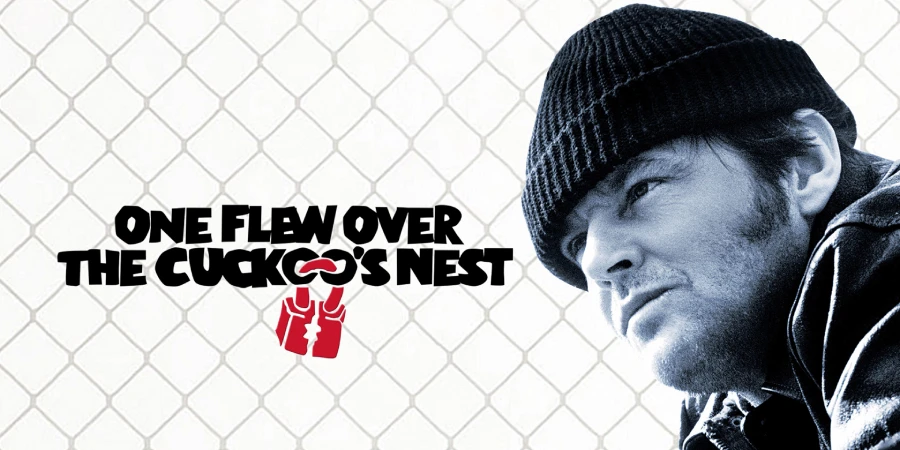

A con man fakes insanity to dodge prison labor and walks straight into the calmest villain in film history. One Flew Over the Cuckoo’s Nest (1975) turns a psychiatric ward into a battlefield of wills. Miloš Forman‘s adaptation of Ken Kesey’s novel swept the top five Oscars, and it still stings half a century later. Consider this your full spoiler warning.
Detailed Summary
McMurphy Arrives at the Ward
Randle Patrick McMurphy (Jack Nicholson) reaches an Oregon state hospital in the fall of 1963. He has been serving a sentence on a work farm for statutory rape, and the state wants him evaluated. Dr. Spivey suspects he simply wants to escape hard labor.
McMurphy barely hides the ruse. He grins, jokes, and treats the interview like a poker hand. Within minutes he sizes up the place as a softer version of prison.
Meeting the Patients and Nurse Ratched
Nurse Mildred Ratched (Louise Fletcher) runs the ward with quiet precision. Her voice never rises; her control never slips. She schedules medication, music, and group therapy with the same gentle smile.
Around her sit the ward’s talkative patients: stuttering Billy Bibbit, pompous Dale Harding, jittery Charlie Cheswick, dreamy Martini, and hostile Max Taber. McMurphy also notices Chief Bromden, a towering man everyone believes is deaf and mute.
The Vote on the World Series
McMurphy wants the ward to watch the World Series. Ratched allows a vote, and he collects nine hands out of eighteen patients, one short of a majority. He tries again the next day and gets the same nine.
Then Chief raises his hand. Ratched calmly declares the meeting adjourned, so the tenth vote does not count. McMurphy sits in front of the dark television and narrates an imaginary game anyway, and the men roar as if it were real.
Basketball, Cards, and a Stolen Bus
McMurphy teaches Chief to play basketball and turns the ward into a casino during card games. Ratched fights back by rationing cigarettes and holding them behind the glass of the nurses’ station. Every small pleasure becomes a test of who controls the room.
Later, McMurphy climbs the fence and commandeers the hospital bus with the patients aboard. He picks up his friend Candy, drives to the coast, and steals a fishing boat. He introduces the group to the marina staff as visiting doctors.
The Fishing Trip
Out on the water, the patients fumble with bait, drink beer, and finally hook fish. Cheswick takes the wheel and beams with pride. For a few hours, nobody looks like a mental patient at all.
Police and hospital staff wait at the dock when the boat returns. Dr. Spivey considers sending McMurphy back to prison. However, Ratched argues that he should stay on her ward, where she can handle him.
A Costly Discovery
In the hospital pool, the orderly Washington explains the rules to McMurphy. His prison sentence means nothing here; committed patients stay until the staff decides otherwise. McMurphy goes pale.
He then learns something worse. Most of the other men are voluntary patients who could walk out at any time. He confronts them in group therapy, and Cheswick, emboldened, demands his cigarettes. McMurphy smashes the glass of the nurses’ station, a brawl erupts, and orderlies haul McMurphy, Chief, and Cheswick away.
Shock Treatment
While waiting for electroshock therapy, McMurphy offers Chief a stick of gum. Chief thanks him. The silent giant has been able to speak and hear the whole time.
McMurphy laughs with delight, and the two men begin plotting an escape to Canada. Moments later, staff strap McMurphy down and send electricity through his skull. He returns to the ward shuffling and blank, only to drop the act and grin. It was a prank on Ratched, and it is his last real victory.
The Party
McMurphy bribes the night orderly Turkle with cash and the promise of company. Candy and her friend Rose climb in through a window with bags of liquor. The ward becomes a nightclub, complete with dancing and pilfered medication.
Billy confesses a crush on Candy, so McMurphy arranges a private “date” for them in a side room. He plans to slip out the window afterward with Chief. Instead, drunk and sentimental, he sits down to wait and falls asleep with everyone else.

Movie Ending
Morning light hits a wrecked ward, and Ratched walks in with the day staff. Bottles litter the floor; patients sleep in heaps. She orders a headcount and discovers Billy missing.
Orderlies find Billy in bed with Candy. Billy emerges cheerful and, for the first time, speaks without a stutter. Ratched asks whether he feels ashamed, and he says no. Then she mentions his mother, her old friend, and promises to tell her everything.
Billy’s stutter comes crashing back. He begs, blames the others, and collapses into terror. Staff lock him in the doctor’s office while Ratched calmly tells the room to resume the daily routine. Minutes later, a scream: Billy has cut his throat with broken glass.
McMurphy snaps. He grabs Ratched by the throat and squeezes until Washington clubs him unconscious. Weeks pass. Ratched returns wearing a neck brace, her voice now a rasp, and the ward grinds on as if nothing happened.
Rumors swirl that McMurphy escaped. Chief knows better. Late one night, orderlies wheel McMurphy back to his bed with fresh scars on his temples. The hospital has lobotomized him.
Chief tells his friend that he would never leave without him. He then presses a pillow over McMurphy’s face and holds it until the body stills. This is mercy, not murder; Chief refuses to let Ratched keep McMurphy as a living trophy.
He walks to the tub room and wraps his arms around the massive hydrotherapy console, the same fixture McMurphy failed to lift earlier in the film. Chief tears it from the floor, hurls it through the barred window, and runs into the dawn. Taber wakes and cheers.
Why does it land so hard? McMurphy loses everything, yet his rebellion wakes up the one man who can actually escape. Ratched keeps her ward, but she never gets the surrender she wanted. Consequently, the ending feels like both a funeral and a jailbreak.
Are There Post-Credits Scenes?
No. One Flew Over the Cuckoo’s Nest ends with Chief running across the grounds, followed by a traditional credit roll. There is nothing after the credits, so you can turn it off once the names finish.
Type of Movie
This is a psychological drama with strong streaks of dark comedy. The first half plays like an anti-authority caper; the second half turns into a tragedy about institutional cruelty. Forman balances the two tones without letting either one cheapen the other.
Expect a character study rather than a thriller. Nonetheless, the tension in the final act rivals any suspense film of the decade.
Cast
- Jack Nicholson – Randle Patrick McMurphy
- Louise Fletcher – Nurse Mildred Ratched
- Will Sampson – Chief Bromden
- Brad Dourif – Billy Bibbit
- William Redfield – Dale Harding
- Sydney Lassick – Charlie Cheswick
- Danny DeVito – Martini
- Christopher Lloyd – Max Taber
- Vincent Schiavelli – Fredrickson
- Michael Berryman – Ellis
- Delos V. Smith Jr. – Scanlon
- Josip Elic – Bancini
- Peter Brocco – Colonel Matterson
- Scatman Crothers – Orderly Turkle
- Nathan George – Washington
- Dean R. Brooks – Dr. Spivey
- Marya Small – Candy
- Louisa Moritz – Rose
Film Music and Composer
Jack Nitzsche composed the score, and it sounds like nothing else from 1975. He built the main theme around a musical saw and wine glasses, producing an eerie, wobbling tone that feels both folksy and unwell. That opening cue over the misty Oregon mountains sets the mood before a single line of dialogue.
Nitzsche came from the pop world. He arranged records for Phil Spector, worked with the Rolling Stones, and collaborated with Neil Young. The Academy nominated his score, and he later won an Oscar for co-writing the song “Up Where We Belong” from An Officer and a Gentleman (1982).
Music also matters inside the story. Ratched pipes soft orchestral records through the ward during medication time, and McMurphy’s request to turn it down becomes their first open conflict.
Filming Locations
Forman shot the film inside the real Oregon State Hospital in Salem, Oregon. The building still housed patients during production, which gave every corridor an authenticity no soundstage could match. Actual patients even appear as extras in several scenes.
The fishing sequence used the harbor at Depoe Bay on the Oregon coast. Its tiny working marina made the stolen-boat escapade feel plausible. In contrast to the hospital’s locked wards, the open ocean visually represents the freedom the men taste for one afternoon.
Awards and Nominations
At the 48th Academy Awards, the film received nine nominations and won five. Those five were the “Big Five”: Best Picture, Best Director (Forman), Best Actor (Nicholson), Best Actress (Fletcher), and Best Adapted Screenplay (Lawrence Hauben and Bo Goldman). Only It Happened One Night (1934) had achieved that sweep before, and only The Silence of the Lambs (1991) has done it since.
Brad Dourif earned a Best Supporting Actor nomination. The film also competed for Cinematography, Film Editing, and Original Score.
It dominated the Golden Globes as well, taking Best Motion Picture (Drama), Best Director, Best Actor and Actress in a Drama, and Best Screenplay, while Dourif won for his acting debut. At the BAFTAs it collected Best Film, Best Direction, Best Actor, Best Actress, Best Supporting Actor for Dourif, and Best Editing.
Behind the Scenes Insights
- Kirk Douglas starred in the 1963 Broadway adaptation and bought the film rights, but he could not get a studio to bite. He eventually handed the project to his son, Michael Douglas, who produced it with Saul Zaentz.
- Forman kept his cast at the hospital for weeks before cameras rolled. Actors observed real group therapy sessions and studied the daily rhythms of the ward.
- Several well-known actresses passed on Nurse Ratched. Forman found Louise Fletcher after seeing her in Robert Altman’s Thieves Like Us (1974), and she signed on shortly before shooting began.
- Will Sampson was a painter and rodeo performer with no acting experience. Producers needed a very tall Native American man, and a chance recommendation led them to him.
- Cinematographer Haskell Wexler left the production partway through, and Bill Butler finished the film. Both received the Oscar nomination for Cinematography.
- The fishing scenes left much of the cast seasick, which explains some of the green faces on screen.
- Dean R. Brooks, who plays Dr. Spivey, was the actual superintendent of Oregon State Hospital at the time.
- Nicholson had four previous Oscar nominations before this role finally brought him the win.
- Fletcher delivered part of her Oscar acceptance speech in sign language for her deaf parents, one of the ceremony’s most remembered moments.
- Ken Kesey despised the changes to his novel, sued the producers, and claimed he never watched the finished film.
Inspirations and References
Kesey wrote the 1962 novel after working night shifts at a veterans’ hospital in Menlo Park, California. He also took part in government-funded experiments with LSD and other drugs, and he later said the patients and the hallucinations shaped Chief Bromden’s narration.
The title comes from an old children’s counting rhyme about birds flying east and west. Playwright Dale Wasserman adapted the book for Broadway in 1963, and that production kept the property alive until Michael Douglas revived it.
Beyond its sources, the film speaks to a wider 1970s distrust of institutions. Similarly themed movies of the era questioned prisons, governments, and corporations; this one aimed at psychiatry.
Alternate Endings and Deleted Scenes
No alternate ending exists for the film. Forman kept the novel’s conclusion intact: Billy’s suicide, the attack on Ratched, the lobotomy, and Chief’s escape all match the book’s shape.
Later home video releases include a handful of deleted scenes. They consist mostly of extended ward routines and minor character beats, and none of them changes the plot. The theatrical cut remains the definitive version.
Book Adaptations and Differences
Yes, the film adapts Ken Kesey’s 1962 novel, and the differences are significant. Kesey told the story through Chief Bromden‘s eyes, complete with hallucinations about fog machines and a vast controlling force he calls the Combine. The film drops that narration entirely and follows McMurphy from the outside.
Chief’s backstory shrinks as a result. In the novel, readers learn about his father, his tribe, and how the government’s dam projects broke his family. On screen, he offers only a few lines about his father before the escape plan.
Other changes soften or reshape the plot. The novel’s fishing trip is an approved outing with Dr. Spivey aboard; the film turns it into a stolen bus and a stolen boat. Cheswick drowns himself in the pool in the book, whereas he survives in the film. McMurphy’s final attack on Ratched in the novel also involves tearing open her uniform, a detail Forman removed.
Memorable Scenes and Quotes
Key Scenes
- McMurphy narrating a World Series game to a blank television while the ward cheers.
- Chief quietly accepting a stick of gum and revealing he can talk.
- McMurphy straining to lift the hydrotherapy console, failing, and declaring that at least he tried.
- The fishing trip, with Cheswick at the wheel and Martini hooking a fish.
- Ratched asking Billy whether he feels ashamed, then invoking his mother.
- Chief smothering McMurphy, then hurling the console through the window.
Iconic Quotes
- McMurphy after his first meeting with the patients: “Which one of you nuts has got any guts?”
- McMurphy describing himself to Dr. Spivey as a marvel of modern science.
- Chief’s first words: “Mmm. Juicy Fruit.”
- McMurphy on his failed lift: “But I tried, didn’t I? Goddamnit, at least I did that.”
- McMurphy shoving a patient aside: “Get out of my way, son, you’re using my oxygen.”
- Ratched’s chilling question to Billy: “Aren’t you ashamed?”
Easter Eggs and Hidden Details
- McMurphy’s fake World Series broadcast name-checks Sandy Koufax, which fits the 1963 Series between the Dodgers and the Yankees.
- Dr. Spivey reads McMurphy’s age as 38 from his file, a small nod to Nicholson’s real age at the time.
- The hydrotherapy console appears early as a failed challenge and returns as Chief’s escape tool, one of cinema’s cleanest bookends.
- Ratched’s starched cap looks decades out of date even for 1963, a subtle visual cue that she belongs to an older, harsher era of nursing.
- The scars on McMurphy’s temples in the final scene confirm the lobotomy without a single line of exposition.
- Real patients of Oregon State Hospital populate the background of several ward scenes.
Trivia
- The film premiered in November 1975 and runs 133 minutes.
- It cost only a few million dollars to make and earned well over one hundred million at the box office.
- The Library of Congress added it to the National Film Registry in 1993.
- The American Film Institute ranked Nurse Ratched fifth on its list of the greatest screen villains.
- Danny DeVito had already played Martini in a 1971 off-Broadway revival of the stage version.
- The film marked Christopher Lloyd‘s feature debut.
- Michael Berryman‘s distinctive appearance comes from a genetic condition, and Forman cast him without any makeup.
- Netflix’s series Ratched (2020) gave the nurse an origin story, with Sarah Paulson in the role.
Why Watch?
Few films earn their reputation as completely as this one. Nicholson and Fletcher deliver a duel of performances that still teaches actors how to hold a room. Moreover, the story asks hard questions about freedom and conformity, and it refuses easy comfort. Watch it, then argue about it.
Director’s Other Movies
- Black Peter (1964)
- Loves of a Blonde (1965)
- The Firemen’s Ball (1967)
- Taking Off (1971)
- Hair (1979)
- Ragtime (1981)
- Amadeus (1984)
- Valmont (1989)
- The People vs. Larry Flynt (1996)
- Man on the Moon (1999)
- Goya’s Ghosts (2006)