
A cannibal psychiatrist spends well under half an hour on screen and still owns the entire film. The Silence of the Lambs turns a simple manhunt into a duel of minds fought through a pane of glass. Jonathan Demme’s thriller is frightening, yes, but it is also oddly tender. Consequently, it remains the gold standard for the genre more than three decades later.
Detailed Summary
Clarice Starling Gets Her Assignment
FBI trainee Clarice Starling is running the obstacle course at Quantico when a summons arrives. Jack Crawford, head of the Behavioral Science Unit, has an “errand” for her. He wants her to present a questionnaire to Dr. Hannibal Lecter, a brilliant psychiatrist and convicted cannibal.
Crawford hides his real motive. He hopes Lecter will offer insight into Buffalo Bill, a serial killer who skins his female victims. Clarice, however, believes she is simply doing research.
The First Meeting with Hannibal Lecter
At the Baltimore State Hospital for the Criminally Insane, Dr. Frederick Chilton greets Clarice with smug flirtation. He shows her a photo of what Lecter did to a nurse. Then he sends her down the corridor alone.
Lecter stands waiting behind glass, perfectly still. He reads her instantly: cheap shoes, a good bag, and a West Virginia accent she tries to hide. Their talk ends badly when he dismisses her.
On her way out, the inmate next door, Miggs, flings semen at her. Lecter finds such rudeness unforgivable. As a result, he calls her back and offers a clue: seek out his old patient, Miss Mofet.
The Head in the Storage Unit
Clarice follows the clue to a storage facility near Baltimore. Inside a draped vintage car, she finds a severed head in a jar. It belongs to Benjamin Raspail, a former patient of Lecter’s.
Back at the asylum, Lecter hints that the head connects to Buffalo Bill. He offers a profile in exchange for a transfer away from Chilton. Meanwhile, Miggs has died; Lecter whispered to him all night until he swallowed his own tongue.
The Moth in the Throat
A new body surfaces in West Virginia, and Crawford brings Clarice to the autopsy. She notices something lodged in the victim’s throat. Entomologists identify it as the cocoon of a Death’s-head moth, a species someone must have raised by hand.
Clarice also clears a room full of staring male deputies with quiet authority. Demme lingers on those stares. They form a motif that runs through the whole film.
Catherine Martin Is Taken
In Memphis, Buffalo Bill fakes a broken arm and asks a young woman to help load a couch into his van. He knocks her out and drives away. His captive is Catherine Martin, daughter of U.S. Senator Ruth Martin.
Suddenly the case is national news. Bill keeps his victims alive for a few days before killing them. Therefore, everyone knows exactly how little time Catherine has.
Quid Pro Quo
Crawford sends Clarice back with a fake offer: a new facility with a view, plus yearly time on Plum Island. Lecter agrees to help, but he sets a price. For every insight he gives, she must share a personal memory.
Clarice tells him about her father, a town marshal who was shot when she was ten. In return, Lecter explains that Bill is not truly transgender. He believes Bill hates his own identity and craves transformation, which explains the moths.
Chilton’s Betrayal
Chilton has secretly recorded these sessions. He exposes the offer as a fraud and cuts his own deal with Senator Martin. Soon Lecter is strapped to a hand truck, masked, and flown to Tennessee.
On the tarmac, Lecter taunts the senator and then gives a name: “Louis Friend.” Clarice sees through it quickly. In fact, the name is an anagram of iron sulfide, better known as fool’s gold.
The Screaming of the Lambs
Clarice talks her way into the Memphis courthouse, where Lecter sits in a makeshift cage. He pushes her toward first principles, citing Marcus Aurelius. Bill covets, he says, and people begin by coveting what they see every day.
Before he says more, he demands her worst memory. After her father died, she lived on a relative’s ranch in Montana. One morning she woke to spring lambs screaming at slaughter; she tried to save one and failed.
Lecter seems moved for the first time. Guards drag Clarice out, but he hands back her case file through the bars. Their fingers touch for one unsettling second.
Lecter’s Escape
That evening, two officers bring Lecter his dinner. He has hidden a piece of a pen, and he uses it to pick his handcuffs. His attack is shockingly fast.
Police storm the floor and find one officer strung up on the cage like a grotesque angel. His partner lies on the floor, barely alive, his face a ruin. Paramedics rush the survivor to an ambulance.
Then the police spot a body on the elevator roof, dressed in Lecter’s clothes. It is the second officer. Inside the ambulance, the “survivor” sits up and peels away the dead man’s face.
The Trail Leads to Belvedere
Clarice studies Lecter’s notes with her roommate, Ardelia Mapp. The coveting clue finally clicks: Bill knew his first victim personally. That victim was Fredrica Bimmel of Belvedere, Ohio.
In Fredrica’s bedroom, Clarice finds dressmaking patterns and grasps the truth. Bill is a tailor, and he is sewing a suit from women’s skin. Crawford, however, is already airborne with a tactical team bound for Calumet City, Illinois.
The Wrong Door
Demme then pulls off one of cinema’s great editing tricks. Agents surround a house while a doorbell rings in Bill’s basement. He climbs the stairs and opens the door, and Clarice stands there alone.
Crawford’s team has raided an empty house. Clarice, still canvassing Fredrica’s acquaintances, has stumbled onto the killer, who calls himself Jack Gordon. A Death’s-head moth flutters across the room, and she draws her gun.
Movie Ending
Jame Gumb bolts into his basement, and Clarice follows him into a maze of grim rooms. She finds Catherine alive at the bottom of a dry well, screaming for help. Clarice promises to return, then pushes forward.
Suddenly the lights die. Gumb slips on night-vision goggles and stalks her through total darkness. We watch through his green lenses as his hand reaches toward her hair.
He cocks his revolver, and that tiny click saves her life. Clarice spins and empties her gun into him. Daylight bursts through a shattered window as he dies on the floor.
Some time later, Clarice graduates as a full FBI agent. Crawford shakes her hand and tells her that her father would be proud. During the party, she takes a phone call, and Lecter is on the line.
He asks whether the lambs have stopped screaming. Clarice never answers, and her silence tells us plenty. Saving Catherine brought relief, not a cure.
Lecter also promises not to come after her, because the world is more interesting with her in it. This is the closest thing to affection he can offer. In contrast, he shows no such mercy to Dr. Chilton.
Lecter is calling from a sunny island town, where Chilton steps nervously off a small plane. He says he is having an old friend for dinner and hangs up. Then he strolls after his former jailer and disappears into the crowd.
So who wins? Clarice earns her badge and saves a life, yet a far worse monster walks free because of the case. Ultimately, the film asks us to cheer for both outcomes, and somehow we do.
Are There Post-Credits Scenes?
No. The Silence of the Lambs has no mid-credits or post-credits scene.
Do stay for the start of the credits, though. They roll over that final street shot as Lecter follows Chilton out of sight, which works as a chilling coda.
Type of Movie
The Silence of the Lambs is a psychological thriller with strong horror and crime procedural elements. It follows the structure of a detective story. Nonetheless, its scares come from conversation as much as violence.
Demme keeps the tone cold, intimate, and tense. Characters often speak straight into the camera, so the audience sits in Clarice’s seat. For instance, every man who sizes her up also sizes us up.
Cast
- Jodie Foster – Clarice Starling
- Anthony Hopkins – Dr. Hannibal Lecter
- Scott Glenn – Jack Crawford
- Ted Levine – Jame “Buffalo Bill” Gumb
- Anthony Heald – Dr. Frederick Chilton
- Brooke Smith – Catherine Martin
- Diane Baker – Senator Ruth Martin
- Kasi Lemmons – Ardelia Mapp
- Frankie Faison – Barney
- Charles Napier – Lt. Boyle
- Tracey Walter – Lamar
- Roger Corman – FBI Director Hayden Burke
Film Music and Composer
Howard Shore composed the score. He chose a brooding, mournful orchestral sound over cheap jolts. Consequently, the music feels like Clarice’s grief rather than a horror alarm.
Shore was already known for his work with David Cronenberg. Earlier still, he served as the first musical director of Saturday Night Live. He later won Academy Awards for The Lord of the Rings trilogy.
Several existing tracks became famous through the film. “Goodbye Horses” by Q Lazzarus plays during Buffalo Bill’s mirror dance. In addition, Catherine sings along to Tom Petty’s “American Girl” just before her abduction.
Classical music matters too. Lecter listens to Bach’s Goldberg Variations in his Memphis cage, moments before the bloodshed. That contrast between elegance and savagery defines him.

Filming Locations
Most of the shoot took place in and around Pittsburgh, Pennsylvania. Its gray towns and worn houses give the film a working-class chill. Moreover, they echo the small-town roots Clarice wants to escape.
Pittsburgh’s Soldiers and Sailors Memorial Hall stands in for the Memphis courthouse. Its grand, echoing interior makes Lecter’s cage look like a museum exhibit. Similarly, the Carnegie Museum of Natural History hosts the insect scenes.
Buffalo Bill’s home is a real house in rural Fayette County, Pennsylvania. Its ordinary exterior sells the idea that a monster could live on any street.
Demme also shot at the FBI Academy in Quantico, Virginia, with the Bureau’s cooperation. Those real hallways ground Clarice’s training in fact. Finally, the island epilogue was filmed in Bimini in the Bahamas.
Awards and Nominations
The Silence of the Lambs swept the “Big Five” at the 64th Academy Awards. It won Best Picture, Best Director (Jonathan Demme), Best Actor (Anthony Hopkins), Best Actress (Jodie Foster), and Best Adapted Screenplay (Ted Tally). It also earned nominations for Film Editing and Sound.
Beyond the Oscars, Demme won the Silver Bear for Best Director at the Berlin International Film Festival. Foster took home a Golden Globe, and both leads won BAFTA Awards. Furthermore, the Library of Congress added the film to the National Film Registry in 2011.
Behind the Scenes Insights
- Gene Hackman originally planned to direct the adaptation and star in it. He later withdrew, which opened the door for Demme.
- Demme first offered Clarice to Michelle Pfeiffer, who declined because of the dark material. Foster, meanwhile, had campaigned hard for the part.
- Hopkins suggested that Lecter should be standing calmly in his cell when Clarice first sees him. He reasoned that the doctor could smell her coming.
- For Lecter’s voice, Hopkins has cited HAL 9000 from 2001: A Space Odyssey as an influence, along with Truman Capote and Katharine Hepburn.
- That famous slurping hiss after the fava beans line was Hopkins’ own addition.
- Scott Glenn prepared by spending time with FBI profiler John Douglas, the model for Jack Crawford.
- Foster has said she kept her distance from Hopkins during the shoot because he genuinely unnerved her. Admittedly, he later confessed that he was nervous around her too.
- Cinematographer Tak Fujimoto shot many close-ups with actors looking directly into the lens.
- Orion Pictures released the film on Valentine’s Day, 1991.
Inspirations and References
Ted Tally adapted the screenplay from Thomas Harris’ 1988 novel of the same name. That book is a sequel to Red Dragon (1981), which introduced Lecter. Michael Mann had already filmed that earlier story as Manhunter (1986), with Brian Cox as the doctor.
Buffalo Bill is a composite of real killers. Specifically, Ed Gein inspired the skinning, Ted Bundy inspired the fake cast, and Gary Heidnik inspired the pit in the basement.
Lecter has a real-world seed as well. Harris later revealed that a doctor he met in a Mexican prison in the 1960s helped inspire the character. Researchers identified that man as Alfredo Ballí Treviño.
Alternate Endings and Deleted Scenes
No alternate ending is known to have been filmed. An earlier draft reportedly placed Lecter’s final call closer to a captive Chilton. Demme and Tally chose the subtler island stroll instead.
Home video releases do include a batch of deleted scenes. Notably, one shows FBI Director Burke disciplining Crawford and Clarice after Lecter’s escape. Other trims extend the Lecter interviews and the investigation.
Most cuts were made for pace. As a result, Roger Corman’s cameo as the FBI Director shrank to a brief appearance.
Book Adaptations and Differences
The film stays remarkably faithful to Harris’ novel. Still, Tally made several smart changes.
- Crawford’s wife: In the book, Crawford’s wife Bella is dying throughout the story. The film removes this subplot entirely.
- Lecter’s appearance: Harris gives Lecter maroon eyes and a sixth finger on his left hand. Hopkins has neither.
- The wine: Book Lecter pairs the census taker’s liver with a big Amarone. The film switched to a “nice Chianti,” which audiences would recognize.
- The head in the jar: In the novel, the head belongs to Klaus, Raspail’s lover. The film simplifies things and makes it Raspail himself.
- The false name: Book Lecter offers “Billy Rubin” as his fake lead. On screen, he says “Louis Friend.”
- The ending: The novel ends with letters from Lecter, not a phone call. Therefore, the shot of Lecter trailing Chilton is the film’s own invention.
- Clarice’s peace: Harris closes with Clarice sleeping soundly, at last, in the silence of the lambs. Demme, on the other hand, leaves her healing uncertain.

Memorable Scenes and Quotes
Key Scenes
- The first walk down the corridor: Clarice passes cell after cell before finding Lecter standing motionless and smiling.
- The lambs confession: Two faces in extreme close-up, one memory, and the title explained.
- The escape: A Bach-scored massacre, a body in the elevator shaft, and a face removed in an ambulance.
- The mirror dance: Buffalo Bill performs for his camera to “Goodbye Horses” while Catherine plots below.
- The doorbell switch: Two houses, one bell, and the worst possible person answering.
- Night vision: Clarice gropes through the dark while Gumb’s hand hovers inches from her face.
Iconic Quotes
- “A census taker once tried to test me.”
- “Quid pro quo, Clarice.”
- “It rubs the lotion on its skin.”
- “Well, Clarice, have the lambs stopped screaming?”
- “I’m having an old friend for dinner.”
Easter Eggs and Hidden Details
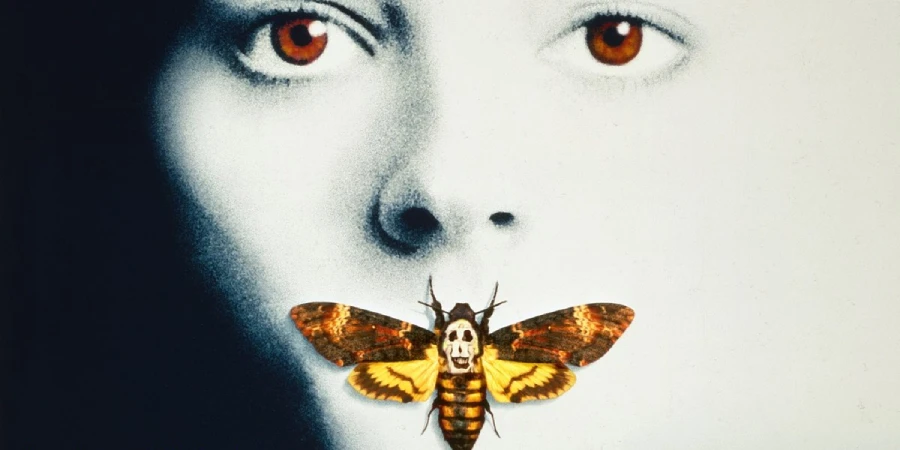
- The poster’s skull: Look closely at the moth on the poster. Its skull marking is made of nude female figures, a nod to the Salvador Dalí and Philippe Halsman photograph In Voluptas Mors.
- The dinner menu: Liver, fava beans, and red wine are all foods that patients on certain older antidepressants (MAOIs) must avoid. Many viewers read the line as a psychiatrist’s inside joke.
- Miss Hester Mofet: Lecter’s clue is an anagram for “the rest of me.” Fittingly, it leads to the rest of his patient.
- Demme’s friends: Producer and director Roger Corman, Demme’s old mentor, plays the FBI Director. In addition, horror legend George A. Romero appears briefly in Memphis, and singer Chris Isaak plays a SWAT commander.
- Lecter’s sketch: In the Memphis cage, one of his drawings shows Clarice cradling a lamb.
- Winged imagery: The strung-up officer resembles a moth with spread wings, which echoes the film’s obsession with transformation.
Trivia
- It was only the third film to win all “Big Five” Oscars, after It Happened One Night (1934) and One Flew Over the Cuckoo’s Nest (1975).
- Hopkins gives one of the shortest performances ever to win Best Actor.
- The production cost roughly $19 million and grossed more than $270 million worldwide.
- It opened in February 1991 and won Best Picture more than a year later. Interestingly, early-year releases rarely survive that long in voters’ minds.
- The American Film Institute named Hannibal Lecter the greatest screen villain in its 2003 list. Moreover, Clarice Starling ranked among its top heroes.
- Hopkins barely blinks when Lecter speaks, which adds to the character’s reptilian calm.
- Later films in the series include Hannibal (2001), Red Dragon (2002), and Hannibal Rising (2007).
Why Watch?
Few thrillers are this smart, this scary, and this humane at once. Foster and Hopkins deliver career-defining work, and Demme never wastes a frame. Watch it for the mind games; you will stay for Clarice. Decades later, it still gets under your skin.
Director’s Other Movies
- Melvin and Howard (1980)
- Stop Making Sense (1984)
- Something Wild (1986)
- Married to the Mob (1988)
- Philadelphia (1993)
- Beloved (1998)
- The Manchurian Candidate (2004)
- Rachel Getting Married (2008)