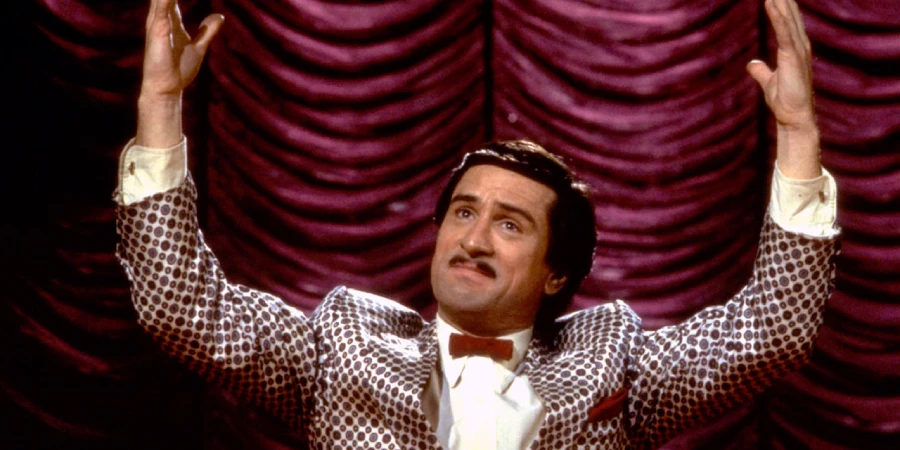

Rupert Pupkin is not a lovable underdog. He is a delusional, obsessive, deeply unsettling man who mistakes fantasy for reality and stalks his way to fame. Martin Scorsese’s The King of Comedy (1982) takes that uncomfortable premise and never lets you laugh without flinching. Robert De Niro delivers one of cinema’s most quietly terrifying performances, and the film remains bracingly relevant in an age of influencer culture and manufactured celebrity.
Detailed Summary
Rupert Pupkin and His Fantasy World
We meet Rupert Pupkin (Robert De Niro), a thirty-something aspiring stand-up comedian living in his mother’s basement in New Jersey. He is a nobody who believes, with absolute certainty, that he is a star. His bedroom is decorated with life-size cardboard cutouts of celebrities, and he conducts elaborate fantasy conversations with them.
In these basement fantasies, Rupert imagines himself as a peer of famous talk show host Jerry Langford. He rehearses monologues, pictures standing ovations, and daydreams about being invited onto Jerry’s show. Scorsese presents these sequences without warning, blurring the line between delusion and reality from the very start.
The Encounter with Jerry Langford
Rupert’s first real contact with Jerry comes when he helps the star escape a crowd of fans outside a television studio. He pushes his way into Jerry’s limousine alongside another obsessive fan, Masha (Sandra Bernhard). Jerry, visibly exhausted by public attention, tolerates them briefly before having his driver remove them.
Rupert, however, interprets this brief encounter as a genuine connection. He becomes fixated on the idea that Jerry will personally launch his career. Meanwhile, Masha develops her own disturbing obsession with Jerry, one that runs on a more volatile and explicitly romantic frequency than Rupert’s professional fixation.
Rupert Pursues Jerry Through Proper Channels
Rupert attempts to get an audition through Jerry’s production company. He visits the offices repeatedly, charming the receptionist and waiting for hours. Each time, he walks away believing he has made progress when, in fact, he has been politely stonewalled.
He brings his reluctant date, Rita (Diahnne Abbott), to a country club, falsely telling her that Jerry invited them. Jerry arrives, is visibly annoyed, and makes clear that Rupert has fabricated the entire relationship. This scene is excruciating to watch because Rupert barely registers the humiliation.
Rupert Goes to Jerry’s Country Home
Undeterred, Rupert shows up uninvited at Jerry’s private country home, bringing Rita along as if this is a perfectly normal social call. Jerry answers the door, stunned. He makes his displeasure clear in no uncertain terms, firmly telling Rupert to leave and never contact him again.
Rita is mortified. Rupert, however, experiences almost no shame. He retreats, regroups, and almost immediately pivots to a new, far more drastic plan. His capacity for self-delusion has no ceiling, and this scene makes that horrifyingly clear.
The Kidnapping Plot
Rupert and Masha team up and kidnap Jerry Langford in broad daylight on the streets of New York. They bundle him into a car and restrain him. Masha takes Jerry to her apartment, where she holds him bound to a chair while Rupert pursues his real goal.
Rupert’s goal is airtime. He records his stand-up monologue on tape and delivers his ransom demands to Jerry’s network: air his routine, or Jerry does not come home. As a result, he actually gets what he wants. The network, under pressure, agrees to broadcast his set.
Rupert’s Moment of Fame
Rupert surrenders to the police after confirming his monologue will air. He watches his own television debut from a holding cell. His stand-up set, which turns out to be genuinely competent and funny, airs to a national audience.
Meanwhile, Masha releases Jerry, but not before attempting a bizarre, unwanted romantic encounter with him. Jerry escapes. Consequently, both perpetrators face legal consequences, but Rupert, crucially, has achieved his dream on his own terms.

Movie Ending
Rupert pleads guilty and serves a short prison sentence, around two and a half years. Far from destroying him, the notoriety turbocharges his public profile. Publishers offer him a book deal, and he writes a memoir about his crime and his obsession with fame.
Upon his release, Rupert steps back into the spotlight. A narrator announces his name in triumphant, reverential tones. He walks onto a stage before a roaring crowd, framed like a conquering hero. Scorsese holds on this image with deliberate, nauseating irony.
Here is the critical question audiences always ask: is this ending real, or is it another of Rupert’s fantasies? Scorsese leaves it genuinely ambiguous. Some viewers read the triumphant finale as one final delusion playing out in Rupert’s head. Others argue that the film’s satirical logic demands we take it at face value, because that makes the point far more disturbing.
Either interpretation works, and that is the film’s masterstroke. If it is real, then crime and obsession genuinely do pay in the media age. If it is fantasy, then Rupert is still sitting in a cell, dreaming. Both possibilities are bleak, and both land with equal force.
Are There Post-Credits Scenes?
The King of Comedy does not include any post-credits scenes. Once the film’s final ironic flourish lands, it simply ends. No additional footage follows the credits.
Type of Movie
The King of Comedy occupies an uneasy, deliberately uncomfortable space between dark comedy and psychological thriller. Scorsese refuses to let it settle into either genre cleanly. You laugh, you cringe, you feel implicated.
In tone, it is one of the coldest films Scorsese ever made. There is no warmth, no catharsis, and no redemption arc. It functions as a sharp, almost clinical satire of celebrity culture and American ambition.
Cast
- Robert De Niro – Rupert Pupkin
- Jerry Lewis – Jerry Langford
- Sandra Bernhard – Masha
- Diahnne Abbott – Rita
- Ed Herlihy – Himself
- Lou Brown – Bandleader
- Shelley Hack – Cathy Long
- Tony Randall – Himself
- Victor Borge – Himself
Film Music and Composer
The King of Comedy takes an unconventional approach to its score. Rather than commissioning a traditional orchestral soundtrack, Scorsese assembled a compilation of existing pop and rock tracks. The musical choices feel deliberately jarring and off-kilter.
Notable tracks include Robbie Robertson’s work alongside pieces from artists including The Pretenders and B.B. King. Robertson, a longtime Scorsese collaborator, served as music supervisor. His fingerprints on the film’s sonic identity are unmistakable.
The music rarely soothes. Instead, it undercuts scenes or amplifies their discomfort, functioning almost as a character in its own right. Scorsese uses the soundtrack to reinforce the film’s off-balance, satirical register.



Filming Locations
Principal photography took place in New York City, anchoring the film’s reality in a recognizable urban landscape. Scorsese shot extensively on actual Manhattan streets, capturing the city’s indifferent, relentless energy.
Rupert’s scenes in New Jersey serve a specific tonal purpose. His suburban basement world feels sealed off and stifling, a cocoon of delusion separated from the glamorous Manhattan he obsesses over. That physical distance mirrors his psychological distance from genuine success.
Shooting on real locations rather than studio sets gives the film a grubby, documentary-like texture. Consequently, when Rupert’s fantasies intrude, they feel even more synthetic and disturbing by contrast.
Awards and Nominations
The King of Comedy received little major awards attention upon its initial release, largely because it performed poorly at the box office and divided critics at the time. Sandra Bernhard, however, earned a Golden Globe nomination for Best Supporting Actress, which stands as one of the film’s few formal recognitions.
Behind the Scenes Insights
- Robert De Niro used method acting to embody Rupert, going so far as to perform stand-up comedy in character at real clubs.
Jerry Lewis deliberately played against his comedic persona, delivering a controlled, subdued performance that made Jerry Langford feel genuinely weary and irritated rather than caricatured. - Scorsese and De Niro have both cited this film as one of their most personal collaborations, precisely because it made audiences deeply uncomfortable without offering a conventional release valve.
- Sandra Bernhard was a relative newcomer to film when she was cast, and her performance as Masha drew immediate attention for its unnerving intensity.
- Initial test screenings reportedly left audiences unsettled and confused, contributing to the film’s rocky theatrical run.
- Scorsese made the film during a period when he was reassessing his own relationship with fame and the entertainment industry, lending the project a sharp personal edge.
Inspirations and References
Screenwriter Paul D. Zimmermann drew inspiration from the culture of celebrity worship that intensified throughout the 1970s in America. He observed the behavior of real fans and autograph seekers and pushed that behavior to its logical, criminal extreme.
Scorsese has cited Federico Fellini’s approach to fantasy and reality as a broader artistic reference point. Notably, the film also echoes the themes of Taxi Driver (1976), another Scorsese and De Niro collaboration centered on a dangerously delusional man navigating a cold, indifferent city.
In addition, the film anticipates later works about the dark side of fame, including Network (1976) and, more recently, Joker (2019), which borrowed heavily from its premise and visual language. Scorsese himself acknowledged that comparison.
Alternate Endings and Deleted Scenes
No widely documented alternate ending exists for The King of Comedy. Scorsese committed to the ambiguous finale as the intended conclusion from an early stage of production.
Some scenes involving Rupert’s interactions with Jerry’s production staff were reportedly trimmed to tighten the film’s pacing. However, no significant deleted scenes have surfaced publicly in any home video release or retrospective.
Book Adaptations and Differences
The King of Comedy is not based on a book. Paul D. Zimmermann wrote an original screenplay specifically for this project. No novelization of the film has been widely released.

Memorable Scenes and Quotes
Key Scenes
- Rupert’s basement fantasy sequences, where he conducts imaginary conversations with cardboard cutouts of Jerry Langford and Liza Minnelli, establish his delusional world immediately and disturbingly.
- Rupert showing up uninvited at Jerry’s country home with Rita in tow, only for Jerry to deliver a cold, humiliating rejection that Rupert absorbs with barely a flinch.
- Masha’s apartment scene, where she holds a bound and gagged Jerry captive, serving him food and attempting to recreate a romantic dinner in one of cinema’s most deeply unsettling sequences.
- Rupert’s actual stand-up performance airing on national television, which forces the audience to confront the fact that he is not entirely without talent, complicating any simple moral judgment.
- The final triumphal sequence, with Rupert walking onto a stage bathed in adulation, leaving viewers to wrestle with whether they just watched reality or the inside of a sick man’s head.
Iconic Quotes
- “Better to be king for a night than schmuck for a lifetime.” – Rupert Pupkin
- “I know, I know, I know, I know.” – Jerry Langford, exhausted and dismissive, capturing every celebrity’s hollow response to fan adulation.
- Rupert’s opening monologue on the show, delivered with startling confidence, in which he jokes about his own mother calling him a moron and his own failed ambitions.
Easter Eggs and Hidden Details
- Several real-life television personalities appear as themselves, grounding the satire in a recognizable media world and making Jerry Langford feel like a composite of actual talk show giants of the era.
- Rupert’s cardboard celebrity cutouts in his basement include figures positioned as if engaged in real conversations, reflecting how completely he has replaced human connection with parasocial fantasy.
- Scorsese shoots Rupert’s fantasy sequences with warmer lighting and softer framing than the cold, flat look of the real-world scenes, providing a visual grammar for distinguishing delusion from reality, though he sometimes deliberately blurs that grammar.
- Jerry Lewis’s casting carries its own meta-layer: he was one of France’s most beloved celebrity figures, making his role as a beleaguered American talk show star a quietly ironic comment on how differently cultures construct and consume fame.
- The film opens with a chaotic crowd scene outside a studio, immediately placing the audience in the middle of fan obsession rather than observing it from a safe distance.
Trivia
- Critics initially gave the film a mixed reception, but over subsequent decades it gained recognition as one of the most prescient American films about celebrity culture ever made.
- De Niro and Scorsese considered this one of their most challenging collaborations, partly because the film offered audiences no comfortable emotional release point.
- Todd Phillips has publicly acknowledged that Joker (2019) drew directly from The King of Comedy, specifically its premise of a failed, delusional comedian who turns to crime as a path to fame.
- Jerry Lewis reportedly found the role draining because it required him to suppress his natural comedic instincts almost entirely throughout production.
- The film’s box office performance was disappointing on release, which surprised many given the star power of De Niro and the critical reputation of Scorsese at the time.
- Sandra Bernhard’s performance launched her wider career in film and television, demonstrating a range that audiences and casting directors had not previously seen from her.
Why Watch?
The King of Comedy is one of the few films that genuinely gets more relevant with every passing year. It predicted influencer culture, parasocial obsession, and the media’s appetite for notoriety decades before social media made those phenomena universal. De Niro’s performance is a masterclass in discomfort, and Scorsese’s cold, precise direction never lets you look away. This film will haunt you long after the credits roll.
Director’s Other Movies
- Who’s That Knocking at My Door (1967)
- Mean Streets (1973)
- Alice Doesn’t Live Here Anymore (1974)
- Taxi Driver (1976)
- New York, New York (1977)
- Raging Bull (1980)
- After Hours (1985)
- The Color of Money (1986)
- The Last Temptation of Christ (1988)
- Goodfellas (1990)
- Cape Fear (1991)
- The Age of Innocence (1993)
- Casino (1995)
- Bringing Out the Dead (1999)
- Gangs of New York (2002)
- The Wolf of Wall Street (2013)
- Silence (2016)