
Some legends never truly fade; they just set down their cue stick for a while. For “Fast” Eddie Felson, that retirement is a gilded cage of liquor sales and comfortable mediocrity. Martin Scorsese’s The Color of Money masterfully chronicles the electrifying and messy return of a master to the game he thought he left behind.
Detailed Summary
Finding Vincent
Twenty-five years after the events of The Hustler, an older “Fast” Eddie Felson (Paul Newman) is a successful but bored liquor salesman. He still stakes other players, but his own fire is long gone. Consequently, his life lacks the edge he once thrived on.
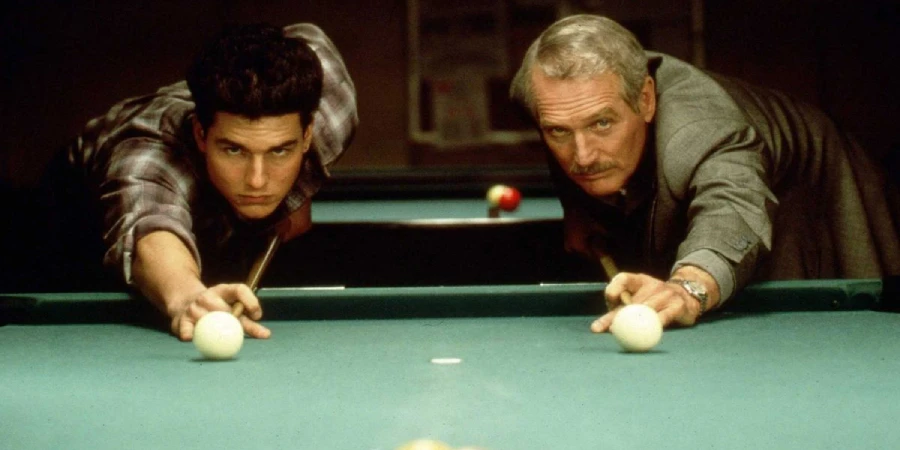
Everything changes when he spots Vincent Lauria (Tom Cruise), a young, wildly talented, and arrogant pool player. Vincent plays with a flashy, hyper-aggressive style, accompanied by his shrewd girlfriend and manager, Carmen (Mary Elizabeth Mastrantonio). In Vincent, Eddie sees a flicker of his own past and a massive, untapped financial opportunity.
The Stakehorse Relationship
Eddie convinces Vincent and Carmen to let him take them on the road. His plan is to stake them, teach Vincent the art of the hustle, and prepare him for a high-stakes 9-Ball tournament in Atlantic City. Eddie’s lessons, however, are not just about trick shots.
He tries to teach Vincent about psychology, patience, and the importance of losing when you need to. Vincent, on the other hand, is a pure showman who cannot stand to lose or even pretend to. This fundamental conflict creates immediate and constant tension between mentor and student.
The Road Trip Hustle
Their journey through America’s smoky pool halls is a series of successes and failures. Vincent wins games he should be throwing, scaring off bigger money. In one key moment, a fed-up Eddie decides to teach Vincent a lesson by hustling him personally, but is instead humiliated by a much smaller-time hustler named Amos (Forest Whitaker).
This defeat deeply shakes Eddie, making him question his own abilities and relevance. Meanwhile, Vincent and Carmen begin to operate more on their own, growing tired of Eddie’s old-school methods. Their partnership becomes increasingly frayed with every stop they make.
The Atlantic City Breakup
The breaking point arrives just before the Atlantic City tournament. After a particularly frustrating stretch where Vincent’s ego costs them a huge score, Eddie confronts him. He realizes Vincent is unteachable and that being his manager is killing his own soul.
Disgusted and feeling his own competitive spirit reawakening, Eddie leaves Vincent and Carmen. He tells them he is done. He then checks into a hotel, buys a new, expensive Balabushka cue stick, and begins to practice relentlessly, getting himself back into playing shape.
Eddie’s Comeback
Eddie enters the Atlantic City tournament himself. Clean, focused, and playing with the wisdom of age, he cuts a path through the competition. He plays smart, disciplined pool, a stark contrast to Vincent’s flashy, erratic style.
He eventually faces and defeats Vincent in a heated quarter-final match. Eddie feels vindicated and reborn. However, his triumph is short-lived, setting the stage for the film’s final, crucial confrontation.
Movie Ending
After defeating Vincent in the tournament, Eddie is handed an envelope. It contains his share of a large sum of money. A confused Eddie later confronts Vincent, who casually admits he threw their match because he could not bear to beat his teacher.
Vincent explains he bet against himself and made a fortune, thinking he was doing Eddie a favor and showing him what he had learned about hustling. This revelation crushes Eddie. For him, the victory had to be real; the money was secondary. It proved that Vincent still did not understand the most important lesson: respect for the game and for oneself. Winning dirty was not winning at all.
Disgusted, Eddie forfeits his next match, withdraws from the tournament, and finds Vincent. He throws the “dirty” money back and challenges him to a real game, for ten thousand dollars, right then and there. As Vincent grins and prepares to break, Eddie chalks his cue and says with a steely confidence, “I’m back.” The film ends here, with Eddie having reclaimed his identity not as a hustler or a winner, but as a player who respects the art of the game above all else.
Are There Post-Credits Scenes?
No, there are no post-credits scenes or mid-credits scenes in The Color of Money. Once the credits begin to roll, the story is complete.
Type of Movie
The Color of Money is a sports drama and a profound character study. It functions as a sequel but stands entirely on its own as a story about mentorship, aging, and redemption. The film’s tone is gritty and realistic, capturing the smoky, nocturnal world of professional pool with an energetic, almost kinetic style typical of director Martin Scorsese.
Cast
- Paul Newman – Eddie Felson
- Tom Cruise – Vincent Lauria
- Mary Elizabeth Mastrantonio – Carmen
- Helen Shaver – Janelle
- John Turturro – Julian
- Forest Whitaker – Amos
Film Music and Composer
The film’s score was curated and composed by Robbie Robertson, guitarist and primary songwriter for The Band. Instead of a traditional orchestral score, Robertson built a soundtrack that mirrors the film’s atmosphere. He combined original blues-inflected compositions with existing rock and blues tracks.
Notably, the film features Eric Clapton’s hit song “It’s in the Way That You Use It,” which was written specifically for the movie. Other key tracks include Don Henley’s “Who Owns This Place?” and Warren Zevon’s “Werewolves of London,” used memorably during one of Vincent’s showboating victories.


Filming Locations
The Color of Money was primarily filmed on location in Chicago, Illinois, and Atlantic City, New Jersey. This choice was deliberate and impactful. Chicago’s numerous old-school, dimly lit pool halls provided the perfect authentic, gritty backdrop for Eddie and Vincent’s road trip.
In contrast, Atlantic City represents a different world. Its flashy casinos and grand tournament halls symbolize the transition from the street-level hustle to the corporate, high-stakes world of professional gambling. The two locations effectively mirror the two phases of Eddie’s journey.
Awards and Nominations
The film’s most significant achievement was Paul Newman winning the Academy Award for Best Actor. It was his first and only competitive Oscar win after seven prior acting nominations. For many, it was seen as a long-overdue honor, rewarding not just this performance but his entire legendary career.
In addition, Mary Elizabeth Mastrantonio received an Academy Award nomination for Best Supporting Actress. The film also earned nominations for Best Adapted Screenplay and Best Art Direction.
Behind the Scenes Insights
- Director Martin Scorsese used a custom-built camera rig, sometimes called a “SnorriCam,” to create the dynamic shots that seem to travel with the pool balls across the table.
- Paul Newman performed many of his own complex pool shots for the film. He trained extensively with professional player Michael Sigel to make his portrayal of a master player authentic.
- Tom Cruise also did his own stunt pool playing. His high-energy practice sessions often mirrored his character’s personality on screen.
- Scorsese was initially reluctant to direct a sequel, but he was drawn to the story of an aging character confronting his past and reigniting his passion.
Inspirations and References
The Color of Money is based on the 1984 novel of the same name by author Walter Tevis. This novel was Tevis’s own sequel to his 1959 book, The Hustler, which was adapted into the classic 1961 film starring Paul Newman. The film serves as a direct sequel to the 1961 movie, continuing Eddie Felson’s story.
Alternate Endings and Deleted Scenes
There are no known officially released alternate endings or significant deleted scenes for The Color of Money. Martin Scorsese’s final cut is the definitive version of the film. The story he and screenwriter Richard Price crafted concludes exactly as intended, with Eddie’s decisive “I’m back.”
Book Adaptations and Differences
While the film is based on Walter Tevis’s novel, it deviates from the book’s plot significantly, especially in its second half and conclusion. The movie was written by Richard Price, who crafted a new narrative trajectory for Eddie Felson. Notably, the movie’s ending is entirely different from the source material.
In the novel, Eddie’s journey culminates in a showdown with his old rival, Minnesota Fats, which the film completely omits. The movie instead focuses on the psychological rivalry between Eddie and his protégé, Vincent, making their relationship the story’s core. The film’s optimistic, character-driven ending is a stark contrast to the book’s more somber conclusion.


Memorable Scenes and Quotes
Key Scenes
- The Opening Shot: An elaborate, single-take tracking shot through a bar, landing on Eddie Felson as he sells liquor, perfectly establishing his new life.
- “Werewolves of London”: Vincent clears a table in a display of pure, arrogant showmanship while the iconic song blares, infuriating Eddie but dazzling the crowd.
- Amos’s Hustle: A humiliating turning point where Eddie, trying to teach Vincent a lesson, is himself thoroughly beaten by a seemingly harmless player.
- “I’m Back”: The final scene where Eddie confronts Vincent, ready to play a pure game, having reclaimed his honor and identity.
Iconic Quotes
- “Money won is twice as sweet as money earned.” – Eddie Felson
- “You gotta have brains and you gotta have balls. And you have too much of one and not enough of the other.” – Eddie to Vincent
- “It’s like a religion. You know, you do it right… you can be forgiven. Nobody can beat ya.” – Vincent Lauria
- “For a guy who’s a student of human moves, you really don’t know a thing about me, do you?” – Carmen to Eddie
- “I’m back.” – Eddie Felson
Easter Eggs and Hidden Details
- The Cue Case: The fancy Balabushka cue case a player carries is a subtle status symbol in the world of pool. Eddie buying one for himself signals his serious return to the game.
- Julian’s Character: John Turturro’s character, Julian, who taunts Vincent in the tournament, is a throwback to the kind of small-time, antagonizing hustler a younger Eddie Felson might have been.
- The Color Green: Director Martin Scorsese uses the color green throughout the film—the green of the pool table felt, the green of US currency—to visually link the game with its financial stakes.
Trivia
- Paul Newman won his Oscar for this film 25 years after first being nominated for playing the same character in The Hustler (1961).
- Martin Scorsese is the uncredited voice of the director providing narration on the VCR tape that Janelle shows Eddie early in the film.
- The film’s title, The Color of Money, is a direct quote from the original 1961 film, The Hustler.
- This was one of the first films to receive a “No-Smoking” clause in its contracts, an ironic detail given the smoky atmosphere of the pool halls depicted.
Why Watch?
See a master craftsman return to a career-defining role. The electrifying dynamic between grizzled veteran Paul Newman and explosive upstart Tom Cruise, guided by Martin Scorsese’s kinetic direction, makes this a must-see character study about relevance, pride, and passion.