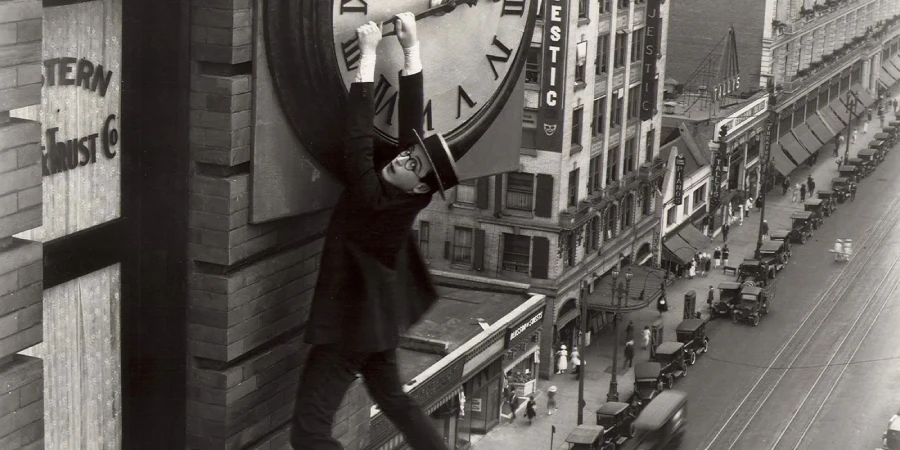

A man dangles from a clock face hundreds of feet above Los Angeles, and the whole world holds its breath. Safety Last! (1923) built that image into one of cinema’s most recognizable frames, yet most people have never seen the full film that earns it. Harold Lloyd delivers a masterclass in physical comedy and genuine danger, crafting a story that is equal parts love letter, con job, and white-knuckle thrill ride.
Detailed Summary
Harold Heads to the Big City
Harold (played by Harold Lloyd himself) leaves his small hometown and his devoted girlfriend, Mildred, with a promise: he will make his fortune in the city and send for her soon. He projects total confidence as he boards the train, waving goodbye like a man who already owns the place.
However, the reality waiting for him in Los Angeles is far less glamorous. Harold shares a cramped boarding house room with his friend Bill (Bill Strother) and scrapes by on a meager salary at a department store called De Vore’s.
Playing the Big Shot
Harold writes letters home that dramatically exaggerate his success. He implies he holds a high executive position, sending Mildred gifts he can barely afford while dodging his own landlady over unpaid rent.
Mildred, eager to see him, announces she is coming to the city. Harold panics and scrambles to stage an elaborate deception, borrowing the boss’s office and acting the part of a powerful department store executive for her visit.
Meanwhile, Bill has his own problems. A police officer named Stubby has a personal grudge against Bill and spends much of the film pursuing him with single-minded, comedic relentlessness.
The Big Idea
Harold overhears that the store’s general manager is desperate for a publicity stunt to draw crowds. Sensing an opportunity, Harold pitches an idea: pay someone one thousand dollars to climb the outside of the building in full public view.
Harold plans to pocket the money by having Bill do the climbing, since Bill is an accomplished human fly. In exchange, Harold promises Bill half the fee. It sounds simple enough, which is always a warning sign in a Harold Lloyd picture.
Everything Goes Wrong on Climb Day
On the day of the stunt, Officer Stubby spots Bill near the base of the building. Bill, desperate to escape, begs Harold to start the climb himself and promises to take over at the second floor once the coast is clear.
Harold reluctantly agrees. He begins scaling the building’s exterior in front of a massive crowd. Consequently, every time Harold reaches a new floor and looks for Bill to swap in, something keeps Stubby right on Bill’s heels, forcing Harold to keep going.
Floor by floor, Harold climbs higher, and the obstacles multiply. A dog on a ledge, a wire net, a flock of pigeons, a man with a mouse phobia, a weathervane, and a clock face all conspire to make his ascent a spectacular, terrifying ordeal.
The Clock Face and the Peak
Harold’s grip on the clock hands is the sequence audiences remember most. He swings out over the street, hanging by his fingers with the city sprawling dizzyingly below him. It is the film’s visual and emotional peak, a single image that concentrates everything the story has been building.
Furthermore, each obstacle on the way up feels earned rather than random. Lloyd and directors Fred Newmeyer and Sam Taylor structured the climb so that tension escalates logically, with each new floor raising the stakes before the previous scare has fully dissolved.
Movie Ending
Harold reaches the roof. He hauls himself over the edge and stands at the top of the building, battered, disheveled, and triumphant. Mildred is waiting for him up there, having made her way to the rooftop during the chaos below.
She rushes to embrace him, and the film closes on their reunion. Harold has, in the most literal sense possible, climbed his way to the top for her. The ending works because it pays off both the romantic thread and the physical ordeal simultaneously, giving audiences relief and warmth in the same breath.
Notably, the film does not punish Harold for his many deceptions. His plan was reckless and built on lies, yet the sheer effort and courage he displayed during the climb function as a kind of redemption. Mildred never seems to mind the full truth of how the day unfolded.
In addition, the manager is delighted. Harold’s stunt drew exactly the massive crowd the store wanted, so Harold’s professional future at De Vore’s looks considerably brighter than when he started the day. The ending is sunny and uncomplicated in a way that feels genuinely satisfying rather than naively optimistic.
Are There Post-Credits Scenes?
Safety Last! is a silent film from 1923. Post-credits scenes as a concept did not exist in this era of filmmaking. There is nothing after the final title card.
Type of Movie
Safety Last! falls firmly into silent comedy and physical comedy genres, with a strong thread of romantic comedy running through the entire story. Its tone balances genuine warmth with escalating, almost vertiginous suspense.
In contrast to many comedies of its era, the film generates real anxiety during its climax. It occupies a fascinating space where laughs and genuine tension coexist without either undercutting the other.
Cast
- Harold Lloyd – Harold “The Boy”
- Mildred Davis – Mildred, “The Girl”
- Bill Strother – Bill, “The Pal”
- Noah Young – Officer Stubby, “The Law”
- Westcott Clarke – The Store General Manager
Film Music and Composer
As a silent film, Safety Last! was originally accompanied by live music performed in theaters, with individual venues often choosing their own arrangements. No single definitive original score accompanied every screening during its initial release.
However, modern restorations have featured newly composed scores. Carl Davis composed a well-regarded orchestral score for later restoration versions, and his work has become closely associated with how contemporary audiences experience the film. Davis is a prolific composer of silent film accompaniments, with credits spanning dozens of classic restorations.

Filming Locations
Production took place primarily in Los Angeles, California. The famous building-climb sequence used real Los Angeles rooftops, with cameras positioned to maximize the appearance of height while keeping Lloyd relatively close to safety nets positioned just out of frame.
Shooting on actual urban rooftops rather than on a studio lot gave the footage an unmistakable authenticity. Real streets, real crowds, and real sky all contributed to the vertigo audiences felt watching Harold dangle above the city.
Moreover, the genuine Los Angeles architecture of the early 1920s gives the film a rich documentary texture alongside its comedy. It captures a specific moment in the city’s urban history that no set could have replicated convincingly.
Awards and Nominations
Safety Last! predates the Academy Awards, which began in 1929, and did not receive formal awards recognition during its initial release. Over time, however, it earned a place on the National Film Registry at the Library of Congress, where it was selected for preservation as a culturally, historically, and aesthetically significant work.
Behind the Scenes Insights
- Harold Lloyd performed many of his own stunts, though safety nets and camera angles worked together to make heights appear greater than they sometimes were.
- Lloyd had previously lost the thumb and forefinger of his right hand in a 1919 accident involving a prop bomb. He wore a prosthetic glove during filming, meaning he completed these physically demanding sequences with a significant disability.
- Bill Strother, who played Bill the human fly, was an actual professional building climber whom Lloyd and his team discovered performing real climbs to promote businesses in Los Angeles.
- Directors Fred Newmeyer and Sam Taylor co-directed the film, a common collaborative arrangement in Lloyd’s productions of this period.
- The production team used a combination of forced perspective, camera placement, and strategically positioned safety platforms to stage the climb sequences safely while preserving the illusion of extreme danger.
- Mildred Davis, who played Harold’s love interest on screen, was Harold Lloyd’s real-life romantic partner. They married shortly after the film’s release.
Inspirations and References
Lloyd and his team drew inspiration from real-life human flies, professional daredevils who climbed the exteriors of tall buildings as a form of public spectacle and advertising in early twentieth-century American cities. Bill Strother himself was one such performer.
In addition, the film taps into a broader cultural anxiety and fascination with urban modernity and vertical ambition. Skyscrapers were reshaping American cities, and the idea of an ordinary man scaling one resonated with audiences navigating rapid social and economic change.
The story’s romantic deception plot owes something to theatrical farce traditions, where a young man must maintain an impossible pretense before his beloved and the world eventually catches up with him.
Alternate Endings and Deleted Scenes
No well-documented alternate endings or significant deleted scenes for Safety Last! have entered the public record. Silent film production of this era rarely generated the kind of archival paper trail that later Hollywood productions left behind.
Some scenes in early prints vary slightly in length due to different theatrical cutting practices, but no major alternative narrative version of the film is known to exist.
Book Adaptations and Differences
Safety Last! is not based on a book or any pre-existing literary source. The story originated as an original screenplay developed specifically for Harold Lloyd and his production company.

Memorable Scenes and Quotes
Key Scenes
- The clock face sequence: Harold grips the hands of a large exterior clock as his body swings out over the street far below, creating the film’s defining image.
- Harold impersonating a store executive: Borrowing the boss’s office and staging an elaborate performance for Mildred, Harold juggles interruptions and near-disasters with frenetic, escalating desperation.
- Bill constantly intercepted by Officer Stubby: Every time Harold reaches a new floor and waits for his rescue, a perfectly timed cutaway reveals Bill being chased away by Stubby yet again, each interception more absurd than the last.
- The opening gallows gag: Harold appears to stand before a gallows in an emotional farewell scene, only for the camera to pull back and reveal it is simply a train platform railing; a confident piece of misdirection that sets the film’s playful tone immediately.
- The mouse sequence: A man on one of the upper floors panics at the sight of a mouse, creating chaos that Harold must navigate mid-climb without losing his grip or his nerve.
Iconic Quotes
- “I’ll be a big man in the city before I send for you.” (Harold’s intertitle promise to Mildred as he departs, establishing the film’s central dramatic irony.)
- “Go on up, Bill will be right behind you.” (The fateful promise that sets the climb in motion and proves spectacularly, hilariously wrong.)
Easter Eggs and Hidden Details
- Lloyd’s prosthetic right hand is worn throughout the climbing sequences, yet the camera work makes it virtually impossible to detect. Knowing this detail reframes every close-up of his hands during the climb.
- Several of the crowd members watching the climb from the street below are genuine passersby rather than paid extras, giving their reactions an authentic quality that staged crowd scenes rarely achieve.
- Bill Strother performs several of the earlier, lower-level climbing shots himself, and sharp-eyed viewers can spot the shift between Strother and Lloyd at certain points in the sequence.
- A safety net is visible in at least one shot if viewers look carefully just below the frame’s lower edge during one of the more extreme height illusions.
- Harold’s character is identified in intertitles simply as “The Boy,” a recurring Lloyd character type across multiple films, linking this story to a broader universe of Lloyd protagonists.
Trivia
- Safety Last! was a major commercial success upon release, cementing Harold Lloyd as one of the top box office draws of the silent era alongside Charlie Chaplin and Buster Keaton.
- Harold Lloyd reportedly earned more money than either Chaplin or Keaton during the 1920s, making him arguably the most commercially successful comedian of his generation.
- Lloyd retained ownership of most of his films for decades, controlling how and when they were re-released; as a result, his work was less visible to later generations than Chaplin’s or Keaton’s for many years.
- The image of Harold hanging from the clock face has appeared in countless homages, parodies, and references in subsequent decades of film and television.
- Mildred Davis retired from acting after marrying Harold Lloyd in 1923, the same year Safety Last! was released.
- Bill Strother, the real human fly, performs his climbing skills on camera, meaning the film contains genuine documentary footage of an actual professional daredevil at work.
- Lloyd wore his famous round glasses throughout his films as a defining character accessory; interestingly, the glasses had no corrective lenses.
Why Watch?
Safety Last! remains a pure, exhilarating experience that needs no historical context or silent film patience to appreciate. Its climax generates visceral, physical tension that modern blockbusters with unlimited budgets frequently fail to match. Harold Lloyd’s combination of charm, physical courage, and genuine comic timing makes every minute feel earned.
Director’s Other Movies
- Dr. Jack (1922)
- Girl Shy (1924)
- Hot Water (1924)
- The Freshman (1925)
- For Heaven’s Sake (1926)
Recommended Films for Fans
- The General (1926)
- The Kid (1921)
- Sherlock Jr. (1924)
- Modern Times (1936)
- City Lights (1931)
- The Navigator (1924)
- Speedy (1928)
- One Week (1920)