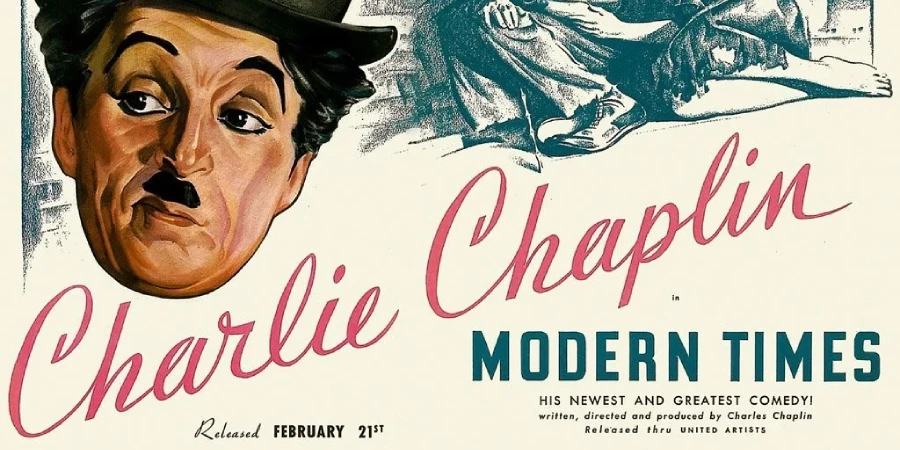

Charlie Chaplin made a film that feels less like entertainment and more like a diagnosis. Modern Times (1936) captures the soul-crushing grind of industrial capitalism with a gag about a man eating a machine. It remains one of cinema’s great contradictions: a nearly silent film released nearly a decade after sound took over Hollywood, and one of the funniest movies ever made about suffering. Chaplin was not joking around.
Detailed Summary
The Factory Floor and the First Breakdown
Chaplin’s Tramp opens the film on an assembly line, tightening bolts in a relentless, mechanical rhythm. His only job is to turn two bolts on every piece that passes him, over and over, faster and faster. When the line speeds up, the Tramp cannot keep pace, and he begins to malfunction himself, twitching and spasming as though his body has absorbed the machine’s logic.
His boss watches from a surveillance screen, barking orders at workers through a monitor. This detail is remarkable: Chaplin essentially depicted workplace surveillance technology in 1936 with chilling accuracy. When the Tramp accidentally gets pulled into the machine’s gears, the image becomes one of cinema’s most iconic visual metaphors.
A feeding machine is tested on the Tramp during his lunch break, designed to eliminate downtime by feeding workers while they continue working. It malfunctions spectacularly, slapping him with a rotating corn cob and soaking him with soup. Consequently, the experiment is abandoned, and the Tramp goes back to the line.
Eventually, the Tramp suffers a full nervous breakdown, dancing through the factory in a manic frenzy, tightening anything that resembles a bolt, including a woman’s buttons and a supervisor’s nose. He causes total chaos and gets sent to a psychiatric hospital. His fragile mental state frames the entire film as a story about a man destroyed and rebuilt by economic forces beyond his control.
Release, Arrest, and an Accidental Revolution
After his release from the hospital, the Tramp wanders into trouble almost immediately. He picks up a red warning flag that fell off a lumber truck and waves it to signal the driver. Meanwhile, a Communist protest march rounds the corner behind him, and the police assume he is their leader.
He gets arrested as a Communist agitator, which is one of the film’s sharpest political jokes. Inside jail, he accidentally ingests cocaine hidden in a salt shaker and foils a prison break while happily high, earning the warden’s admiration. As a result, he gets special treatment inside, making prison ironically more comfortable than freedom.
The Gamin Enters the Story
Paulette Goddard plays the Gamin, a young woman surviving on the street after her father gets shot during a worker’s uprising. She steals bananas for her younger sisters and dodges the authorities with fierce, resourceful energy. Goddard lights up every scene she enters, giving the film its emotional engine.
After the Tramp gets released from prison again, he and the Gamin cross paths and quickly become partners in survival. She dreams of a home and a stable life, while he keeps stumbling into disaster. Their chemistry transforms what could be a bleak social critique into something genuinely warm.
Jobs, Chaos, and the Department Store
The Tramp cycles through a series of jobs, each ending in catastrophe. He works at a shipyard, accidentally launching a ship before it is ready. He gets a job as a night watchman at a department store, where he and the Gamin sneak in for a night of pretend luxury, eating food from the store and roller-skating through the darkened aisles.
The department store sequence has a dreamlike, almost magical quality. For one night, these two people with nothing get to pretend they have everything. However, it ends with the Tramp encountering a gang of burglars, one of whom turns out to be a former coworker, making arrest and chaos inevitable.
The Dream Cottage and the Café
In one of the film’s most tender sequences, the Tramp and the Gamin imagine themselves in a perfect suburban home, with food appearing from nowhere and a cow supplying milk at the door. Reality, predictably, delivers a ramshackle shack that collapses around them. Still, they hold onto the dream.
The Tramp lands a job at a café where the Gamin performs as a dancer. He gets hired as a singing waiter, which creates the film’s most celebrated sound moment. His character cannot remember the lyrics, so he writes them on his cuff, promptly loses the cuff, and improvises a nonsense song in a fake Italian-French hybrid language. It is the only time in the film audiences hear Chaplin’s voice, and he chose to make it deliberately unintelligible.
Movie Ending
Authorities show up at the café to take the Gamin away, since she is still a ward of the state. The Tramp and the Gamin flee together into the open road. There is no last-minute rescue, no sudden change in fortune, and no material resolution to any of their problems.
What makes the ending powerful is what happens in those final seconds. The Gamin sits on the roadside looking broken and defeated, and she asks whether things will ever get better. The Tramp mimes “smile,” and they walk forward together toward the horizon, side by side, into an uncertain future.
Chaplin deliberately withheld the fairy-tale resolution that audiences might have expected. Moreover, this ending marked the last time he played the Tramp on film, giving the walk into the horizon a genuinely elegiac weight. These two people do not win; they simply refuse to stop moving, and that refusal is the film’s entire argument.
For audiences wondering whether they end up together or find stability, the honest answer is that Modern Times does not offer that comfort. It offers something harder and more valuable: the idea that dignity and companionship matter more than success, and that surviving with someone you love is its own kind of victory.
Are There Post-Credits Scenes?
No, Modern Times contains no post-credits scenes. Films of this era did not follow that convention. Once the Tramp and the Gamin walk into the horizon, the film is over.
Type of Movie
Modern Times fits within silent comedy and social satire, though it technically includes some synchronized sound effects, music, and that one vocal performance. Its tone balances slapstick physical comedy with genuinely pointed political commentary. In contrast to pure escapist entertainment, it asks uncomfortable questions while keeping audiences laughing.
The film also carries strong elements of romantic drama in its second half. It is, ultimately, a love story told through pratfalls and poverty. Chaplin works in a register that very few filmmakers have ever matched: comedy that aches.
Cast
- Charlie Chaplin – The Tramp
- Paulette Goddard – The Gamin
- Henry Bergman – Café Owner
- Tiny Sandford – Big Bill, the factory worker
- Chester Conklin – The mechanic
- Hank Mann – Burglar
- Stanley Blystone – Gamin’s father
- Allan Garcia – The factory president
Film Music and Composer
Charlie Chaplin composed the entire score for Modern Times himself, which is remarkable on its own terms. He worked with musical arranger David Raksin to orchestrate his compositions, and the collaboration was reportedly tense. Chaplin had strong instincts about his music but limited formal training, which created friction in the studio.
The most famous piece from the score is “Smile,” a melody Chaplin wrote for the film’s emotional climax. Decades later, lyrics were added and the song became a standard, most famously recorded by Nat King Cole. Notably, the score functions almost as a separate narrator, shaping the audience’s emotional response to each scene with extraordinary precision.
Chaplin’s approach to sound in the film was deliberate and political. He used synchronized music and sound effects while refusing to include dialogue, keeping the Tramp in a pre-verbal, universal space. Furthermore, this choice let him distribute the film internationally without the barriers of language.



Filming Locations
Principal photography took place on Chaplin’s own studio in Hollywood, California, at 1416 North La Brea Avenue. Chaplin built elaborate factory sets there, giving him complete creative control over every mechanical detail on screen. The factory sequences owe much of their visual power to the precision of those custom-built sets.
Some exterior scenes used real Los Angeles locations to ground the film in recognizable urban poverty. The contrast between those real streets and the stylized studio sets reinforces the film’s tension between fantasy and harsh reality. Chaplin understood that location could carry meaning without a single word of dialogue.
Awards and Nominations
Modern Times received no major competitive awards at the time of its release, which reflects the industry’s complicated relationship with Chaplin’s refusal to make a full sound film. However, the film has since received enormous retrospective recognition, including a spot on virtually every major “greatest films” list ever compiled.
In 1989, the United States Library of Congress selected Modern Times for preservation in the National Film Registry, citing it as “culturally, historically, or aesthetically significant.”
Behind the Scenes Insights
- Chaplin spent roughly three years developing and shooting Modern Times, starting production around 1934.
- His collaborator and co-star Paulette Goddard was his romantic partner in real life during production, which many historians believe deepened the authenticity of their on-screen chemistry.
- Chaplin originally considered giving the Tramp full dialogue but ultimately decided against it, reportedly because he felt the character would lose his universal appeal the moment he spoke a specific language.
- David Raksin, who orchestrated Chaplin’s score, later went on to compose the famous theme for Laura (1944).
- The massive gear sequences required precisely engineered prop machinery built specifically for the film, representing a significant portion of the production budget.
- Chaplin both wrote, directed, produced, and scored the film, making it one of the most complete one-person creative achievements in Hollywood history.
- The film faced political controversy in several countries due to its perceived sympathy for workers and its depiction of Communist marches, even though Chaplin framed the politics through comedy rather than ideology.
Inspirations and References
Chaplin cited his own observations of Detroit’s Ford assembly lines as a primary inspiration for the factory sequences. He reportedly visited an automobile plant and was disturbed by the repetitive, dehumanizing work he witnessed. That firsthand experience gave the opening sequences their specificity and their horror.
The broader economic context of the Great Depression shaped nearly every decision in the film. Chaplin wanted to make something that spoke directly to the millions of unemployed and dispossessed Americans living through the 1930s. In addition, the film draws on earlier traditions of literary social criticism, echoing writers like Charles Dickens in its portrait of industrialism crushing ordinary human beings.
Some scholars have noted parallels with Aldous Huxley’s Brave New World, particularly in the surveillance technology and the feeding machine sequence. Whether Chaplin read the novel directly is unclear, but the cultural anxieties both works address clearly ran deep in that decade.
Alternate Endings and Deleted Scenes
Chaplin reportedly shot and discarded several alternative conclusions for the film. One version apparently had the Tramp and the Gamin settling into more conventional domestic stability. He abandoned this version, feeling it undercut the film’s honest appraisal of their circumstances.
Various scenes were trimmed during editing to maintain pacing, particularly in the factory sequences, which Chaplin reportedly shot with far more material than he used. No fully reconstructed “director’s cut” with substantial deleted footage has been officially released. The version audiences see today reflects Chaplin’s final intentions fairly closely.
Book Adaptations and Differences
Modern Times is not based on any book, novel, or pre-existing literary work. Chaplin wrote the original screenplay himself, drawing on personal observation and social commentary rather than adapting a source text. For that reason, no book-to-film comparison applies here.


Memorable Scenes and Quotes
Key Scenes
- The Tramp getting pulled into the factory’s giant gears and passing through the machine like a piece of raw material
- The automatic feeding machine sequence, in which a rotating corn cob and a malfunctioning soup dispenser turn lunch into assault
- The Tramp roller-skating blindfolded near the edge of a department store balcony, obliviously gliding past a fatal drop
- The Tramp accidentally leading a Communist march after picking up a red flag from the street
- The Tramp and the Gamin imagining their perfect dream cottage, complete with a doorstep cow
- The gibberish song at the café, where Chaplin finally lets audiences hear his voice while saying absolutely nothing intelligible
- The final walk into the horizon, with the Gamin and the Tramp heading toward an uncertain but shared future
Iconic Quotes
- “Smile, though your heart is aching” (the melody; the emotional thesis of the entire film, built into the score rather than spoken)
- The gibberish song lyrics, which Chaplin performed in an invented language, defy direct quotation but remain one of cinema’s most celebrated vocal moments
- The intertitle card at the film’s opening: “Modern Times: A story of industry, of individual enterprise, humanity crusading in the pursuit of happiness.”
Easter Eggs and Hidden Details
- The surveillance screen showing the factory boss watching workers predates widespread discussion of workplace monitoring technology by decades, functioning almost as a prophetic detail.
- The sheep shown at the film’s opening, herded into a pen, immediately cut to workers flooding out of a subway station: Chaplin makes the comparison explicit and does not wait for the audience to catch up.
- The cocaine hidden in the salt shaker is presented entirely through visual comedy, with no intertitle explanation, trusting audiences to read the escalating behavior.
- The Tramp’s jail cell is decorated more comfortably than any living space he occupies as a free man, a pointed visual joke about the inversion of liberty and security under capitalism.
- During the department store roller-skating scene, the drop beyond the railing is visible in the background but never called attention to verbally, letting attentive viewers feel the danger the Tramp cannot see.
- Chaplin frames the factory president as a man who sits alone reading comics and doing puzzles while workers suffer on the floor below, a character detail delivered entirely without dialogue.
Trivia
- Modern Times was the last film in which Chaplin appeared as the Tramp, his most beloved character.
- Chaplin began production while the world was in the depths of the Great Depression and released the film as conditions were slowly improving, giving it both urgency and retrospective weight.
- The film’s score has been re-recorded and re-released multiple times; Chaplin himself supervised a re-release version in 1954 with a remixed soundtrack.
- Paulette Goddard’s exact marital status with Chaplin was famously ambiguous during production, which caused controversy at the time.
- Despite being a nearly silent film released in 1936, Modern Times was a commercial success, proving audiences still responded to Chaplin’s physical comedy even in the sound era.
- The film’s working title during production was reportedly The Masses, which makes its political intent even more explicit than the final title suggests.
- Chaplin financed the entire production himself through his own studio, giving him complete independence from major studio interference.
Why Watch?
Modern Times remains essential viewing because it proves that physical comedy and serious ideas do not just coexist, they strengthen each other. Chaplin builds a genuine argument about labor, poverty, and human dignity entirely through movement, timing, and music. Moreover, the film’s critique of industrial capitalism has only grown more relevant with time, not less. Watching it in the present moment feels less like history and more like a mirror.
Director’s Other Movies
- The Kid (1921)
- The Gold Rush (1925)
- The Circus (1928)
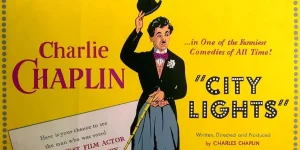
- City Lights (1931)
- The Great Dictator (1940)
- Monsieur Verdoux (1947)
- Limelight (1952)
- A King in New York (1957)