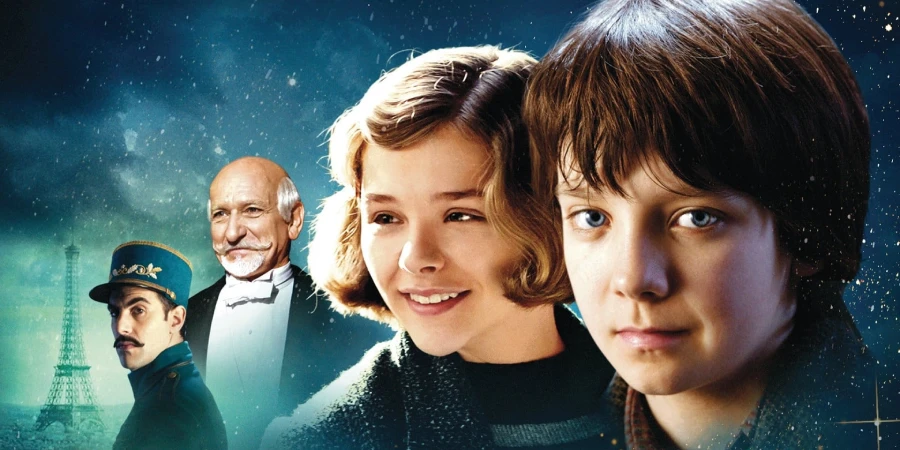

Martin Scorsese made a children’s film, and somehow it became one of the most emotionally devastating love letters to cinema ever put on screen. Hugo (2011) hides an adult obsession inside a boy’s adventure story, using clockwork automata and stolen notebooks to resurrect the forgotten genius of Georges Méliès. It swept the Academy Awards technical categories and left audiences genuinely surprised by how much they cared. This is a film that rewards every second of attention you give it.
Detailed Summary
Hugo Lives Inside the Walls
We meet Hugo Cabret, a twelve-year-old boy living secretly inside the walls of a busy Paris train station in the 1930s. He winds the station’s clocks, steals food and croissants to survive, and hides from the station inspector at every turn. His only connection to his dead father is an automaton, a mechanical man his father discovered and began repairing before dying in a museum fire.
Hugo believes the automaton holds a message from his father. He has been stealing mechanical parts from a toy booth in the station to complete the repair.
Papa Georges and the Notebook
Hugo gets caught stealing parts by Papa Georges, the bitter old man who runs the toy booth. Papa Georges confiscates Hugo’s notebook, the very notebook containing his father’s drawings and repair notes for the automaton. Hugo is devastated; that notebook is everything.
Meanwhile, Hugo notices that Papa Georges’ goddaughter, Isabelle, carries a heart-shaped key around her neck. Hugo immediately recognizes it as the key that fits the automaton’s winding mechanism. In addition, Isabelle is clever and bookish, and she agrees to help Hugo retrieve the notebook.
The Automaton Draws a Moon
Hugo and Isabelle sneak the key and wind up the automaton together. Instead of writing a personal message, the machine draws a precise image: a rocket ship lodged in the eye of the moon. Below the drawing, it signs a name: Georges Méliès.
Hugo has no idea what this means. Isabelle, however, recognizes the image from a book about early cinema. Consequently, the two children begin investigating who Georges Méliès really was.
Film History Hidden in Plain Sight
Isabelle’s friend, a film historian named René Tabard, confirms their suspicion. Papa Georges is not just a toy merchant. He is the real Georges Méliès, one of cinema’s first and greatest magician-filmmakers, the man who created A Trip to the Moon. Tabard is overwhelmed with emotion at the discovery.
Georges, however, wants nothing to do with the past. He made hundreds of films, and after World War One, his studio failed, his films were largely destroyed or melted down for chemicals, and the world forgot him. He considers that chapter of his life dead and buried.
Mama Jeanne’s Secret
Isabelle finally learns the truth from her adoptive mother, Mama Jeanne, who is Georges’ wife and former leading actress. Jeanne reveals the full tragedy: the financial collapse, the erasure of his legacy, the years of quiet grief. Georges built the automaton himself, long ago, as a celebration of his craft.
Georges had locked everything away to protect himself from pain. Learning that children had been chasing his ghost finally cracks his armor open.
Hugo Is Caught
Station Inspector Gustave catches Hugo and threatens to send him to an orphanage. Hugo escapes in a frantic chase through the station’s gears and clock machinery. He nearly falls to his death from a giant clock face high above the station floor, in a scene that deliberately echoes Harold Lloyd’s famous stunt in Safety Last! (1923).
Hugo survives and escapes, but his precarious situation at the station grows more urgent. He has no legal guardian and nowhere safe to go.
The Film Prints Are Saved
Tabard reveals that a film archive actually preserved many of Méliès’ films. Georges, confronted with this news and with the love Hugo and Isabelle clearly have for his work, finally breaks down emotionally. He agrees to participate in a ceremony honoring his contributions to cinema.
Georges publicly receives recognition for the first time in decades. He gifts the restored automaton to Hugo as acknowledgment of the boy’s role in bringing him back to the world.
Movie Ending
Georges Méliès stands before an adoring crowd at a formal ceremony celebrating his life’s work. Film scholars, critics, and admirers pack the hall. For a man who believed the world had completely erased him, this moment functions as a resurrection. He delivers a speech about magic, filmmaking, and the act of dreaming, tying the film’s core theme together with quiet grace.
Hugo receives a legal guardian in Georges himself, resolving his orphan crisis. He finally has a home, a family, and a purpose. Moreover, his father’s death is contextualized not as pure loss but as the catalyst that led Hugo to restore a forgotten artist to history.
Inspector Gustave, softened throughout the film by a tentative romance with a flower seller named Lisette, steps back from his rigid rule-following. He stops pursuing Hugo. In contrast to his earlier menace, Gustave ends the film as a figure of warmth rather than threat.
Hugo’s final voiceover wraps everything up with deliberate intention. He compares the world to a giant machine where every part has a purpose. His purpose, he concludes, was to fix the automaton and return Georges Méliès to the world. It is sentimental but earned, because the film spent two hours building the emotional logic that makes it land.
Audiences frequently ask whether the automaton drawing carries a deeper meaning. It does. Méliès built the machine as a tribute to his own most famous film. Finding it in a museum and sending it into the world again was his unconscious hope that someone would care. Hugo became that someone.
Are There Post-Credits Scenes?
Hugo contains no post-credits scenes. Once the credits roll, the film is complete. You can safely leave the theater, or stop the stream, without missing anything additional.
Type of Movie
Hugo blends family adventure, historical drama, and a deeply felt love letter to silent cinema. Its tone is warm and nostalgic but never saccharine. Scorsese builds genuine tension through the chase sequences while keeping the emotional core rooted in grief, art, and memory.
Technically, it is a 3D fantasy-adventure aimed at family audiences. In practice, it resonates most strongly with anyone who has ever loved a film enough to mourn what almost got lost.
Cast
- Asa Butterfield – Hugo Cabret
- Chloë Grace Moretz – Isabelle
- Ben Kingsley – Georges Méliès
- Sacha Baron Cohen – Station Inspector Gustave
- Jude Law – Hugo’s Father
- Ray Winstone – Uncle Claude
- Emily Mortimer – Lisette
- Helen McCrory – Mama Jeanne
- Michael Stuhlbarg – René Tabard
- Christopher Lee – Monsieur Labisse, the bookshop owner
Film Music and Composer
Howard Shore composed the score for Hugo, and it stands among his finest work outside the Lord of the Rings trilogy. Shore uses accordion, strings, and a distinctly French flavor to evoke 1930s Paris without slipping into pastiche. The music feels lived-in rather than decorative.
Notable tracks include the main theme, which carries a bittersweet mechanical quality that mirrors the film’s clockwork imagery. Shore received an Academy Award nomination for his work on this score. His background in lush, narrative-driven orchestration suits Scorsese’s visual storytelling perfectly.
Filming Locations
Production designer Dante Ferretti built an extraordinary recreation of a 1930s Paris train station entirely on soundstages at Shepperton Studios in England. Scorsese did not shoot at a real French station; the entire world of the film exists as a constructed environment. This decision gave the film its heightened, slightly magical quality.
Some exterior shots used real Paris locations for establishing context. However, the immersive station interior, with its clocks, cafes, and hidden passages, came entirely from Ferretti’s imagination and craftsmanship. Ferretti won the Academy Award for Best Art Direction for his work on the film.
Awards and Nominations
Hugo received eleven Academy Award nominations, winning five: Best Cinematography (Robert Richardson), Best Art Direction, Best Sound Editing, Best Sound Mixing, and Best Visual Effects. It was one of the most nominated films at that ceremony.
Notably, Scorsese and the film lost the Best Picture and Best Director awards to The Artist that year, a result that struck many critics as ironic given both films centered on celebrating silent cinema. Furthermore, Ben Kingsley and the script both received significant critical praise without converting into acting nominations at the major ceremonies.
Behind the Scenes Insights
- Martin Scorsese’s daughter, Francesca Scorsese, appears briefly in the film as one of the schoolchildren at the station.
- Scorsese used 3D technology with genuine enthusiasm, treating it as an expressive tool rather than a gimmick. He cited early cinema pioneers as his inspiration for embracing the format.
- Ben Kingsley spent considerable time researching the real Georges Méliès, studying his mannerisms, his magician background, and his emotional arc from celebrity to obscurity.
- The film’s automaton prop was built by a specialized team and functioned practically on set, not purely through digital effects.
- Scorsese worked with cinematographer Robert Richardson to develop a visual language where the camera movements themselves felt mechanical, mimicking the turning of gears and cogs.
- Sacha Baron Cohen underwent significant physical transformation for the role, including a leg brace that changed his walk. He played the role almost entirely straight, which surprised many audiences familiar with his comedic persona.
- Production spent over a year in pre-production designing the station environment before principal photography began.
Inspirations and References
Hugo adapts Brian Selznick’s illustrated novel The Invention of Hugo Cabret, published in 2007. Selznick drew direct inspiration from the real life of Georges Méliès, the actual French filmmaker who pioneered special effects in early cinema and whose story closely mirrors what the film depicts.
Scorsese layered additional cinematic references throughout the film. Harold Lloyd’s clock-hanging sequence from Safety Last! directly inspires Hugo’s near-fall. Scorsese also references the Lumière Brothers’ famous footage of a train arriving at a station, recreating it within the film’s narrative as a piece of early cinema history.
The film functions, in part, as Scorsese’s personal argument for film preservation. His real-world involvement with the Film Foundation, which he founded to preserve endangered films, gives the themes of the story a deeply personal dimension.
Alternate Endings and Deleted Scenes
No widely documented alternate endings for Hugo exist in the public record. The film’s ending aligns closely with the source novel’s resolution, suggesting Scorsese and screenwriter John Logan were committed to that conclusion from early development.
Some scenes featuring Inspector Gustave’s romantic subplot with Lisette were reportedly trimmed for pacing during editing. These cuts tightened the film’s focus on Hugo and Méliès without eliminating Gustave’s emotional arc entirely.
Book Adaptations and Differences
Hugo adapts The Invention of Hugo Cabret by Brian Selznick. Selznick’s book is famously unusual: it combines prose with nearly 300 pages of detailed pencil illustrations that function almost like a silent film themselves. The visual storytelling of the book directly influenced Scorsese’s camera work.
John Logan’s screenplay compresses certain plot elements and expands the roles of secondary characters like Inspector Gustave and Isabelle. The book focuses more tightly on Hugo’s isolation, whereas the film opens outward to embrace more of the station’s community life.
Selznick publicly praised the adaptation and remained involved as a consultant during production. In contrast to many book-to-film transitions, this one maintained strong fidelity to the source’s emotional core and central themes.
Memorable Scenes and Quotes
Key Scenes
- The automaton completing its drawing and signing Georges Méliès for the first time, a genuinely shocking reveal.
- Hugo dangling from the giant clock face high above the station floor, echoing Harold Lloyd’s iconic silent-film stunt.
- Georges watching a screening of his own films for the first time in years, with tears running down his face.
- The recreation of the Lumière Brothers’ train-arrival film, shown as a terrifying in-universe event that causes audiences to flee the room.
- Georges delivering his speech at the ceremony, calling himself a magician who made dreams real.
- Hugo and Isabelle first winding the automaton with the heart-shaped key, unsure of what it will do.
Iconic Quotes
- “I’d imagine the whole world was one big machine. Machines never come with any extra parts, you know. They always come with the exact amount they need. So I figured, if the entire world was one big machine, I couldn’t be an extra part. I had to be here for some reason.” – Hugo
- “Happy endings only happen in the movies.” – Georges Méliès (and the film’s quiet argument against that belief)
- “My life was a mess of a story. Why try to write it down?” – Georges Méliès
Easter Eggs and Hidden Details
- Scorsese hides references to at least a dozen silent films throughout the background of various scenes, including posters and set dressing that reflect early cinema history.
- Harold Lloyd’s iconic clock-face image from Safety Last! is deliberately recreated in Hugo’s near-fall sequence. Scorsese plants an actual still from Lloyd’s film earlier in the movie as a visual foreshadowing clue.
- The bookshop run by Monsieur Labisse (Christopher Lee) contains books whose spines, on close inspection, reference important literary and cinematic works that influenced Selznick’s original novel.
- Georges’ toyshop is stocked with automata and mechanical figures that mirror the devices he used as props in his actual films.
- Camera movements throughout the film subtly mimic the turning of gears and the clicking of mechanical parts, connecting the film’s visual grammar to its thematic obsession with machines and purpose.
- The heart-shaped key carried by Isabelle connects the mechanical world of the automaton to the emotional world of memory and family, a visual metaphor the film plants early and pays off in full.
Trivia
- Hugo marked Martin Scorsese’s first film specifically aimed at a family audience and his first significant use of 3D technology.
- The real Georges Méliès did indeed fall into obscurity after World War One and was rediscovered in the late 1920s and early 1930s. The film’s timeline loosely follows this historical arc.
- Brian Selznick’s novel took five years to write and illustrate. Its unusual format, part novel and part graphic narrative, had no real precedent in children’s publishing.
- Scorsese is a founding member of the Film Foundation, a nonprofit dedicated to preserving and restoring motion pictures. Hugo functions as both a film and a public argument for why that work matters.
- Asa Butterfield beat out a large number of young actors for the role of Hugo. His wide-eyed intensity, which Scorsese specifically sought, became one of the film’s most discussed visual qualities.
- The film’s 3D was widely praised by critics as one of the best uses of the technology since Avatar, with Scorsese using depth to enhance atmosphere rather than simply throw objects at the audience.
- Despite its critical acclaim and award success, Hugo underperformed at the box office relative to its production and marketing budget.
Why Watch?
Hugo offers something genuinely rare: a film about loving films that actually earns that sentiment through story rather than nostalgia alone. Scorsese packs genuine grief, wonder, and historical weight into what looks like a children’s adventure. Ben Kingsley’s performance as Méliès is quietly devastating. Anyone who cares about why cinema matters should watch this film at least once.
Director’s Other Movies
- Taxi Driver (1976)
- Raging Bull (1980)
- Goodfellas (1990)
- Cape Fear (1991)
- The Age of Innocence (1993)
- Casino (1995)
- Gangs of New York (2002)
- The Aviator (2004)
- The Departed (2006)
- Shutter Island (2010)
- The Wolf of Wall Street (2013)
- Silence (2016)
- The Irishman (2019)
- Killers of the Flower Moon (2023)