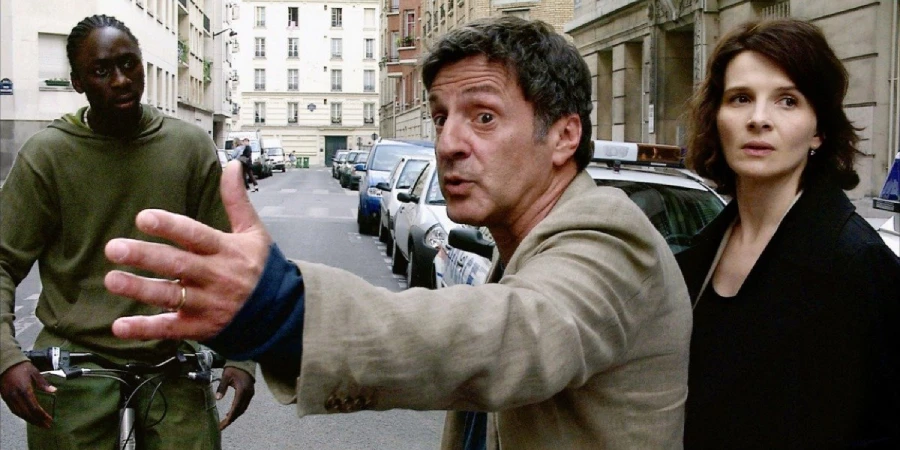
Surveillance footage arrives uninvited, and suddenly a comfortable Parisian life begins to crack at the seams. Caché, directed by Michael Haneke, is one of the most quietly devastating films ever made about guilt, denial, and the violence hidden inside bourgeois respectability. It refuses to hand you answers, and that refusal is precisely the point. Georges Laurent is not a victim; he is a man being forced to remember what he chose to forget.
Detailed Summary
The Tapes Begin Arriving
Georges Laurent, a literary television host, and his wife Anne discover a videotape left anonymously on their doorstep. It contains footage of their home, filmed from a fixed camera across the street, with no explanation and no apparent motive. Inside the package sits a childlike drawing of a figure with blood pouring from its mouth.
More tapes follow. Each one inches closer to something personal, something Georges seems to recognize but initially refuses to name. Anne grows frightened; Georges grows evasive in a way that reads as suspicious rather than simply anxious.
Georges and the Memory of Majid
Georges eventually admits, reluctantly, that the tapes remind him of his childhood. As a boy, his parents employed an Algerian farmhand whose wife and husband died during the Paris massacre of October 17, 1961, a historical atrocity in which French police killed dozens of Algerian protesters. The farmhand’s young son, Majid, was left an orphan and was meant to be taken in by Georges’s family.
Georges, jealous and threatened by the prospect of sharing his parents’ affection, told a deliberate lie. He claimed Majid had been coughing up blood, a fabrication designed to make Majid seem ill and undesirable. As a result, Majid was sent away to an orphanage, his life irrevocably altered by a child’s selfish cruelty.
Confronting Majid as an Adult
One tape leads Georges to a housing project on the outskirts of Paris. He finds Majid there, now a quiet, worn-down man played by Maurice Bénichou. Majid insists, calmly and consistently, that he has no idea who is sending the tapes.
Georges does not believe him. He reports Majid to the police, and officers arrest Majid and his adult son. Neither man is charged, because no evidence links them to the tapes. Georges returns home carrying his suspicion like a shield, refusing to consider that his guilt itself might be the real subject of this harassment.
Majid’s Shocking Act
Majid contacts Georges and asks him to come to his apartment one more time. Georges arrives, tense and guarded. Without warning or extended preamble, Majid produces a knife and slashes his own throat in front of Georges, collapsing and dying almost immediately.
Haneke stages this moment with brutal economy: no swelling music, no slow motion, no dramatic close-up. It happens fast, in a single wide shot, and Georges stands there, stunned. Majid’s suicide is not revenge; it reads as a final act of bearing witness, of forcing Georges to see the consequences of what was set in motion decades ago.
Majid’s Son Confronts Georges
Later, Majid’s adult son tracks Georges down and confronts him. He tells Georges bluntly that he simply wants Georges to know that he will live with this. He is not threatening; he is delivering a verdict. Georges, for his part, remains defensive and cold throughout the exchange.
Georges returns home and takes a sleeping pill, retreating into unconsciousness. His professional life, his marriage (strained by mutual suspicion about Anne’s relationship with a colleague), and his sense of self continue to unravel around him. However, no resolution arrives, because Haneke does not offer one.
Movie Ending
Georges swallows a sleeping pill and retreats to his bedroom. He shuts out the world with pharmaceutical efficiency. Haneke lingers on this image briefly before cutting to the final, crucial shot.
That final shot shows the entrance to Pierrot’s school, filmed from a distance in the same flat, surveillance-camera style as the tapes. Students file out at the end of the school day. After a moment, sharp-eyed viewers can spot Pierrot, Georges and Anne’s teenage son, meeting and speaking with Majid’s son on the steps. Their conversation appears calm, even familiar.
Haneke holds this shot for a long time and then cuts to black. No explanation follows. This ending generates enormous debate, because it raises the possibility that Pierrot and Majid’s son collaborated on the tapes, potentially even planned the entire campaign together. It also raises the possibility that their meeting is coincidental or peripheral.
Crucially, Haneke confirmed in interviews that he deliberately refused to resolve the mystery. The identity of the sender matters less than what the tapes force into the open: specifically, France’s collective suppression of its colonial violence, and one man’s lifetime of unapologetic self-interest. The surveillance footage functions as a metaphor for guilt that refuses to stay buried. Moreover, the film implicates the audience directly, since we, too, have been watching, judging, and yet unable to intervene.
Are There Post-Credits Scenes?
Caché contains no post-credits scenes. After that long, ambiguous final shot, the film simply ends. Sitting through the credits will not reward you with additional footage or hidden answers. In some ways, that absence is itself part of Haneke’s design: there is no comfortable coda, no parting gift of clarity.
Type of Movie
Caché operates primarily as a psychological thriller, though that label undersells its ambitions. It functions simultaneously as a political drama and a slow-burn mystery that deliberately refuses genre satisfaction. Haneke weaponizes the conventions of the thriller, building dread and expectation, only to redirect them toward moral and historical reckoning.
Its tone is cold, precise, and deeply unsettling. Moments of sudden violence erupt inside an otherwise restrained, almost clinical atmosphere. In contrast to conventional thrillers, the central mystery is never solved in any traditional sense.
Cast
- Daniel Auteuil – Georges Laurent
- Juliette Binoche – Anne Laurent
- Maurice Bénichou – Majid
- Annie Girardot – Georges’s Mother
- Bernard Le Coq – Georges’s Colleague
- Walid Afkir – Majid’s Son
- Lester Makedonsky – Pierrot Laurent
Film Music and Composer
Caché uses almost no conventional score. Haneke made a deliberate choice to strip away music that might guide audience emotion or signal when to feel tense. Sound design carries most of the atmospheric weight instead.
This approach is consistent with Haneke’s broader aesthetic philosophy: he refuses to manipulate the viewer through conventional cinematic tools. The silence and ambient noise of Paris do more work than any composed soundtrack could. Consequently, every sudden sound in the film, a car horn, a dropped object, lands with disproportionate force.

Filming Locations
Principal photography took place in Paris, France. The Laurent home exterior was filmed on Rue des Iris, a residential street that reads as affluent but not ostentatious. That ordinariness is essential: Haneke wanted a home that looks safe, watched, and very much like a place where nothing should go wrong.
Majid’s apartment in the housing projects on the outskirts of Paris provides a stark geographical and social contrast. The distance between these two locations maps the class and racial divide that sits at the heart of the film. Furthermore, the streets of central Paris appear in sequences from Georges’s television work, grounding the story inside recognizable, everyday French life.
Awards and Nominations
Caché won the Best Director award for Michael Haneke at the Cannes Film Festival 2005. It also won the FIPRESCI Prize and the Prize of the Ecumenical Jury at Cannes that same year.
Additionally, the film received nominations from BAFTA and various European film bodies. Haneke’s direction drew near-universal critical acclaim, and the film frequently appears on critical lists of the greatest films of the 2000s.
Behind the Scenes Insights
- Haneke reportedly kept the cast uncertain about the identity of the tape-sender even during production, mirroring the audience’s own confusion.
- Daniel Auteuil has spoken about the difficulty of playing a man who is guilty but never explicitly confesses, requiring him to convey suppression rather than emotion.
- Haneke shot the surveillance footage sequences on video to deliberately create an aesthetic difference from the main film, blurring the line between diegetic tape and cinematic image.
- The film was a French-Austrian-German-Italian co-production, reflecting Haneke’s ongoing collaboration with European funding bodies across his career.
- Haneke insisted on long, unbroken takes to prevent audiences from relaxing into conventional editing rhythms, keeping them perpetually alert and slightly unsettled.
Inspirations and References
Haneke has cited the Paris massacre of October 17, 1961 as the central historical catalyst for the film. French police, under the direction of Maurice Papon, killed a significant number of Algerian protesters, and France suppressed public acknowledgment of the event for decades. Georges’s personal denial mirrors France’s national one.
The film also draws on broader traditions of surveillance culture and the politics of the gaze, referencing anxieties that were already intensifying in post-September 11 Europe. In addition, Haneke’s interest in bourgeois guilt connects Caché thematically to his earlier work, particularly Funny Games and The Piano Teacher.
Alternate Endings and Deleted Scenes
No officially released alternate endings or significant deleted scenes exist for Caché. Haneke is notoriously precise in his filmmaking and does not typically produce material that diverges substantially from his intended vision. What reaches the screen closely reflects his original plan.
Some interview material suggests minor editorial decisions were made in post-production, but nothing substantive has surfaced publicly. The final cut stands as Haneke’s definitive version of the story.
Book Adaptations and Differences
Caché is not based on any book, novel, or pre-existing source material. Haneke wrote the original screenplay himself. Consequently, there are no source-text comparisons to draw.

Memorable Scenes and Quotes
Key Scenes
- Majid’s suicide: Filmed in a single, unflinching wide shot, this moment is one of the most shocking and economical acts of violence in modern cinema precisely because it is staged without melodrama.
- The first tape playback: Georges and Anne sit watching their own home on a television screen, and Haneke holds the frame long enough to make the audience question what they themselves are watching.
- Georges confronting Majid for the first time: The quiet, civil horror of two men facing each other across decades of unspoken damage is almost unbearably tense.
- The flashback sequences: Brief, vivid, and shot in a way that integrates seamlessly with the present-day footage, these childhood memory scenes carry enormous weight in relatively little screen time.
- The final school steps shot: Long, static, and deliberately ambiguous, this closing image sent audiences arguing for years and continues to do so.
Iconic Quotes
- “I have nothing to feel guilty about.” (Georges, to Anne, with a conviction that reads entirely as its opposite)
- “I just wanted you to know that you’ll have to live with this.” (Majid’s son, delivering his quiet, devastating verdict to Georges)
Easter Eggs and Hidden Details
- Several sequences that appear to be surveillance tapes are, in fact, simply Haneke’s own film footage, shot in an identical visual register. Audiences cannot reliably tell the difference, which is entirely intentional.
- Background televisions in the Laurent home occasionally show news footage referencing contemporary geopolitical conflicts, subtly reinforcing the film’s themes of Western guilt and selective attention.
- Pierrot and Majid’s son appear together in that final shot, but their meeting is easy to miss on a first viewing because Haneke places them at the periphery of a busy frame. Many viewers only catch this detail on rewatching.
- The drawings accompanying the tapes, crude and bloody, echo the visual style of a child’s artwork, subtly pointing toward the childhood origin of the central trauma long before Georges confesses it.
Trivia
- Caché was selected as the Austrian entry for the Academy Award for Best Foreign Language Film but was ultimately not nominated.
- Haneke shot the surveillance footage using consumer-grade video cameras to achieve the grainy, flat aesthetic that distinguishes those sequences from the main film.
- The film’s French title translates simply to Hidden in English, a word that applies equally to the tapes, to Georges’s guilt, and to France’s historical memory of colonial violence.
- Maurice Bénichou, who plays Majid, also appeared in Haneke’s earlier film Code Unknown (2000), making him something of a recurring presence in Haneke’s Parisian world.
- Critics and scholars continue to debate the final shot actively, with no consensus emerging even years after the film’s release.
Why Watch?
Caché is one of those rare films that treats its audience as intelligent adults and makes them pay for it. Haneke builds dread from stillness, guilt from omission, and political commentary from a domestic thriller framework. Few films have used the mechanics of cinema itself, the act of watching, so precisely against the viewer. It rewards patience, punishes passivity, and stays with you long after the screen goes dark.
Director’s Other Movies
- The Seventh Continent (1989)
- Benny’s Video (1992)
- 71 Fragments of a Chronology of Chance (1994)
- Funny Games (1997)
- Code Unknown (2000)
- The Piano Teacher (2001)
- Time of the Wolf (2003)
- Funny Games (2007)
- The White Ribbon (2009)
- Amour (2012)
- Happy End (2017)