
Few films have the audacity to argue that love, cinema, and loss are all the same wound. Giuseppe Tornatore’s Cinema Paradiso makes that argument with devastating patience, building across decades of a Sicilian boy’s life until a single reel of film reduces grown adults to tears. It won the Academy Award for Best Foreign Language Film and earned its place as one of cinema’s most beloved love letters to moviegoing itself. Prepare for full spoilers, because this story only works if you know exactly where it goes.
Detailed Summary
A Phone Call from the Past
The film opens in Rome, where a successful film director named Salvatore Di Vita, known to everyone as Toto, receives a message. His mother calls to tell him that an old man named Alfredo has died back in Sicily. Salvatore has not returned to his hometown of Giancaldo in thirty years.
His girlfriend notices his distant reaction and pushes him to talk. Instead, he lies awake, and memories begin to flood back. This framing device anchors the entire film in nostalgia and unresolved grief.
Young Toto and the Cinema Paradiso
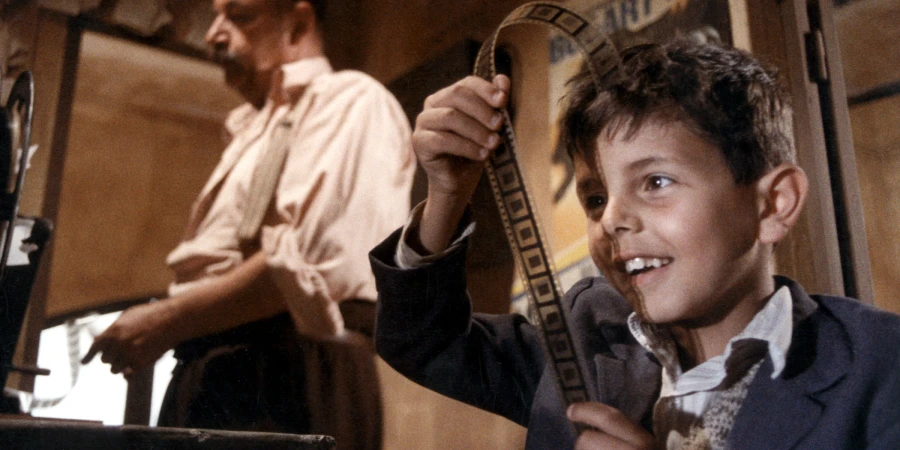
In his memories, Salvatore returns to his childhood in Giancaldo, a small Sicilian village. Young Toto, played with magnetic charm by Salvatore Cascio, is obsessed with the local movie theater, the Cinema Paradiso. He sneaks in constantly, stealing used film reels and pestering the projectionist.
That projectionist is Alfredo, a gruff but warm man who initially resents the boy’s constant intrusions. However, a bond begins to form. Toto’s curiosity and love for film prove impossible for Alfredo to resist.
Alfredo and the Censored Kisses
A crucial figure in the village’s film culture is the local priest, who screens every film in advance and rings a bell at any moment he deems morally indecent. Alfredo dutifully cuts those moments, specifically kissing scenes, from every print before public screenings. This running gag doubles as a sharp comment on provincial conservatism.
Young Toto watches Alfredo work and absorbs everything. He learns projection, film splicing, and the quiet dignity of tending to a community’s dreams. Alfredo becomes, in every meaningful way, his surrogate father.
The Fire and Its Aftermath
Disaster strikes during a packed screening when highly flammable nitrate film catches fire in the projection booth. Alfredo, trying to save the situation, suffers severe burns and loses his sight. Toto, still a child, heroically pulls Alfredo from the burning theater.
The Cinema Paradiso burns to the ground. A local businessman named Ciccio eventually rebuilds it as a larger, modern theater. Toto, now old enough to operate the equipment, takes over as projectionist in Alfredo’s place. Alfredo, though blind, remains Toto’s closest confidant.
Elena and First Love
As a teenager, Toto falls desperately in love with Elena, a banker’s daughter played later by Agnese Nano. She is beautiful, intelligent, and initially cool toward him. Toto pursues her with the kind of single-minded romantic persistence that only teenagers and movie heroes manage.
His courtship includes standing outside her window every night, rain or shine, for a hundred nights. Elena eventually falls for him. Their love affair becomes the emotional center of the film’s middle section.
Alfredo’s Fateful Advice
When Toto is called up for military service, his relationship with Elena strains under the distance. He returns to find her gone, without explanation. Alfredo, Toto later realizes, had secretly intervened by telling Elena to leave Toto and let him pursue a bigger life away from Giancaldo.
At the time, this feels like cruel abandonment. In retrospect, it reads as Alfredo’s most profound act of love. He sacrificed Toto’s immediate happiness to prevent him from becoming trapped in a small village, living a small life.
Toto Leaves Giancaldo
Alfredo delivers his most famous piece of advice directly: “Get out of here. Go back to Rome. Don’t come back. Don’t think about us.” He tells Toto that whatever he ends up loving, he should never return. Toto obeys, reluctantly, and builds a successful career as a filmmaker in Rome.
He never returns to Giancaldo for thirty years. He never fully explains why, even to himself. That silence becomes the film’s central mystery until the very end.
Movie Ending
Salvatore returns to Giancaldo for Alfredo’s funeral, visiting the village for the first time in three decades. Everything feels smaller than he remembered. His mother greets him warmly, the village has aged, and the old Cinema Paradiso sits condemned, scheduled for demolition.
He watches the demolition of the theater in a public square. It is a wrenching scene, the literal destruction of a place that shaped him entirely. Moreover, it signals that an entire era of communal moviegoing has ended, replaced by television and modern indifference.
Before he leaves, Salvatore receives a gift that Alfredo left for him. It is a reel of film. Back in Rome, he screens it alone in a private projection booth. What he sees changes the texture of the entire film retroactively.
Alfredo had spent years collecting every kissing scene that the village priest had ordered cut from those old prints. He spliced them all together into a single reel, a gift of all the love and tenderness that had been censored from the village’s cultural life. Salvatore watches, and he weeps.
This final sequence works on several levels simultaneously. On the surface, it is a beautiful act of posthumous generosity. On a deeper level, it is Alfredo returning all the love and beauty he once felt obliged to suppress, a metaphor for the repressed emotions of Toto’s entire life.
Consequently, the ending reframes Alfredo not just as a mentor but as a keeper of everything the world tried to take away. It also reframes Toto’s career: he became a filmmaker because someone believed, silently and without credit, that he deserved a life full of beauty. That is the film’s final, devastating argument.
Are There Post-Credits Scenes?
Cinema Paradiso contains no post-credits scenes. The film ends on Salvatore’s tearful, grateful face as he watches Alfredo’s reel. No additional footage follows the credits.
Type of Movie
Cinema Paradiso is a drama with strong elements of romance and nostalgia. Its tone is warm, elegiac, and bittersweet, moving from the playful energy of childhood through the ache of first love and into the quiet melancholy of middle age.
It functions as a love letter to cinema itself, belonging to a tradition of films about the power of film. In contrast to purely sentimental pictures, it earns its emotion through restraint, time, and genuine character development.
Cast
- Philippe Noiret – Alfredo
- Salvatore Cascio – Young Salvatore “Toto” Di Vita
- Marco Leonardi – Teenage Salvatore Di Vita
- Jacques Perrin – Adult Salvatore Di Vita
- Agnese Nano – Elena (adult)
- Antonella Attili – Young Maria (Toto’s mother)
- Pupella Maggio – Older Maria (Toto’s mother)
- Leopoldo Trieste – Father Adelfio, the village priest
- Enzo Cannavale – Spaccafico
Film Music and Composer
The score for Cinema Paradiso was composed by Ennio Morricone, one of cinema’s most celebrated composers, working alongside his son Andrea Morricone. The main theme is among Morricone’s most recognizable and emotionally direct pieces, built on a simple, aching melody that seems to contain an entire childhood.
Notable tracks include the main love theme, which recurs throughout the film and reaches its peak during the final reel sequence. Morricone uses piano and strings with remarkable economy. He never overloads a scene; he lets the melody breathe alongside Tornatore’s images.
Filming Locations
Principal photography took place in Palazzo Adriano, a small town in the province of Palermo, Sicily. Tornatore chose it for its authentic, preserved quality, its streets and piazzas genuinely resembling a postwar Sicilian village without heavy modification. For instance, the central square where the Cinema Paradiso stood was dressed minimally because the location already carried the right atmosphere.
Some scenes were also shot in Cefalù, another Sicilian town. The Roman sequences, representing adult Salvatore’s life, were filmed in Rome. The contrast between Sicily’s warmth and Rome’s cool anonymity reinforces the film’s central emotional divide.
Awards and Nominations
Cinema Paradiso won the Academy Award for Best Foreign Language Film at the 1990 ceremony. It also won the Grand Prix at the Cannes Film Festival in 1989, sharing it with Sex, Lies, and Videotape.
Furthermore, it received a BAFTA Award for Best Film Not in the English Language. Ennio Morricone’s score received widespread critical acclaim, though the score itself did not win the Oscar that year. The film’s global success helped launch Italian cinema into mainstream international attention in a significant new way.
Behind the Scenes Insights
- Director Giuseppe Tornatore based significant portions of the story on his own childhood experiences growing up in Sicily and his love of local cinema.
- Casting young Salvatore Cascio was a pivotal decision; Tornatore reportedly spotted the boy’s natural charisma and built much of the childhood section around his energy.
- Philippe Noiret, a French actor, performed all his dialogue in French on set. His lines were later dubbed into Italian for the final film, a common practice in Italian productions of the era.
- Tornatore and cinematographer Blasco Giurato worked to give each time period its own visual texture, with warmer, softer photography for the childhood sequences and a cooler palette for the adult Roman scenes.
- Ennio Morricone composed the score before filming was complete, which allowed Tornatore to play the music on set and use it to guide the emotional pacing of certain scenes.
- The original Italian release ran significantly longer than the international cut. The theatrical version seen in most countries is considerably shorter than Tornatore’s full director’s cut.
Inspirations and References
Tornatore drew heavily from his own autobiography. He grew up in Bagheria, Sicily, where local cinema held the same communal, almost sacred role that the Cinema Paradiso holds in the film. His personal memories of a charismatic projectionist figure shaped Alfredo directly.
On a broader cultural level, the film references the tradition of Italian neorealism, particularly in its attention to working-class village life and its use of non-professional child actors. Similarly, it pays tribute to the specific era when Hollywood films dominated Italian screens in the postwar years, an era Tornatore witnessed firsthand as a child.
Alternate Endings and Deleted Scenes
Tornatore’s original director’s cut runs approximately 170 minutes, compared to the roughly 123-minute international theatrical version. The extended cut includes a crucial subplot that the shorter version omits almost entirely. In it, adult Salvatore actually reunites with Elena during his return to Giancaldo, and she explains what happened between them.
Elena reveals that Alfredo had visited her father and deliberately engineered their separation. This confrontation scene adds significant weight to Salvatore’s complicated grief for Alfredo and makes the mentor-figure more morally ambiguous. Many critics and fans consider the director’s cut a substantially different, and in some ways richer, film.
However, Tornatore himself has expressed that both versions represent valid interpretations of the story. The shorter cut is more purely mythic; the longer cut is more psychologically realistic. Neither version changes the ending’s final reel sequence.
Book Adaptations and Differences
Cinema Paradiso is not based on a book or any previously published source material. Tornatore wrote the original screenplay himself. Therefore, no book-to-film comparison applies here.


Memorable Scenes and Quotes
Key Scenes
- The nitrate fire: Young Toto drags a burning, blinded Alfredo from the projection booth while the Cinema Paradiso burns around them. Raw, terrifying, and pivotal.
- The hundred nights at the window: Toto stands outside Elena’s window every night for weeks, a testament to teenage love’s stubborn, beautiful excess.
- Alfredo’s farewell advice: Alfredo tells young Toto to leave, never return, and never look back. Simple words that carry the full weight of a father’s sacrifice.
- The demolition of the Cinema Paradiso: A crowd watches the old theater implode. The sequence works as both literal event and cultural elegy.
- The final reel of kisses: Salvatore watches Alfredo’s assembled collection of censored kiss scenes, and the film earns every one of its tears in this closing sequence.
Iconic Quotes
- “Whatever you end up doing, love it. The way you loved the projection booth when you were a little squirt.” (Alfredo to Toto)
- “Get out of here. Go back to Rome. Don’t come back. Don’t think about us.” (Alfredo)
- “Living here day by day, you think it’s the center of the world. You believe nothing will ever change. Then you leave, a year, two years. When you come back, everything’s changed.” (Alfredo)
Easter Eggs and Hidden Details
- Many of the film clips shown on the Cinema Paradiso screen are real Italian and Hollywood films from the postwar era, grounding the story in genuine cinematic history.
- The priest’s bell becomes a visual and audio motif throughout the childhood sequences, ringing to signal censorship. Pay attention to how Tornatore frames each cut, always just before a kiss, to mirror the audience’s own sense of deprivation.
- Alfredo’s blindness after the fire carries thematic resonance: the man who spent his life showing others beautiful images cannot see them himself, a quiet, painful irony Tornatore never underlines too heavily.
- In the background of several village scenes, posters for real Italian films of the era are visible on walls, functioning as period detail and cinephile tribute simultaneously.
- The choice to cast three different actors as Salvatore across his life stages, each with distinct physical energy, reinforces how completely different people we become over decades, a central theme of the film.
Trivia
- Cinema Paradiso was initially a commercial and critical disappointment in Italy on its first release. International acclaim, particularly after Cannes, transformed its reputation at home.
- Tornatore was only 32 years old when he directed the film, making its emotional depth and formal confidence particularly remarkable for such a young filmmaker.
- Philippe Noiret did not speak Italian, yet his performance as Alfredo is among the most beloved in the film’s history, entirely because of physical presence and the quality of his Italian dubbing.
- Ennio Morricone’s main theme for the film became one of his most requested and performed concert pieces in the decades following the film’s release.
- The village of Palazzo Adriano saw a significant boost in tourism after the film’s international success, with visitors seeking out the actual locations.
- Tornatore considered the film deeply personal and has stated in interviews that making it was a form of processing his own nostalgia for a Sicily that no longer existed.
Why Watch?
Cinema Paradiso offers something increasingly rare: a film that genuinely earns its emotional climax through patience and character. It argues, beautifully and without sentimentality, that the people who shape us most are often the ones we never properly thank. Notably, it works both as a personal story and as a tribute to every crowded, noisy, magical moviegoing experience anyone has ever had.
Director’s Other Movies
- Il Camorrista (1986)
- Everybody’s Fine (1990)
- A Pure Formality (1994)
- The Star Maker (1995)
- The Legend of 1900 (1998)
- Malena (2000)
- The Unknown Woman (2006)
- Baaria (2009)
- The Best Offer (2013)
- The Correspondence (2016)