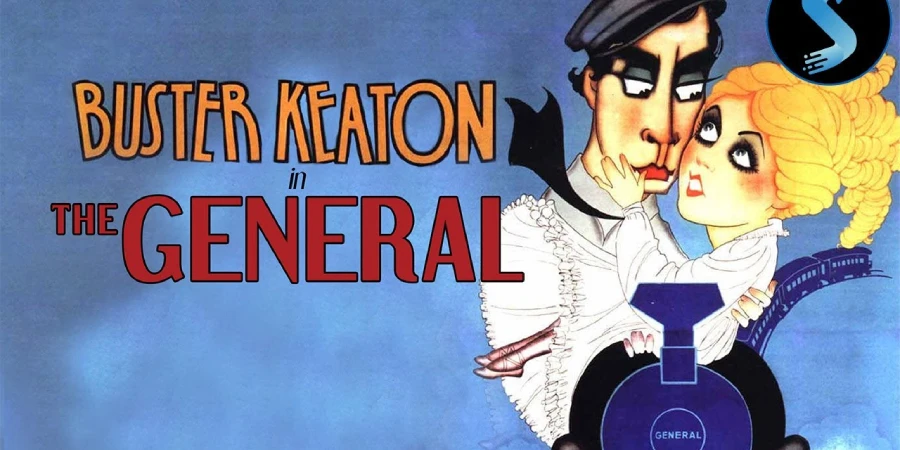

Buster Keaton steals a locomotive, gets chased across half of Civil War Georgia, and pulls off one of the most expensive single stunts in silent film history, all without cracking a smile. The General runs on pure mechanical comedy: trains collide, bridges collapse, and a mild-mannered Southern railroad engineer named Johnnie Gray somehow saves both his engine and his girl. What makes this film so watchable in 2024 is not nostalgia but craft, the kind where every gag is engineered as precisely as a gear train. Keaton treats comedy the way a watchmaker treats a movement: no wasted parts.
Detailed Summary
Johnnie Gray Tries to Enlist
The film opens in Marietta, Georgia, in 1861. Johnnie Gray (Buster Keaton) loves two things: his locomotive, The General, and Annabelle Lee (Marion Mack). He visits Annabelle and her family, but when Confederate recruiters appear outside, Johnnie rushes to enlist before she can stop him.
Army officials reject him without explanation, deciding privately that he is more valuable as an engineer than as a soldier. Annabelle and her family do not know this. They see only that Johnnie returned from the recruitment office without a uniform, and Annabelle refuses to speak to him until he joins up. Johnnie tries repeatedly to enlist and gets turned away each time, once while sitting so close to a recruiter that the man literally steps over him.
The Great Locomotive Chase Begins
A year passes. Union spies, led by Captain Anderson (Glen Cavender), hatch a plan to steal a Confederate locomotive, burn bridges behind them, and cripple Southern supply lines. They choose The General as their target.
During a meal stop at Big Shanty, Georgia, the spies unhitch the passenger cars while the crew and passengers eat inside. Johnnie, last to leave the train, returns to find his engine gone. He gives chase on foot, then aboard a handcar, then hijacks a second locomotive called The Texas. This solo pursuit through the Georgia countryside is one of the funniest and most precisely choreographed sequences in film history.
Johnnie Pursues Alone
Keaton rides the nose of The Texas like a man totally unbothered by physics. He dodges artillery shells, shovels wood, and deals with a second engine the spies cut loose to block him. The loose engine rolling toward him, and Johnnie’s deadpan adjustments to stay alive, generate comedy from pure geometry.
At one point, Johnnie climbs onto the cowcatcher of The Texas to clear a log from the tracks, and the train keeps moving. He sits there, plucking at the wood with calm annoyance while the ground rushes past beneath him. It is probably the best single image in the film.
Annabelle Is Captured
Johnnie tracks the spies into Northern territory and discovers, inside an enemy-occupied house, that Annabelle has been taken prisoner by the Union soldiers. He sneaks in, hides under a table while officers discuss their battle plans, and accidentally falls asleep. He wakes up and overhears a critical detail: Union General Thatcher plans a massive surprise attack on the Confederate flank.
Johnnie frees Annabelle and hides her in a large burlap sack. Getting her out of the building requires a series of increasingly absurd close calls, each resolved by Keaton’s physical precision rather than luck.
The Return Chase
Now Johnnie steals The General back and races south, with Annabelle aboard and the entire Union pursuit force behind him. This second chase runs in reverse geography, which Keaton uses brilliantly to re-deploy earlier visual setups with new payoffs.
Annabelle tries to help stoke the engine. She picks up a small, thin piece of wood to toss into the furnace, and Keaton’s double-take reaction, followed by his gentle-but-exasperated kiss before throwing in a bigger log, lands as one of the warmest comic moments in the film. Keaton gets more emotion across in that three-second gag than most actors manage in a full dramatic scene.
Johnnie sets fire to a wooden railroad bridge over Rock River to stop the pursuing Union train. He makes it across. The Union engineer pushes forward anyway, and the burning bridge collapses under the weight of the locomotive. That collapsing bridge, with the real train plunging into the real water below, cost an enormous sum and remains one of the most spectacular practical stunts ever filmed.

Movie Ending
Johnnie reaches Confederate lines and delivers his intelligence about the Union attack. Confederate officers scramble to prepare, and a genuine battle erupts. Keaton plays Johnnie in the middle of it all, still chasing, still ducking, now accidentally heroic.
General Thatcher’s surprise assault collapses because Johnnie’s warning gave the South time to regroup. During the fighting, Johnnie single-handedly captures General Thatcher at gunpoint, stumbling into heroism the way he stumbles into everything. Confederate officers commission him as a lieutenant on the spot.
Now in uniform, Johnnie reunites with Annabelle. He sits on the locomotive’s sidestep in his new officer’s coat, arm around Annabelle, and soldiers keep interrupting to salute him. He salutes back, then returns to Annabelle, then salutes again, building a rhythm that is funny, sweet, and a little bittersweet all at once. It is a perfect closing image: Johnnie finally has his girl and his rank, but the war keeps intruding even in his happiest moment. Keaton ends on a gag that is also a quiet observation about how life never fully pauses for personal joy.
Are There Post-Credits Scenes?
The General is a 1926 silent film. There are no post-credits scenes.
Type of Movie
The General fits firmly in the silent comedy and action-adventure categories. Its tone is deadpan and physical, building laughs from engineering logic rather than mugging or slapstick chaos.
It also functions as a surprisingly effective Civil War adventure film. Keaton takes the period seriously enough that the battle sequences carry genuine tension, even when Johnnie is tumbling through them.
Cast
- Buster Keaton – Johnnie Gray
- Marion Mack – Annabelle Lee
- Glen Cavender – Captain Anderson
- Jim Farley – General Thatcher
- Frederick Vroom – A Confederate General
- Charles Henry Smith – Annabelle’s Father
- Frank Barnes – Annabelle’s Brother
Film Music and Composer
As a silent film, The General had no single fixed score during its original release. Theater organists and pianists performed live accompaniment, choosing or improvising music to suit the action.
Various orchestral scores have accompanied the film in restoration screenings and home releases over the decades. Carl Davis composed one well-regarded orchestral score for a restoration presentation. His work matches the film’s pacing closely, leaning on period-flavored melodies and driving rhythms during the chase sequences.
Filming Locations
Despite being set in Georgia, The General was filmed almost entirely in Oregon, primarily around the town of Cottage Grove and along the Row River. Keaton and co-director Clyde Bruckman chose Oregon because its landscape, forests, and narrow-gauge railway lines closely matched the Southern Appalachian terrain of the 1860s.
The collapsing bridge sequence was shot at the Row River near Cottage Grove. That wrecked locomotive sat in the river for years afterward and became a minor local landmark before it was eventually scrapped during World War II for metal salvage.
Awards and Nominations
The General received no major awards recognition upon its release in 1926 and 1927. Critical and popular opinion at the time was lukewarm; wider recognition of the film’s achievement came decades later.
Behind the Scenes Insights
- Keaton co-directed the film with Clyde Bruckman, though Keaton drove most creative decisions about the gags and staging.
- Keaton based the film on an actual Civil War incident known as the Great Locomotive Chase, which occurred in April 1862.
- The bridge collapse involved a real, full-sized locomotive plunging into the river below. No model work. The production did not fish the engine out; it was too expensive to retrieve.
- Keaton reportedly hurt his neck during production when a water jet from a pipe knocked him off the train. He did not realize until years later that the injury had been serious.
- Marion Mack found the shoot physically grueling. She was required to be dragged, tossed, and bundled into a sack on multiple takes.
- Keaton’s team built and operated real locomotives, not props. The production worked with actual narrow-gauge rail lines in Oregon.
- Contemporary reviews were mixed to negative, with some critics calling the film too long and too serious for a Keaton comedy. History has not been kind to those reviews.
Inspirations and References
Keaton based The General directly on Daring and Suffering: A History of the Great Railroad Adventure, a memoir by William Pittenger, one of the Union soldiers involved in the actual 1862 raid. Pittenger’s account gave Keaton the factual skeleton of the story.
Keaton flipped Pittenger’s perspective. Pittenger wrote from the Union soldiers’ point of view, framing the raiders as heroes. Keaton told the same story from the Confederate engineer’s side, which gave Johnnie Gray his underdog logic and kept the politics relatively neutral for a 1920s audience.
Alternate Endings and Deleted Scenes
No well-documented alternate endings exist for The General. Given Keaton’s working method, gags were developed and tested practically on location rather than scripted in multiple versions first.
Some footage and gags from production did not make the final cut, but no formally documented deleted scenes have entered the public record in a way that allows confident description here.
Book Adaptations and Differences
The General draws from Pittenger’s memoir but is not a strict adaptation. Keaton invented Annabelle Lee entirely; the romance has no basis in the historical account. The Union raiders in Pittenger’s book are the protagonists, while Keaton turned the Confederate engineer into his hero. The film borrows the factual premise and little else.
Memorable Scenes and Quotes
Key Scenes
- The cowcatcher log scene: Johnnie sits on the front of a moving locomotive, methodically removing a log from the tracks while the train barrels forward. His posture suggests mild inconvenience, not mortal danger.
- The cannon gag: Johnnie loads a cannon on a flatcar and tries to aim it at the pursuing Union train. Every bump and curve of the track shifts the barrel. It eventually points directly at Johnnie himself, who leans aside just as it fires.
- The small stick of wood: Annabelle tosses a tiny, worm-eaten splinter into the furnace. Johnnie stares at it. He gives her an exasperated kiss, takes the stick out, and throws in a proper log.
- The bridge collapse: Johnnie’s burning bridge gives way under the Union locomotive. The engine tips, falls, and hits the river in a cloud of steam. Shot once, with a real engine.
- The final salute loop: Johnnie tries to sit quietly with Annabelle while soldiers keep interrupting to salute. He develops a rhythm: salute, kiss, salute, kiss, each beat perfectly timed.
Iconic Quotes
- The General is a silent film. Its intertitles carry the story rather than spoken dialogue, and none have entered popular culture as quotable lines the way dialogue from sound films has.
Easter Eggs and Hidden Details
- Keaton frequently positioned himself in the geometric center of wide shots, making his small figure the visual anchor of enormous landscapes. Watch how often he is framed dead center between two large objects in motion.
- The Oregon locations feature trees and terrain that do not match Georgia at all on close inspection. Keaton counted on audiences not being geographers.
- Several of the soldiers in the battle scenes were actual Oregon National Guard members hired as extras, which gives the crowd shots an unusual sense of real military discipline.
- The second locomotive used in the film, The Texas, shares its name with a real locomotive involved in the original 1862 chase, which Keaton included as a nod to the historical record.
- Keaton wears the same jacket throughout the entire film, which makes continuity between the chaotic action sequences feel oddly grounded.
Trivia
- The film flopped commercially on its initial release, contributing to financial pressures on Keaton’s production company.
- Keaton considered The General his personal favorite among his own films.
- The bridge collapse sequence ranks among the most expensive single shots in the silent film era.
- Cottage Grove, Oregon, later held screenings and events celebrating the film’s connection to the town.
- Keaton performed all of his own stunts. No stunt double sat on that cowcatcher.
- The film runs roughly 79 minutes in most standard restorations, though projection speed variations during the silent era mean different prints run at slightly different lengths.
- Keaton’s production team had to coordinate with actual working railways to film on active tracks.
- Union soldiers in the film are portrayed as competent and organized rather than as cartoonish villains, which was unusual for a Confederate-perspective Civil War story in the 1920s.
Why Watch?
Keaton builds his biggest laughs from engineering, not anarchy. Every gag in The General works because it obeys physics and then exploits it, which means you can follow the logic in real time and still be surprised. No sound film has ever staged a chase with this level of spatial clarity. Watch it for the cannon sequence alone; few films since have matched that single gag’s comic construction.
Director’s Other Movies
- The Navigator (1924)
- Sherlock Jr. (1924)
- Seven Chances (1925)
- Our Hospitality (1923)
- Steamboat Bill, Jr. (1928)
- The Cameraman (1928)