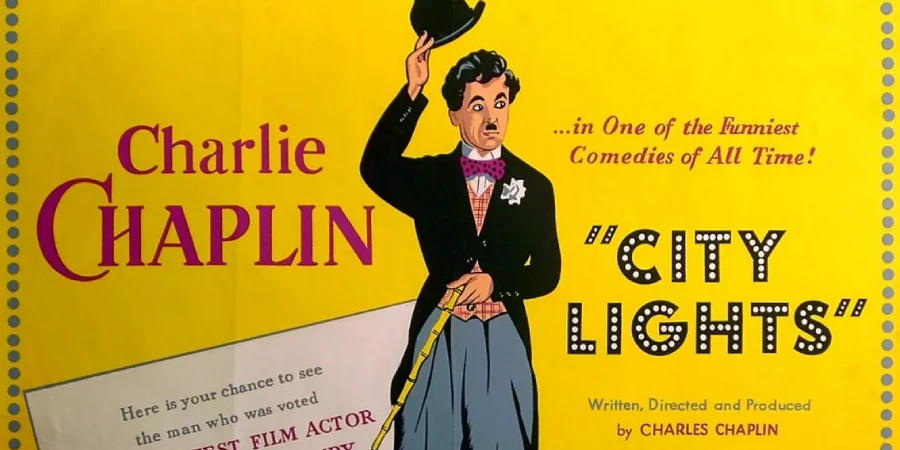

Charlie Chaplin made a film so emotionally precise that its final shot has reduced audiences to tears for nearly a century. City Lights (1931) follows a nameless, penniless Tramp who falls in love with a blind flower girl and orchestrates an elaborate, desperate scheme to restore her sight. Chaplin released it as a silent film in an era when sound had already taken over Hollywood, essentially betting his career on pantomime. He won that bet, and then some.
Detailed Summary
The Statue Unveiling: A Tramp Appears
City dignitaries gather to unveil a new public monument celebrating “Peace and Prosperity.” When the cloth drops, the Tramp is discovered sleeping in the arms of one of the statues. His attempts to climb down without causing offense are a masterclass in physical comedy, setting the film’s tone immediately.
He scrambles away from the angry crowd, navigating the city streets with his familiar shuffling dignity. From the very first scene, Chaplin establishes the Tramp as a man who exists in the cracks of polite society, tolerated by no one and noticed by very few.
Meeting the Blind Flower Girl
On a street corner, the Tramp encounters a young woman selling flowers. She is beautiful, gentle, and completely blind. He buys a flower from her, and when she hears a wealthy man’s car door slam nearby, she assumes her customer is rich.
This mistaken identity becomes the emotional engine of the entire film. The Tramp does nothing to correct her assumption. He is smitten, and her belief in his wealth gives him a purpose he has never had before.
The Eccentric Millionaire
That same night, the Tramp wanders to a riverside and encounters a wealthy, suicidal man about to drown himself. He saves the man’s life, and the millionaire, in a flood of gratitude, immediately adopts the Tramp as his best friend. However, there is a catch: when the millionaire sobers up, he has no memory of the Tramp at all and treats him like a stranger.
This cycle repeats throughout the film. Drunk, the millionaire is generous and warm; sober, he is cold and dismissive. Chaplin uses this device to satirize the arbitrary, alcohol-soaked nature of upper-class loyalty.
Living the High Life, Temporarily
During one of the millionaire’s generous drunk spells, he invites the Tramp to a lavish party. The Tramp attends in borrowed finery, eating well and mingling with the elite. Consequently, the gap between his real circumstances and his performed status becomes a source of both comedy and melancholy.
He sneaks away from the party to visit the flower girl again, bringing her money and maintaining the fiction of his wealth. Meanwhile, he learns she is seriously ill and behind on her rent.
The Boxing Match
Desperate for money to help the girl, the Tramp agrees to participate in a fixed boxing match. His original partner in the scheme abandons him, and a much larger replacement fighter takes his place. What follows is one of cinema’s great physical comedy sequences, as the Tramp ducks, weaves, and uses the referee as an unwilling human shield.
He loses the fight decisively. In addition to his battered pride, he walks away with no money, no plan, and a girl who is growing sicker by the day.
The Doctor’s Bill and the Millionaire’s Rescue
Circumstances grow increasingly dire for the flower girl and her grandmother. A doctor tells them she needs an operation to restore her sight, but the cost is far beyond anything they can manage. The Tramp is frantic to help.
Fortune briefly intervenes when the millionaire, drunk again, runs into the Tramp and gives him a thousand dollars to give to the girl. The Tramp rushes to deliver the money, paying her rent and funding her medical treatment. For one shining moment, everything seems possible.
Robbery, Arrest, and Ruin
That same night, burglars break into the millionaire’s mansion. Police arrive, the millionaire sobers up, and he has no recollection of giving the Tramp any money. From the millionaire’s sober perspective, the Tramp looks exactly like a thief caught fleeing with a thousand dollars.
Police arrest the Tramp. He goes to prison, and the girl undergoes her operation while he serves his sentence. She never learns what really happened; she only knows that her mysterious benefactor has vanished.
Movie Ending
Months pass. The Tramp is released from prison, visibly worn down, his clothes even more ragged than before. He drifts back through the city streets, a figure so diminished that even children mock him and toss garbage at his head. Chaplin plays this sequence with a quiet, aching sadness that no amount of slapstick can soften.
Meanwhile, the flower girl’s sight has been fully restored. She now runs a small, prosperous flower shop with her grandmother. She is happy, healthy, and beautiful in the full light she can finally see. However, she still thinks of her mysterious benefactor, imagining him as some elegant, wealthy gentleman.
Fate brings them to the same street corner. She spots the Tramp through her shop window, and on impulse, she steps out to offer him a flower and a coin, moved by pity for this shabby little man. He stares at her, instantly recognizing the woman he sacrificed everything for.
She takes his hand to press the coin into it, and in that moment of touch, she recognizes him. Her expression shifts from amusement to astonishment to something far more complex. She asks quietly, “You?” He nods, smiling with trembling hope. She replies, “You can see now?” And she answers, “Yes, I can see now.”
Chaplin holds on his face. It is the most famous close-up in silent cinema: a man simultaneously hopeful and terrified, loving and ashamed, yearning and unsure. He does not know if she sees a hero or a disappointment. Audiences never quite know either, and that ambiguity is precisely the point.
This ending matters because it refuses easy comfort. Chaplin does not give us a kiss, a declaration, or a resolution. He gives us a feeling, raw and unresolved, and trusts the audience to carry it. Moreover, the irony is devastating: she gained her sight, but now she can see exactly who he really is.
Are There Post-Credits Scenes?
City Lights has no post-credits scene. Films of this era did not include such sequences. The story ends on that extraordinary final close-up, and the credits roll without any additional footage.
Type of Movie
City Lights is a silent comedy-drama with strong romantic and satirical elements. Its tone shifts constantly and deliberately, moving from pure slapstick to heartbreaking pathos within single scenes. In contrast to most comedies of its era, it treats its emotional content with absolute seriousness.
Chaplin described it as “a comedy romance in pantomime.” That label is accurate but undersells the film’s emotional ambition and its quietly devastating critique of class and wealth.
Cast
- Charlie Chaplin – The Tramp
- Virginia Cherrill – The Blind Flower Girl
- Harry Myers – The Eccentric Millionaire
- Hank Mann – The Boxing Opponent
- Florence Lee – The Flower Girl’s Grandmother
Film Music and Composer
Chaplin composed the score himself, one of his most celebrated achievements outside of acting and directing. He had no formal musical training, yet he created melodies of genuine beauty and emotional precision. His working method involved humming themes to musical arrangers who then transcribed and orchestrated his ideas.
The most notable piece is “La Violetera”, a Spanish song Chaplin adapted as the flower girl’s leitmotif. Its gentle, recurring presence ties her character to every emotional high point in the film. Chaplin actually faced a lawsuit over his use of the melody, which he ultimately settled.
Notably, the score was one of the first Chaplin composed to synchronize with a sound film print, even though the film itself contained no spoken dialogue. Sound effects and musical accompaniment replaced dialogue entirely, giving the film a hybrid identity that sat between silent and sound cinema.

Filming Locations
Production took place almost entirely on the United Artists studio lot in Hollywood, California. Chaplin built elaborate street sets to simulate a bustling American city, giving him complete control over the visual environment. This control mattered enormously to a filmmaker who was famously obsessive about every frame.
Some exterior scenes used real Los Angeles streets and locations to blend with the studio work. In contrast to directors who relied on natural locations for authenticity, Chaplin preferred the constructed world because he could shape it to serve the story’s emotional logic rather than its geographic reality.
Awards and Nominations
City Lights predates the era when the Academy Awards recognized films of its kind with major nominations. However, the American Film Institute ranked it among the greatest American films ever made, and it consistently appears on international critics’ lists of the finest cinema ever produced.
Chaplin received an honorary Academy Award during his career, recognizing his extraordinary body of work as a whole. City Lights stands as a central pillar of that legacy.
Behind the Scenes Insights
- Chaplin spent nearly three years completing City Lights, an extraordinarily long production period driven by his perfectionism and constant reshooting of scenes.
- Virginia Cherrill, who played the flower girl, famously clashed with Chaplin on set; he reportedly came close to replacing her mid-production and actually filmed test footage with another actress.
- Chaplin shot the opening sequence with the statues numerous times over many months, dissatisfied with how the comedy was landing.
- Cherrill’s dismissal and rehiring became one of Hollywood’s more dramatic production stories; Chaplin ultimately kept her because recasting would have required reshooting too much footage.
- Chaplin released the film as a silent picture in 1931, long after the industry had converted to sound, a decision widely considered commercial suicide that proved to be a triumph instead.
- Albert Einstein attended the Los Angeles premiere alongside Chaplin, famously remarking on the crowd’s adulation of a man they could not understand, which Chaplin took as a profound compliment.
Inspirations and References
Chaplin drew on his own experiences of poverty growing up in London. His childhood in working-class South London, marked by genuine deprivation, informed the Tramp’s relationship with wealth, dignity, and social invisibility. The character was not an abstraction for Chaplin; it carried real autobiographical weight.
The romantic plot involving a blind woman likely drew on broader sentimental literary traditions common in Victorian and Edwardian fiction. Chaplin was a voracious reader who absorbed influences widely, though no single source text inspired the story directly.
Furthermore, the film’s satirical treatment of the drunken millionaire reflects Chaplin’s deep ambivalence about the wealthy, a class he had entered but never fully trusted. His political sympathies always ran toward the poor, and the millionaire’s conditional generosity functions as a pointed social critique.
Alternate Endings and Deleted Scenes
Chaplin shot and discarded enormous amounts of footage during the three-year production. His archives reportedly contain alternate takes of nearly every major sequence, including multiple versions of the final encounter between the Tramp and the flower girl. However, no substantially different alternate ending has been officially released or widely documented.
Some footage from the extended production period exists in archival collections, but Chaplin controlled his own archive fiercely and did not release outtakes or deleted scenes for public consumption during his lifetime. As a result, much of what he cut away from the final film remains inaccessible or undocumented.
Book Adaptations and Differences
City Lights is not based on any book, play, or previously published work. Chaplin wrote the original story himself, developing it through improvisation, rehearsal, and a years-long process of trial and error on set. The film has no source text to compare against.

Memorable Scenes and Quotes
Key Scenes
- The opening statue sequence, where the Tramp is discovered sleeping on a civic monument during its unveiling ceremony.
- The Tramp’s first meeting with the blind flower girl, built entirely on the comedy and tragedy of mistaken identity.
- The boxing match sequence, one of the most precisely choreographed pieces of physical comedy Chaplin ever filmed.
- The Tramp delivering the thousand dollars to the flower girl’s home, a scene of pure, unironic warmth.
- The final close-up, arguably the most emotionally loaded single shot in cinema history.
Iconic Quotes
- “You can see now?” – The Tramp, in the film’s closing title card.
- “Yes, I can see now.” – The Flower Girl, the final line of the film.
- The opening monument’s dedication inscription: “To the people of the city we donate this monument: Peace and Prosperity.”
Easter Eggs and Hidden Details
- During the party sequence, Chaplin includes a brief moment where the Tramp accidentally swallows a party noisemaker, producing increasingly absurd sounds; this sequence is partly a subtle, playful jab at the talking pictures Chaplin refused to make.
- Chaplin cast his own children in small background roles in some of his productions, and close viewers of crowd scenes in his films often spot family members.
- The millionaire’s cycle of drunk generosity and sober hostility mirrors real behaviors Chaplin observed in wealthy patrons he encountered during his rise to fame, giving the satire a documentary edge.
- Virginia Cherrill reportedly never fully mastered the technical challenge of looking blind convincingly; several close-up takes were cut because her eyes tracked movement instinctively. Chaplin’s workaround was to carefully limit her close-up angles.
Trivia
- Chaplin reportedly shot the scene where the flower girl first sells a flower to the Tramp over three hundred times across multiple days, obsessively seeking the exact emotional tone he wanted.
- Albert Einstein attended the world premiere; his presence alongside Chaplin produced one of film history’s most photographed red carpet moments.
- Despite releasing a silent film in 1931, Chaplin’s film was a massive commercial success, vindicating his refusal to adopt sound dialogue.
- James Agee, the legendary film critic, called the ending of City Lights “the greatest single piece of acting ever committed to celluloid.”
- Chaplin personally supervised every aspect of the production, including costume design, set construction, musical composition, and editing, making him one of cinema’s first true auteurs in the modern sense.
- Virginia Cherrill was largely unknown before this film; Chaplin cast her after a chance encounter, which was consistent with his practice of discovering non-professional faces for key roles.
Why Watch?
City Lights is the rare film that makes you laugh until it breaks your heart, then leaves you sitting quietly in the wreckage, grateful for the experience. Its final moments communicate something about love, class, and human dignity that most films with full dialogue and modern budgets never approach. Chaplin proves here that silence can carry more emotional weight than any spoken word.
Director’s Other Movies
- The Kid (1921)
- The Gold Rush (1925)
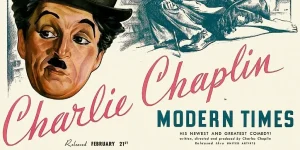
- Modern Times (1936)
- The Great Dictator (1940)
- Monsieur Verdoux (1947)
- Limelight (1952)
Recommended Films for Fans
- The General (1926)
- Sunrise: A Song of Two Humans (1927)
- Modern Times (1936)
- The Kid (1921)
- Gigot (1962)
- The Artist (2011)
- Safety Last! (1923)
- Roman Holiday (1953)