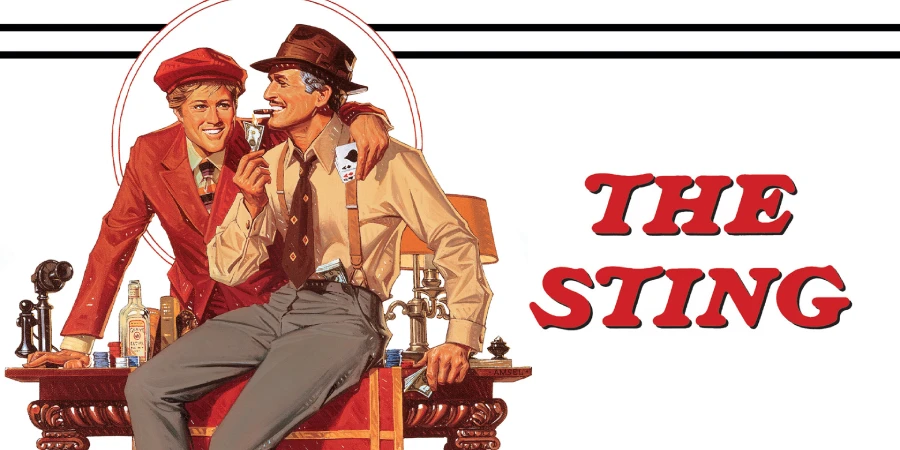

Paul Newman lights a cigarette, glances sideways at Robert Redford, and you already know these two men are going to steal something from somebody. The Sting is a confidence game running at full tilt from its opening frames, a film so comfortable in its own deception that it cheerfully cons the audience along with its mark.
Director George Roy Hill orchestrates the whole affair with the cool precision of a card dealer who has already seen your hand. Every smile in this movie means something different from what you think it means.
Detailed Summary
The Setup: Hooker Gets Burned
We open in Joliet, Illinois, in 1936. Small-time grifter Johnny Hooker (Robert Redford) and his partner Luther Coleman (Robert Earl Jones) accidentally rob a numbers runner working for Doyle Lonnegan, a powerful New York mob boss. It feels like a lucky score until Lonnegan’s men track Luther down and kill him.
Hooker is devastated and furious. He wants revenge, but he is badly outmatched. Luther had always talked about a legendary Chicago con man named Henry Gondorff, and Hooker decides that Gondorff is the only person with the skill and the nerve to take Lonnegan down.
Finding Gondorff
Hooker travels to Chicago and finds Gondorff (Paul Newman) drunk, hiding from the FBI, and living above a merry-go-round. It is a deliberately unglamorous introduction for the film’s elder statesman of the con. Gondorff is sleeping off a bender when Hooker wakes him, and Newman plays the grogginess with such relaxed charm that you root for this man before he has done a single impressive thing.
Gondorff agrees to help. He wants to run a big con on Lonnegan, something that requires an entire crew, a fake betting parlor, and weeks of careful orchestration.
Assembling the Crew
Gondorff calls in favors from a network of veteran grifters. They rent a space and transform it into a convincing off-track betting parlor called The Wire. Every detail gets dressed: fake bettors, fake tellers, fake telephone operators feeding race results with a deliberate delay that will serve as the mechanism of the con.
Director Hill makes these preparation scenes genuinely entertaining, treating the logistics with the same energy other directors save for action sequences. Watching a fake establishment get built from scratch carries real momentum here.
Hooking Lonnegan on the Train
Gondorff gets himself into a high-stakes poker game aboard a train where Lonnegan is playing. He plays drunk, abrasive, and obnoxious. He cheats openly enough for Lonnegan to notice but not so obviously that Lonnegan can prove it. Gondorff wins a large pot by cheating, and Lonnegan is humiliated in front of his own men.
This is where Hooker steps in with his own role. He introduces himself to Lonnegan as a disgruntled Gondorff employee who has access to racing results before they go out over the wire. He pitches Lonnegan a scheme to beat Gondorff at his own game. Lonnegan, already furious at Gondorff and deeply greedy, takes the bait.
Playing Lonnegan
Hooker feeds Lonnegan two small, winning bets to build his confidence. This is the classic convincer play: let the mark win first so he bets bigger later. Lonnegan wins, relaxes, and starts dreaming of destroying Gondorff financially.
Complications pile up fast. A corrupt local cop named Lieutenant Snyder (Charles Durning) is squeezing Hooker for money and threatening to expose him. Hooker has a brief, ambiguous romance with a diner waitress named Loretta (Dimitra Arliss), who turns out to be an assassin hired by Lonnegan to kill him.
The FBI Complication
A federal agent named Polk approaches Hooker and claims to represent the FBI. Polk threatens Hooker with prison unless he agrees to betray Gondorff and hand him over to federal authorities. Hooker appears to comply, and the film briefly suggests that the whole operation might unravel from the inside.
This subplot keeps the pressure building on Hooker personally. He is being squeezed from three directions at once: Lonnegan’s assassin, Snyder’s blackmail, and now a federal ultimatum.
The Big Bet
Lonnegan arrives at The Wire to place a massive bet based on Hooker’s tip. He brings a briefcase stuffed with cash. Everything seems to be running perfectly. Gondorff is playing his role as the oblivious bookmaker, the fake staff is in position, and the false race result is ready to go out.
Lonnegan bets on a horse to win. But Hooker, at the last possible moment, tells him the horse will place, meaning finish second. Lonnegan frantically tries to change his bet, but the bet is already locked in. The race result comes in: the horse wins rather than places. Under the terms of a place-only bet, Lonnegan loses everything.

Movie Ending
Lonnegan explodes. He pulls a gun and shoots Hooker. Gondorff rushes in, a gun appears from nowhere, and Gondorff gets shot too. FBI agents flood the room. The agent Polk orders everyone to clear out immediately, telling Lonnegan that he has been running an illegal betting operation and needs to vanish before he gets arrested. A shaken Lonnegan grabs his empty briefcase and flees with his tail between his legs.
Then the doors close. Gondorff gets up off the floor. Hooker gets up off the floor. Both men are perfectly alive. The gunshots were blanks. Agent Polk is not actually FBI; he is part of the crew. The entire shootout was staged for Lonnegan’s benefit, a theatrical flourish designed to make him run before he could stop and realize he had been robbed of everything.
Hooker and Gondorff share a quiet, satisfied look at each other. No celebration, no long speech. Hooker walks out the back door, leaving his cut of the money behind, and the audience understands this was never purely about cash. It was about avenging Luther.
What makes the ending work so well is that the film has been conning the audience right alongside Lonnegan. Every scene suggesting Hooker might betray Gondorff was planted misinformation. The apparent FBI agent, the apparent romance, the apparent internal conflict: all of it was performance. Hill trusts viewers to feel fooled and delighted at exactly the same time, and that simultaneous embarrassment and pleasure is the film’s sharpest achievement.
Are There Post-Credits Scenes?
No. The Sting has no post-credits scene of any kind. When the film ends with Hooker walking away from the money and the ragtime score sweeping back in, that is the whole story. Nothing follows the final credits.
Type of Movie
The Sting is a caper film and a period crime comedy. Its tone sits somewhere between a winking comedy and a genuine thriller, never fully committing to either mood and being better for it. The film plays fair with its twists while simultaneously hiding them in plain sight.
Pacing-wise, it moves with confidence through its two-hour runtime. Some viewers find the middle section slightly slow during the crew-assembly montages, but that patience pays off when the final act clicks everything into place.
Cast
- Paul Newman – Henry Gondorff
- Robert Redford – Johnny Hooker
- Robert Shaw – Doyle Lonnegan
- Charles Durning – Lieutenant William Snyder
- Ray Walston – J.J. Singleton
- Eileen Brennan – Billie
- Harold Gould – Kid Twist
- John Heffernan – Agent Polk
- Dimitra Arliss – Loretta
- Dana Elcar – Hickey
- Robert Earl Jones – Luther Coleman
Robert Shaw deserves particular credit here. His Lonnegan is not a cartoon villain. Shaw plays him with a cold, watchful intelligence that makes every scene feel genuinely dangerous. Casting a man of Shaw’s physical authority as the mark was an inspired choice; it raises the stakes every time Hooker and Gondorff manipulate him.
Film Music and Composer
Marvin Hamlisch arranged and adapted the score, drawing entirely from the ragtime compositions of Scott Joplin. Hamlisch did not write original music so much as curate and orchestrate Joplin’s catalog for a film audience that, in 1973, largely did not know this music at all. The move was bold and somewhat counterintuitive given that ragtime peaked roughly thirty years before the film’s 1930s setting.
The most recognizable piece is “The Entertainer,” which Hamlisch arranged in a slightly slower, more wistful tempo than the standard version. It became one of the most recognized film themes of the decade. Hamlisch won the Academy Award for his work on the score.
Joplin’s music pulls off a neat trick: it sounds playful and nostalgic at the same time, which perfectly mirrors the film’s attitude toward its own elaborate deceptions. You feel like you are being entertained by professionals who genuinely love their work.

Filming Locations
Production was based primarily in Los Angeles, with sets and locations dressed to evoke 1930s Chicago and New York. The production design team worked extensively to recreate Depression-era street life, storefronts, and interiors without leaving Southern California.
Universal Studios back lots provided much of the infrastructure for the period recreation. Using controlled studio environments gave the filmmakers precise control over lighting and set dressing, which was particularly important for the elaborate interior of The Wire betting parlor.
A few exterior sequences were filmed on location in the Chicago area to add authentic architectural texture. The combination of real locations and studio construction gives the film a slightly heightened, theatrical quality that suits a story about professional performance and illusion.
Awards and Nominations
The Sting won seven Academy Awards including Best Picture, Best Director for George Roy Hill, Best Original Screenplay for David S. Ward, and Best Film Editing. It received ten nominations total.
Marvin Hamlisch won Best Original Dramatic Score, which remains one of the more unusual wins in that category given that the score consisted of adapted Joplin compositions rather than original music. Neither Newman nor Redford received acting nominations, which still feels like one of the Academy’s more baffling oversights.
Behind the Scenes Insights
- The Sting reunited director George Roy Hill with Newman and Redford following their massive success on Butch Cassidy and the Sundance Kid (1969).
- Robert Redford reportedly lobbied to get the film made after reading David S. Ward’s original script and recognizing its commercial potential.
- The ragtime score decision came relatively late in production and almost did not happen; other musical approaches were considered before the Joplin direction was locked in.
- Robert Shaw performed many of his scenes while nursing a knee injury sustained during production.
- The film’s chapter-title cards, styled after old illustrations, were a deliberate structural choice by Hill to give the film the feeling of a serialized story from a pulp magazine.
- The production consulted with people knowledgeable about actual confidence schemes to ensure the mechanics of the big con felt authentic and plausible.
- George Roy Hill had a military background and ran sets with a discipline that some cast members noted felt unusual for Hollywood productions of that era.
Inspirations and References
David S. Ward based his screenplay on the nonfiction book The Confidence Man by David Maurer, a linguistic scholar who spent years documenting the subculture of professional con artists in mid-twentieth century America. Maurer actually sued over the screenplay, claiming it drew too heavily from his earlier work. The case was settled out of court.
Ward also drew on the broader tradition of Depression-era crime fiction and pulp storytelling. The chapter-structure format and the visual style of the opening title cards nod toward serialized fiction of the 1930s. The film is deeply aware of its own genre history without becoming a parody of it.
Alternate Endings and Deleted Scenes
No officially documented alternate endings for The Sting exist in the public record. The film as released represents Hill’s complete vision, and no significant deleted sequences have been made widely available or discussed in detail by the production team.
Some early script drafts reportedly handled the Loretta subplot differently, with her role in the con’s final mechanics being slightly more prominent. Whatever those variations were, they did not survive into the shooting script in any documented form.
Book Adaptations and Differences
The Sting was not adapted from a single source novel. David S. Ward wrote an original screenplay, though it drew on David Maurer’s nonfiction research into confidence schemes as noted above. No novel version of this specific story exists as a source text to compare against.


Memorable Scenes and Quotes
Key Scenes
- The poker game on the train: Gondorff plays drunk and reckless, winning by cheating while letting Lonnegan see just enough to be infuriated. Newman’s performance here is physical comedy and menace at the same time. He spills his drink, slurs his words, and still takes everything on the table.
- Hooker discovers Loretta is an assassin: She pulls a gun on him in a diner. The scene flips from romantic tension to cold threat in a single cut, and it is one of the sharpest gear changes in the film.
- The final reveal of the staged shooting: Gondorff and Hooker rise off the floor as Lonnegan runs. No music underscores it at first. The silence before the score kicks back in is the best editorial decision in the film.
- Lonnegan placing his bet: Robert Shaw conveys greed, satisfaction, and latent menace all in one unbroken medium shot as he pushes his cash across the counter. You feel the trap closing around him, and the film lets you savor it.
- Gondorff and Hooker’s first meeting: Hooker finds Gondorff passed out and has to drag him awake. It is a deliberately anticlimactic introduction for the film’s most skilled character, and it earns every laugh.
Iconic Quotes
- “He’s not as tough as he thinks.” / “Neither are we.” (Gondorff and Hooker, establishing the film’s central tension in two lines)
- “I don’t know enough to be scared yet.” (Hooker, arriving in Chicago)
- “What was I supposed to do, call him for cheating better than me?” (Lonnegan, explaining why he did not confront Gondorff at the poker table, which perfectly captures how the con traps him)
Easter Eggs and Hidden Details
- The chapter title cards mimic the visual style of J.C. Leyendecker illustrations, a deliberate reference to the golden age of American magazine illustration that would have been current during the film’s 1936 setting.
- Several of the fake bettors populating The Wire in the final act are recognizable from earlier crowd scenes, a subtle visual joke about how thoroughly Gondorff has staffed his operation with professionals.
- The name “The Wire” refers to a real historical confidence scheme in which operators would intercept horse racing telegraph results and use the brief delay to place bets on known outcomes. Maurer documented this scheme in detail.
- Gondorff’s merry-go-round hiding spot is a small visual joke: a man whose entire career involves going in circles, never quite getting anywhere, living literally above a machine that does the same thing.
- Lonnegan’s rigid, formal posture throughout the film contrasts deliberately with Gondorff’s loose, physical ease. Hill uses body language to show who is truly in control before the plot makes it explicit.
Trivia
- The Sting was the highest-grossing film of 1973 in North America.
- Scott Joplin died in 1917, and his music had largely faded from public consciousness by 1973. The film’s success directly triggered a major Joplin revival and brought ragtime back into mainstream American culture.
- Robert Shaw was not an American, which gives his performance as a New York mob boss an interesting dimension: he built Lonnegan’s entire physicality and speech pattern from research rather than lived cultural familiarity.
- George Roy Hill, Newman, and Redford all reportedly agreed to significantly reduced upfront fees in exchange for backend profit participation, which proved to be an extremely lucrative arrangement given the film’s massive box office performance.
- David S. Ward was a relatively unknown screenwriter when he sold the script. Winning the Academy Award for Best Original Screenplay was his breakthrough.
- The film’s title refers to the final moment of a big con, specifically the instant when the mark realizes he has been taken but it is already too late to do anything about it.
- A sequel, The Sting II, was released in 1983 with a different cast and none of the original filmmakers involved. It was poorly received.
Why Watch?
Newman and Redford’s chemistry is the real mechanism here, and no other film quite replicates it: two men so naturally comfortable together that their scenes feel genuinely improvised even when they are not. Watching Gondorff run Lonnegan through a scheme built on layers of performance, all while the film runs the same scheme on you, produces a pleasure that is both intellectual and purely sensory. If you want to understand how editing and misdirection work together to manipulate a viewer, this is your classroom.
Director’s Other Movies
- Butch Cassidy and the Sundance Kid (1969)
- Slaughterhouse-Five (1972)
- The Great Waldo Pepper (1975)
- Slap Shot (1977)
- A Little Romance (1979)
- The World According to Garp (1982)