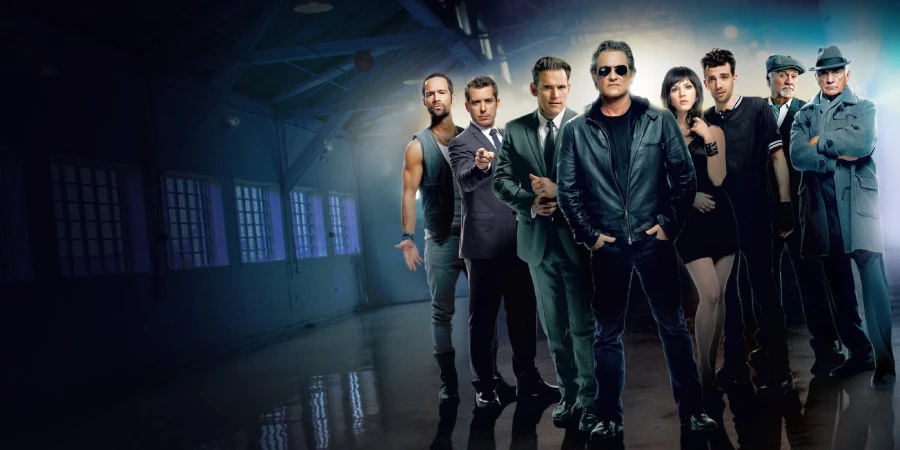

Con artists are only as good as their last betrayal, and The Art of the Steal knows this down to its bones. Kurt Russell plays Crunch Calhoun, a second-rate motorcycle stuntman and part-time art thief who gets conned by his own brother and sent to a Polish prison, then agrees to one last job with that exact same brother years later. Writer-director Jonathan Sobol builds the whole film around a single uncomfortable question: how stupid does a man have to be to trust someone who already burned him once? Spoiler: not stupid at all, as it turns out.
Detailed Summary
Introducing Crunch Calhoun and the World of Small-Time Art Crime
Crunch Calhoun (Kurt Russell) is not exactly a master criminal. He pulls off small art heists on the side while performing dangerous motorcycle stunts for low-budget shows in Europe. His crew is competent but operates far from the glamorous end of the criminal spectrum.
His half-brother Nicky Calhoun (Matt Dillon) is the more polished operator of the two. When a past job goes wrong and Crunch ends up taking the fall, he spends time in a Polish prison while Nicky walks free. That prison stint is the wound the entire film keeps pressing on.
The Reluctant Reunion
Years later, Crunch is scraping by in Canada. He has a new girlfriend, Lola (Katheryn Winnick), and a low-key life he seems genuinely comfortable with. Nicky shows up with a job that promises a serious payday, and Crunch, against every instinct he should have developed in prison, agrees.
Nicky brings a crew that includes Guy (Jay Baruchel), a nervous young accomplice who studies forgery and idolizes Crunch, and Paddy (Kenneth Welsh), an older veteran thief. Rounding things out is Francie (Chris Diamantopoulos), Nicky’s slick and untrustworthy associate. The ensemble has the right texture: everyone has an angle.
The Job: Stealing the Morgenstern Gospel
The target is a priceless illuminated manuscript called the Morgenstern Gospel. A shady collector wants it, and Nicky has brokered the deal. The plan requires forging the manuscript and swapping it for the real thing at a border crossing, which means the crew needs both a skilled forger and a convincing distraction.
Guy handles the forgery. Crunch uses his stunt career as cover. Each piece of the plan slots into place with the film’s characteristic lightness, Sobol keeping the tone breezy even when the logistics tighten.
Interpol and the Heat
Agent Bick (Jason Jones), an Interpol investigator, has been tracking the crew for some time. He circles closer as the job takes shape. His presence keeps the film from drifting into pure caper fantasy; there are real consequences waiting if anything goes sideways.
Bick is not the sharpest Interpol agent ever committed to film, frankly. He functions more as a deadline than a genuine threat, but the screenplay uses him well enough to maintain tension without letting him overshadow the central brother dynamic.
Betrayal, Layered and Revealed
This is where The Art of the Steal earns its title. As the heist reaches its final stages, the film starts peeling back what has actually been happening. Multiple layers of double-cross emerge, each recontextualizing scenes the audience thought it understood.
Crunch has not been the naive mark the film led us to believe. He anticipated Nicky’s betrayal and constructed a counter-plan, running a separate con beneath the one everyone else thought was the job. Guy, Paddy, and Lola are all in on it. Nicky, for once, is the one getting played.
Movie Ending
Crunch’s long game pays off in the final act with satisfying precision. While Nicky believes he is executing his own double-cross against his brother, the real manuscript has already been moved. Crunch’s crew has swapped things around so thoroughly that Nicky ends up with the forgery, thinking he has the genuine article.
Nicky tries to sell the manuscript to the collector, at which point it becomes clear he is holding worthless paper. His scheme collapses completely. Crunch, Lola, and the crew walk away with both the real Morgenstern Gospel and the money from the transaction Nicky thought he controlled.
Agent Bick closes in, but the crew has already covered their tracks. Crunch and Lola vanish cleanly. Guy gets away too, his arc completing a small but genuine emotional beat: he came in as Nicky’s plant but fully committed to Crunch’s side. His loyalty to Crunch over Nicky feels earned rather than convenient.
What makes the ending land is not just the mechanism of the con. It is the quiet satisfaction on Crunch’s face when Nicky realizes what happened. Kurt Russell plays it with enormous restraint, a small smile where a lesser film would have given him a speech. That restraint is the best directorial decision Sobol makes in the whole picture.
Are There Post-Credits Scenes?
The Art of the Steal does not include any post-credits scenes. Once the credits roll, the film is done. No bonus footage, no stingers, nothing extra. You can leave when the titles start.
Type of Movie
This is a crime caper comedy, light in tone but structurally clever. It fits comfortably alongside ensemble heist films that prioritize wit over violence. The stakes feel real but the film never loses its sense of fun.
Sobol keeps the pacing nimble. At no point does The Art of the Steal mistake itself for a prestige thriller. It knows exactly what it is: a crowd-pleasing con film with a sharp screenplay and a cast that visibly enjoys the material.
Cast
- Kurt Russell – Crunch Calhoun
- Matt Dillon – Nicky Calhoun
- Jay Baruchel – Guy
- Katheryn Winnick – Lola
- Kenneth Welsh – Paddy
- Chris Diamantopoulos – Francie
- Jason Jones – Agent Bick
Film Music and Composer
The score for The Art of the Steal was composed by Todor Kobakov. His work on the film keeps things brisk and playful, matching the caper tone without tipping into parody. The music supports the con-within-a-con structure by staying deceptively light even when the plot tightens.
Kobakov, a Canadian composer, has worked frequently in Canadian film and television. His scoring here understands that a good heist film needs music that feels confident without tipping the hand of the screenplay.



Filming Locations
Production took place primarily in Canada, with significant shooting in Toronto and surrounding Ontario locations. The film also makes use of European-flavored settings to sell the international scope of Crunch’s criminal career.
Certain sequences were designed to evoke Poland and other European locations, which matters for the backstory of Crunch’s prison stint. The Canadian production infrastructure handles the budget efficiently, and Sobol squeezes convincing atmosphere from locations that could easily have felt generic.
Awards and Nominations
The Art of the Steal did not receive significant awards recognition. It was a modestly budgeted commercial release that found its audience through home video and streaming rather than the festival circuit.
Behind the Scenes Insights
- Jonathan Sobol wrote the screenplay with Kurt Russell specifically in mind for the role of Crunch Calhoun.
- Jay Baruchel, a Canadian actor, was a natural fit for a Canadian production, and his chemistry with Russell reportedly developed quickly on set.
- Matt Dillon’s casting as the charming but treacherous Nicky leaned deliberately on his ability to play likability and menace at the same time.
- The film was produced with Canadian tax credit financing, a common model for mid-budget genre pictures produced in Ontario.
- Sobol shot the film with an emphasis on practical locations to keep the visual texture grounded rather than stylized.
Inspirations and References
Sobol has cited classic Hollywood caper films as touchstones for the project. The Sting is the obvious ancestor: the long-con structure, the revealed double-cross, the breezy tone. The film wears that influence openly rather than hiding it.
The world of art crime itself, a genuinely active underworld involving forged manuscripts and stolen antiquities, gives the film its grounding. Real art theft involving illuminated manuscripts and rare books has a long history, and Sobol uses that authenticity to keep the MacGuffin feeling weighty.
Alternate Endings and Deleted Scenes
No alternate endings or significant deleted scenes from The Art of the Steal have been made public. The home video release did not include an extensive making-of package with cut footage. If alternate versions exist, they have not surfaced in any documented form.
Book Adaptations and Differences
The Art of the Steal is an original screenplay by Jonathan Sobol. It is not based on any novel, memoir, or prior source material. No book-to-film comparison applies here.
Memorable Scenes and Quotes
Key Scenes
- Crunch’s motorcycle stunt sequence early in the film, which establishes his recklessness and his faded glory in one economical sequence.
- Nicky’s pitch to Crunch for the job, where Matt Dillon layers on enough charm that the audience almost believes it themselves.
- The border crossing sequence, where the forgery swap plays out with clock-ticking precision and genuine suspense.
- The reveal that Crunch has been running his own counter-con the whole time, reframed through a rapid series of cutbacks that recontextualize earlier scenes.
- Crunch’s final quiet smile when Nicky realizes he has been holding a fake, Kurt Russell doing more with his face in four seconds than most actors do in a monologue.
Iconic Quotes
- “The first rule of the con: everybody’s conning somebody.”
- “You can’t cheat an honest man, but nobody in this room is honest.”
Easter Eggs and Hidden Details
- Several background artworks visible during gallery scenes echo the stylistic period of actual illuminated manuscripts, a small bit of production design care that rewards attention.
- Crunch’s motorcycle show is deliberately shabby, his stunts visibly less polished than they once were, a visual shorthand for his diminished circumstances that pays off when his skills matter later.
- Guy’s forgery workspace contains reference books that sharp-eyed viewers can identify as actual published texts on manuscript authentication.
- Nicky’s wardrobe is noticeably more expensive than Crunch’s throughout the film, a costuming choice that underlines who has been living well since the Polish prison job.
Trivia
- Kurt Russell had not led a caper comedy in some years before this film, making the casting feel like a deliberate callback to his more playful screen persona.
- Jay Baruchel was involved in several Canadian productions around this period and brought his established screen awkwardness to Guy in a way that feels organic rather than performed.
- The Morgenstern Gospel, the manuscript at the center of the heist, is a fictional creation of the screenplay and does not correspond to any real historical document.
- Jonathan Sobol’s script went through a development process within the Canadian film funding system before securing its cast, which is part of why the ensemble skews toward actors with existing Canadian industry connections.
- Chris Diamantopoulos, known for a wide range of character work, plays Francie with a sleazy confidence that makes every scene he shares with Dillon feel slightly combustible.
Why Watch?
Kurt Russell’s performance is the reason to seek this one out. Watch him in that final-act reveal scene: no speech, no grandstanding, just a man who has waited years for this specific moment letting it land quietly on his face. Sobol’s screenplay gives the con structure real mechanical satisfaction, and the film earns its twist by playing completely fair with the audience.
Director’s Other Movies
- A Touch of Spice (2009)
- The Spouse in the House (2013)
Recommended Films for Fans
- The Sting (1973)
- Ocean’s Eleven (2001)
- The Italian Job (2003)
- Matchstick Men (2003)
- Dirty Rotten Scoundrels (1988)
- Now You See Me (2013)
- The Brothers Bloom (2008)