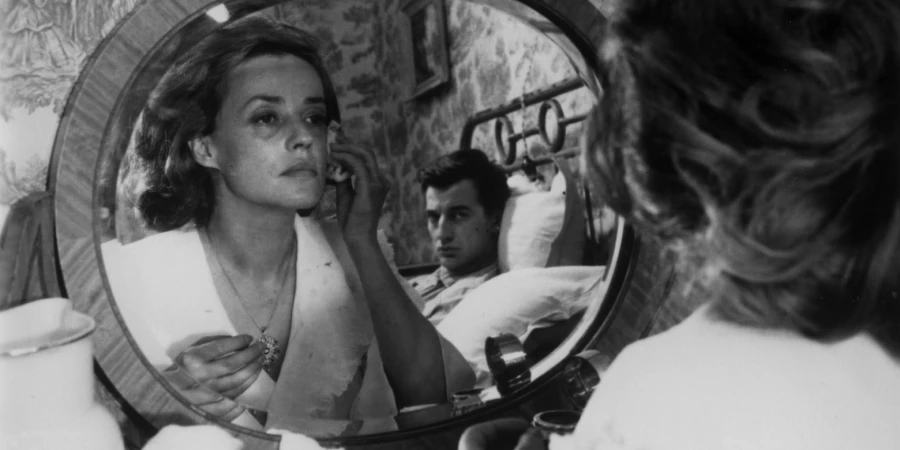

Few films dare to make a murderer out of their most beloved character, and Jules and Jim does exactly that. François Truffaut’s 1962 masterpiece follows a love triangle so intoxicating, so reckless, that it ends in fire and water and ash. Catherine is not simply a free spirit; she is a force of nature that destroys everything she touches, including herself. This film remains one of the most honest, and most devastating, portraits of romantic obsession ever committed to celluloid.
Detailed Summary
Two Friends and a Photograph
Jules, a gentle Austrian, and Jim, a confident Frenchman, meet in Paris in the years before World War One and forge an immediate, deep friendship. Their bond rests on literature, art, and a shared hunger for experience. Neither man is looking for trouble; trouble, however, finds them anyway.
A mutual friend shows them a photograph of a stone statue with a smile that captivates both men instantly. They travel to an Adriatic island just to see the statue in person. That image, serene and unknowable, foreshadows the living woman who will come to consume their lives.
Catherine Arrives
Back in Paris, Jules introduces Jim to Catherine, played with electric unpredictability by Jeanne Moreau. Her face carries the same enigmatic smile as the statue, and both men recognise the connection immediately. Jim steps back; Jules has fallen first, and friendship demands respect.
Catherine is charming, impulsive, and deeply contradictory. She dresses as a man named Thomas to win a race along a bridge, laughing wildly at her own victory. On the other hand, she can pivot into cold fury without warning, and both men sense the danger without fully accepting it.
War Separates the Three
World War One pulls Jules and Jim apart, forcing them onto opposite sides of the conflict as Austrian and French nationals. Truffaut presents the war with archival footage and a brisk, almost documentary pace. Consequently, the horror feels real even as the film refuses to linger on it.
Both men survive, partly because each secretly prays he will not kill the other on the battlefield. That detail, quiet and almost throwaway, says everything about the depth of their friendship. War cannot break what Catherine eventually will.
Jules, Catherine, and a Rhine Cottage
After the armistice, Jim visits Jules in Germany, where Jules has married Catherine. They live in a chalet near the Rhine with their young daughter, Sabine. On the surface, it looks like a pastoral idyll; underneath, the marriage is fracturing badly.
Jules confesses to Jim that Catherine has taken other lovers and will likely leave him entirely. He makes an extraordinary request: he asks Jim to pursue Catherine himself, hoping that keeping her within their shared orbit will prevent her from disappearing for good. In addition, Jules admits he would rather share Catherine with Jim than lose her completely.
Jim and Catherine Together
Jim and Catherine begin a passionate affair, effectively sanctioned by Jules. Their relationship burns bright and intense, but Catherine’s need for total possession quickly creates tension. Jim feels the pull of his Parisian life, including his long-time girlfriend Gilberte, and cannot fully commit.
Catherine becomes pregnant but loses the child. Meanwhile, she and Jim spiral through cycles of joy, jealousy, and cruelty. Jim proposes marriage, then hesitates; Catherine withdraws, then explodes. Their love consumes rather than sustains.
The Relationship Unravels
Jim eventually returns to Paris and reconnects with Gilberte. Catherine, furious at his ambivalence, takes up with another man named Albert. For a period, all three original companions drift apart, each trying to rebuild something resembling a normal life.
However, none of them can fully let go. Jim returns to Catherine one more time, seeking a resolution neither of them is capable of creating. Their final meeting carries a terrible, unspoken weight. Something irreversible is building.
Movie Ending
Catherine invites Jim for a drive, and Jules watches from the riverbank as she steers the car off a broken bridge and into the water below, killing both herself and Jim instantly. She says almost nothing before she does it. Truffaut frames the act with eerie calm, refusing to sensationalise the violence.
Jules survives. He watches the bodies recovered from the water and then attends the cremation of both Catherine and Jim. At the cemetery, he feels, by his own admission, a strange sense of relief. The weight of Catherine’s impossible love has finally lifted.
Truffaut makes no moral judgment here, and that refusal is the point. Catherine does not die as punishment; she dies as the logical conclusion of a personality that could not tolerate limits. Furthermore, Jim dies not as a victim of malice but as the final casualty of a love that was always too large for any stable container.
The ashes of Jim and Catherine are scattered separately, their remains never to mingle. Jules notes that Catherine had once wanted their ashes combined, but the law forbids it. That final irony captures the whole film: even in death, Catherine cannot have what she wants on her own terms.
Are There Post-Credits Scenes?
Jules and Jim contains no post-credits scenes whatsoever. Films of this era did not use that convention, and Truffaut’s ending is entirely self-contained. Once the cremation sequence closes, the film is simply over.
Type of Movie
Jules and Jim fits broadly within the French New Wave movement, blending romance, drama, and tragedy. Tonally, it shifts constantly, moving from playful and comedic in its early sections to deeply melancholic by its final act. That tonal range is part of what makes it so disorienting and so memorable.
In contrast to classical Hollywood melodrama, the film refuses to assign clean roles of villain and victim. It functions, in many ways, as an anti-romance: a film that looks like a love story but systematically dismantles every comfortable expectation that label implies.
Cast
- Jeanne Moreau – Catherine
- Oskar Werner – Jules
- Henri Serre – Jim
- Vanna Urbino – Gilberte
- Boris Bassiak – Albert
- Sabine Haudepin – Sabine
Film Music and Composer
Georges Delerue composed the score for Jules and Jim, and his work here ranks among the finest of his long career. Delerue was a prolific French composer who became one of Truffaut’s most trusted collaborators, scoring several of his films over the following decades. His music carries a lightness that makes the eventual tragedy land even harder by contrast.
The most memorable musical moment in the film is the song Le Tourbillon de la Vie, performed by Jeanne Moreau herself. Moreau sings it simply, with a guitar, and the song’s lyrics about the spinning carousel of life serve as a thematic summary of everything the film explores. It remains one of the most iconic musical interludes in French cinema history.


Filming Locations
Principal photography took place in Paris and in the Alsace region of France, with some sequences shot near the Rhine to establish the German countryside setting. The Paris sequences ground the film in a specific pre-war bohemian world, all narrow streets and intellectual cafes. That environment gives the early friendship between Jules and Jim a believable cultural texture.

The chalet scenes, filmed in a rural French setting doubling for Germany, create a deliberate contrast with the urban energy of Paris. Notably, the isolation of that countryside location mirrors the emotional isolation Catherine and Jules experience in their marriage. Location and psychology reinforce each other throughout the film.
Awards and Nominations
Jules and Jim received significant critical recognition upon its release but was notably absent from major international awards ceremonies of the time. Jeanne Moreau’s performance earned wide critical acclaim, though formal nominations for her work were limited during the film’s initial release cycle.
Over subsequent decades, the film appeared on numerous critics’ polls and best-of lists, including prominent positions in Sight and Sound magazine’s influential surveys of the greatest films ever made. Moreover, its lasting canonical status represents a form of recognition that exceeds any single trophy.
Behind the Scenes Insights
- Truffaut shot the film in black and white widescreen, using the Franscope anamorphic process, which gave the images an unusual visual richness for a low-budget production.
- Jeanne Moreau was deeply involved in shaping Catherine’s character, and Truffaut gave her considerable latitude to improvise within scenes.
- Truffaut used freeze frames, iris shots, and handheld camera techniques to create a sense of documentary spontaneity, signatures of the French New Wave approach.
- Oskar Werner and Truffaut had a warm working relationship during production, though it deteriorated significantly on their later collaboration, Fahrenheit 451.
- The film’s voiceover narration, delivered with a deliberately literary quality, was a conscious stylistic choice to honor the novel’s prose style.
- Truffaut reportedly worked extremely quickly on set, completing principal photography in a compressed schedule to maintain energy and spontaneity.
Inspirations and References
Jules and Jim directly adapts the 1953 autobiographical novel of the same name by Henri-Pierre Roché. Roché based the story on his own life, specifically his long friendship with the German writer Franz Hessel and their shared relationship with a woman named Helen Grund, who became Hessel’s wife. The real-life triangle played out over decades, though Roché fictionalised and compressed many events.
Truffaut had admired Roché’s novel intensely for years before adapting it. In addition, Roché’s other novel, Two English Girls, also became a Truffaut film years later. The connection between the two men was genuinely literary and emotional, not merely commercial.
Alternate Endings and Deleted Scenes
No formally documented alternate endings or significant deleted scenes from Jules and Jim have entered public record or been released as supplementary material. Truffaut was known for working with tight, focused cuts, and the film’s structure suggests a director who knew exactly where he was going from the start.
Some scholars have noted that the pace of the film implies judicious editing choices throughout, particularly in the war sequence, but no specific cut footage has been identified or screened publicly.
Book Adaptations and Differences
Jules and Jim adapts Henri-Pierre Roché’s 1953 novel closely in spirit, though Truffaut and co-writer Jean Gruault made structural adjustments to compress the timeline and sharpen the dramatic focus. Roché’s novel spans a much longer period and includes considerably more romantic entanglements on all sides. Truffaut streamlined these to keep Catherine at the emotional centre.
One significant difference involves the ending: Roché’s novel extends further into Jules’s interior reflection after the deaths, whereas Truffaut closes much more abruptly, letting the cremation scene speak for itself. Furthermore, the film amplifies Catherine’s volatility and agency, making her more cinematically vivid than the novel’s somewhat more diffuse portrait.


Memorable Scenes and Quotes
Key Scenes
- Catherine dressing as Thomas and racing the boys across the bridge, winning and laughing triumphantly, establishing her character in a single unforgettable image.
- Moreau performing Le Tourbillon de la Vie with simple guitar accompaniment, the camera resting on her face with quiet adoration.
- Jules asking Jim to pursue Catherine, delivering one of cinema’s most quietly heartbreaking confessions of marital defeat.
- Catherine jumping into the Seine near the film’s beginning, a dramatic act of caprice that both thrills and warns the two men simultaneously.
- The car driving off the broken bridge in the film’s final minutes, filmed with startling directness and without dramatic musical emphasis.
- Jules watching the cremation from a respectful distance, his face carrying something that looks unsettlingly close to peace.
Iconic Quotes
- “She was not particularly beautiful, but she was radiant.” (Narrator, describing Catherine)
- “You said: I love you. I said: Wait. I was going to say: Take me. You said: Go away.” (Catherine, reading her poem)
- “Jules, I want you to make love to Jim. I love you both.” (Catherine, articulating her impossible desire)
- “She was a queen. We were not kings.” (Narrator)
Easter Eggs and Hidden Details
- The stone statue the men travel to see on the Adriatic island physically resembles Jeanne Moreau, a deliberate visual rhyme that Truffaut plants before the audience has even met Catherine.
- Catherine’s habit of pouring vitriol on perceived infidelity connects symbolically to a moment early in the film where she discusses burning men who tell lies, foreshadowing her destructive final act.
- The pinwheel that Catherine plays with in several scenes echoes the title of the song Le Tourbillon, meaning whirlwind or spinning top, quietly linking her physicality to the film’s central metaphor.
- Truffaut uses freeze frames on Catherine’s face at key moments, a technique that subtly positions her as a photographic object, something to be looked at rather than fully understood.
- The name Thomas, which Catherine adopts for her bridge-racing disguise, was also the name Roché used in his novel for the Jim character, a small in-joke for readers of the source material.
Trivia
- Henri-Pierre Roché was in his seventies when he published the source novel; it was his debut work of fiction, drawn from journals he had kept for decades.
- Truffaut considered Jules and Jim one of his most personal films, despite the story not being autobiographical in a literal sense.
- Boris Bassiak, who plays Albert and accompanies Moreau on guitar during Le Tourbillon de la Vie, was a real musician and songwriter, not primarily an actor.
- The film was initially controversial in some quarters for its sympathetic, non-judgmental treatment of adultery and unconventional relationships.
- Jeanne Moreau learned to perform Le Tourbillon de la Vie specifically for the film; the song was written by Bassiak.
- Truffaut dedicated the film to Henri-Pierre Roché, who died in 1959 before the film was completed.
- The film’s voiceover narration quotes and paraphrases passages directly from Roché’s novel, preserving the literary texture of the source.
Why Watch?
Jules and Jim is essential viewing because it does something very few films manage: it makes you love a character you should probably fear. Jeanne Moreau’s Catherine is a portrait of charismatic self-destruction that has never been surpassed. Moreover, Truffaut’s direction turns what could be a simple melodrama into a profound meditation on freedom, loyalty, and the cost of loving without limits.
Director’s Other Movies
- The 400 Blows (1959)
- Shoot the Piano Player (1960)
- Soft Skin (1964)
- Fahrenheit 451 (1966)
- Stolen Kisses (1968)
- The Wild Child (1970)
- Two English Girls (1971)
- Day for Night (1973)
- The Story of Adele H. (1975)
- Small Change (1976)
- The Last Metro (1980)
Recommended Films for Fans
- Breathless (1960)
- Vivre Sa Vie (1962)
- Belle de Jour (1967)
- My Night at Maud’s (1969)
- The Conformist (1970)
- Scenes from a Marriage (1974)
- Betty Blue (1986)
- The Unbearable Lightness of Being (1988)